Contents:
.People don’t talk much about the 1991 quarter. And honestly, that’s part of the reason we like it. It’s a working-class quarter from a year most people barely remember unless they were watching VHS tapes.
There was a man appraising his collection in Yorkshire once. He brought in a box of what he called "pocket rubbish." Inside were hundreds of coins, common, but overlooked too. But nestled between two sticky Canadian loonies was a 1991 quarter in mint state, full luster, barely touched.
The 1991 P quarter value, for example, can reach over $600 if graded MS 67 by PCGS, and that’s not nothing for a coin most folks would spend without thinking. But out of millions minted, only a handful reach that grade. Most of what you’ll find in circulation is dinged up, scuffed, and maybe hiding in your change bowl right now.
A Design Unchanged, Yet Not Unmoved
Specification | Details |
Designer | John Flanagan |
Mint | Denver, San Francisco, Philadelphia |
Metal Composition | 75% Copper, 25% Nickel over a pure Copper center |
Diameter | 24.30 millimeters |
Weight | 5.67 grams |
Edge Type | Reeded |
Speaking of materials, a lot of people think that if the coins have a golden color, then it’s gold. Well, there are some Gold Quarters, but most of them are not. Read more about Gold Quarters Value Guide.
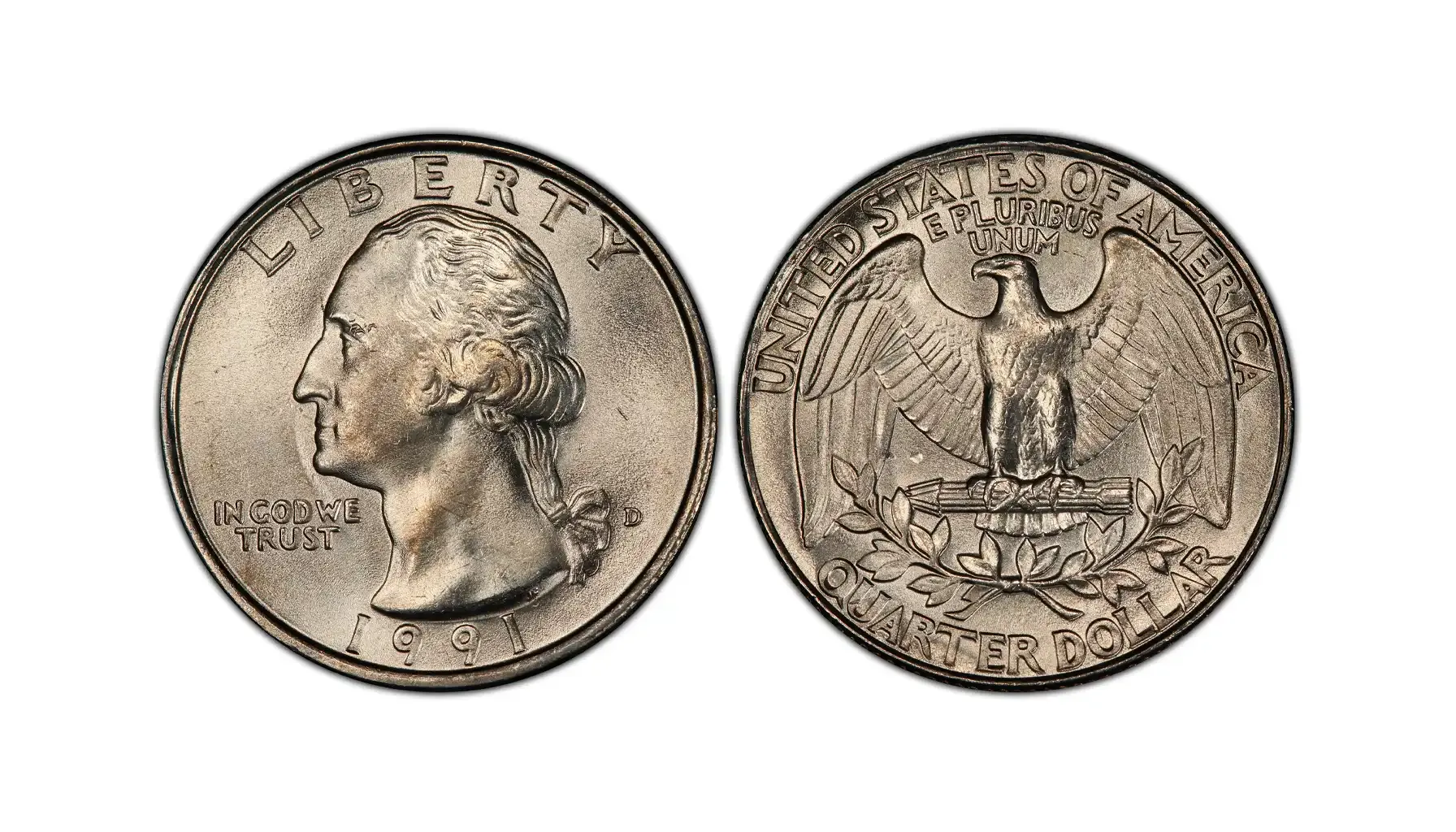
On the obverse, George Washington still stares left, calm and unmoved. The bust is based on Jean-Antoine Houdon’s 18th-century sculpture, but it’s John Flanagan’s hand that translated it to coin form in 1932.
By 1991, we were decades past the debut, but Washington hadn’t aged a day. His hair is tied back in that now-familiar low queue, LIBERTY arcs above him, and IN GOD WE TRUST rests neatly to his left. The date, 1991, is at the bottom, and just beside the ponytail you’ll find the mint mark.
The 1991 P quarter was minted in Philadelphia and lacks any mint mark, that alone throws off more beginners than we can count. They think it's a no-mint error, when really, it's just standard for Philly coins.
Denver, on the other hand, used its “D,” which you’ll spot on the obverse. The 1991 D quarter is the one we tend to find more of in better condition. The 1991 D quarter value changes with condition.
In the wild, you're lucky to pull something over XF. But an MS 67 that’s a coin worth noticing, when fewer than a few dozen.
That said, not all 1991 quarters came out quite right. Some have what we now catalog as a 1991 quarter error: double strikes, broadstrikes, or off-center impressions. Well, even machines misstep. And when they do, collectors like us pay attention.
Mints and Marks: Philadelphia, Denver, San Francisco
Coin Type | Condition | Estimated Value |
1991 No-Mint Mark Quarter | Good to Extremely Fine | $0.30 |
Uncirculated (MS67) | $300 | |
1991-D Quarter | Good to Extremely Fine | $0.30 |
Uncirculated (MS67) | $1,950 | |
1991-S Proof Quarter | Proof (PR67) | $10 |
If you're holding a 1991 quarter, one of the first things you should check is just to the right of George Washington’s ponytail: that tiny letter (or the absence of one) tells you a lot more than most people realize. It tells us where the coin was born, hints at how many were made, and sometimes even helps us understand why a seemingly ordinary coin is anything but.
Let’s start with Philadelphia. The 1991 quarter P, doesn’t carry a “P” mint mark: Philadelphia coins in 1991 were struck without one, which trips up new collectors every time. That missing letter doesn’t make it a rare error; it’s just the norm for that mint. Over 570 million were made there, so yes, they’re common.
Coins in the wild almost never make it to MS66 or MS67, they’ve seen too many pockets and too many decades. That’s why high-grade examples can still give you respectable prices. A true gem can go for $300 or more, even though the average circulated one might give you less than a dollar
Now Denver the overachiever. The 1991 quarter D came from a mintage even larger than Philadelphia’s: more than 630 million. You’ll still find them in your change today if you’re lucky. Most are worth their face value, of course, but collectors know that Denver strikes can vary a bit in quality.
A pristine MS67 coin from this mint is no easy find. In fact, one sold at auction for $1,680 back in 2019, still one of the highest sale records for this series. We remember inspecting a 1991 quarter D specimen in near-gem state during an appraisal in Oxfordshire. It had only the faintest sign of a contact mark. The owner had no idea, thought it was just "an old American coin" her uncle brought back from a trip
Then there’s San Francisco. The proof quarters from 1991 came out of the West Coast with their signature mirrored fields and frosted devices. About 2.8 million of these proof quarters were struck that year.
And while that’s not exactly a tiny number, their visual quality makes them desirable. You can usually snag a decent one for under $30, but a flawless PR70 DCAM can sell for over $500
Of course, among all these coins, there's always the oddball, the misfire from the mint that slipped past the press inspector’s eye. The 1991 quarter value error category has broadstruck pieces, off-center strikes, and the occasional doubled die.
So, how much is a 1991 quarter worth? That’s never just one answer. It depends on where it came from, how it aged, and whether anything went just a little bit wrong during its creation. Like people, coins carry their own stories, and like people, the most interesting ones have something unusual in their past.
Errors in the Margins: When the Press Missteps
Doubled Die
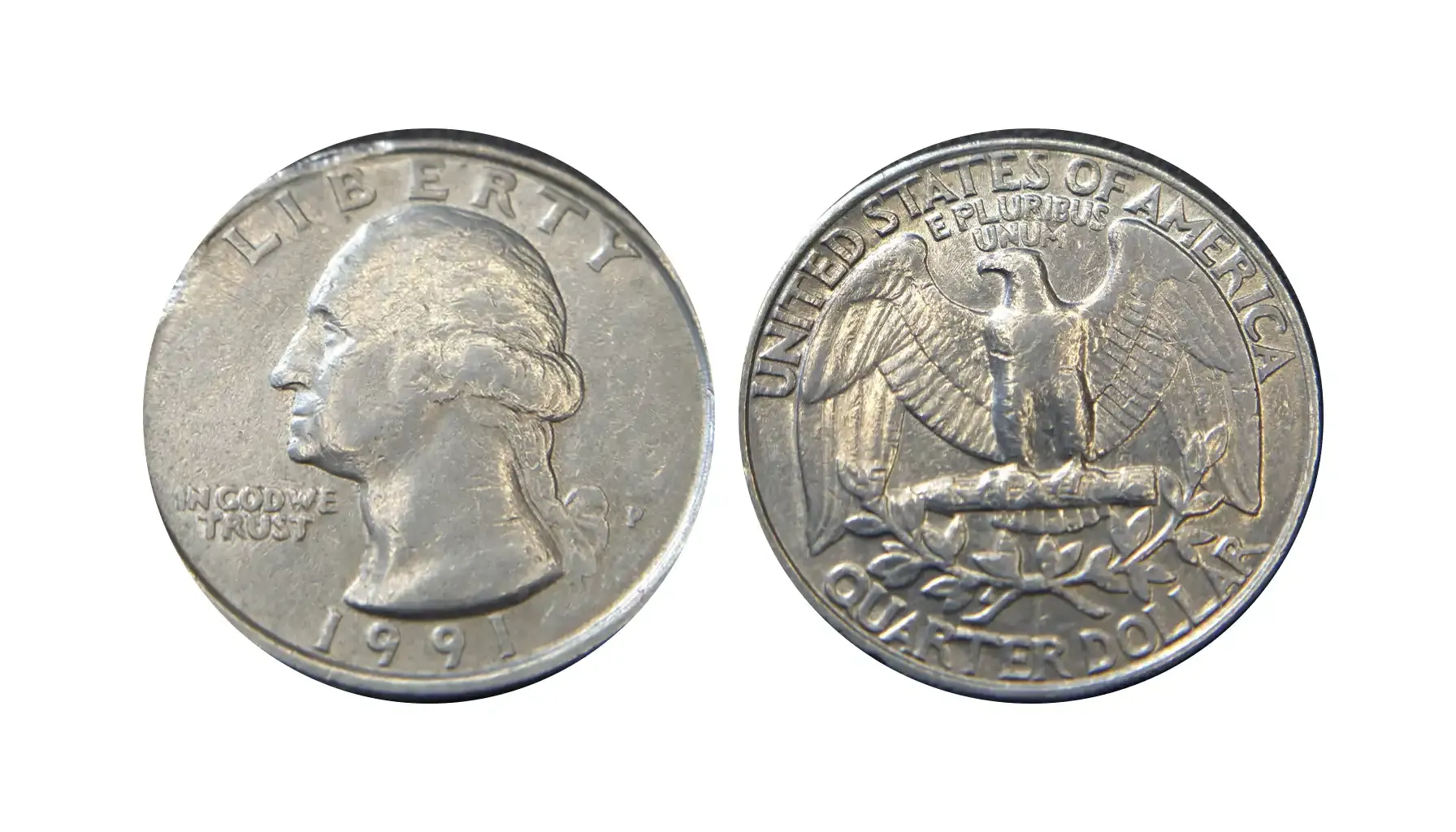
This one shows the classic of hub doubling where parts of the design, like “UNITED” or “DOLLAR,” appear slightly shifted or doubled. They’re subtle on most examples, but unmistakable when spotted. Coins with clean, visible doubling can bring in $50 to $100 depending on condition.
Misaligned Die
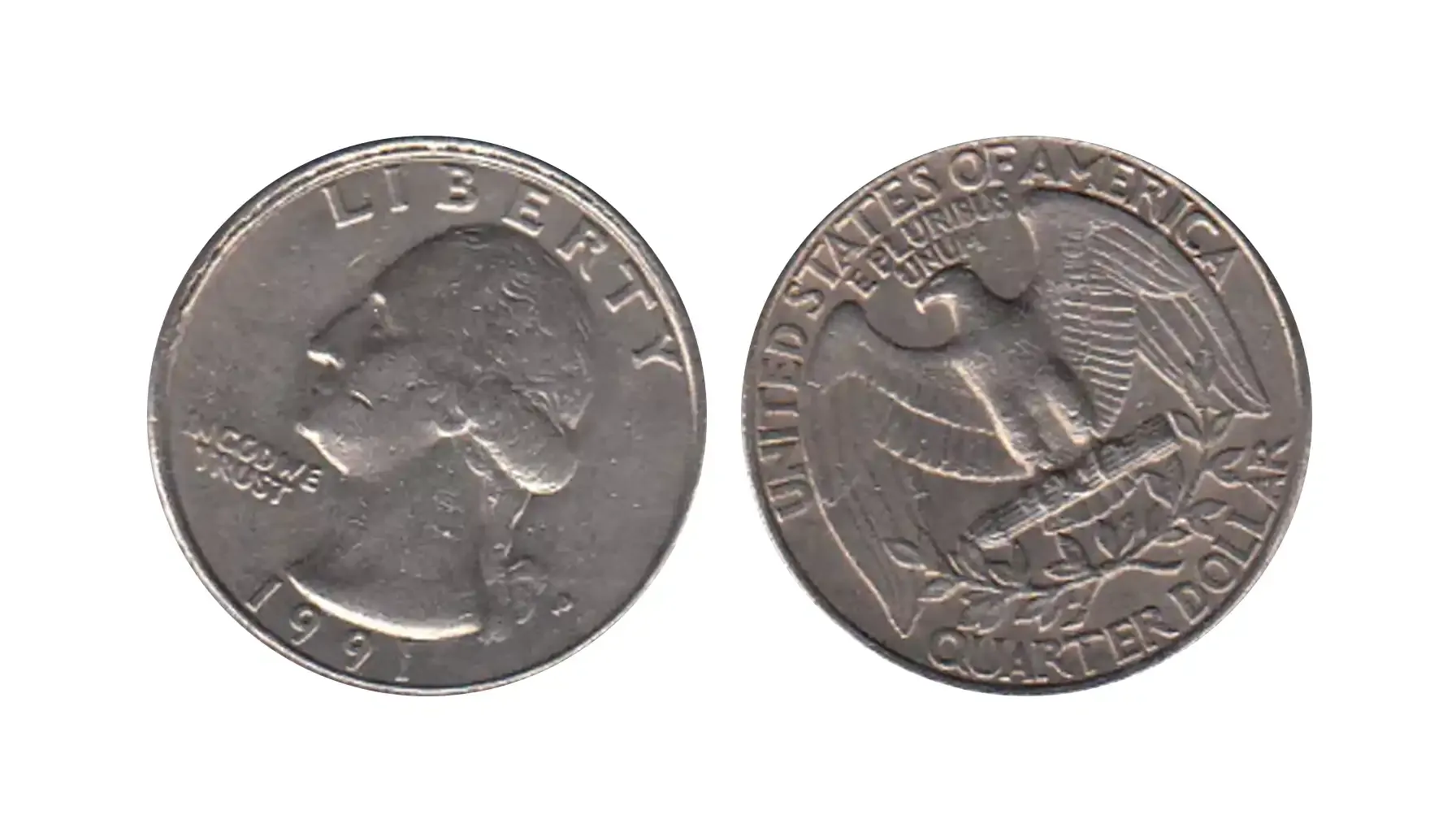
Then there’s the misaligned die. I’ve seen a few misprint 1991 quarter coins that were really just misaligned obverses, the top die shifted during striking, leaving part of the image off-center. This usually causes a “tilted” look on one side of the coin. You won’t retire off one, but you might pocket $10 to $25 for it, depending on how dramatic the misalignment is.
Spitting Eagle
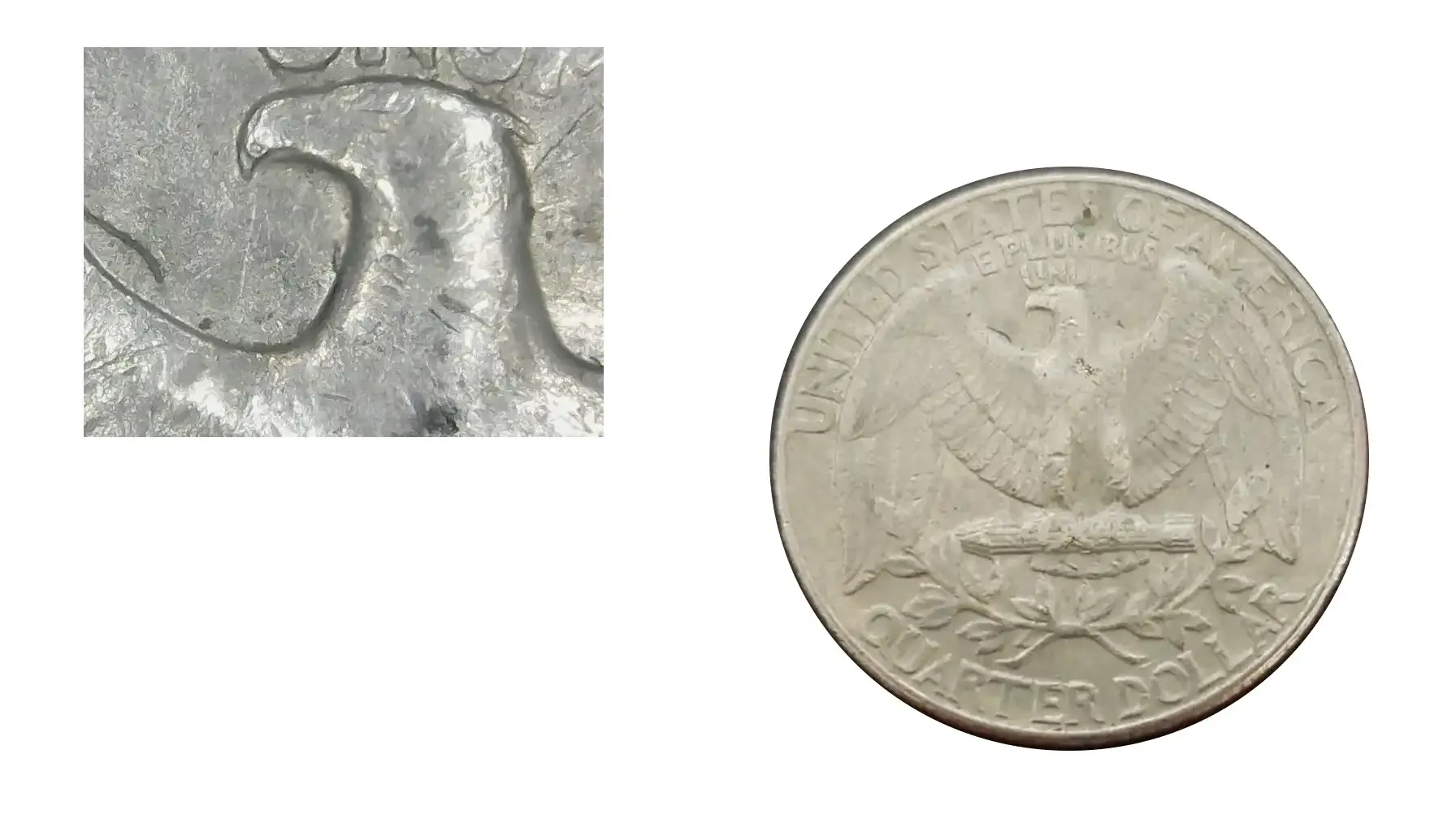
The Spitting Eagle is probably my favorite. It’s a die chip or strike-through that looks like a tiny line extending from the eagle’s beak toward the rim, almost like it’s, well, spitting. You’ll only find it in Washington quarters, and while some scoff at how “minor” it is, I’ve seen these go for $65 to $100 when they’re in decent shape.
1991 D Filled-In Mint Mark Quarter Error
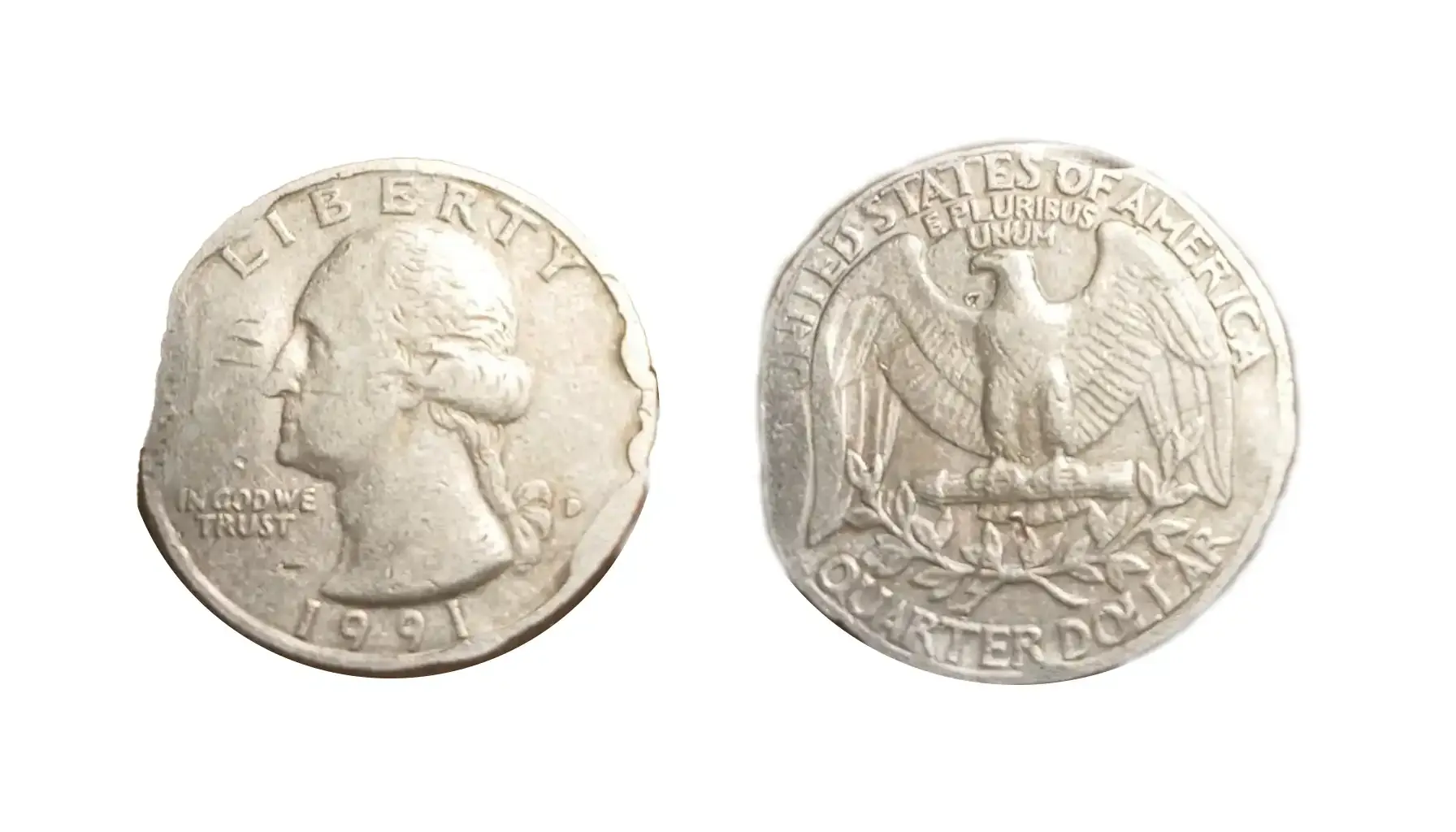
1991 D Filled-In Mint Mark Quarter Error, where the “D” is softened or appears like a blob due to grease or a damaged die. Most people wouldn’t give it a second glance, but enough collectors find them interesting that they hold some modest value.
And then there are strike-through errors, where grease or debris blocked part of the die. These can flatten features or make parts of the coin appear ghosted. A coin with that kind of flaw might be $20–$50, more if it’s uncirculated.
People ask me, is a 1991 quarter worth anything? And the answer is usually no, unless it’s different. Unless something about it is off, misaligned, malformed, or oddly beautiful. I've seen collectors hang onto a 1991 P Washington quarter even because it had a slight shadow behind the letters.
Copper-Nickel and the Question of Value
The truth is, copper-nickel coins, like the 1991 Washington quarter, get overlooked simply because they are nothing special from the outside. But take the 1991 quarter no mint mark, just your typical Philadelphia strike. Common, right? On the surface, yes. But when found in MS67 or higher, that same clad quarter can cost hundreds.
A rare 1991 quarter has grades that are rarely seen, or the obscure errors only a few people have the eye to notice. A mint-state Denver piece with the faintest double strike or a proof San Francisco coin with a mirrored field so clear it reflects text.
Other Quarters Worth Your Time
Coins live in families, in runs of years, in minting trends that stretch across decades. And once you’ve studied one issue deeply, it’s only natural to ask: what else was happening nearby?
Start with 1990. That year’s quarters were struck in even higher numbers than 1991, but they have a few more well-documented doubled die varieties. The Denver issues from 1990 are especially worth checking, and the proofs from San Francisco. I’ve found a few over the years that gave me pause, the ones with strong reverse definition
Then jump forward to 1992. It’s the year the Mint resumed issuing silver proof quarters, something they hadn’t done since 1964 (read more: The 1964 Quarter: The Last Silver Washington Quarter and Its Value Today) . Most of the 1992 silver proofs are easily spotted by weight, tone, or sound, but not everyone knows they exist, and many slip through unnoticed in estate boxes. A clad and a silver proof from the same year look nearly identical to an untrained eye
Even the Bicentennial quarters, dated 1776–1976 but struck in the mid-’70s, still show up regularly, especially in mixed collections. Read more here: The Most Valuable Bicentennial Quarters
A 1991 error quarter, particularly one with clear doubling, a clipped planchet, or a misaligned die, may actually be more desirable than an entire mint set from a different year.
Also, take another look at the 1991 quarter value D, that’s the Denver-minted issue. While the majority are common, finding one in MS67 condition or higher remains challenging. When they do appear, they can cost several hundred dollars at auction.
Final Thoughts
The 1991 Liberty quarter may not look like much at first glance, it’s the kind of coin that reminds me why we fell in love with numismatics in the first place. It isn’t rare in the conventional sense.
Like the 1991 D quarter error value, which can cost hundreds if the conditions align just right. The 1991 quarter teaches us that even the plainest things carry weight. If we’re willing to slow down and really look, we just might find more than we expected.

 Facebook
  X (Twitter)
  Pinterest
  LinkedIn