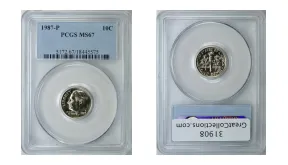
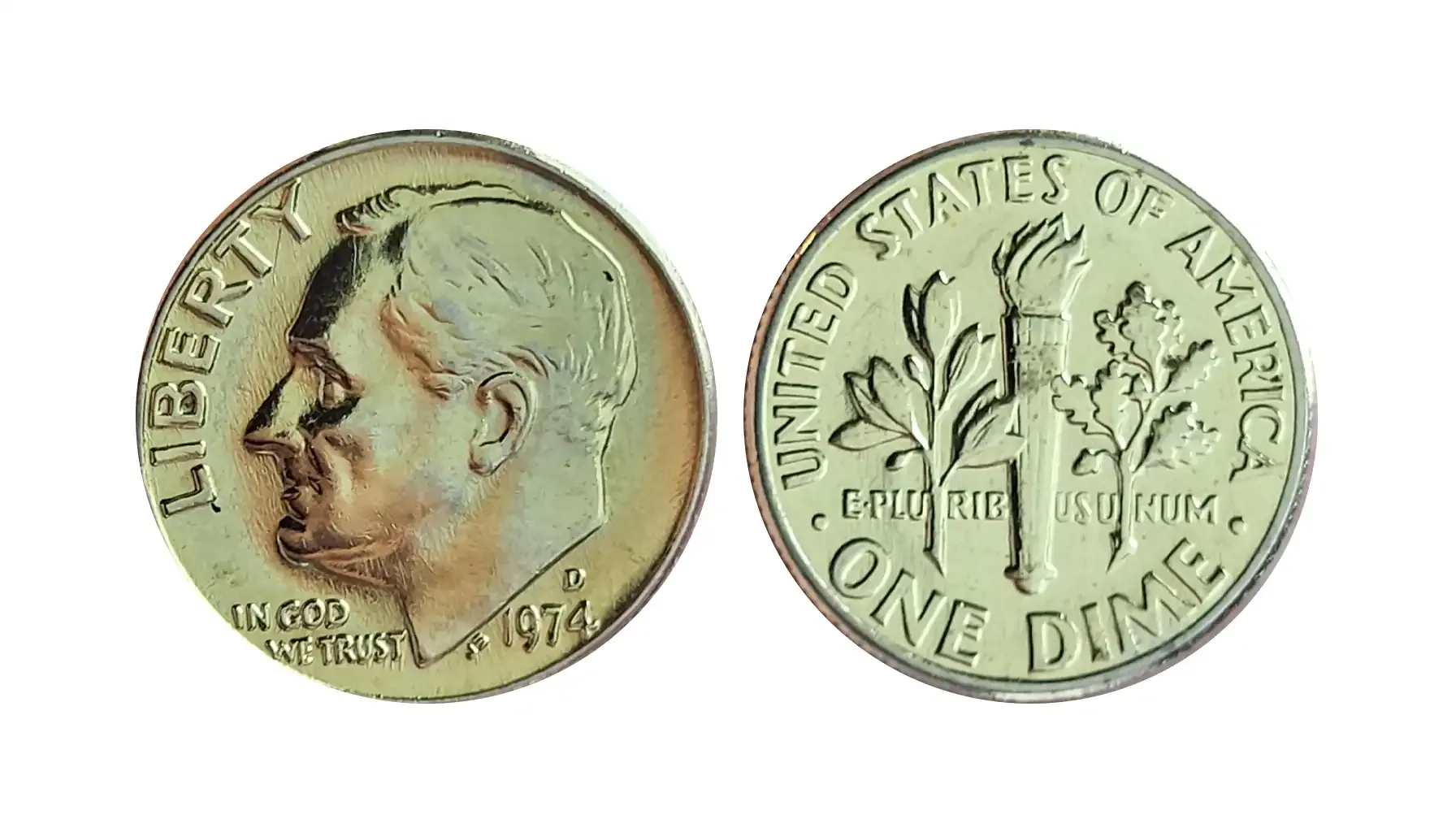
A 1987 dime is a United States ten-cent coin, part of the Roosevelt series that began in 1946. Like all modern dimes since 1965, it is made of a copper core with a copper-nickel outer layer (not silver). It features Franklin D. Roosevelt on the front and a torch with branches of oak and olive on the back.
How much is a 1987 dime worth? In circulation, it’s worth its face value of ten cents, though uncirculated or proof examples can carry small collector premiums.
Coin ID Scanner will tell you everything about it!
Feature | Details |
Year | 1987 |
Obverse | Franklin D. Roosevelt |
Reverse | Torch, olive branch, oak branch |
Designer | John R. Sinnock |
Composition | Outer layers: 75% copper, 25% nickel; Core: pure copper |
Weight | 2.27 g |
Diameter | 17.91 mm |
Thickness | 1.35 mm |
Edge | Reeded (118 reeds) |
Mint Marks | P (Philadelphia), D (Denver), S (San Francisco proof) |
1987 Dime P Mint Mark
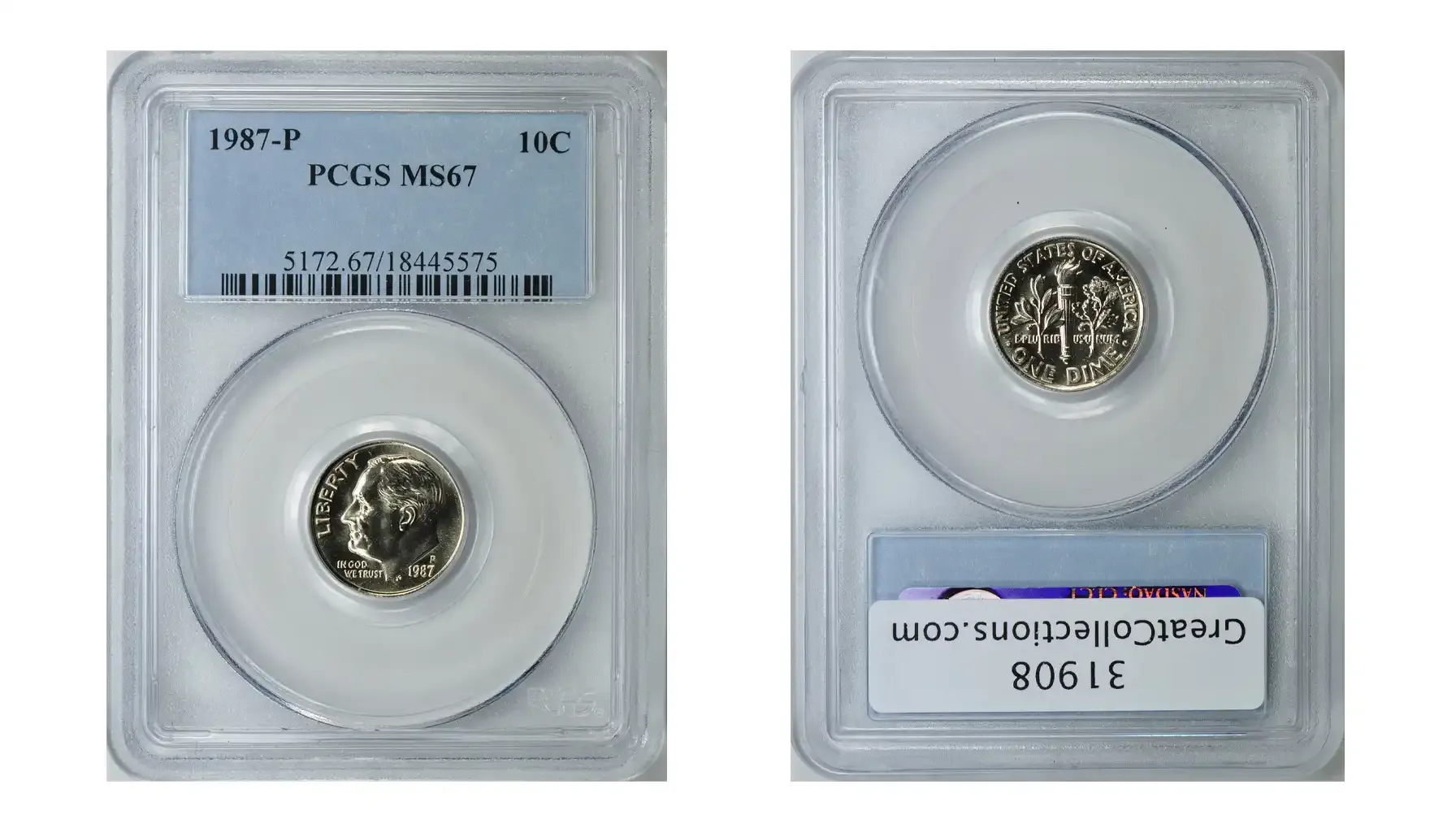
Mintage: 1,091,403,619 (over one billion pieces)
The 1987 P Roosevelt dime is one of the most common modern U.S. coins, struck at the Philadelphia Mint in massive numbers. Despite being a workhorse of circulation, this piece still attracts collector interest because of its role in the long-running Roosevelt series and because a small number of mint errors can make it worth far more than face value.
The mintmark P appears just above the date near Roosevelt’s neck.
How much is a 1987 P dime worth? Because of the enormous mintage, they are plentiful and generally only worth face value in circulated grades. Collectors usually save them in mint state, where strike quality and luster can set one coin apart from another.
1987 P Dime Error List with Pictures
Most are ordinary, but some error examples are known and can be valuable, i.e. 1987 P dime value error list:
Off-center strikes — Portions of the design missing because the blank planchet was misaligned.
Clipped planchets — A curved or straight clip where part of the coin’s metal is missing.
Double die obverse or reverse — Doubling in letters or date from hubbing mistakes (scarcer for 1987, but possible).
Die cracks and cuds — Raised lines or blobs of metal caused by worn or broken dies.
Wrong planchet errors — Extremely rare, but some have been struck on smaller or foreign coin blanks.
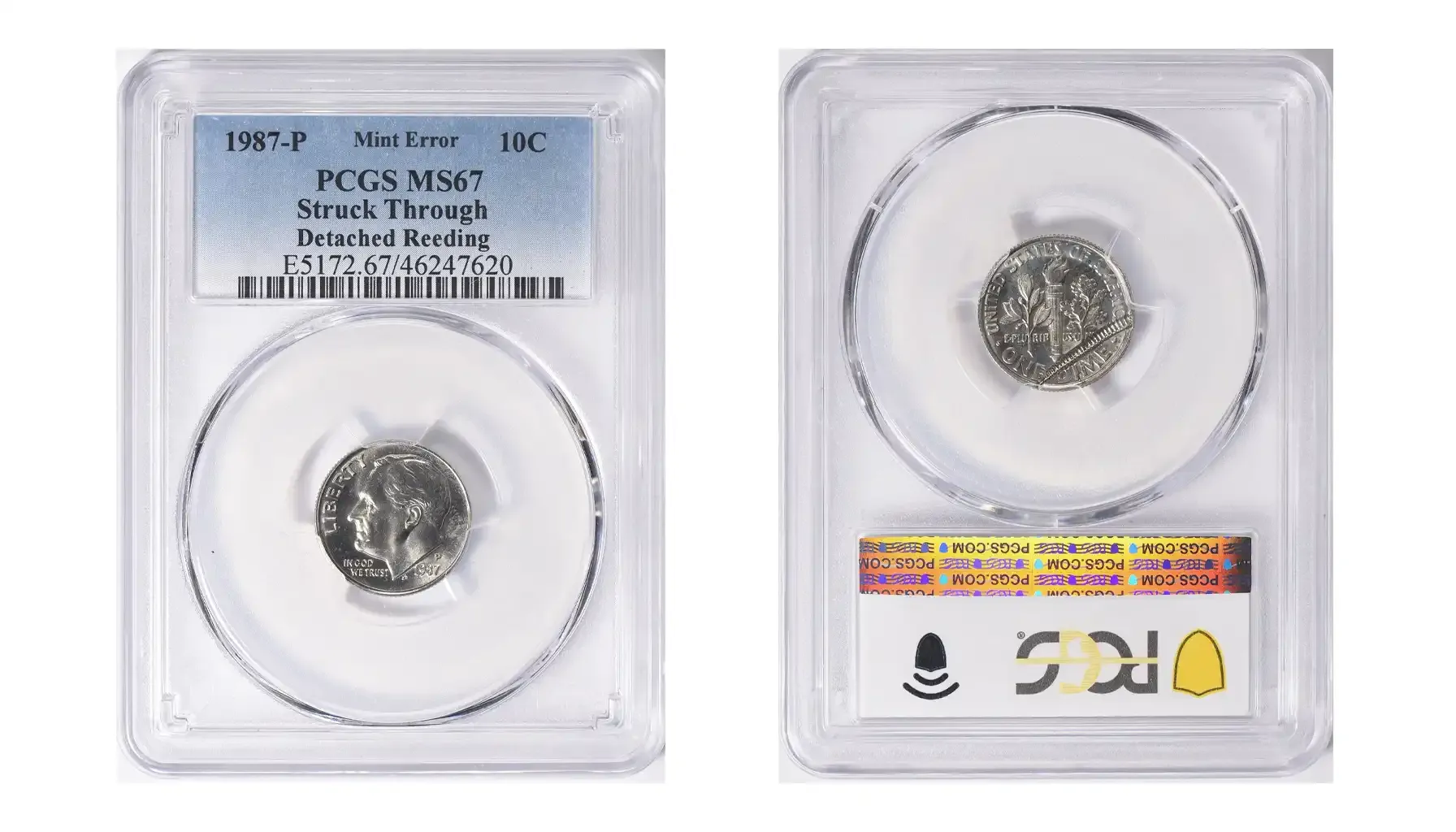
These errors are what give certain specimens higher 1987-P dime value sums.
Price
Grade | Philadelphia 1987 Dime Value |
Circulated (most coins) | $0.10 |
About Uncirculated (AU) | $0.20 – $0.50 |
Mint State MS60 | $1 |
Mint State MS65 | $3 – $5 |
Mint State MS67+ | $30 – $50+ |
Prooflike examples | $50 – $100 |
Major Errors | $50 – more |
1987 Dime D Mint Mark
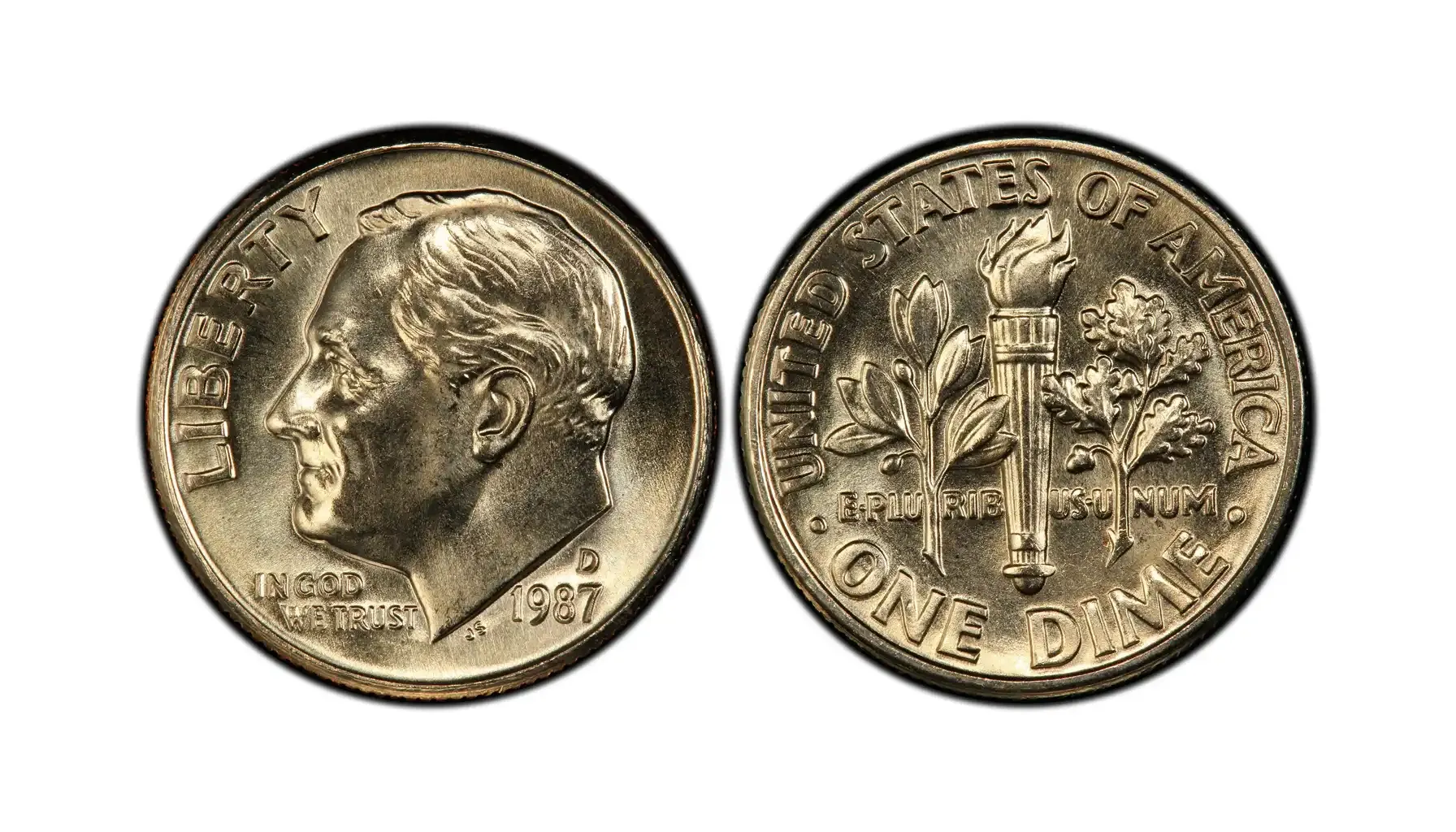
Mintage: 754,000,000+ coins
It was struck at the Denver Mint and, like its Philadelphia counterpart, is a clad coin with no silver content. It belongs to the modern era of the Roosevelt issue that began in 1965, when silver was removed from circulating pieces in favor of copper-nickel clad.
Is a 1987 dime worth anything with this mint mark? Although this coin is extremely common in circulation, it remains an essential part of a complete Roosevelt collection, and examples in very high mint state grades or with mint errors can be of special interest.
The mintmark D appears just above the date, near Roosevelt’s neck.
1987 D Dime Error List with Pictures
While most D dime 1987 pieces are ordinary, certain errors increase the value:
Off-center strikes — Where the design is shifted, sometimes leaving a blank crescent of metal.
Clipped planchets — Coins struck on incomplete blanks, missing a curved or straight edge.
Double die errors — Doubling of letters, numbers, or parts of the design (rare, but collectible).
Broadstrikes — Coins struck without a collar, causing them to spread out wider than normal.
Wrong planchet errors — Scarce cases where a dime was struck on a blank meant for another denomination.
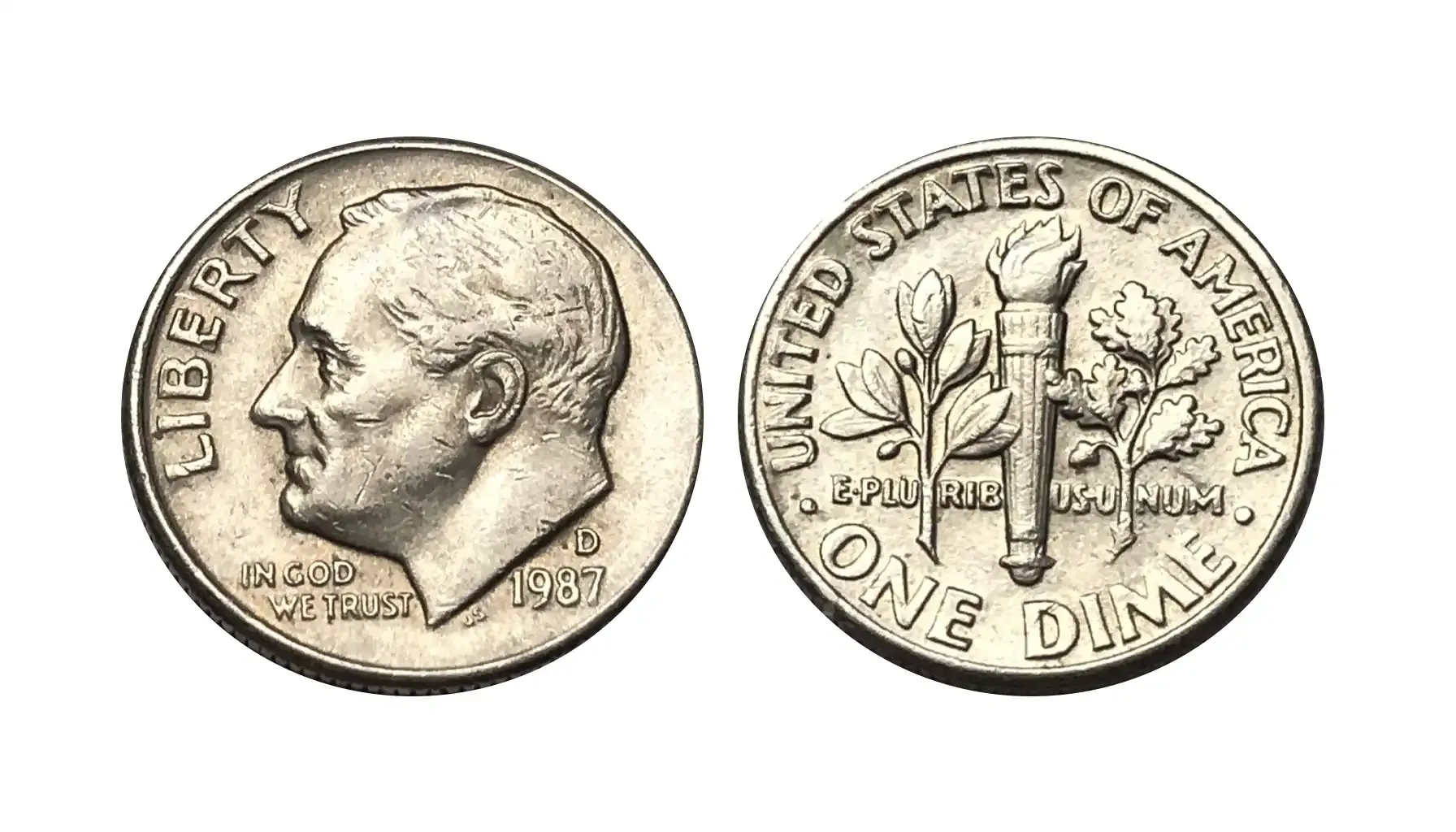
How much is a 1987 D dime worth? Collectors value these mistakes highly, especially if they are big and easily visible.
1987 D Dime Value
Grade | Value |
Circulated (most coins) | $0.10 |
About Uncirculated (AU) | $0.20 – $0.50 |
Mint State MS60 | $1 |
Mint State MS65 | $3 – $6 |
Mint State MS67+ | $25 – $60+ |
Prooflike or exceptional strike | $50 – $100 |
Major Errors | $50 – more |
1987 S Proof Roosevelt Dime
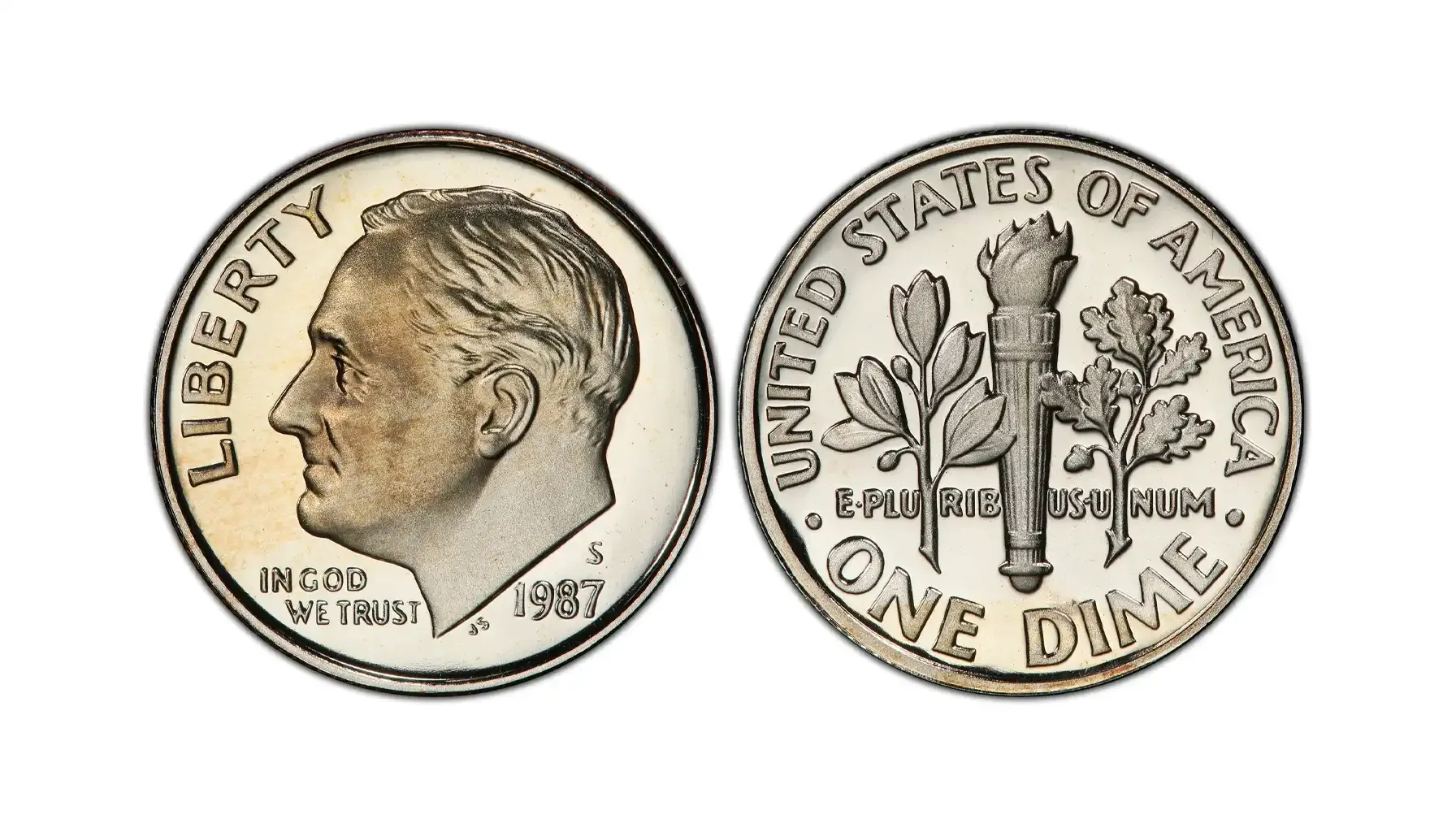
Mintage: 4,227,728 (all for proof sets)
It was produced at the San Francisco Mint, but unlike the Philadelphia and Denver issues, it was not struck for circulation. Instead, all S specimens were minted exclusively as proofs for inclusion in annual U.S. Mint proof sets sold to collectors. Because of this, every genuine one was specially prepared and struck with polished dies on carefully selected planchets.
Proof coins are struck multiple times under higher pressure than circulation strikes, resulting in sharp, frosted devices (design elements) and mirror-like fields. The finest examples feature a “deep cameo” effect, with strong contrast between the frosted design and reflective background.
1987 S Dime Error List
Although rare, some unusual varieties and mishaps are recorded:
Missing S mintmark — The most dramatic proof error, though not confirmed for 1987 (earlier years such as 1975 had famous no-S specimens). Collectors always check carefully.
Cameo variation — Some proofs display weak frosting or uneven contrast, which can affect value.
Packaging mishandling — While not a minting error, coins improperly sealed or damaged in proof sets can lose value quickly.
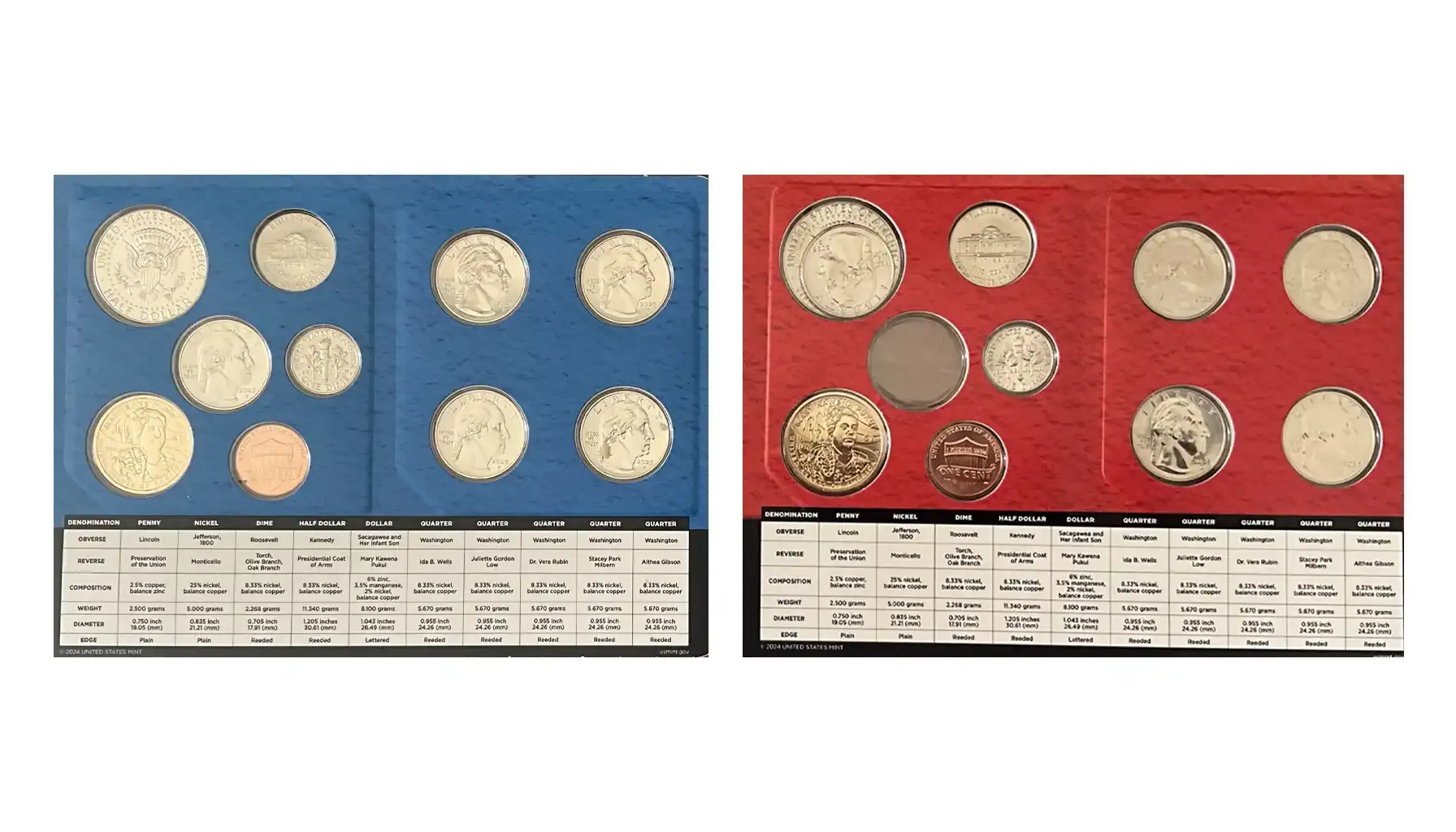
Also read: How Many Dimes in a Roll?
1987 S Proof Dime Value
Grade | Value |
Standard Proof | $2 – $4 |
Proof 65 (Cameo) | $5 – $8 |
Proof 69 (Deep Cameo) | $12 – $20 |
Proof 70 (Deep Cameo) | $50 – $100+ |
Major Errors (e.g., missing mintmark) | Hundreds to thousands (if ever found) |
1987 Gold Dime Value
There is no official 1987 gold dime issued by the U.S. Mint. All regular 1987 Roosevelt pieces (Philadelphia, Denver, San Francisco) were struck in copper-nickel clad, not gold, i.e. you can find only a 1987 copper dime.
However, when people mention a gold one, they usually mean one of two things.
1. Private Gold-Plated Coins
Many companies in the 1980s and 1990s sold standard Roosevelt pieces plated with a thin layer of gold.
These coins were advertised as “collector’s editions” or “commemoratives,” but the gold layer is only decorative.
The underlying coin is still a regular copper-nickel one worth 10 cents. The gold plating adds almost no precious metal value — a few cents. Collectible demand is also very low; they usually sell for $1 or less as novelty items.
2. Off-Metal Mint Errors
Genuine U.S. Mint dimes struck on wrong planchets are possible, but a 1987 dime on a gold planchet is not known yet.
Wrong-planchet errors usually involve copper cents, foreign blanks, or quarter stock.
If a genuine 1987 piece were ever struck on a gold planchet, it would be a one-of-a-kind mint error worth thousands, but no such example has been confirmed.
Disclaimer: The information provided in this article is for educational and collectible reference purposes only. Values of 1987 dime errors and standard pieces listed above are approximate ranges and can fluctuate depending on condition, demand, and certified grading.
If you want to be certain about a coin’s identity, metal composition, and potential value, use modern coin collector tools such as the Coin ID Scanner app that can provide quick photo-based identification. Try one from the 1987 dime error list with pictures right now!

 Facebook
  X (Twitter)
  Pinterest
  LinkedIn