Contents:
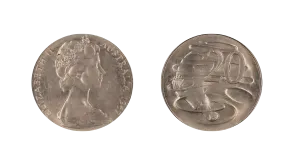
The Australian 20-cent coin issued in 1967 represents an object of deep numismatic analysis.
This issue immediately followed Australia's transition to a decimal currency system in 1966.
The value of a specimen is determined not only by its metal content but also by the presence of specific minting defects, and — yes, it can be easily detected with the AI coin identifier.
1967 20 Cent Coin Overview
The 1967 20-cent token was minted by the Royal Australian Mint in Canberra.
The reverse design, developed by Stuart Devlin, depicts a platypus in water.
Like most of the Queen Elizabeth II coins, it has her portrait on the obverse created by Arnold Machin.
“The portrait of Elizabeth II changed at the time of the introduction of decimal pieces in Great Britain in 1968. Designed by Arnold Machin, the wreath appearing on the Gillick portrait was replaced with a tiara. The Machin design would continue to be used through 1984.”
— Richard Giedroyc, journalist and numismatic expert
Numismatic News
The 1967 mintage totalled 20,700,000 pieces.
This emission volume is moderate compared to the 1966 mintage, exceeding 30 million specimens.
Most 1967 numismatic pieces found in circulation possess significant wear, reducing their collector appeal to face value.
Characteristic | Value |
Metal Composition | 75% copper, 25% nickel |
Total Weight | 11.31 g |
Diameter | 28.52 mm |
Thickness | 2.50 mm |
Shape | Round |
1967 20 Cent Coin Error Guide
The primary factor increasing the value of this denomination is the presence of production defects.
The Wavy Baseline 2 variety remains the most famous and valuable deviation.
Wavy Baseline 2 Error
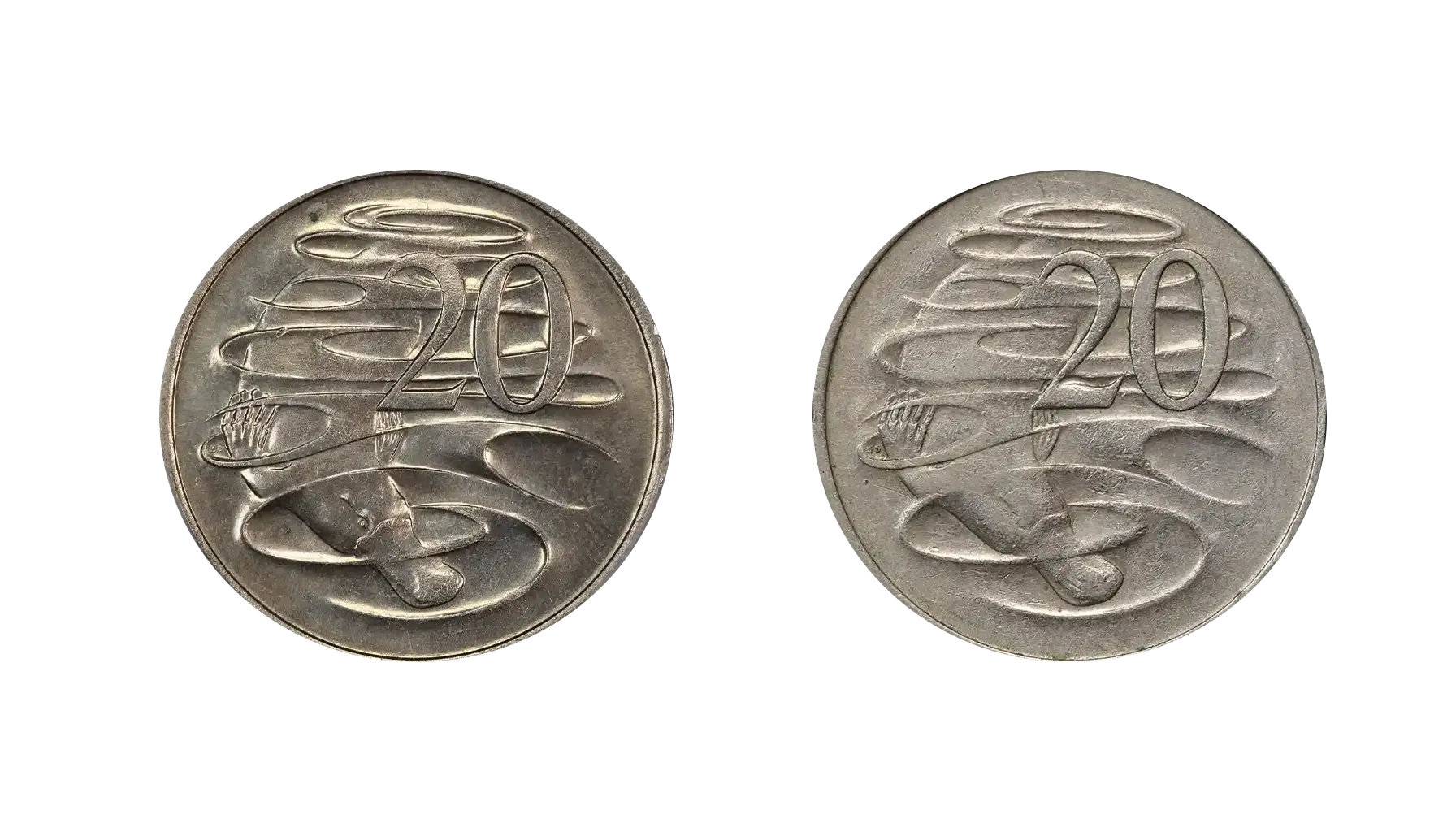
This defect resulted from using a damaged or modified die.
On standard tokens, the top line of the base of the digit 2 in the denomination is perfectly straight.
On rare specimens, this line features a pronounced wave-like curve.
Error location: the base of the digit 2 on the reverse
Visual sign: a wave-like rise of metal above the horizontal line
Accompanying sign: a small indentation in the coin field directly above the curve
Besides the Wavy 2, ones with small metal accumulations and die cracks occur.
Such defects add from $5 to $20 to the 1967 20 cent coin value, depending on the anomaly's size.
1967 Australian 20 Cent Coin Value
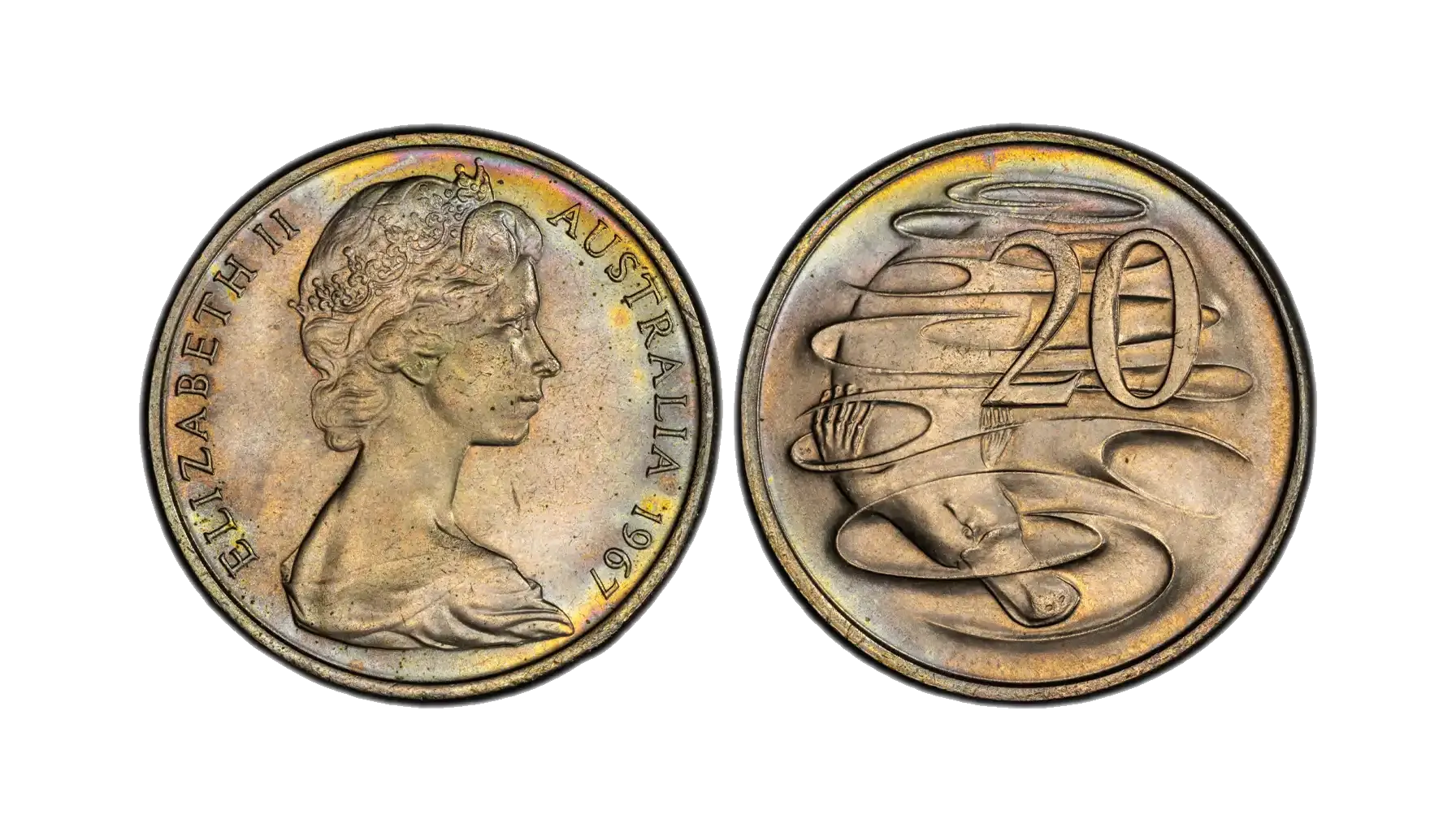
Market value directly depends on the Sheldon scale preservation state and the presence of the aforementioned errors.
Standard Strike Value
Ordinary 1967 pieces without errors are valued only in Uncirculated condition.
Condition | Description | Average Price |
Circulated (VG-VF) | Traces of heavy wear present | $0.20 – $1 |
Extremely Fine (EF) | Minor damage to details | $5 – $15 |
Uncirculated (MS60) | Absence of circulation traces | $40 – $70 |
Choice Unc (MS65) | Perfect luster and clarity | $180 – $350 |
Values change based on market demand, condition, grading, and the specific characteristics of individual coins.
The annual price growth for standard tokens in MS65 condition has averaged approximately 4% over the last five years.
Those in condition below EF practically do not grow in value, trading at face value levels.
Rare 1967 20c Varieties
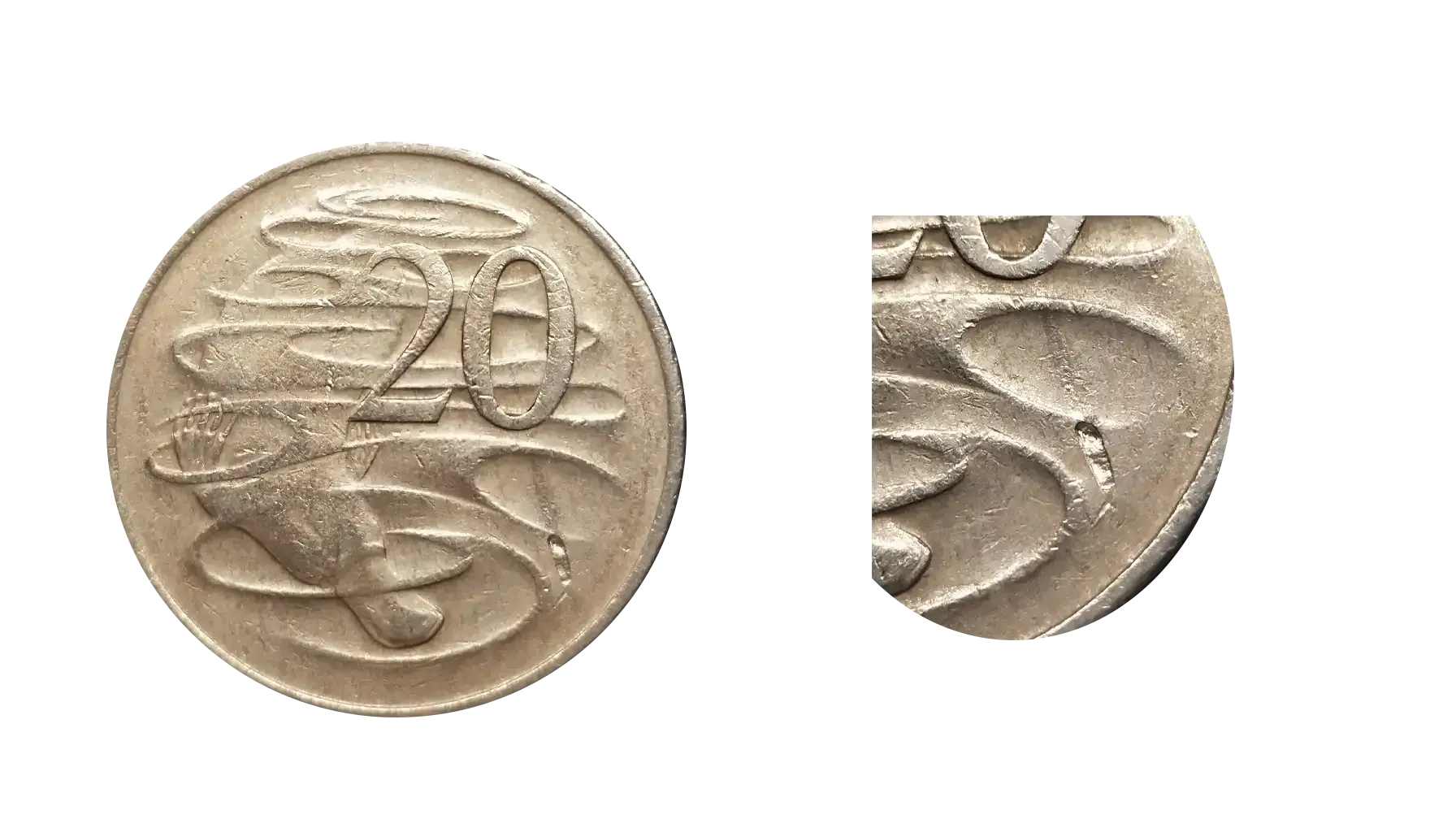
Besides the main issue and the Wavy Baseline 2 error, less common types exist.
Speculative Proof-like: Ones struck by the first hits of new dies
Clipped Planchets: Ones featuring a missing fragment of the circle
Double Strike: Specimens featuring a partially shifted second image
Tokens with a Clipped Planchet defect in EF condition are valued within the $50 – $120 range.
Specimens featuring strike decentralization over 10% can reach a value of $300 at specialized auctions.
Auction Sales Statistics
Data is provided based on Noble Numismatics and Downies trading results.
Variety | Condition | Sale Price | Sale Year |
Wavy 2 | gVF | $1,450 | 2021 |
Wavy 2 | AU55 | $5,200 | 2022 |
Standard | MS66 | $480 | 2023 |
Off-centre | VF | $210 | 2020 |
The total market volume for rare Australian 20-cent coins is estimated at several million dollars per year.
Factors Determining Investment Potential
Investing in the 1967 20-cent coin requires strict adherence to selection criteria.
Authenticity confirmation of the curved two to avoid purchasing fakes created by mechanical means
Absence of cleaning traces using abrasive substances reduces the price by 60%
Preservation of the original mint luster on the reverse fields
Presence of a certificate from independent services like PCGS, Coin ID Scanner, or NGC for specimens exceeding $500
Liquidity of MS-graded tokens is 45% higher than the liquidity of worn specimens.
Purchasing a Wavy 2 variety in a slab provides the investor with protection against market fluctuations due to historical die rarity.
Registry of Rare Variations
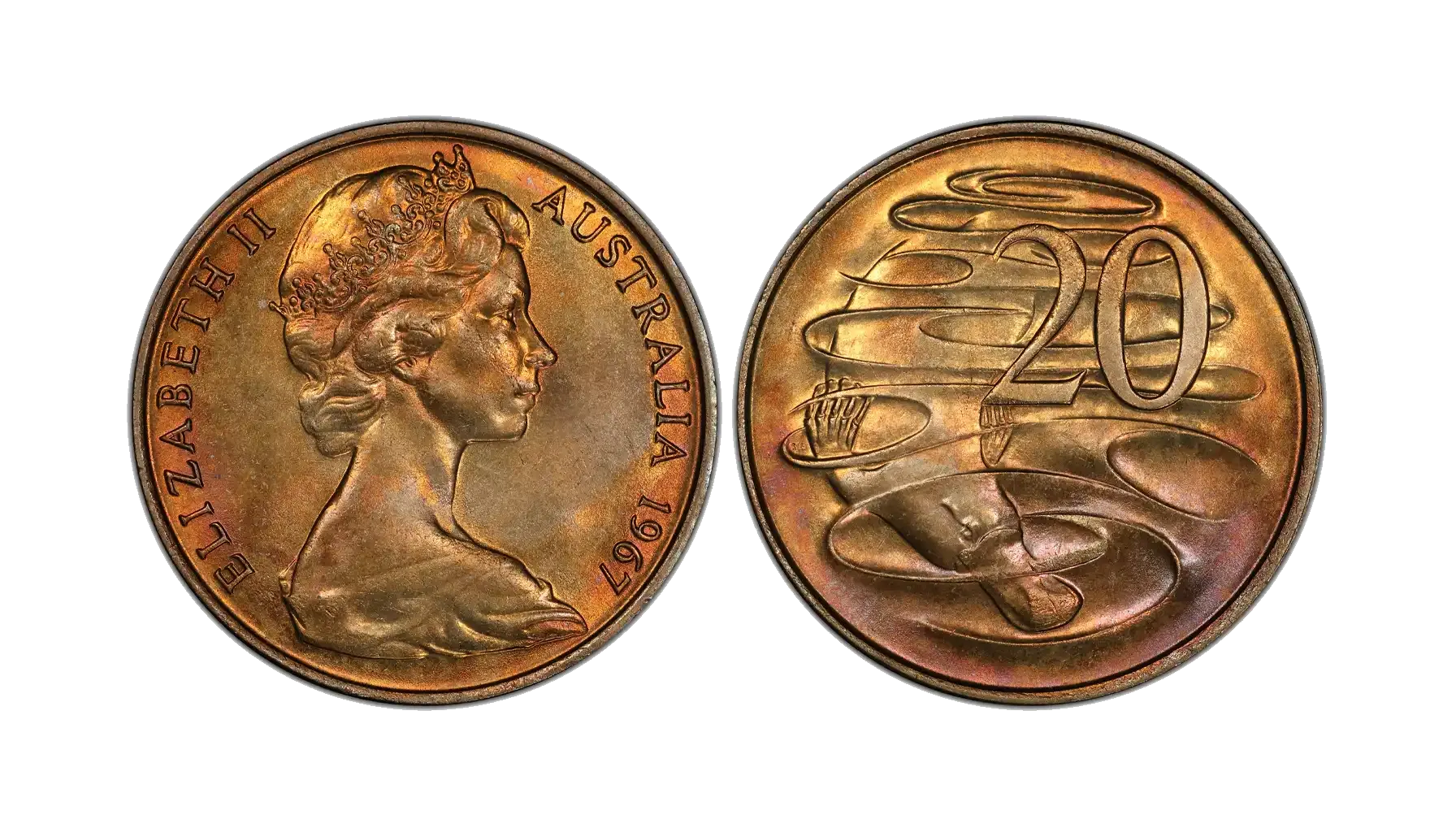
Listed below are signs indicating high value:
A clearly pronounced wave on the top line of the digit 2 base
Absence of contact with other pieces on the Queen's portrait
Presence of full edge reeding without bag marks
Perfect centering of the image relative to the planchet edge
Finding a 1967 20-cent coin in ordinary change showing Wavy 2 signs is unlikely.
Most such pieces were removed from circulation by observant owners back in the 1970s.
Current finds most often occur during the processing of old collections or estate archives.
Conclusion on Market Position
The 1967 20-cent coin remains a fundamental element of Australian numismatics.
Stable demand for the Wavy 2 variety ensures a constant capital inflow into this segment.
The ratio of mintage to the number of surviving high-quality specimens makes this issue a profitable object for long-term investment.
The average annual return of a correctly selected portfolio of such tokens is 5.8% above inflation.

 Facebook
  X (Twitter)
  Pinterest
  LinkedIn