Contents:
The compositional variations in the monetary sector are spectacular: throughout its history, designers strived to develop the most exceptional, exquisitely crafted coins, some of which contain generous amounts of silver or gold. As such, these numismatic creations may serve as a fine investment tool, for their prices depend on the aesthetic appeal, collector's demand, cultural significance, and precious metal content simultaneously.
The Franklin half dollar was quite a phenomenon: its path started with an inspirational idea to commemorate the Founding Father, the thoughtful and somewhat tragic creative process, and the controversies upon its launch. For us, collectors, it is always amusing to take a look at the latest issues, i.e., 1961 to 1963. So, let us focus on the 1961 Benjamin Franklin half dollar, check coin value, and define how beneficial it is to hunt.
Origins and History of the 1961 Silver Half Dollar
The Ben Franklin half dollar 1961 belongs to one of the most recognizable coin series in American numismatics – the Franklin 50C, the one that may boast an intricate history of its emergence. It all started with a desire of Mint Director Nellie Tayloe Ross to honor a man who, though never a president, profoundly shaped the nation’s beginnings and its destiny.
In 1947, she asked Chief Engraver John R. Sinnock to prepare a design for the half dollar, depicting the Founding Father as it had recently been done on his earlier medal of Franklin. Nonetheless, the work was destined to remain unfinished. Sinnock passed away before the project was complete, so his successor Gilroy Roberts finalized the reverse design, though the obverse side had already been done by Sinnock himself.
See also: 10 Most Valuable Franklin Half Dollars: Everything You Need
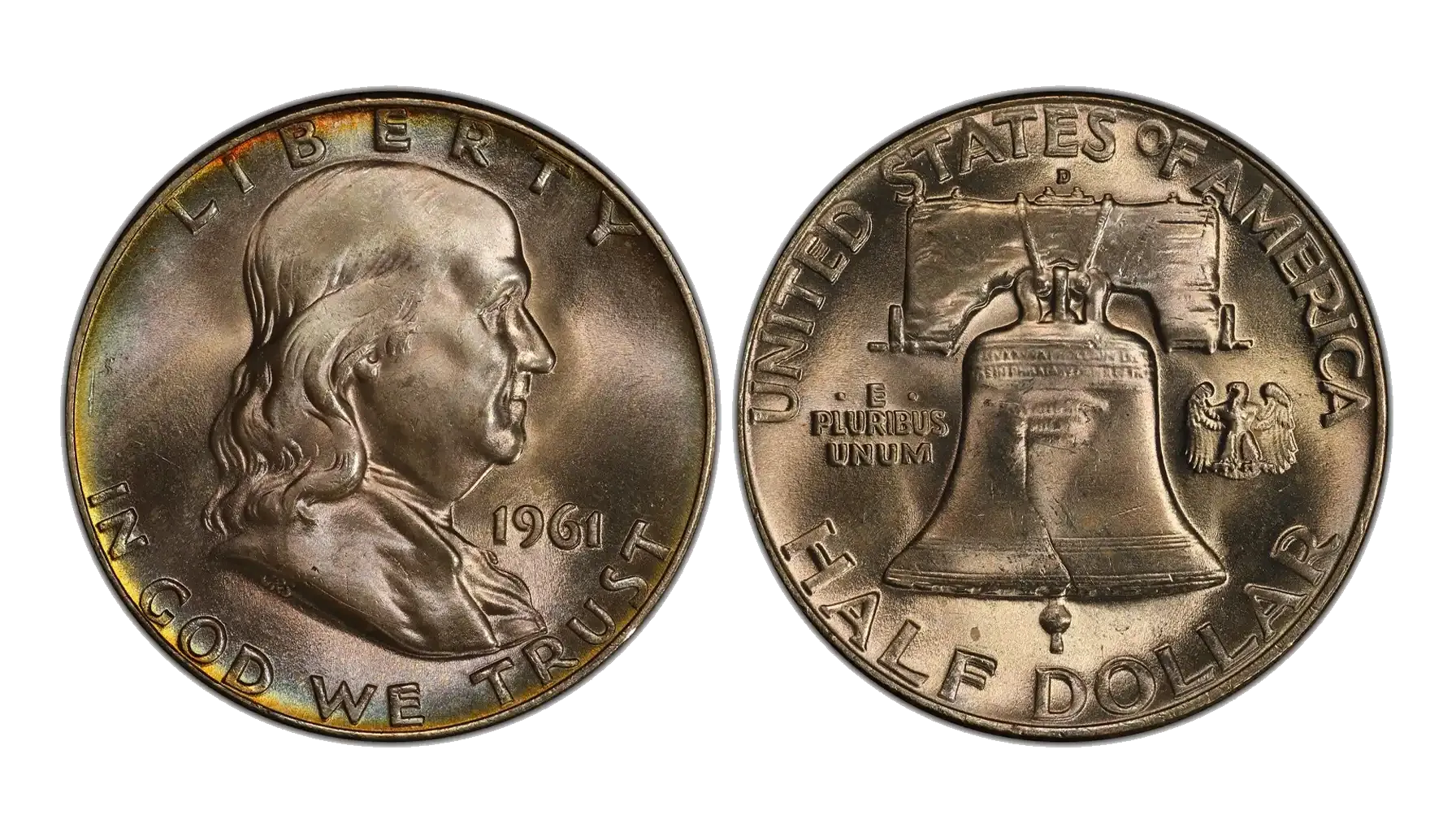
The appearance of the coin was rather distinctive: it featured Franklin’s portrait on the front, as well as the Liberty Bell with its prominent crack and a small eagle (instead of a majestic one) on the back. Despite criticism from the Commission of Fine Arts, the Treasury approved the design anyway.
The Franklin 50C entered circulation in 1948, and by 1961, its reputation was well established and solid. Average users, as well as collectors, appreciated the coin's dependable silver content, dignified design, and its potential to grow into something more substantial, i.e., a collectible of lasting worth. Its age, though, ended abruptly in 1963 after the assassination of President John F. Kennedy, when the Mint moved quickly to redesign the half dollar in honor of the beloved late leader.
Its story may have ended, but its legacy will endure.
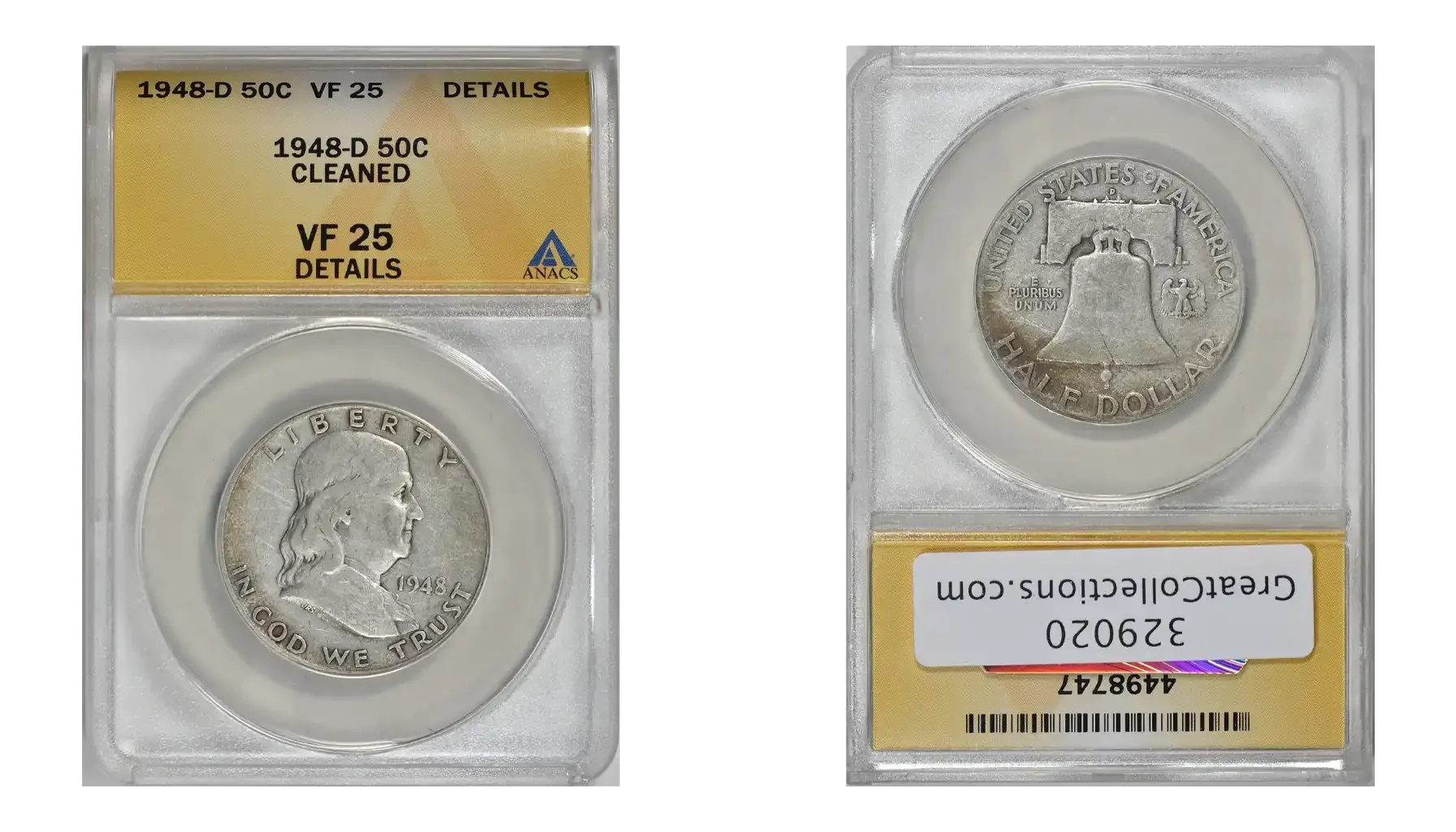
Design Features and the Main Characteristics
Obverse: Presents a distinguished right-facing profile of Benjamin Franklin, as well as the inscription “LIBERTY” along the upper rim, the year “1961” to the right of Franklin’s shoulder, with the lower rim bearing “IN GOD WE TRUST”.
Reverse: Features the Liberty Bell with its famous crack and a small eagle to the right (used to satisfy legal requirements that half dollars must feature the national bird by law), apart from the inscriptions “UNITED STATES OF AMERICA” across the top, a mint mark just below the previous phrase, “E PLURIBUS UNUM” to the left of the bell, and the denomination “HALF DOLLAR” anchoring the bottom.
The Main Specifications | |
Minting Period | 1948–1963 (Franklin series) |
Composition | 90% silver, 10% copper |
Weight | 12.50 g |
Diameter | 30.61 mm (1.205 in) |
Thickness | 1.8 mm |
Edge | Reeded |
Mint Marks | None for Philadelphia “D” for Denver |
Silver Content | 0.3617 troy ounces of pure silver |
Silver Content and Its Role in Value
Before one turns to the 1961 silver half dollar value, it might be reasonable to get acquainted with the relevant terms and the conditions these are subject to. The 1961 Franklin 50-cent numismatic creations, just like other coins in the series, were struck in 90% silver and 10% copper with a total weight of 12.5 grams, irrespective of strike type and mint location. According to official documents, each piece contains about 0.3617 troy ounces of pure silver, which is nearly 90% of the total mass.
Yet, it was meant to be used in everyday commerce, though the silver content soon outpaced its face value as bullion prices rose. These days, even the most heavily circulated instance may carry a guaranteed (=non-deductible) worth based on its metal alone. But how much is a 1961 half dollar worth, if we consider the silver rates only?
At the current silver rate of $38.90 per troy ounce (as of August 2025), the melt value of these units of currency may be approximately:
0.3617 × $38.90 ≈ $14.07 USD
Anyway, do not forget about other external factors that define the 1961 Franklin half dollar value and affect the way it is shaped. Still, this aspect deserves a closer look later.
Related article: Silver Price Predictions 2030: How High Could It Go?
1961 Franklin Half Dollar Varieties & Mint Marks
1961 50C (Regular Strike)
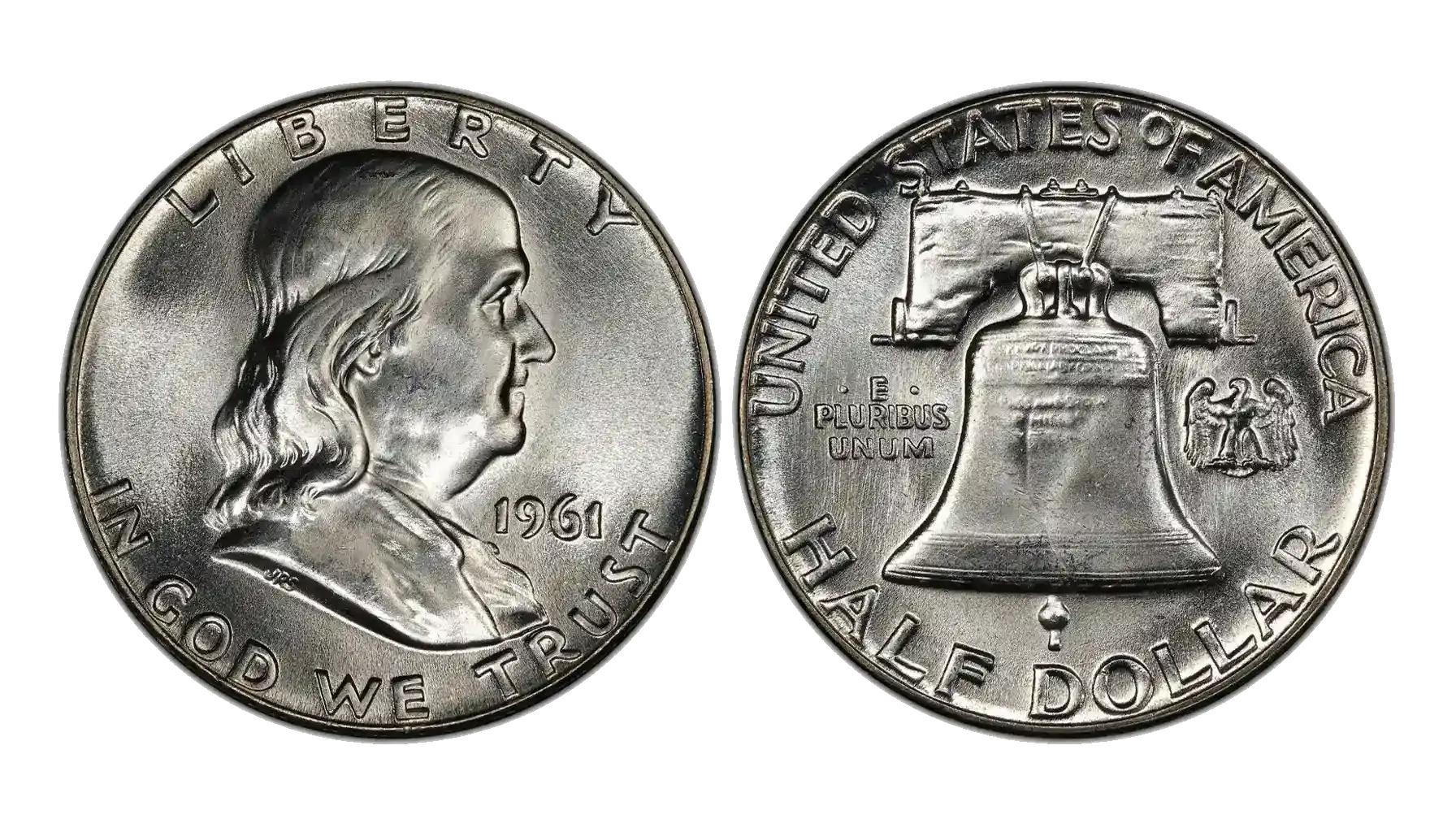
Produced by: Philadelphia Mint
Mintage: 8,290,000
Designations: MS, FBL
Auction Record: $18,000 for MS66+FBL
The Philadelphia Mint is regularly considered the primary location for monetary production, and the case of the 1961 half dollar coin is no exception. Even so, the P-issue may be characterized by relatively modest mintage compared to Denver’s output. This consequently makes the 1961 (P) half dollars a bit rare and valuable, especially when encountered with Full Bell Lines (FBL) designation and higher grades.
1961-D 50C (Regular Strike)
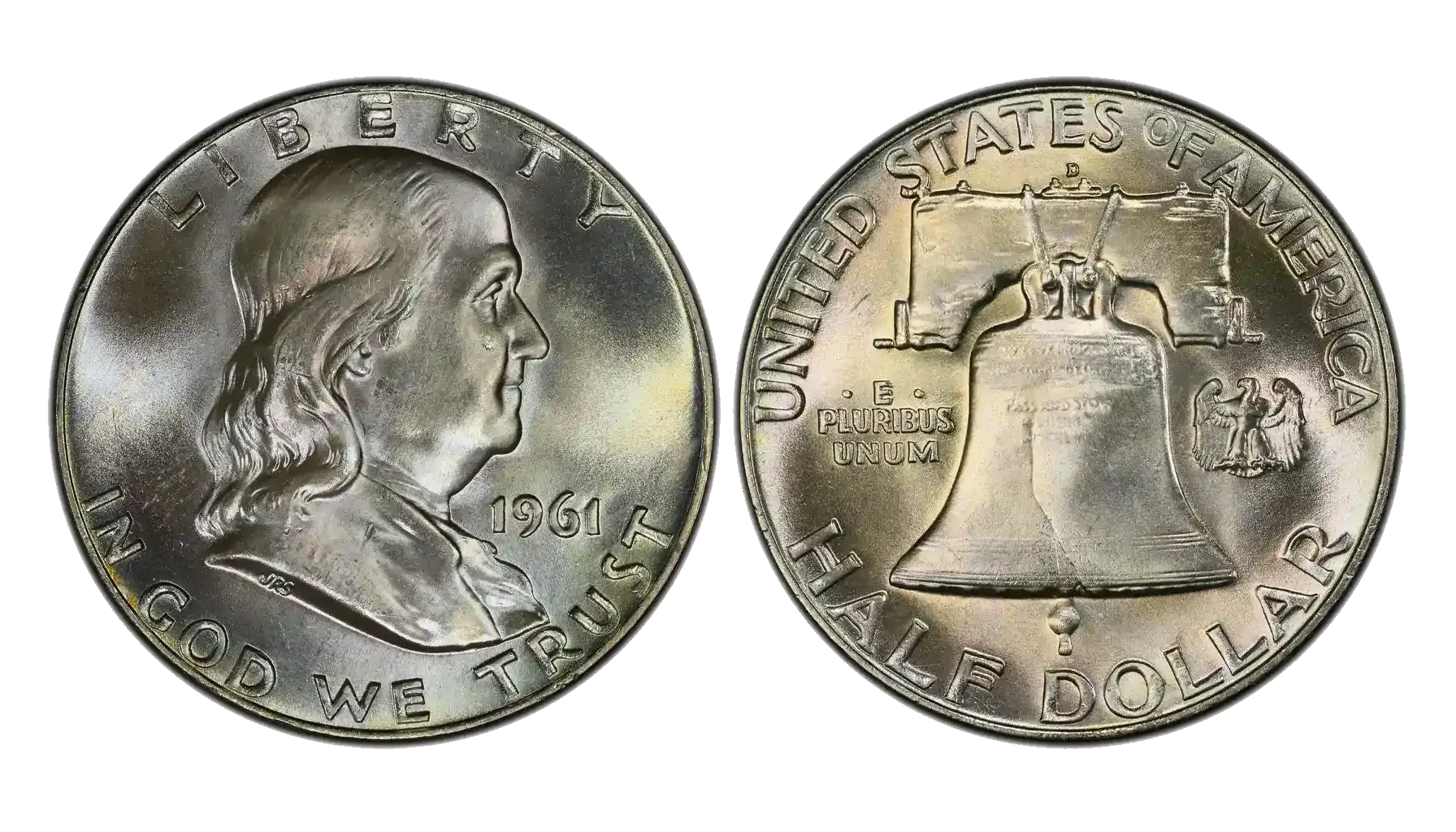
Produced by: Denver Mint
Mintage: 20,276,442
Designations: MS, FBL
Auction Record: $7,800 for MS64
The Denver Mint, on its part, was the most productive facility at that time, as it released more than 20 million pieces that year. Though circulated grades are sufficiently abundant, high-grade (mint state) pieces remain scarce after all. There was one major problem deeply connected to the Denver-produced instances: many suffered from weak strikes and bag marks, which inevitably limit the number of premium survivors, which are still difficult to find.
1961 50C (Proof)
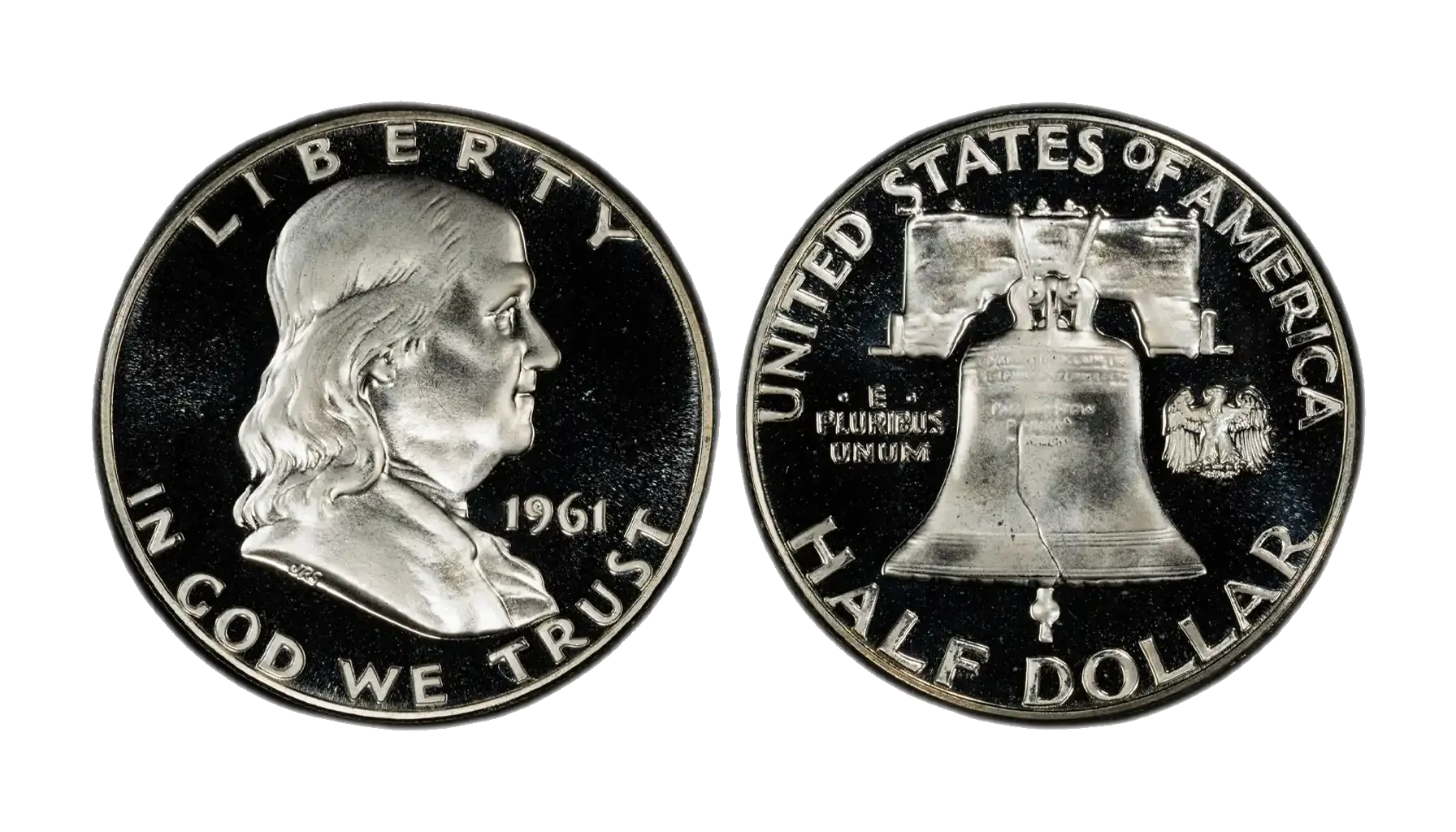
Produced by: Philadelphia Mint
Mintage: 3,028,244
Designations: PR, CAM, DCAM
Auction Record: $40,800 for PR69DC
Proofs do not lie! The 1961 Franklin half dollar proof value is mainly determined by the level of artistry and the elaboration of detail – the things that make these collector-focused creations different. Still, the coin is accessible in lower proof grades but scarce in Cameo (CAM) and especially Deep Cameo (DCAM) designations, where frosted devices contrast against deeply mirrored fields.
All in all, high-end DCAMs are considered trophy coins within the Franklin series and are regularly sought after by collectors worldwide.
1961 Ben Franklin Half Dollar Value by Condition and Type
The 1961 half dollar value today is more complex than that of non-precious samples or those out of the numismatic interest at all. Indeed, the silver melt 1961 half dollar coin value provides a baseline, but it is also dependent on condition, strike quality, designations, current demand, bidding wars (characteristic of numismatic auction platforms), and even more.
Sometimes, they may eventually rise or fall, without any prerequisites or, vice versa, as a result of a long-running tendency. So, what is a 1961 half dollar worth?
Grade | 1961 50C | 1961-D 50C | 1961 50C (Proof) |
Good (G) – Very Fine (VF) | $12 – $18 | $12 – $18 | – |
Extremely Fine (XF40–XF45) | $15 – $22 | $15 – $20 | – |
$18 – $28 | $18 – $25 | – | |
Mint State (MS60–MS63/PR60–PR63) | $20 – $40 | $18 – $35 | $20 – $40 |
Gem Mint State (MS64–MS67/PR64–PR67) | $200 – $4,000 | $150 – $2,500 | $60 – $400 |
Premium Designations (MS66+FBL/PR69CAM/DCAM) | up to $18,000 | up to $7,800 | up to $40,800 |
*Prices may fluctuate. Should you wish to explore more precise data, please refer to Coin ID Scanner to identify coins, analyze their backgrounds, manage collections, and review possible prices for instances in a given state. It is by far the easiest tool to make your collecting experience better and more innovative.
Rare & Valuable Finds
1961 Doubled Die Reverse (DDR)
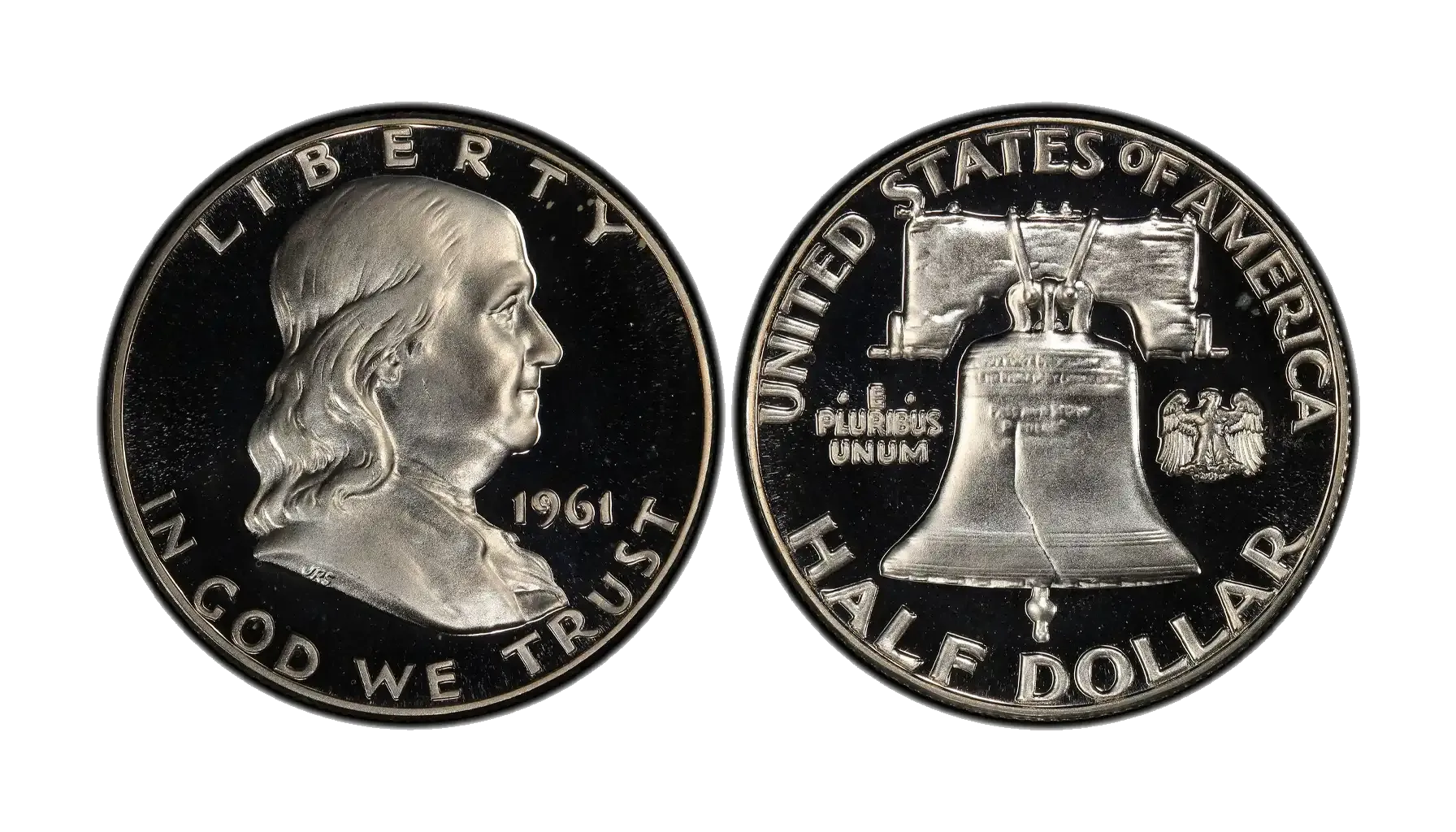
Estimated Value: $22,800
Among the 1961 half dollar errors, the doubled die reverse is probably the most famous deviation known in the series. It is instantly recognizable for its bold doubling on E PLURIBUS UNUM, UNITED STATES, and HALF DOLLAR, and most surviving examples are generally grade PR66+, with only a handful certified in PR67. Cameo pieces are nearly unheard of, and Deep Cameo samples have not been revealed yet.
1961 Doubled Die Obverse (DDO)
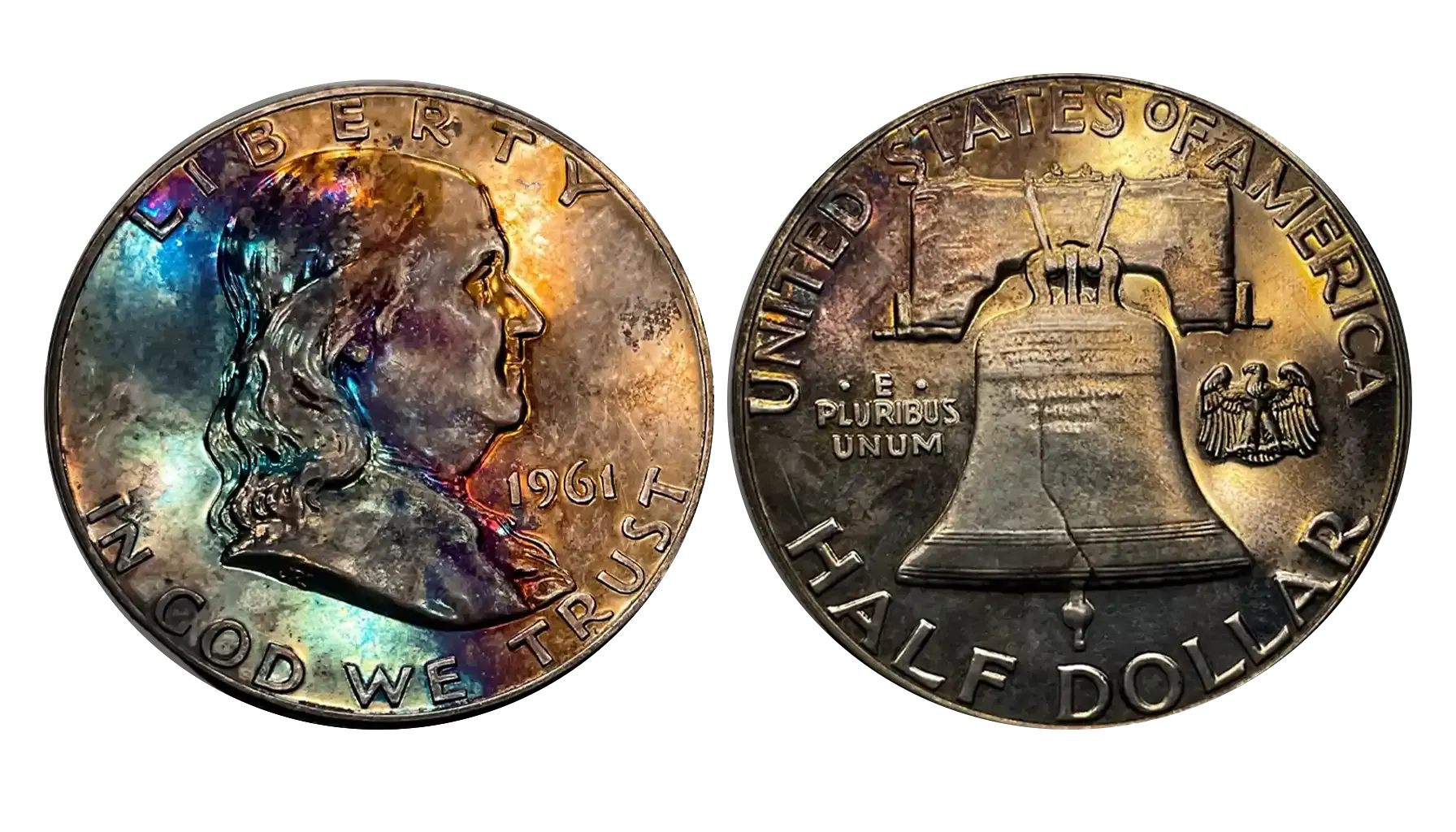
Estimated Value: $1,500
DDRs cannot exist without their doppelgängers, i.e., doubled die obverses, or simply DDOs. This variety, on its part, features noticeable doubling on Franklin’s profile and inscriptions on the front, though this very deviation may not be as visually dramatic as the previous one. All in all, DDO is a highly valuable error for advanced collectors seeking to complete the set.
1961 “Goiter Break” Die Crack
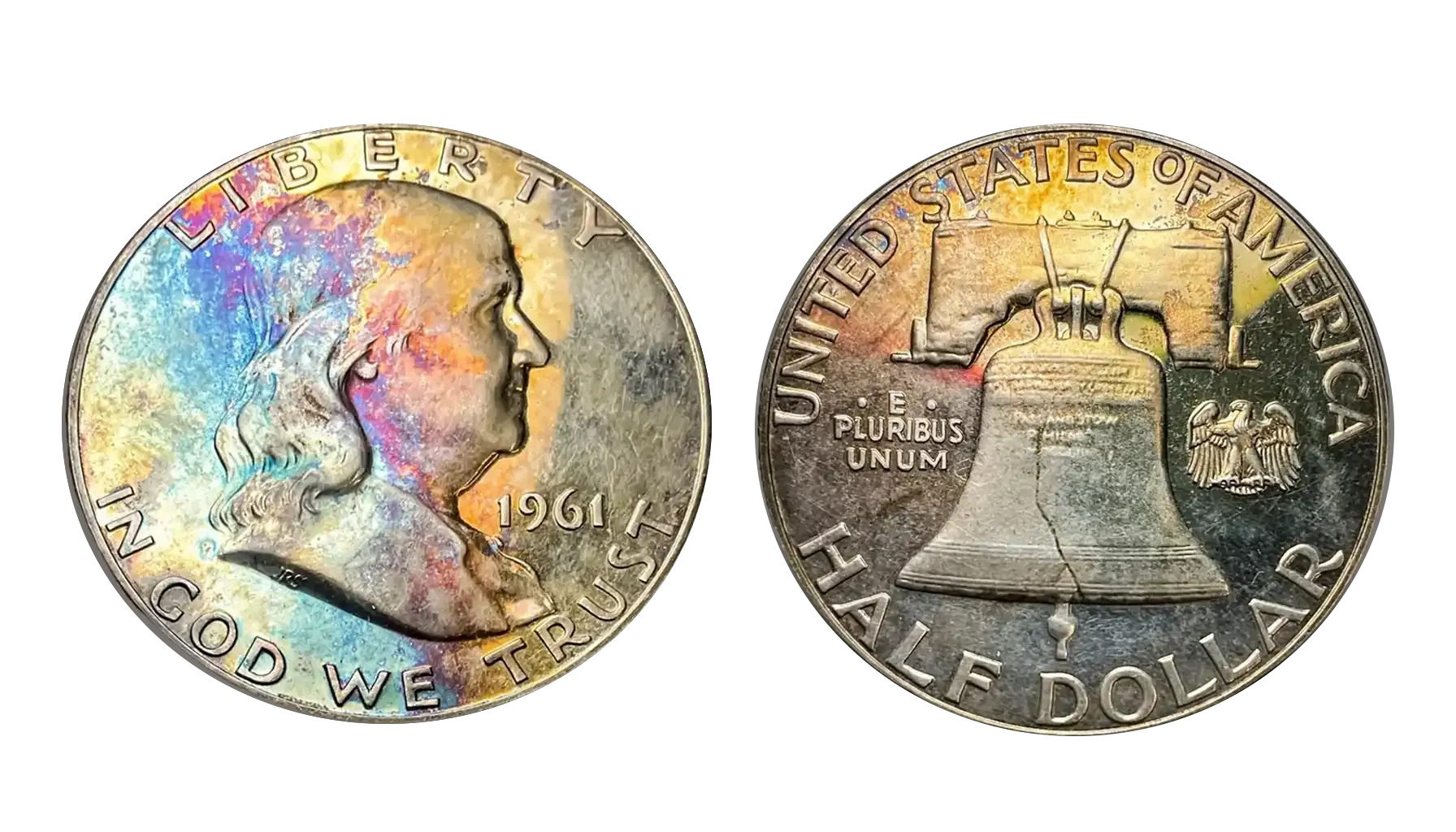
Estimated Value: $900
Some collectors may create unusual, allegorical names for the deviations they spot, and this is how the phenomenon of the “Goiter Break” appeared. This means that the error appears as a raised, irregular line on Franklin’s throat, giving the portrait an unusual, swollen-neck appearance. As a rule, this type of anomaly usually occurs when minting dies become stressed and fractured, which produces coins with highly distinctive flaws until noticed.
Silver may surely be the definitive factor, but it is also about the aesthetics, the history, and the reputation of a coin. Look for the instances you truly enjoy and remember that collecting is a journey through time as much as it is a pursuit of value.

 Facebook
  X (Twitter)
  Pinterest
  LinkedIn