Contents:
1956 is considered a stable year in U.S. coinage—no new denominations, no design changes, and no composition shifts.
The US Mint struck the following regular-issue coins for circulation that year: Lincoln Wheat Cent, Jefferson Nickel, Roosevelt Dime, Washington Quarter, and Franklin Half Dollar.
All dimes, quarters, and half dollars in 1956 contained silver. But what about nickels? Moreover, is a 1956 nickel worth anything? Can free apps to identify coins help you with these specimens?
1956 Jefferson Nicfebruarykel Overview
The coin was produced at two operating mints and released directly into circulation. Large numbers were struck, and most examples circulated normally. Because of this, the 1956 issue is easy to find today in both worn and uncirculated condition.
The design is unchanged from earlier years.
Denomination | Five cents |
Designer | Felix Schlag |
Composition | 75% Cu, 25% Ni, no 1956 nickel silver content |
Weight | 5.00 g |
Diameter | 21.2 mm |
Edge | Plain |
Mint marks | None (Philadelphia), D (Denver) |
Identifying the 1956 Jefferson Nickel
Distinctive Features
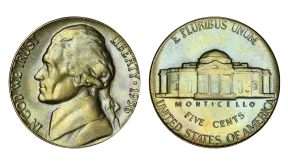
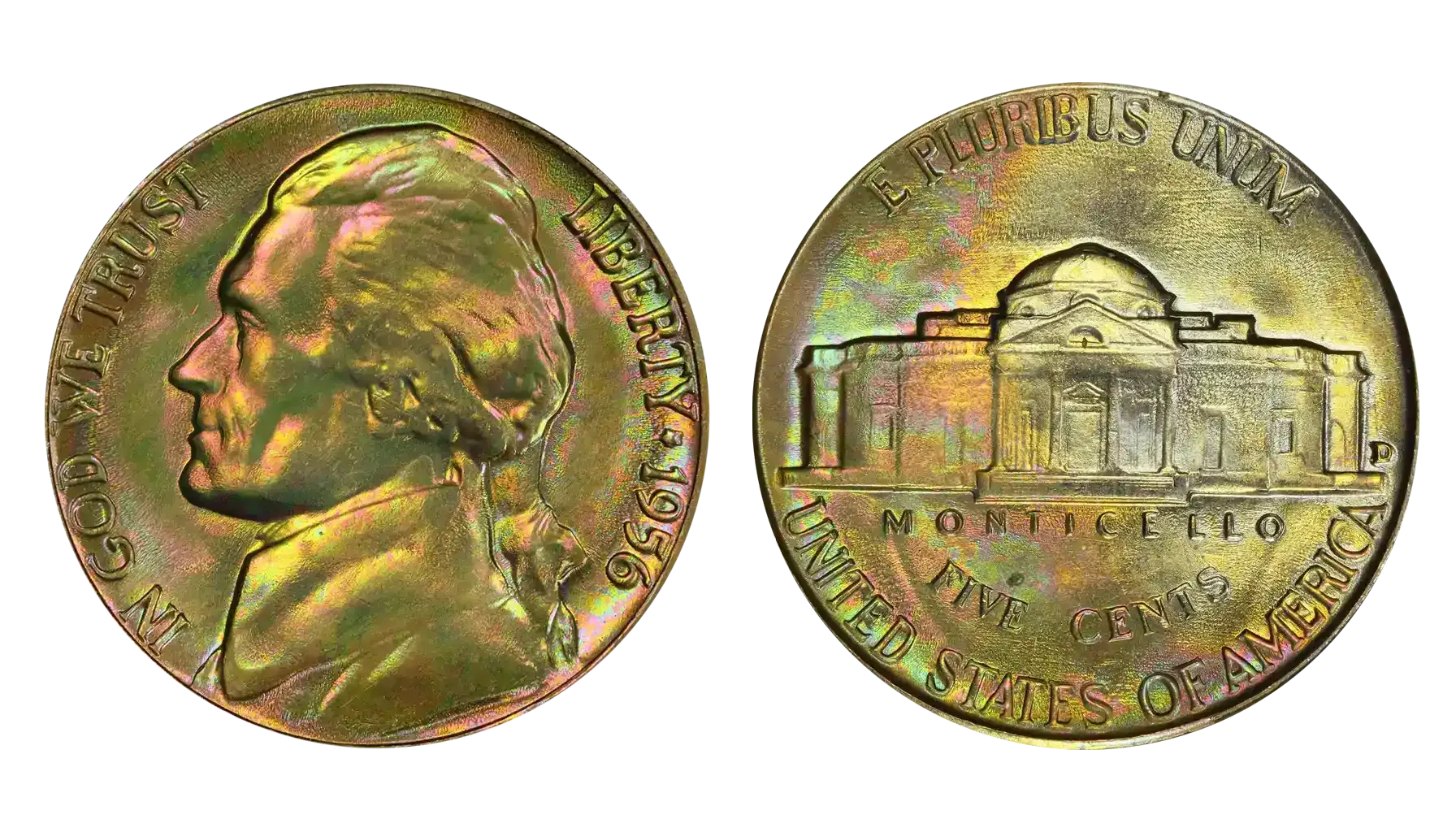
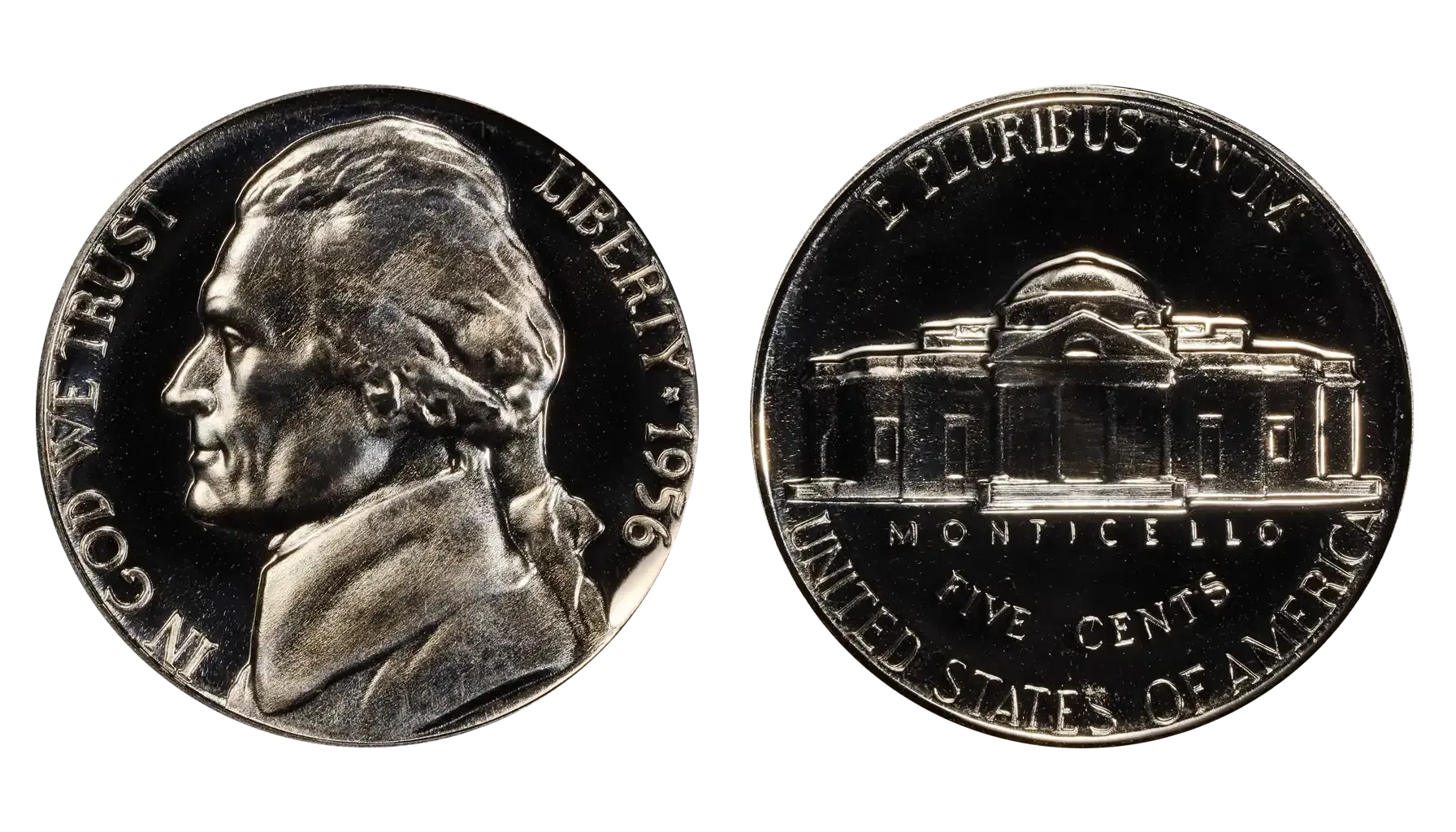
On the obverse, Thomas Jefferson appears facing left. The portrait is shallowly struck, which was usual for the period. On circulated coins, wear shows first on the cheek, jawline, and hair above the ear. The date 1956 sits to the right of the portrait and is normally well defined, even on moderately worn examples.
The reverse shows Monticello centered within the design. Lettering around the building is bold, and the dome and columns are usually clear. The steps at the base of Monticello are the most sensitive detail. On most coins, they appear partially blended, but sharply separated steps indicate a stronger-than-average strike.
Mint marks appear on the reverse, to the right of Monticello.
Coin ID Scanner
The Coin ID Scanner app can help identify any coin from a clear photo. The app compares design layout, lettering, and physical characteristics to verified references and returns the correct specs data. It is useful for quick identification and collection records.
Mint Marks and Varieties of the 1956 Nickel
The piece was struck at two U.S. mints operating at the time, and mint identification is simple because placement and style were consistent throughout the 1950s.
1956 Nickel No Mint Mark — Philadelphia
Philadelphia issues are the most common. They were struck in large numbers and are easy to find in all grades.
D — Denver
Denver coins are also plentiful. Strike quality can vary, especially on the steps of Monticello, which increases the 1956-D nickel value.
None of the mint marks carries inherent rarity for 1956. Differences in the value of 1956 nickel are tied to condition and strike quality rather than mint location.
Varieties
No major doubled dies or recognized hub varieties are associated with this coin.
Minor varieties and errors do exist, but they are typical of the series rather than date-specific. This 1956 nickel error list includes:
minor die cracks or die chips
off-center strikes
lamination flaws
Design Features and Metal Composition
By 1956, the Jefferson pieces dies were well established. Lettering is compact and evenly spaced, especially in IN GOD WE TRUST and E PLURIBUS UNUM. Rims are usually firm and well defined, which helped protect the fields during circulation. The space between Monticello and the rim is often tight, a result of production standards rather than a deliberate redesign.
Is a 1956 Nickel Silver?
It is made of 75% Cu and 25% Ni. U.S. nickels have used this copper-nickel alloy since 1866, with only one exception: wartime nickels from 1942–1945, which contained silver. Because 1956 falls well after World War II, all nickels from that year contain no silver at all, regardless of mint mark.
The CuNi alloy used in 1956 ages slowly. It does not tone like silver and rarely shows dramatic color.
1956 Jefferson Nickel Value by Condition and Mint
It is a common-date coin, so prices are driven mainly by condition, with only minor differences by mint. Exceptional eye appeal or Full Steps can push values higher.
Grade | 1956 Nickel Value No Mint Mark | 1956 D Nickel Value |
Good (G-4) | $0.25 | $0.25 |
Very Good (VG-8) | $0.25 – $0.50 | $0.25 – $0.50 |
Fine (F-12) | $0.50 – $1 | $0.50 – $1 |
Very Fine (VF-20) | $1 – $2 | $1 – $2 |
Extremely Fine (XF-40) | $2 – $4 | $2 – $4 |
About Uncirculated (AU-50) | $4 – $7 | $4 – $7 |
Uncirculated MS60 | $6 – $10 | $6 – $10 |
Uncirculated MS63 | $12 – $20 | $12 – $20 |
Uncirculated MS65 | $30 – $60 | $30 – $60 |
MS65 Full Steps (FS) | $150 – $300 | $250 – $500 |
Common Errors and Collectibility of the 1956 Nickel
It has no famous varieties, but normal minting errors do occur. The most common are off-center strikes, clipped planchets, die cracks, die chips, and occasional lamination flaws. How much is a 1956 nickel worth if it has an error? These pieces are valued based on how visible the error is and the overall condition of the coin. Minor flaws usually bring only small premiums.
“Mint state coins are "ruined" when cleaned, dropping quickly in appeal and value. Circulated nickels are also never cleaned. Most circulated Jefferson nickels are affordable and available in quantities. With many to choose from, collectors pass on any coin with suspicions of a former cleaning.”
— CoinStudy
1956 Nickel Value
Is It Collectible?
This coin is a common-date issue and is mainly collected for set completion. Circulated examples are plentiful, and value increases mainly with condition. Collector interest is strongest in well-struck Mint State coins, especially those with clearly defined steps on Monticello. Original surfaces matter more than the date itself.

 Facebook
  X (Twitter)
  Pinterest
  LinkedIn