Contents:
In 1952, Australia struck one of its rarest pennies – a coin that signals the shift between eras in the country’s monetary history. The coin reflects a period when the Royal Mint continued traditional craftsmanship before the arrival of modern minting techniques.
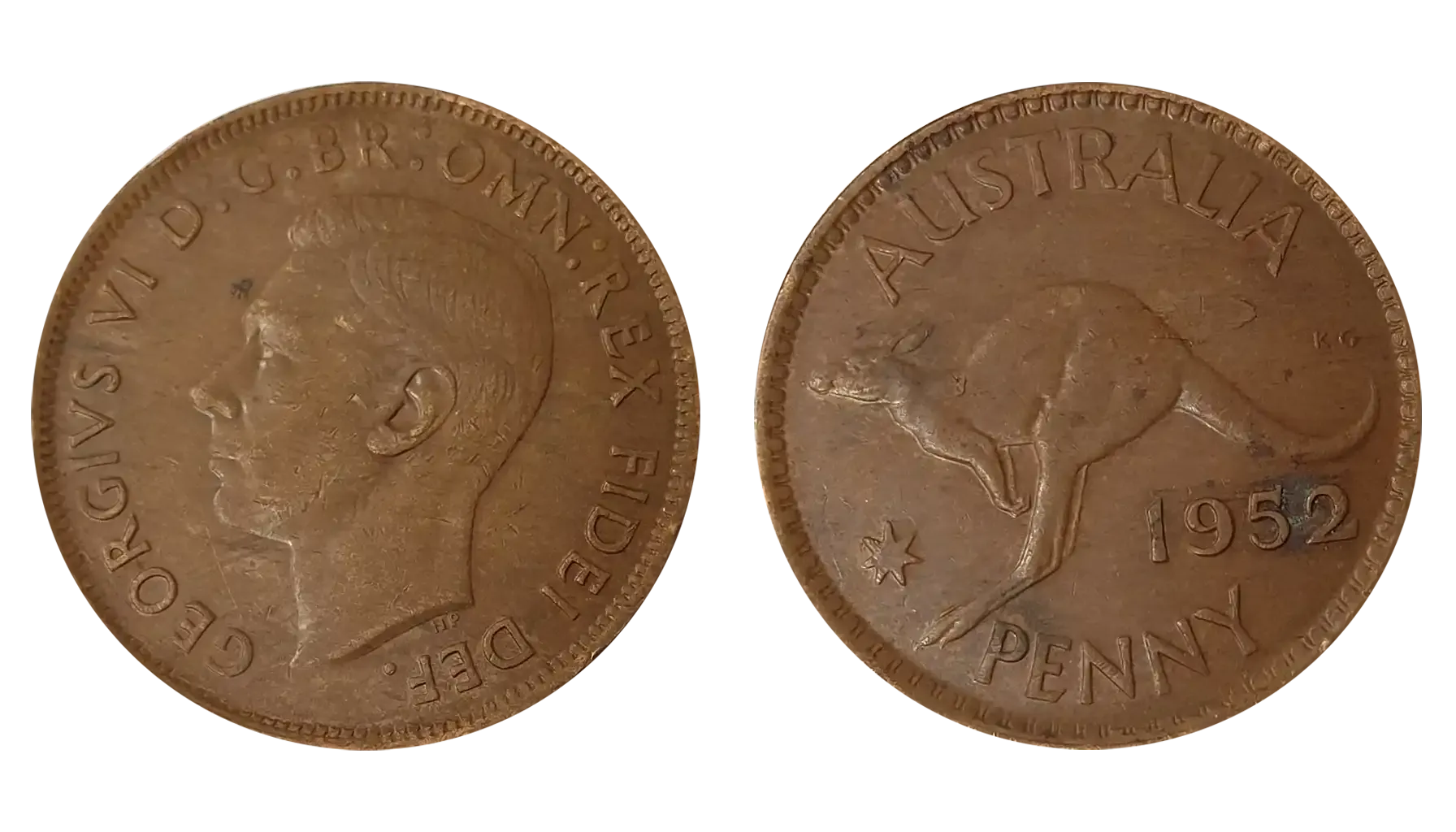
The penny’s design is unique - each coin carries the image of King George VI, who passed away the same year. As a result, the 1952 issue became the final penny struck during his reign.
Introduction
The 1952 Australian penny followed a long lineage of bronze coinage that began with the Commonwealth’s first pennies in 1911. Minted primarily in Melbourne and Perth, the coin retained the traditional kangaroo reverse. Thomas Humphrey Paget shaped the likeness of King George VI for the obverse, and George Kruger Gray crafted the complementary reverse design.
Production statistics confirm the Perth Mint issued the largest share of 1952 coins, whereas the Melbourne Mint’s output was notably lower. Despite not holding the record for lowest mintage, the item’s final‑year designation and the limited survival rate of high‑quality specimens elevate its desirability.
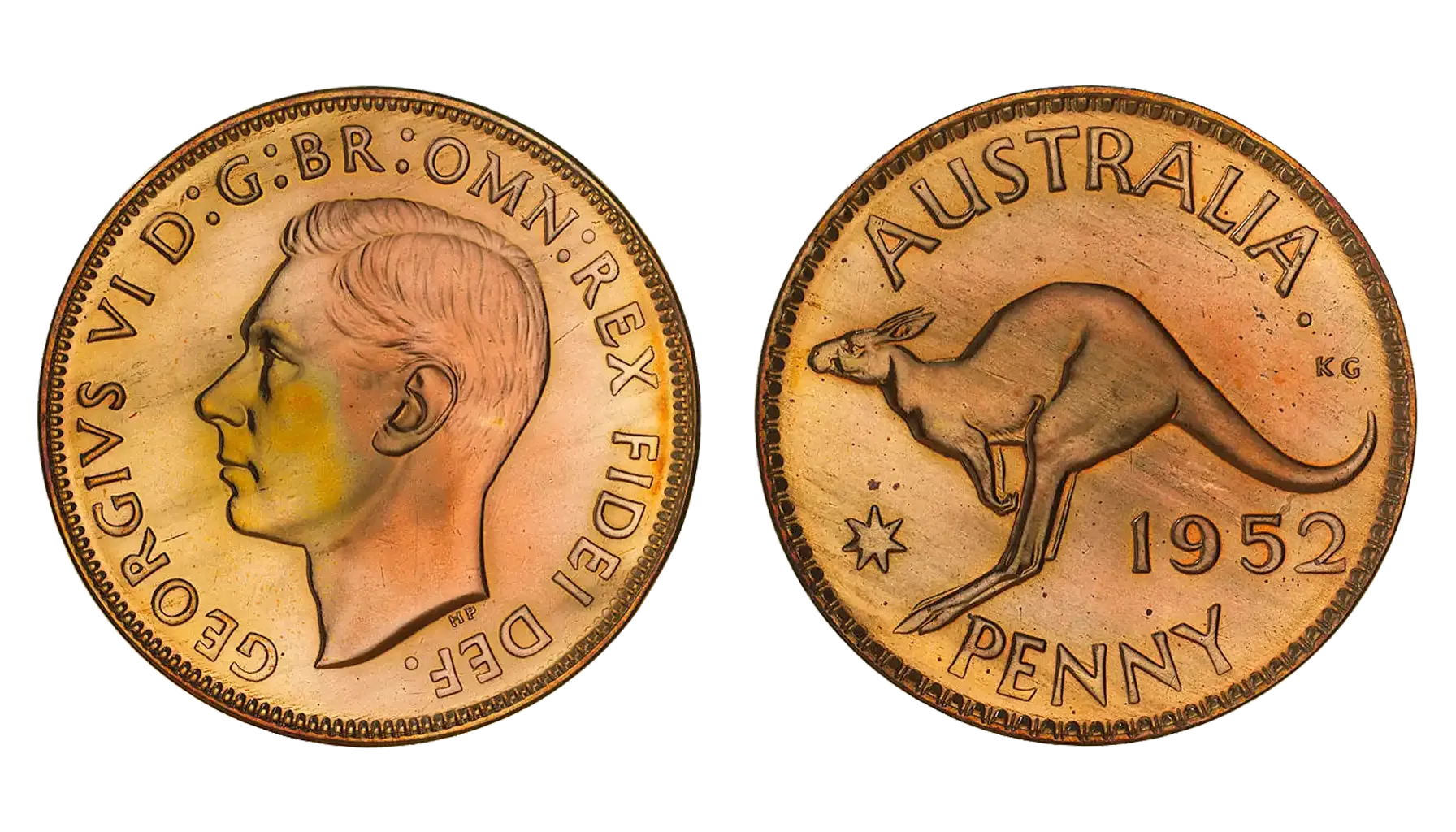
Composition | As similar as 1936, 97% Copper, 2.5% Zinc and 0.5% Tin |
Edge | Plain |
Weight | 9.45g grams |
Diameter | 30.8 mm |
Mintage | 21,240,000 |
Minted | Melbourne |
Engraver | Obverse: Thomas H. Paget Reverse: George Kruger Gray |
Introduction to the 1952 Australian Penny
The Perth issues often appear in slightly redder tones because of alloy variation, while Melbourne coins can show deeper brown patina. Condition is crucial in determining the 1952 Australian penny value. It's worth paying attention to uncirculated examples.
VG $0.90
F $1
VF $2
EF $7
aUnc $20
Unc $35+
Modern price guides, including the Australian Coin and Banknote Values Catalogue, list the Australian penny 1952 value among those with stable demand. For collectors the value reflects condition and market interest in Australian currency.
Rarity and Collectibility of the 1952 Penny
Collectors prize the 1952 penny even though it wasn’t the scarcest mintage. The Perth Mint actually struck millions of these coins—yet its reputation remains solid.
Here’s the reality: though millions were made, only a handful survive as pristine specimens today. Everyday use, exposure to nature, and less‑than‑ideal storage methods have gradually eroded the number of perfectly preserved coins.
Is a 1952 Australian penny rare? In absolute numbers, it is not among the scarcest coins; however, high-grade specimens are uncommon. Brilliant uncirculated examples from original rolls or mint sets have become difficult to locate, which contributes to their desirability.
The Australian Penny Value List 1952
Collectors often consult to compare pricing trends. Over time, the 1952 penny has demonstrated steady appreciation. Auction records show notable results. Melbourne proof strike fetched $725 USD in a private sale.
Remember: counterfeit 1952 Australian penny for sale occasionally appears online. That’s why today’s buyers need to confirm authenticity and carefully evaluate conditions – PCGS or NGC grading provides that essential safeguard.
Grade | Approx. 1952 Penny Value |
PCGS MS63 Brown | $80 – $100 |
PCGS MS64 Red Brown | $100 – $250 |
NGC MS65 Red | $250 – $400 |
PCGS Proof 1952 Melbourne | $400 – $800+ |
"This Proof 1952 Penny is rare on both counts! The original mintage is believed to be fifteen with most of the examples going to public institutions and therefore out of reach of collectors. And the quality is spectacular."
– Paul Holland, Numismatist
Coinworks
Rare Errors
Planchet: Clipped, laminations
Die: Die crack, double die
Strike: Partial collar, uncentered broadstrike
Miscellaneous: Double 52 / Date / King
Preservation Tips for Collectors
The copper‑dominant composition of the 1952 Australian penny leads to patina formation in response to atmospheric oxygen and moisture. Although uniform natural toning may increase aesthetic appeal, the presence of corrosion or verdigris adversely affects the coin’s assigned grade and overall value.
Collectors should:
Handle coins by their edges and use cotton gloves to avoid fingerprint oils to accelerate tarnishing
Safe storage in acid-free holders or archival-quality flips helps maintain condition
Humidity control
Remember: A dry, stable environment prevents oxidation and maintains the coin’s color balance.
When cleaning appears necessary, professionals advise extreme caution. Harsh polishing can remove original surfaces and reduce value dramatically. Conservators often use distilled water rinses or approved numismatic solutions under magnification.
Seasoned numismatists urge collectors to build a visual inventory and track each coin’s history. Modern software and apps simplify the process of record‑keeping. Condition photos, certification numbers, and purchase data preserve the coin’s traceable history—an advantage when reselling.
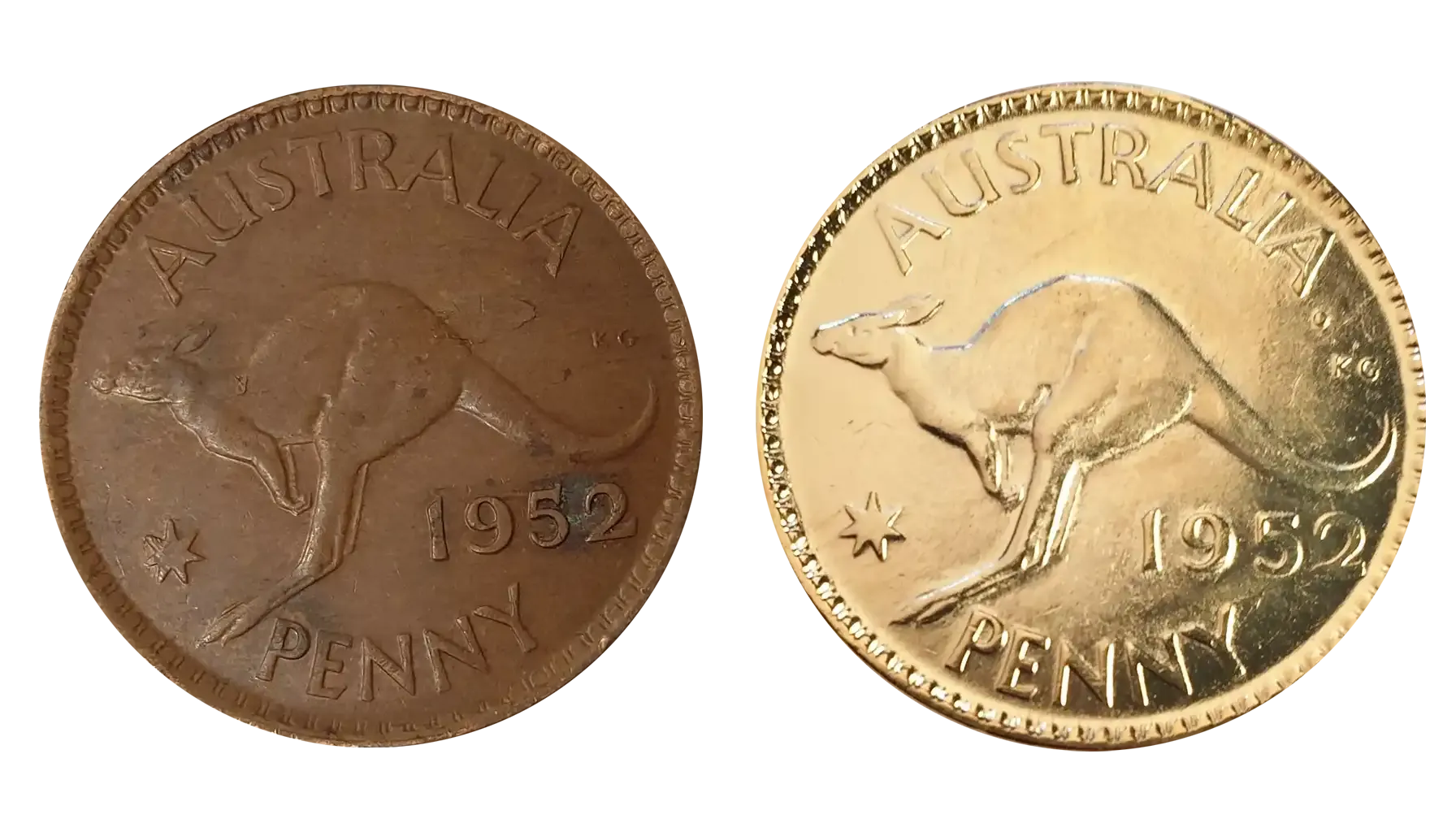
Those who track trends in 1952 penny Australia value today find that coins stored correctly outperform poorly preserved examples. Preservation directly influences price movement, especially among premium specimens.
Legacy and Historical Importance
The penny represents a chapter in the country’s economy. As the last penny issued under King George VI, it closes an era of British monarchy symbolism before Queen Elizabeth II’s reign began in 1953.
Economic historians often point out that Australia in the early 1950s stood between reconstruction and modernisation. Coinage reflected that spirit of endurance and change. The kangaroo reverse, like on the 1943 item, remained a proud emblem of Australian identity.
Today, collectors recognise the 1952 penny as a benchmark issue—both accessible and meaningful in auctions, museums, and private albums.

 Facebook
  X (Twitter)
  Pinterest
  LinkedIn