Contents:
Roosevelt dimes have never been seen as popular or, at least, desirable. Nonetheless, those who have been in the field for years are well aware of the fact that the least prominent creations may be quite valuable, especially in the long run. And certain issues are worth collecting even when they have only been released.
The 1950 Franklin D. Roosevelt coin is one of the first “Type 1” iterations of the series, though its unique position does not presuppose limited mintages either way. Common in circulation and regular by nature – what do these numismatic creations look like? What is the 1950 dime value, and how to identify these coins on the spot?
Briefly About the 1950 Dime History
In broader terms, the path of a dime started in 1792, as soon as the Coinage Act of 1792 proclaimed the decimal system and started the production of the ten-cent piece (e.g., the 1792 half disme). The first design selections were figurative, for they all featured the non-existent Lady Liberty, while the part of the series that commenced with the 1946 Roosevelt dime was different: it finally bore the portrait of the real historical figure, not an image with symbols and meanings beneath.
The reason for this dime’s emergence was obvious: when Roosevelt passed away in 1945, national/governmental authorities sought a way to honor the man whose policies and personal charisma had become a symbol of hope during the Great Depression and World War II. Finally, after a relatively long preparation, the coin saw the light on what would have been Roosevelt’s 64th birthday, i.e., January 30.
Design and Specifications
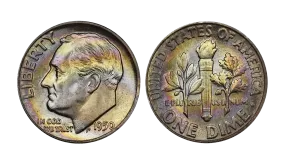
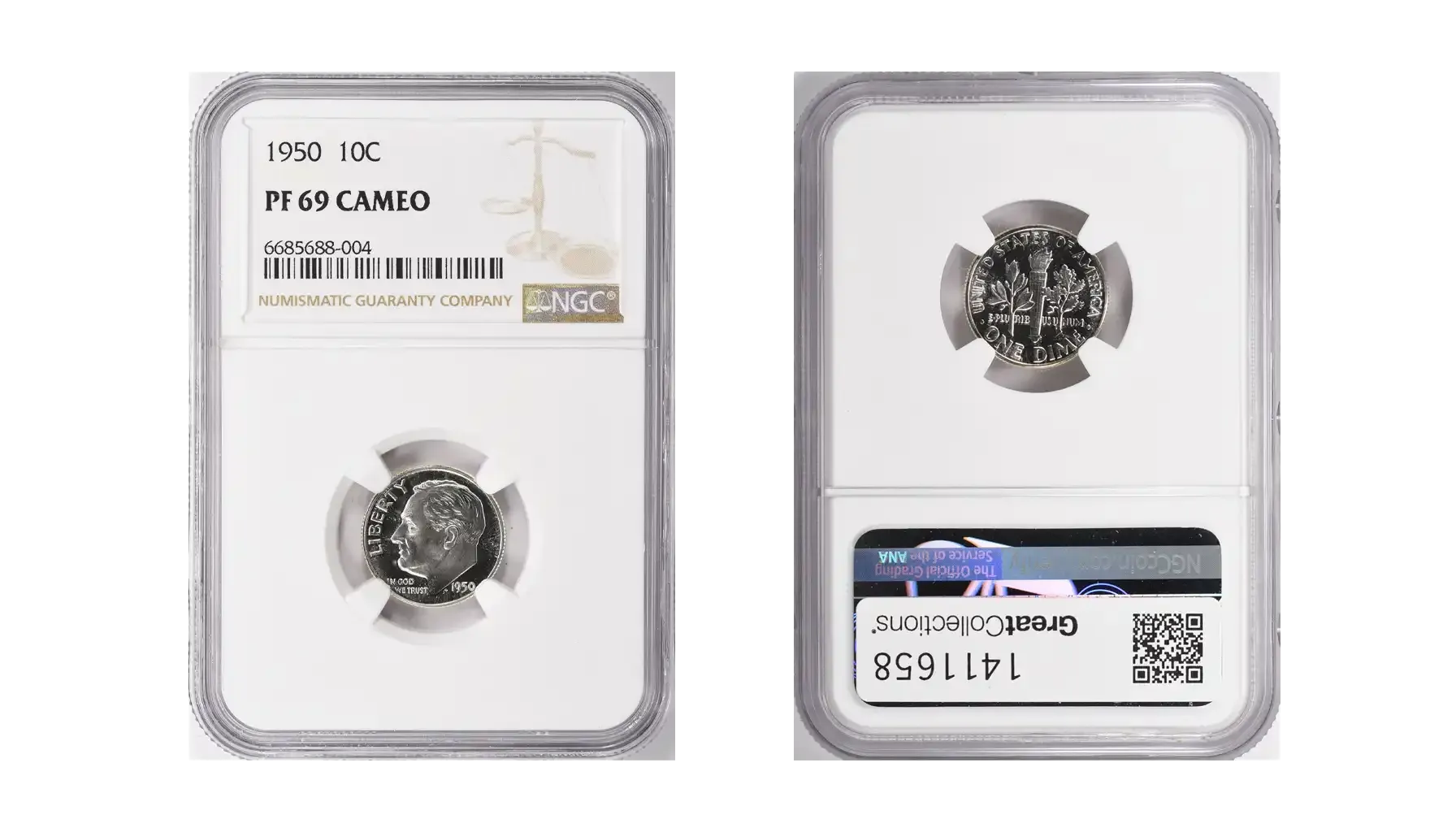
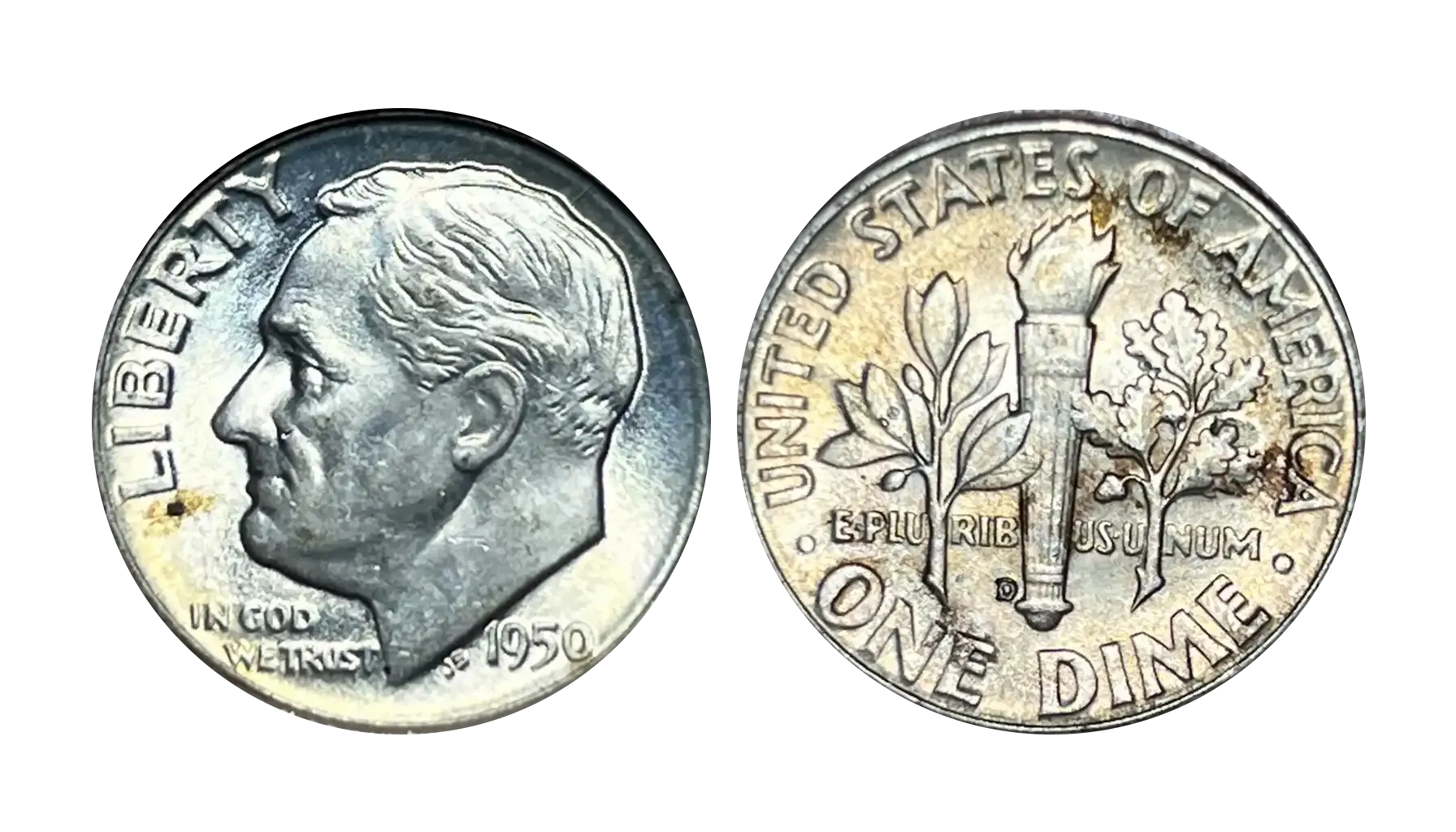
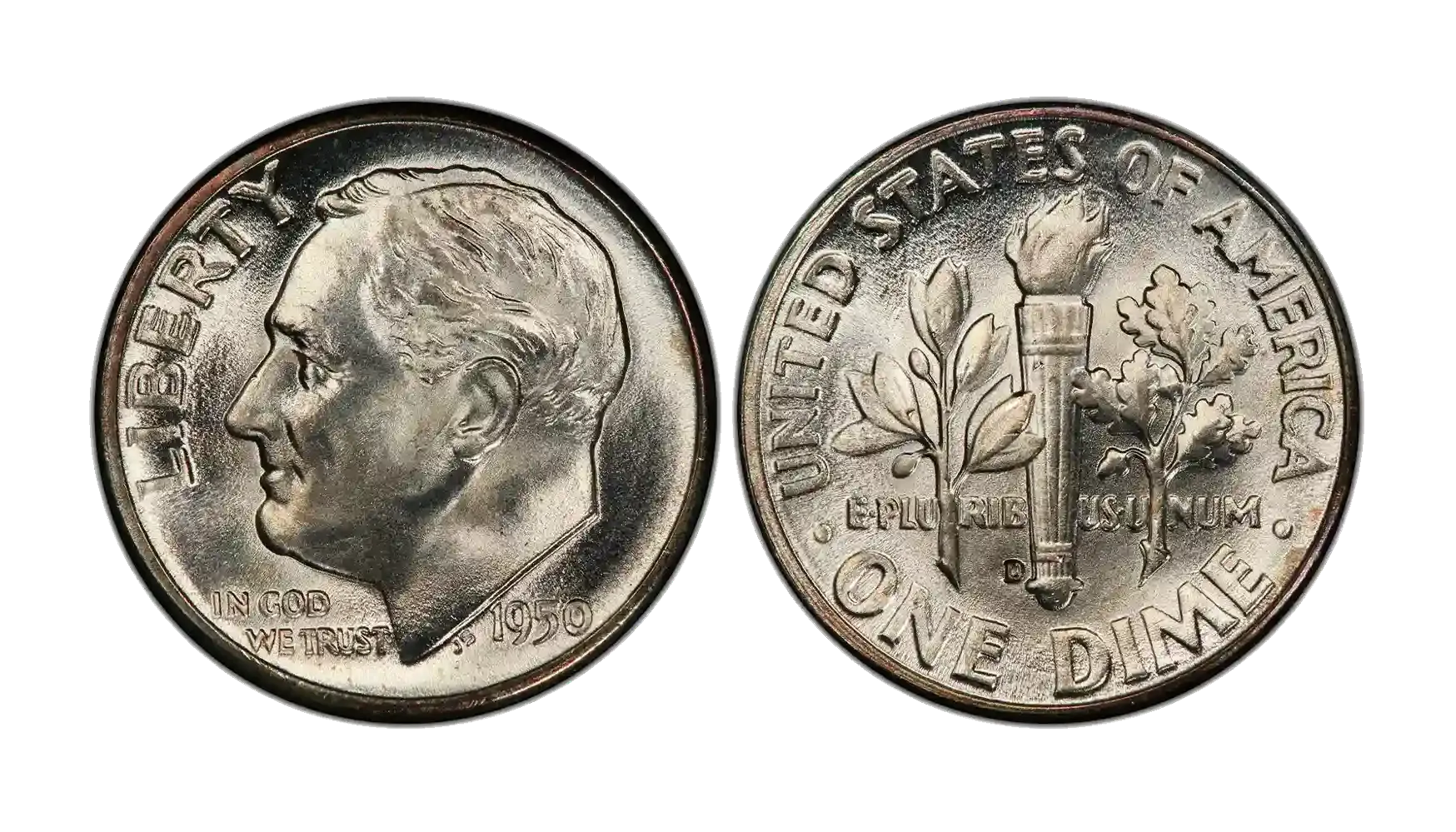
Obverse: Demonstrates the profile of President Franklin D. Roosevelt, as well as the inscriptions “LIBERTY” to the left, “IN GOD WE TRUST” below Roosevelt’s chin, the controversial initials of the designer “JS” below the neck, and the year “1950” to the right.
Reverse: Displays a torch at the center, surrounded by an olive branch on the left and an oak branch on the right, as well as the inscriptions “UNITED STATES OF AMERICA” along the upper rim, the denomination “ONE DIME”, the motto “E PLURIBUS UNUM”, and a mint mark by the bottom part of the torch.
The Main Features | |
Designer | John R. Sinnock |
Composition | 90% silver, 10% copper |
Weight | 2.5 grams |
Diameter | 17.9 mm |
Edge | Reeded |
Mintmarks | None for Philadelphia “D” for Denver “S” for San Francisco |
Mint Varieties of the 1950 Dime
1950 Dime No Mint Mark
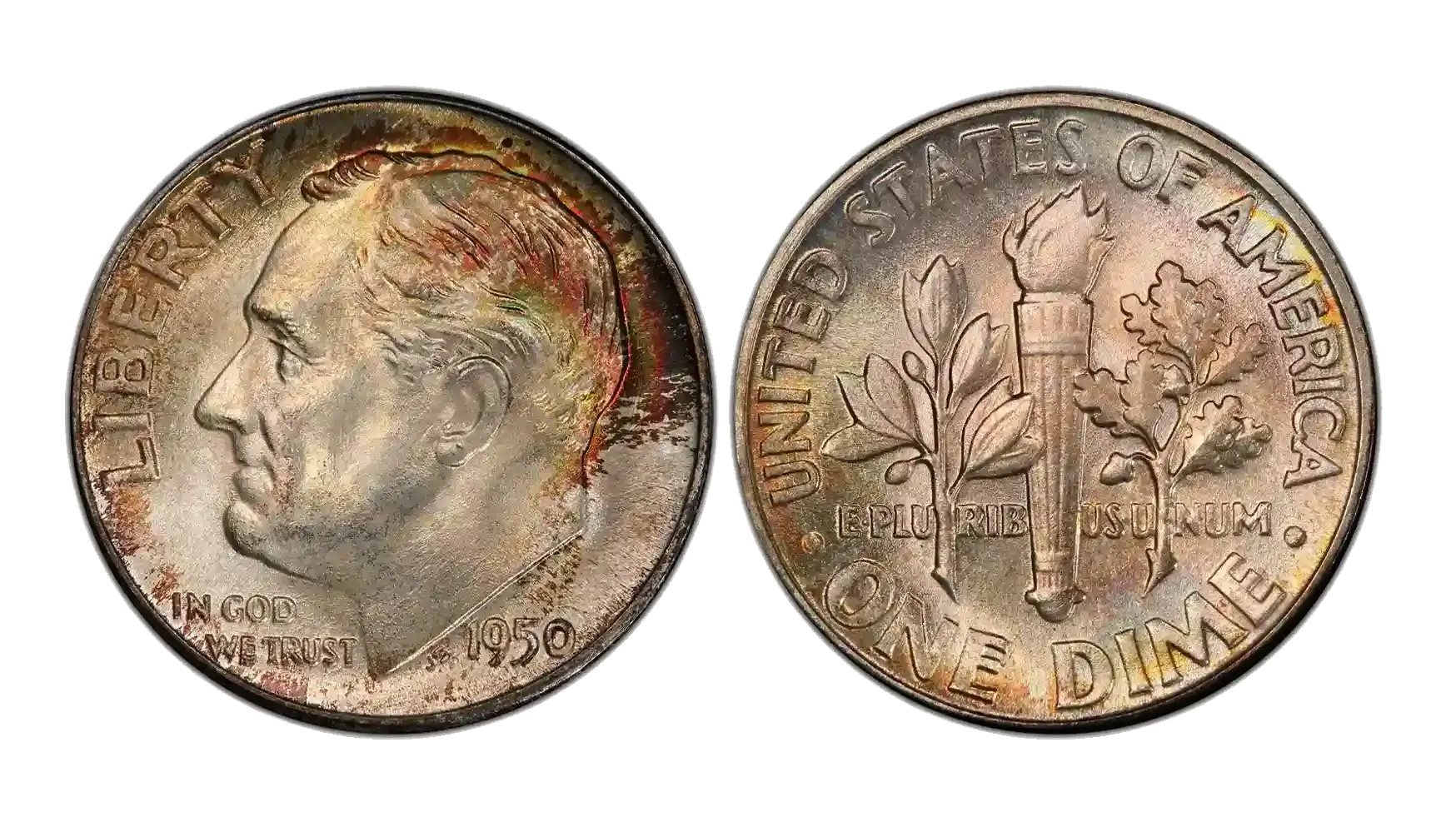
Produced by: Philadelphia
Mintage: 50,130,114
Auction Record: $8,813 for MS68
The Philadelphia Mint produced over 50 million pieces without a mint mark on the surface, and this figure makes the coin extremely common in all grades. In fact, many have survived the circulation, but high-graded instances may still be worth something (up to eight thousand!).
1950 D Dime
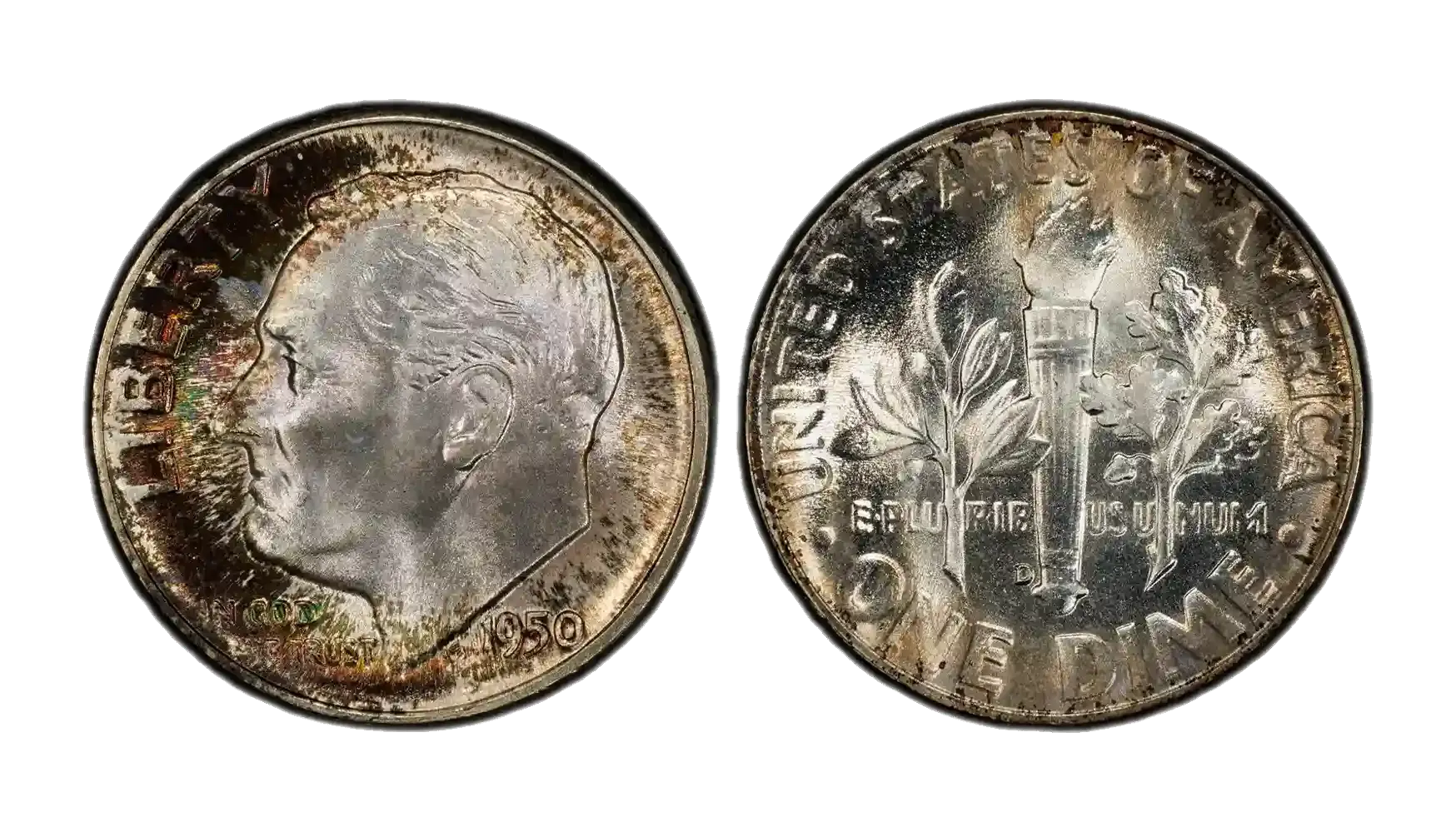
Produced by: Denver
Mintage: 46,803,000
Auction Record: $3,450 for MS68
According to Jaime Hernandez, the main part of those 46 million coins is still present on the market, thanks to high rates of preservation and overall quality of the strike. Nevertheless, the “Full Band” designation, as well as high grades, make the 1950 D dime value noticeably immense.
1950 S Dime
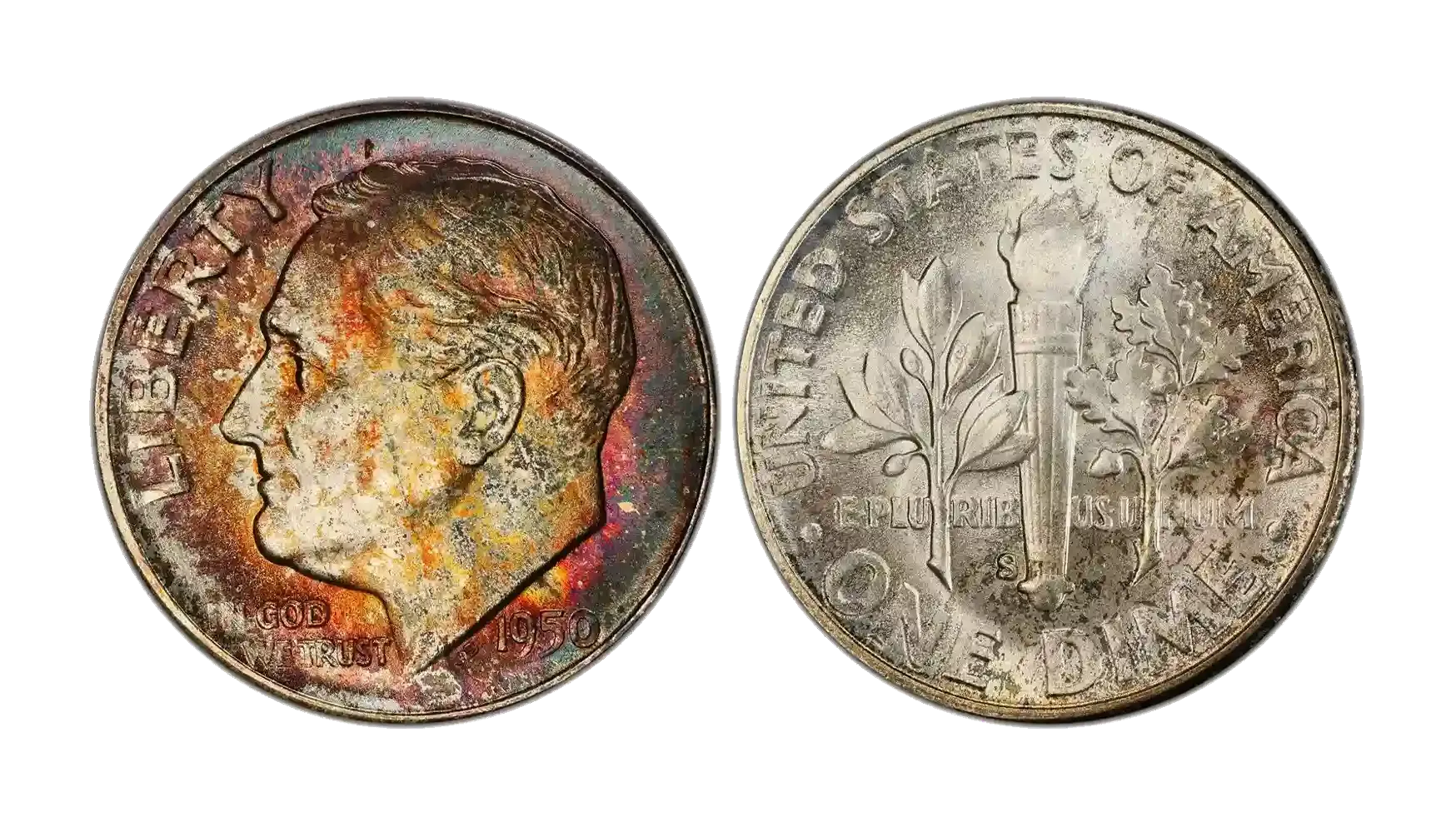
Produced by: San Francisco
Mintage: 20,440,000
Auction Record: $4,025 for MS68
As per PCGS, the San Francisco variety can be characterized by the fifth-lowest mintage in the series, which makes it a quite desirable option in all grades. However, the 1950 S dime value is not so impressive, but this may change over time.
1950 Dime No Mint Mark Proof
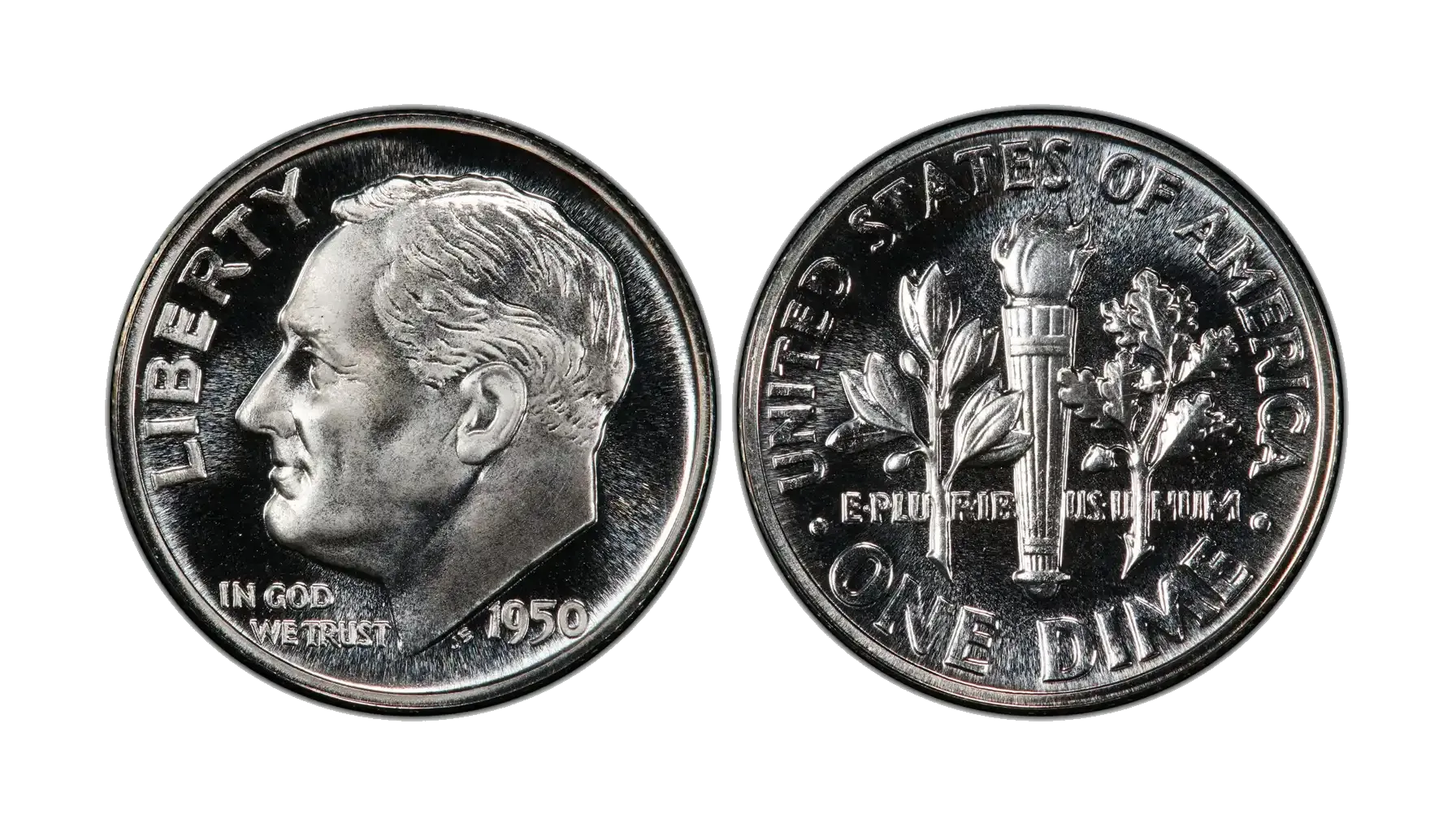
Produced by: Philadelphia
Mintage: 51,386
Auction Record: $18,800 for PR68
Finally, here comes the only proof version of the 1950 dime that appears in three major designations, i.e., PR, CAM (Cameo), and DCAM (Deep Cameo), with the latter being the most valuable to own. And just like with any other proof, it is beneficial to own and fun to explore.
“This is the first year in which the Proof Roosevelt Dime was struck. It is one of the more difficult dates to acquire in high proof grades. In Grades of PR60-66 they are fairly easy to obtain. In Grade PR67 and higher they become hard to find. In PR68 they are very scarce with about two dozen examples known with none being finer.”
— Jaime Hernandez, renowned numismatist, PCGS price guide editor
PCGS CoinFacts
Silver Content and Intrinsic Value
The 1950 dime silver content is 0.0723 troy ounces of pure silver, and this means that even in its debased state, each coin has a base value equal to the price of that amount of silver on the exchange.
Total Weight | Silver Content | Pure Silver Weight |
2.5 g | 90% | 2.25 g (≈0.0723 oz) |
That said, the average 1950 silver dime value, based solely on its composition, should be as follows:
Silver Content (in troy ounces) × Current Silver Price = Intrinsic Value
0.0723 oz × $58 ≈ $4.19
Market Value and Price Ranges
The worth of the coin depends on several factors, and it may fluctuate over time. Anyway, so as to understand the market potential of the piece, it is vital to be aware of the essential factors of evaluation, so here we go again.
Key Factors Influencing Value
Minting Facility. Despite the impressive totals, the distribution between Philadelphia, Denver, and San Francisco plays a role. Coins from San Francisco are noticeably rarer, but when it comes to proof instances, nothing can compete.
Certification. Documents from grading services like NGC or PCGS may also affect the worth, for they always display official grades and evidence that the coins are authentic. The more documents you have, the lower the risk.
Provenance. Coins that have a documented auction history at major coin auctions are valued higher. Collectors appreciate transparency and a “verified past,” especially if the coin was included in famous collections.
How Much Do These Pieces Cost? Values by Type
Type | Circulated | MS-60 to MS-65 | MS-65+/FB | Proof (PR) |
1950 (P) | $3 – $7 | $11 – $22 | $20 – $40+ | – |
1950-D | $3 – $6 | $10 – $17 | $20 – $35+ | – |
1950-S | $5 – $7 | $15 – $33 | $70 – $100+ | – |
1950 Proof | – | – | – | $27 – $950+ |
Note: These figures represent approximate market ranges for average examples. Exceptional pieces may be worth more. To learn more about it, please refer to Coin ID Scanner, i.e., an innovative app for numismatic explorations, collection management, and fruitful coin hunts. Enjoy!
Types of Mint Errors
Doubled Die Obverse (DDO)
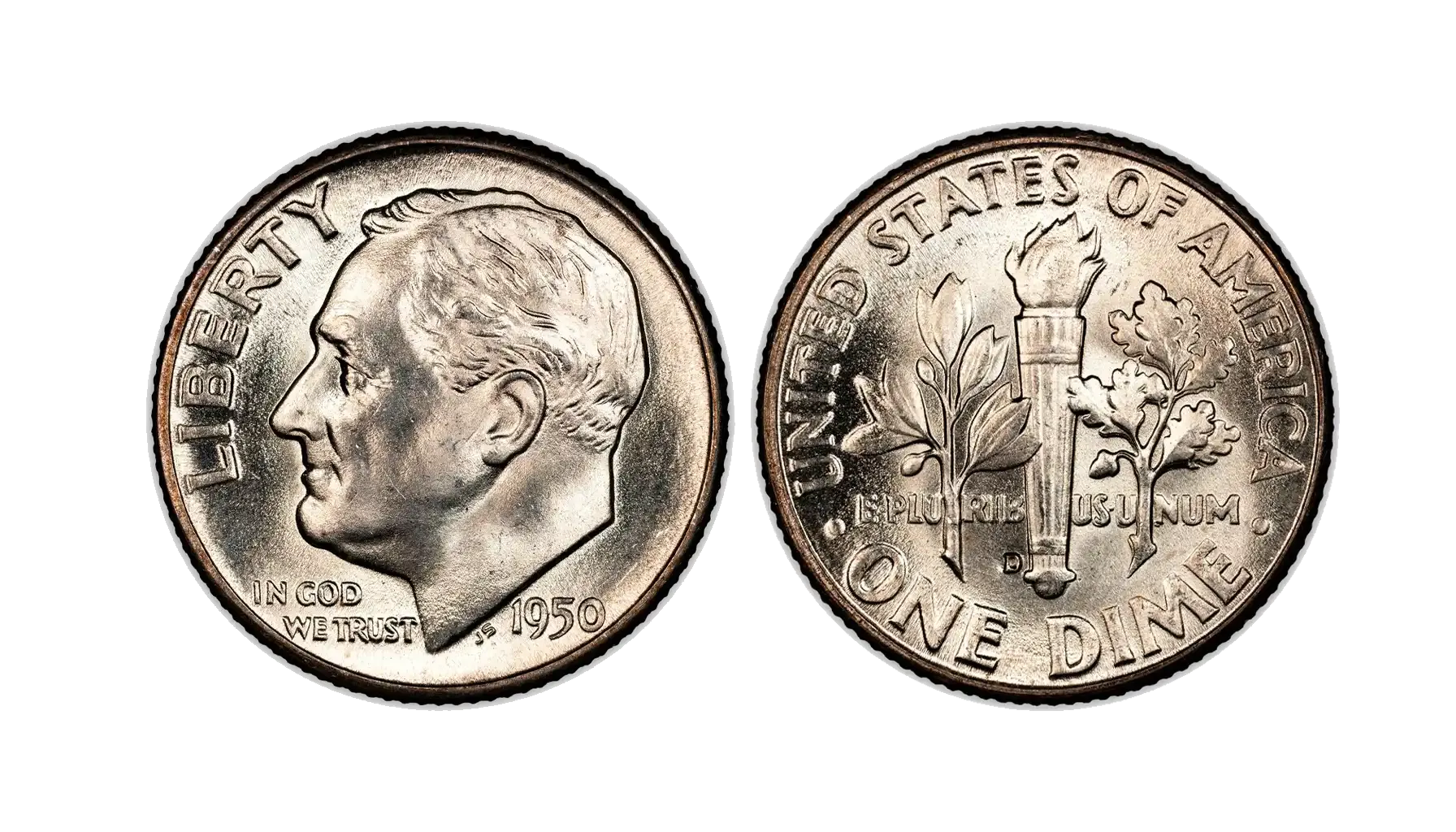
Estimated value: $50–$500+
This error presents the apparent doubling of parts of the inscription “LIBERTY” or date. Sometimes, doubling is also visible on the motto “IN GOD WE TRUST”, and this mainly comes from the repeated die strike on the planchet. Here is the truth: the clearer the doubling, the higher the price.
Off-Center Strike
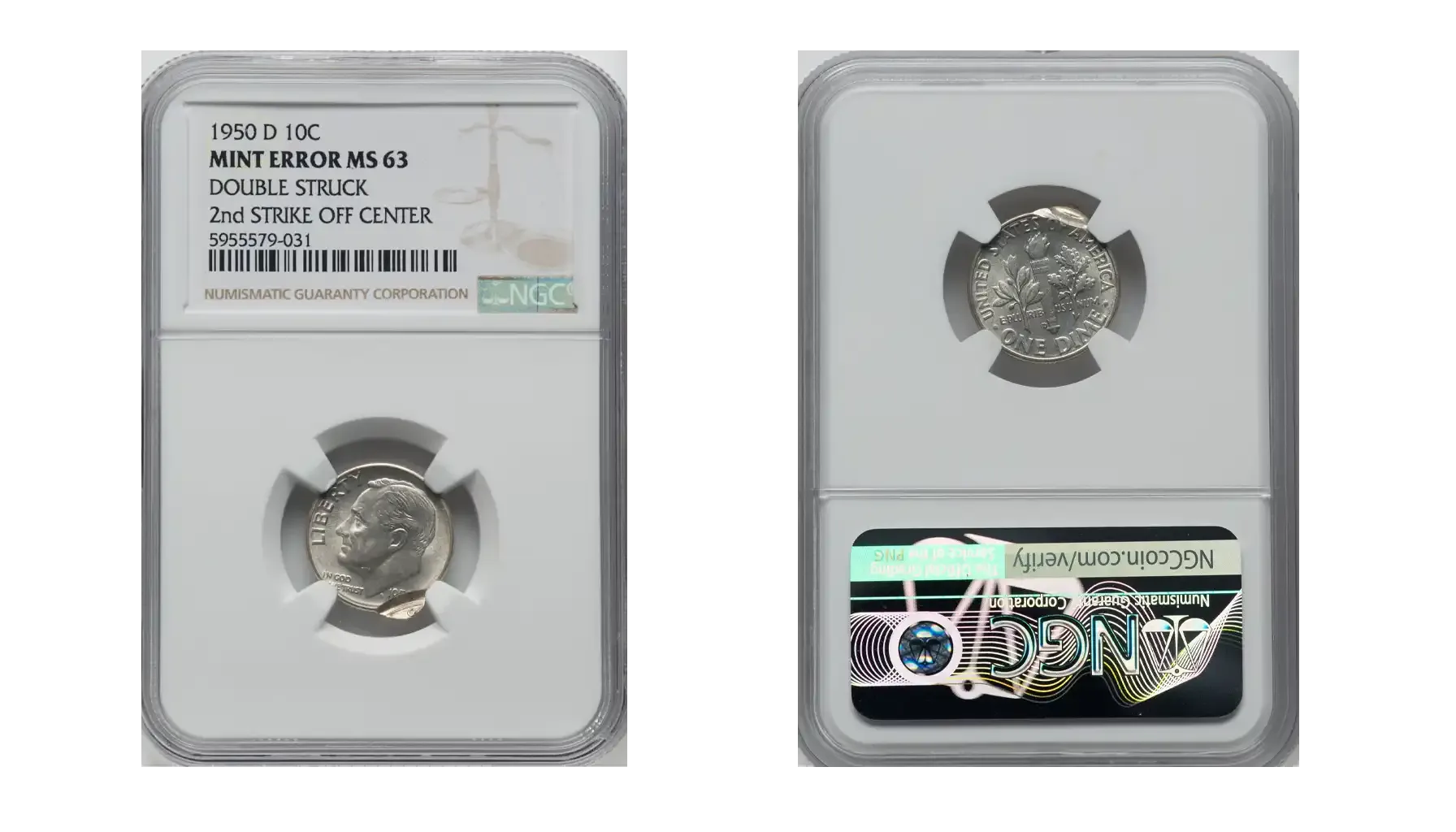
Estimated value: up to $300+
When the planchet is misaligned during striking, a part of the design might get closer to the rim or even extend beyond it. The severity of the deviation is vital, for an example with a shift of about 40% was sold in 2023 for $350, which was quite high.
Repunched Mint Mark (RPM)
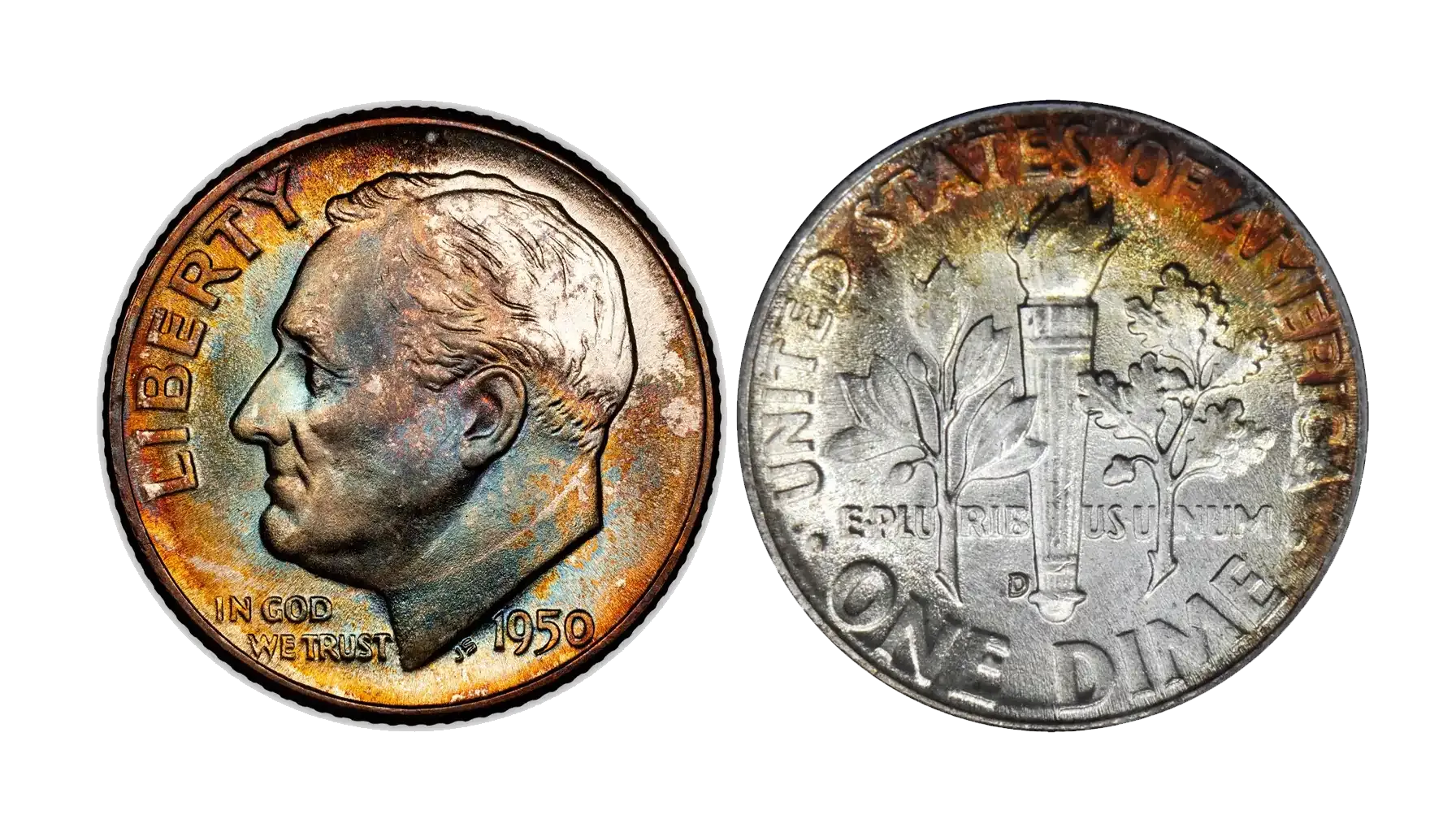
Estimated value: $30–$400+
Certain varieties, e.g., those minted in Denver, are more prone to particular anomalies. As for the RPMs, these feature noticeable overlapping of the “D” in two strikes, sometimes shifted distinctly left or downward.
Wrong Planchet Error
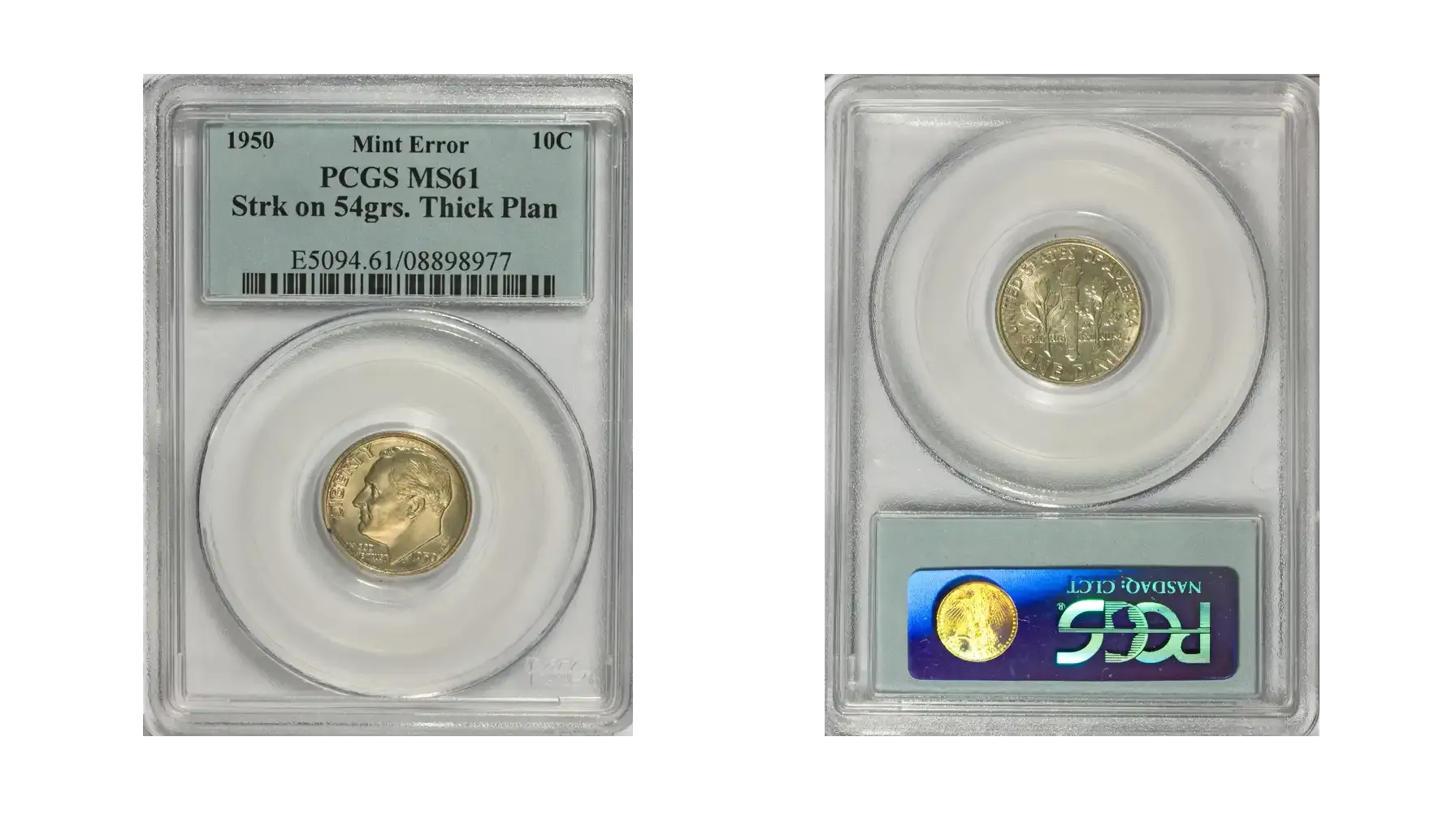
Estimated value: $1,000+
As soon as the coin is minted on a planchet intended for a different denomination (e.g., a cent or 5 cents), it turns into a relic with the prices soaring up. So as to spot it on time, pay attention to weight and diameter discrepancies, for they do not match the standard (color may also vary).
Strike-Through Error
Estimated value: $50–$150+
Foreign impact is also capable of boosting the worth. When a foreign object (a piece of metal, grease, or fiber) gets on the planchet during striking, this becomes a source of indentations or irregularities in the form of an imprint on the surface.
Collector Interest in Mid-20th Century Silver Dimes
The attention of collectors to the Roosevelt series can be explained by the personality of the president. However, it is not the only way to praise. Silver issues have already become a thing of the past, so today they are perceived as material witnesses of time.
All in all, these creations may also be represented “through” the following:
The last major silver issues before the 1965 Coinage Act;
The mintages are substantial, but high grades are rare;
1950 dime value is higher in certified MS65 and Full Bands;
Similar interest is seen in later issues, such as the 1988 quarter, which is valued because of its metal content and the historical context and design.
Cultural Context: 1950s Five and Dime Stores
It is extremely interesting that, in parallel with the existence of the coins themselves, in the 1950s, the US dazzled with the so-called 1950s 5 and dime stores, i.e., stores where you could buy small items for 5 or 10 cents.
Today, this has since become a cultural symbol: the price of a dozen candies or toys was equal to the face value of the coin, which can now cost hundreds of dollars. They allowed families on a limited budget to cover basic needs, and children to make their first independent purchases.
The 1950 variety is genuinely underrated. Learn more about the coins you are unaware of and expand the collections for good.

 Facebook
  X (Twitter)
  Pinterest
  LinkedIn