Contents:
A penny from 1800… This coin alone is older than any reader. It’s no secret that old coins are valuable, but exactly how much is a 1800 penny worth?
About this penny’s value, history, and rarity, you can learn in this article. After reading, you may consider yourself the master of the penny from 1800.
Collects worldwide are starting to use a Сoin Identifier. Such apps are a huge quality-of-life instrument that saves you a lot of time and energy from browsing each coin.
1800 Penny Overview
Back in the 1800s, this coin was more often called a cent. To be more precise, Draped Bust Large Cent. The large cent was one of the earliest U.S. coins minted after the Mint opened in Philadelphia in 1792.
The design for this penny was brought out by Robert Scot. As it often happens with old bits, the design was changed, but by 1800, the design was solidified.
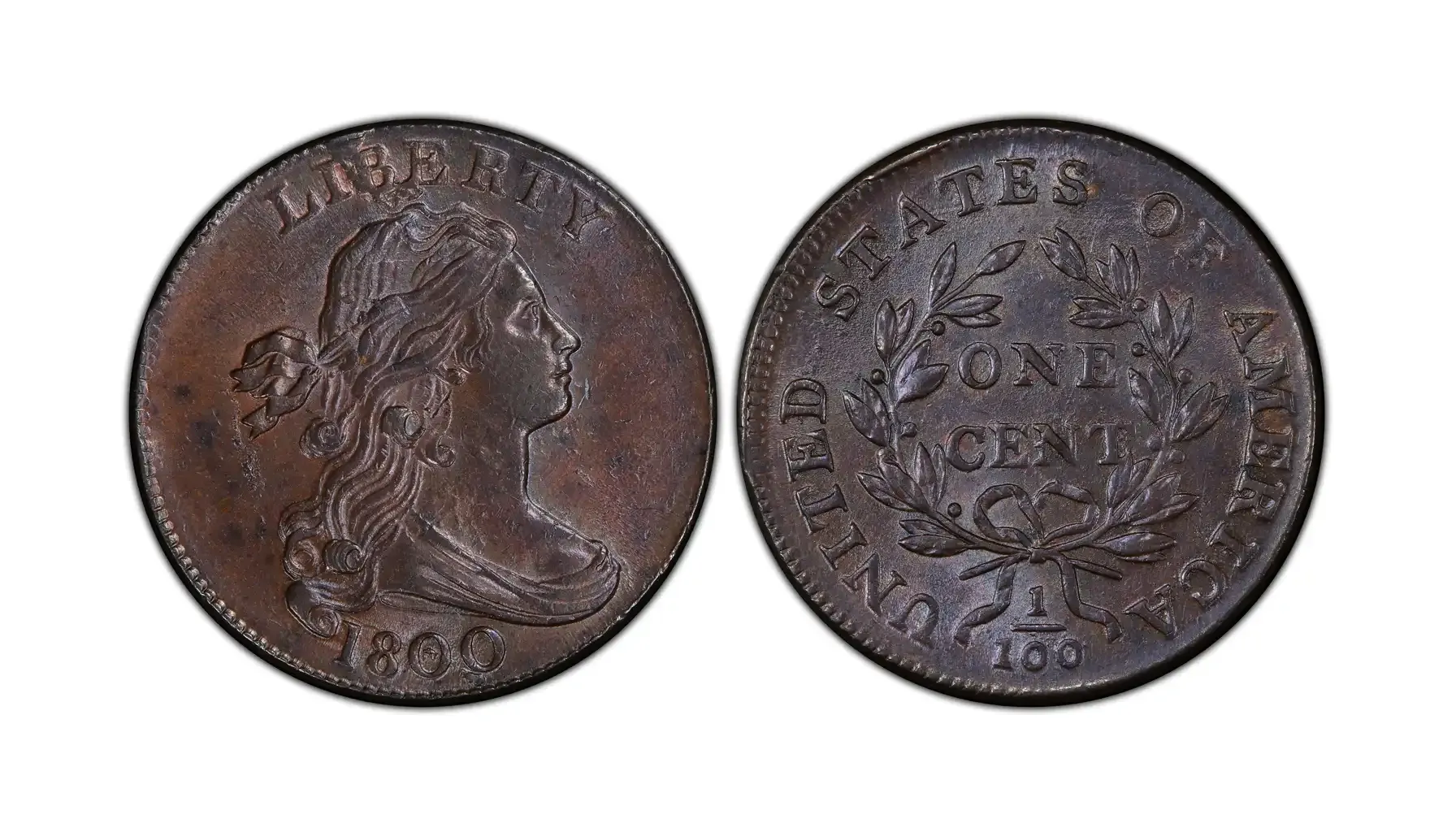
Obverse (front): Lady Liberty’s portrait. She is facing right, with flowing hair tied with a ribbon. The word LIBERTY is above her, and the date 1800 is below.
Reverse (back): A wreath surrounding the denomination ONE CENT, with the words UNITED STATES OF AMERICA around the edge. The fraction 1/100 appears at the bottom. The 1/100 fraction refers to the fact that a penny (cent) is 1/00 of a dollar.
Draped Bust coins are considered one of the earlier American coins, and historically, they are very valuable.
1800 US Penny Overview | |
Country | United States |
Years of Minting | 1796–1807 |
Type | Circulating |
Shape | Round |
Composition and metal content | 100% copper (pure copper planchets) |
Diameter | ~29 millimeters |
Weight | 10.89 grams |
Mint Facilities | The Philadelphia US Mint |
Fun Fact: Did you know that technically, there are other Draped Bust denominations? For example, Draped Bust Quarters. Back then, it was a tradition that all denominations bear the same design. In some way, Robert Scot designed many coins at the same time.
Varieties and Editions
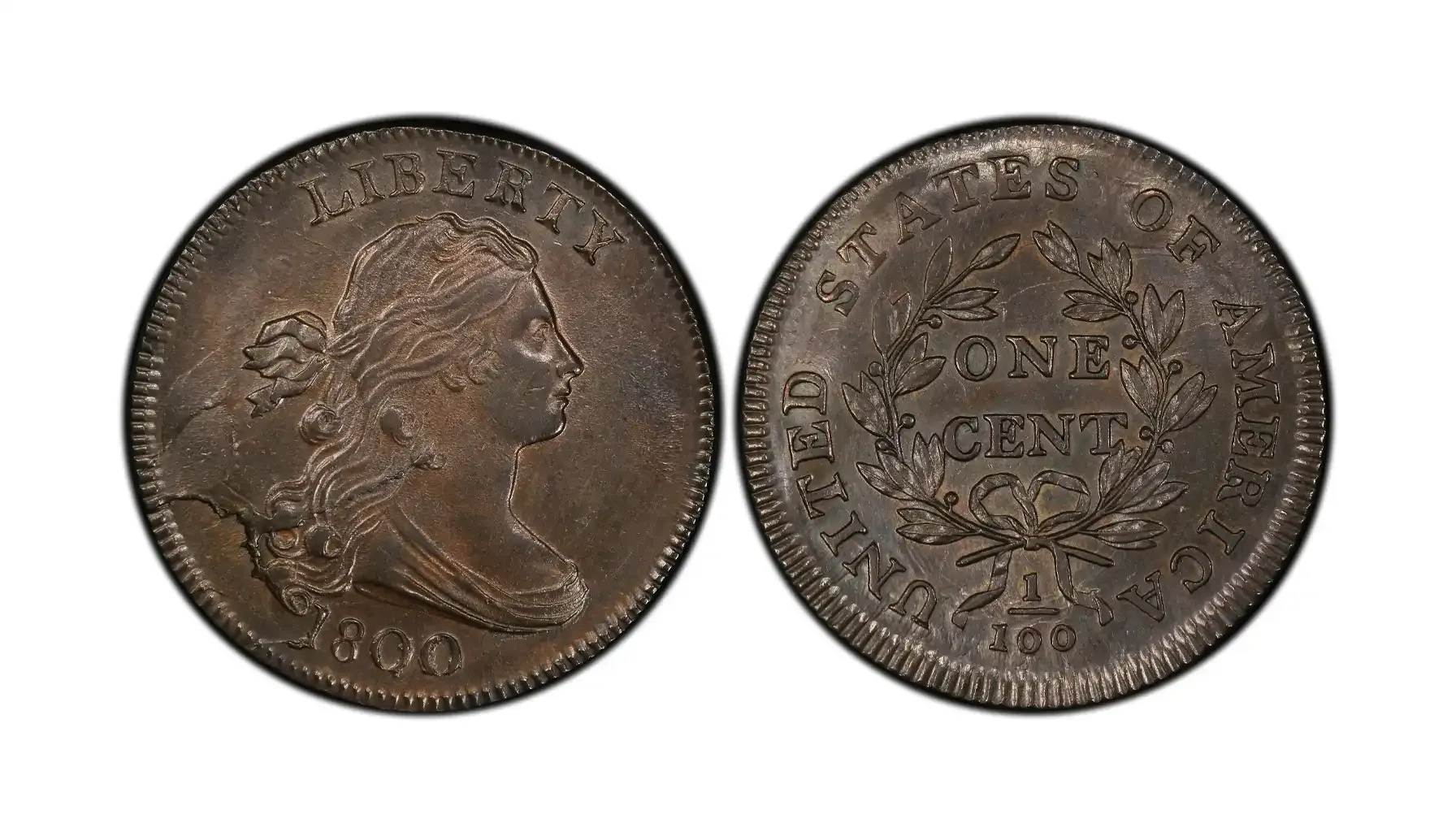
Like many old pieces, this penny is not rich in mint marks and varieties. Back then, the Philadelphia Mint was the one and only coin producer.
How many pieces did this facility produce? In 1800, about 2.8 million large cents were struck, a relatively large number for the time.
Technically, there are other varieties of the cent, but they come from errors, so let's have a better look at various mishaps these cents may come with.
1800 Penny Error List
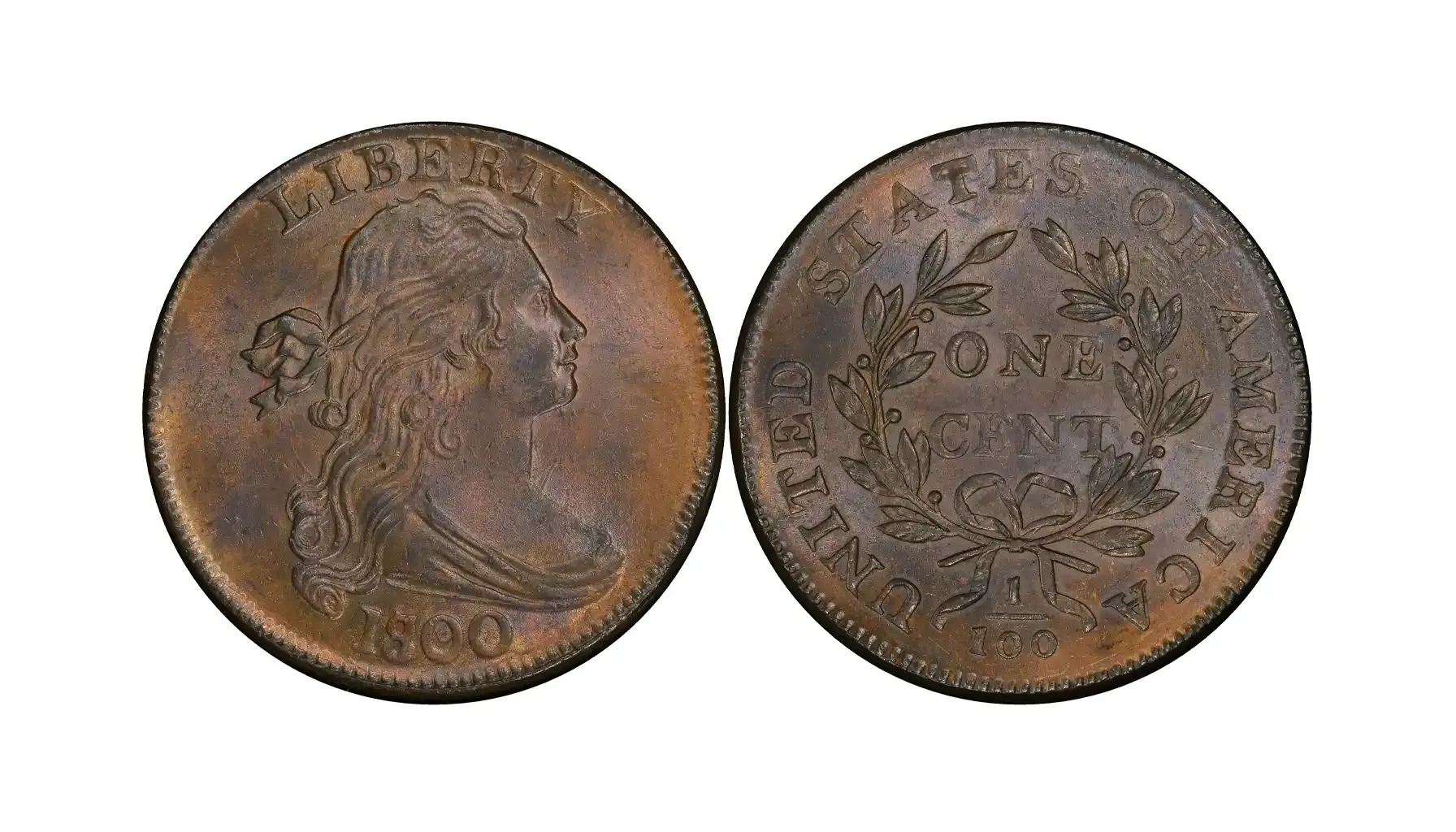
Errors can raise the value of this already precious piece. Some of these errors are so big that they became something similar to a minting variety:
1. Overdate:
It’s an error when the coin was accidentally stuck with the wrong date. The most famous is 1800/1798, where the last digits of 1798 were repunched to make an 1800. Parts of the underlying “8” can be seen beneath the “0.”
A few such overdate examples were sold for $10,000+ and even $50,000!
The reason for this error is simple. The metal parts used to press the bit wear out quickly, and the Mint used multiple obverse and reverse dies. In these cases, the wrong die was used.
2. Planchet Flaws:
The copper blanks (“planchets”) were imperfect, and impurities, laminations, and rough surfaces are common. These can look like cracks or flakes in the coin’s metal.
Usually, lamination problems happen with copper pieces and persist on comparatively newer pieces, too, like the 1890 Indian Head Penny.
3. Striking Errors:
Off-center strikes (where part of the design is missing).
Double strikes (coin struck twice by the press). Very valuable.
Weak strikes (details missing due to uneven pressure). Common for older bits.
Many factors come into the value of these errors. As a rule, the bigger the error and the higher the eye appeal, the more valuable it becomes.
2021 Penny Value
A few things make this cent valuable: scarcity, old age, and the fact that a few survivors left rarely come in good condition.
How much is a 1800 penny worth today also depends on the Sheldon scale evaluation. Basically, the coins are inspected and given the number corresponding to how well the details are preserved, from 1 to 70.
Grade | Value Range | Description |
Good (G4) | $50–$100 | Heavily worn, with most details worn away. |
Very Good (VG 8) | $100–$150 | Liberty's hair and date are readable. Some details remain. |
Fine (F12) | $150–$250 | Clear date and Liberty's portrait are visible. Moderate wear. |
Very Fine (VF20–30) | $250–$500 | Sharp details with minimal wear; attractive for collectors. |
Extremely Fine (EF40–45) | $500–$900 | Light wear with nearly full details. High eye appeal. |
About Uncirculated (AU50–58) | $900–$1,500 | Minimal wear. Coins show little to no circulation. |
Mint State (MS60–63) | $1,500–$3,000 | Has no wear. Full luster with minor imperfections. |
Gem Mint State (MS64–65) | $3,000–$7,000+ | Exceptional quality. Rare and highly sought after. |
While this cent is not the most valuable when it comes to older pieces, it is still a worthy asset. If you indeed have such a cent in your collection, you are a lucky one.
Do you suspect that your coin is of high quality? We advise you to get this coin graded officially by NGC or PGC. This way, your bit gets an official stamp of approval, and you can raise the value on sale for having a certificate.
Coin ID Scanner
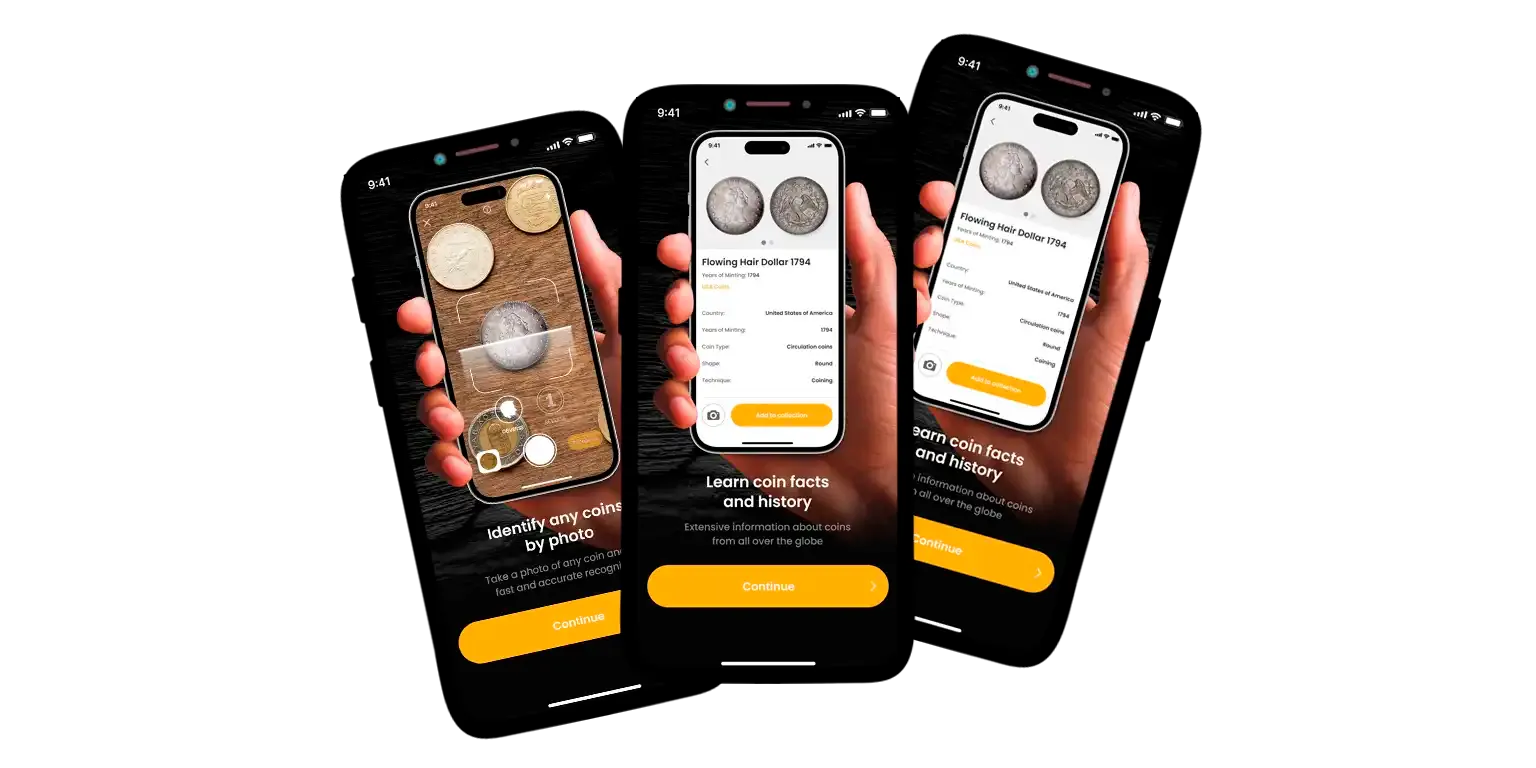
Coin ID Scanner is a free app for coin identification and valuation. The app can help out collectors, travelers, and numismatic enthusiasts.
The main function here is to allow users to quickly identify coins by simply taking or uploading a photo. After a quick scan, the app provides detailed information such as country of origin, denomination, mint year, composition, and estimated value.
Coin ID Scanner has a nice, modern interface, making it intuitive and easy to use for both beginners and experienced collectors.
As for beginners, the app can even teach you a few things about collecting in trading via blogs, numismatic news, and even an AI consultant that comes with the app. If you have any coinage-related questions, the AI could help you out.
Are you intrigued by the Coin ID Scanner? The app is free and available on Android / iOS devices.
FAQ
What Is the 1800 Indian Head Penny Value?
Technically, such a coin doesn’t exist. The Indian Head series started only in 1859, much later. 1800 penny is a part of the Draped Bust series, and is worth $50+.
Is 1800 Cent Considered Rare?
This cent is not extremely rare, but it is more scarce than most. About 2.8 million coins were minted in 1800, which is a relatively high number for the early U.S. Mint. The rarity depends heavily on condition and variety: Most common 1800 cents in Good or Very Good condition are relatively easy to find.
What Penny Series Is the Oldest in the US?
Before the Draped Bust (where 1800 cent comes from), two other series were minted in the US. The first U.S. one-cent coin was the Flowing Hair Large Cent in 1793, soon overtaken by the Liberty Cap Cent (1793–1796). Only then came the Draped Bust Cent (1796–1807).
Is 1800 Cent a Good Investment?
Most likely, it is a good investment. A few factors are a sign that you should spend your money on the piece: condition (higher-grade coins are scarcer and look great), variety (rare die varieties, like overdates, are especially valuable), and market trends (early large cents have been strong performers among U.S. coins).

 Facebook
  X (Twitter)
  Pinterest
  LinkedIn