Contents:
Is a 1985 quarter worth anything? At first glance, it might seem like an ordinary coin. But for numismatists and coin collectors, these Washington quarters that were minted in 1985 can be really interesting because of the historical details, minting quirks, and error varieties that influence their value.
If you're looking for a rare error or simply want to know if your quarter 1985 is worth more than its face value, then you will not be dissatisfied with this guide. We will walk you through the numismatic details that the 1985 P and D quarters can hold. Moreover, you will find out how to check the value of coins if you need to understand it as quickly as possible.
A Brief History of the 1985 Washington Quarter
Attribute | Details |
Mintmarks | "P" (Philadelphia) or "D" (Denver = 1985 quarter D), located near Washington’s neck on the obverse |
Composition | 91.67% Copper, 8.33% Nickel |
Weight | 5.67 grams |
Diameter | 24.26 mm |
Thickness | 1.75 mm |
Edge | Reeded with 119 reeds |
Mintage | 776,065,000 (Philadelphia) 519,962,000 (Denver) |
Obverse Design | George Washington's profile facing left, inscriptions: "LIBERTY," "IN GOD WE TRUST," "1985" |
Reverse Design | Bald eagle with outstretched wings clutching arrows and an olive branch, inscription: "UNITED STATES OF AMERICA," "E PLURIBUS UNUM," denomination |
The Washington piece has been a part of U.S. coinage since 1932. It was originally designed to celebrate the bicentennial of George Washington's birth. By 1985, they were produced in mass quantities at both the Philadelphia (P) and Denver (D) mints.
Interesting fact: These are not the only coins that portray this president. For example, you may have heard about the George Washington 1789 dollar coins.
The composition of the 1985 quater follows the same pattern as previous years, with a copper core surrounded by a cupro-nickel (copper-nickel) layer. This blend of metals gives it its characteristic weight of 5.67 grams and its familiar silverish luster. Despite this, what draws collectors to the 1985 P quarter and the 1985 D quarter is not so much the coin’s physical appearance as its anomalies — the minting errors.
“Worn 1985 quarters can weigh even less due to loss of metal through circulation wear.”
— Joshua McMorrow-Hernandez, numismatist
U.S. Coins Guide
1985 Quarter Value Chart
Grade | 1985 P Quarter Value | 1985 Quarter Value D | 1985-S Proof Quarter Value |
G-4 | $0.25 | $0.25 | — |
F-12 | $0.25 | $0.25 | — |
XF-40 | $0.30 | $0.30 | — |
AU-55 | $0.40 | $0.40 | — |
MS60 | $1 | $1 | $2 |
MS63 | $2 | $2 | $4 |
MS65 | $12–$18 | $10–$15 | $8–$12 |
MS66 | $35–$60 | $30–$55 | $12–$18 |
MS67 | $400–$1,000+ | $300–$800+ | $20–$40 (PR69 DCAM) |
For the casual observer, it might seem like it holds little more than face value. However, it depends on a few key factors:
Condition: A pristine, uncirculated specimen can cost much even without errors.
Minting Errors: As discussed earlier, minting anomalies like the double rim or clipped planchet can elevate the 1985 quarter value P and D.
Demand Among Collectors: Rare or unusual coins often have higher value when there’s high demand.
For reference, a standard 1985 P quarter dollar value in circulated condition generally is close to its 25-cent face value. However, uncirculated 1985 quarter P value can be up to a few dollars, while error coins can bring in much more.
How to Spot Valuable 1985 Quarters
Here are a few tips for identifying a potentially valuable coin:
Check the Rim: Look closely at the rim of the coin to spot a double rim or misaligned edges, or other 1985 quarter errors.
Inspect the Mintmark: Look for the "P" or "D" mintmark, located on the front of the coin, to determine whether it was minted in Philadelphia or Denver.
Look for Off-Center Strikes: Coins where the design is not fully centered may be worth more.
Examine for Errors: Fine cracks or chips in the metal could indicate a rare 1985 quarter error.
Use Numismatic Apps: If you can't determine what kind of coin is in front of you, you can always download and use an application for coin collectors. For example, Coin ID Scanner can scan a coin and show all the necessary information about it.

Top 10 Most Valuable 1985 Quarter Worth Money
The coin is usually common in circulation, but some high-grade coins and mint errors can cost more.
1. 1985-P Washington Quarter — MS67+
Top-grade Philadelphia coins are difficult to find because most were heavily circulated. Pieces graded MS67 or higher with strong luster and clean surfaces can reach several hundred dollars at auction.
2. 1985-D Washington Quarter — MS67
The standard 1985 D quarter value is also not very expensive, but very high-grade examples remain scarce. Well-preserved coins with minimal contact marks can sell for hundreds of dollars.
3. 1985-S Proof Quarter — PR70 Deep Cameo
Proof coins from San Francisco were made for collector sets. Perfect examples graded PR70 with strong contrast between frosted devices and mirror fields can sell for much higher prices than typical proofs.
4. Double Die Obverse
Some quarters show doubling on the lettering or date due to a die error during production. Clear examples of doubled design elements can increase the price.
5. Off-Center Strike
When the planchet is not properly aligned during striking, the design appears shifted, and part of the coin remains blank. Dramatic off-center errors are popular with collectors.
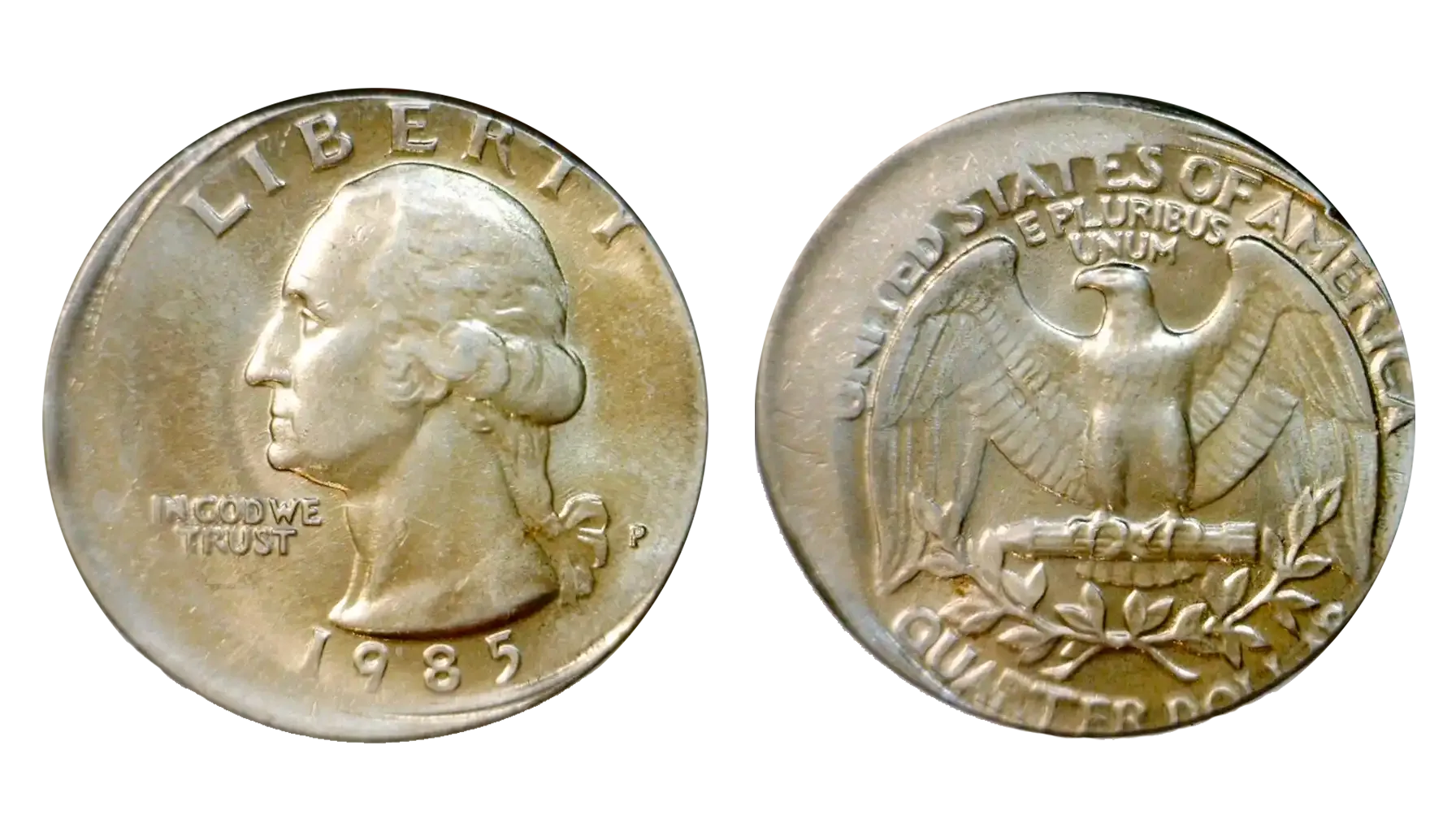
6. 1985 Error Quarter Broadstrike
Broadstruck coins occur when the collar die fails to hold the planchet in place. The result is a coin with an expanded diameter and a weak or missing rim.
7. Struck-Through Error
If grease or debris interferes with the dies during striking, parts of the design may appear faint or missing. These struck-through errors vary in appearance and value.
A clipped planchet occurs when the blank is improperly cut from the metal strip before striking. The coin shows a curved missing section along the edge.
9. Missing Clad Layer
Modern quarters are made from layered metal. If one layer is missing, the coin may show a copper color and weigh less than normal.
10. Die Crack or Cud Error
A damaged die can produce raised cracks or metal blobs along the rim known as cuds. Large and clearly visible examples are especially collectible.
Not every coin is going to be an expensive one. However, certain varieties — especially those from the 1985 P quarter error list with pictures — can be worth more than their 25-cent face value.
Anyway, there’s plenty of numismatic excitement to be found in every coin. Moreover, price is not the only aim of collecting, right?
FAQ
How much is a 1985 quarter worth today?
Most specimens remain worth their face value of 25 cents because they were produced in very large numbers. Circulated coins usually sell for only a small premium, often under one dollar. Uncirculated pieces can bring higher prices.
How much would a 1985 quarter be worth?
The value depends on the condition. A worn coin is worth face value. A clean uncirculated example may sell for several dollars.
What makes a 1985 D quarter valuable?
It becomes valuable mainly when it survives in exceptional condition. Coins with sharp strike, bright original luster, and very few contact marks are much harder to find. Certified high-grade pieces, especially MS66 or MS67, are the ones that attract strong collector interest. Rare 1985 D quarter error list examples can also increase value.
How rare is a coin from 1985?
A typical one is not rare. Hundreds of millions were struck at the Philadelphia and Denver mints. Because so many entered circulation, most examples remain common today.
Is there an error on the 1985 quarter?
Several types of mint errors can appear. Examples include off-center strikes, broadstrikes, clipped planchets, and struck-through errors. Some coins may also show missing clad layers or die cracks. These and other instances you may find in different 1985 quarter error list pieces.
How many 1985 quarters were minted?
The Philadelphia Mint produced more than 770 million pieces in 1985, while the Denver Mint struck roughly 445 million coins. In addition, the San Francisco Mint produced proofs for collector sets. These large mintages explain why most coins from this year are common.
How much should a 1985 quarter weigh?
A standard piece weighs about 5.67 grams. Small differences can occur due to circulation wear, but a noticeable weight change may indicate a mistake from the 1985-P quarter error list or damage.
What is a 1985 quarter made of?
The coin uses a copper-nickel clad structure. The outer layers are made from copper and nickel alloy, while the center core is copper. This layered construction has been used for U.S. quarters since 1965.

 Facebook
  X (Twitter)
  Pinterest
  LinkedIn