Contents:
- What Is the Value of a 1986 Quarter Today?
- 1986 Washington Quarter Overview
- How Much Is a 1986 Quarter Worth in High Grades?
- Rare 1986 Quarter Errors List
- Most Valuable 1986 Quarter Errors Ever Found
- What Makes a 1986 Quarter Valuable?
- How to Identify a Rare 1986 Quarter
- Are 1986 Quarters Worth Anything?
- FAQ
Although most issues are only worth face value, some rare varieties, errors and pristine condition coins can fetch significant sums in the numismatic world. The ordinary price starts from $0.25 to $5.
What Is the Value of a 1986 Quarter Today?
"The 1986 Philadelphia and Denver quarters are among the most difficult issues of the decade to find in truly high grades."
– Q. David Bowers, expert
A Guide Book of Washington Quarters
In the 1980s, most items from the year were in the large bags where they scratched each other. Finding a P or 1986 quarter value D without visible scratches and with sharp details is extremely difficult.
While an MS-65 coin is worth up to $10, a jump to MS-67 grade can increase the value to $400 or more. Below is a table with actual Denver and San Francisco prices. How much is a 1986 D quarter worth in today’s world?
MS-60 | MS-62 | MS-63 | MS-63+ | MS-64 |
$1–$5 | $1–$5 | $2–$5 | $2–$5 | $5 |
The 1986 quarter value P and D are driven entirely by the Population Report. For example, while over 500 million D items were made, only one has been graded as an MS-67+ by PCGS. That single point on the grading scale is the difference between a $10 coin and a $2,000 coin.
1986 Washington Quarter Overview
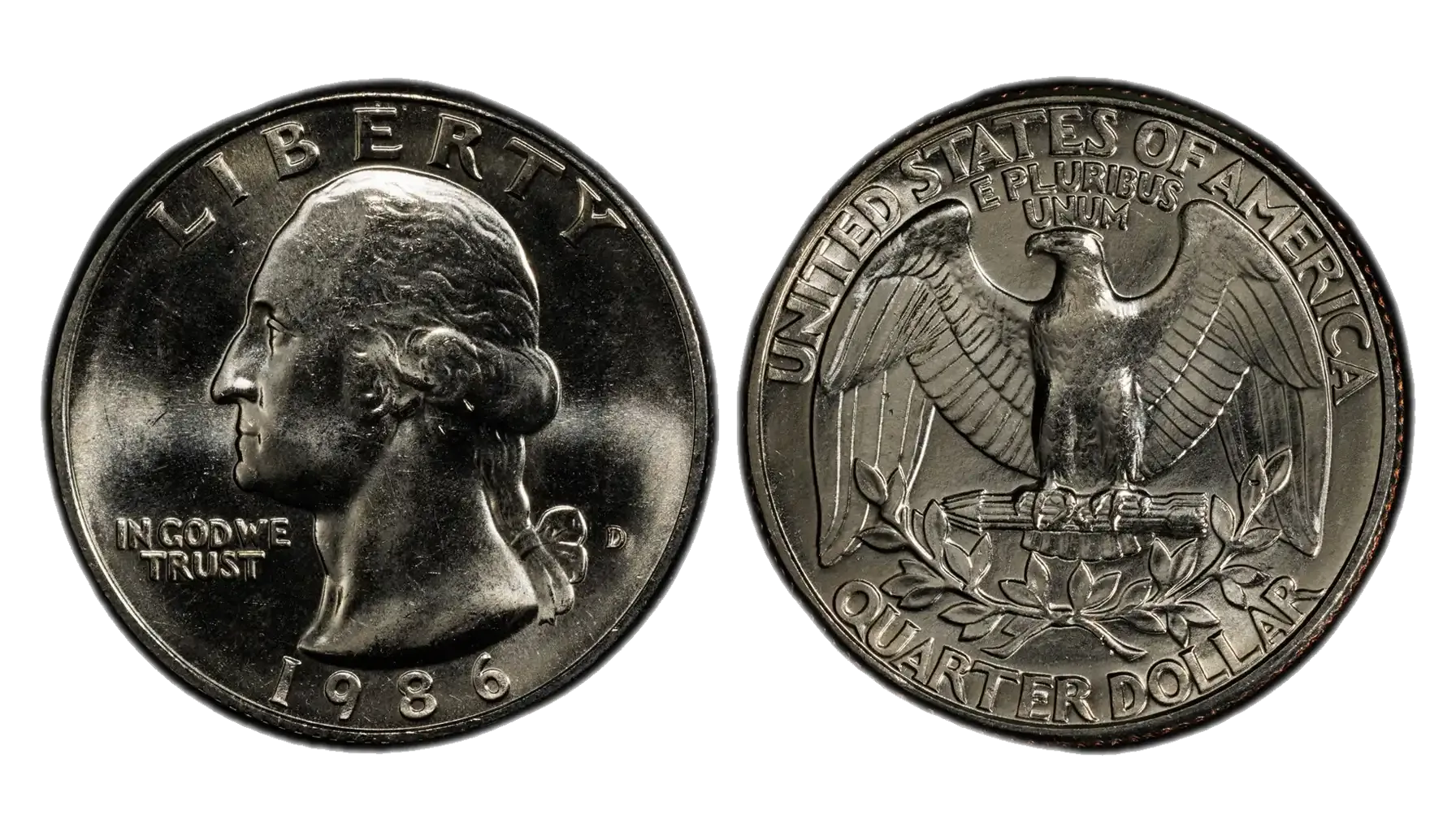
Denomination – 25 Cents
Obverse Design – George Washington
Reverse Design – Heraldic Eagle
Designer | John Flanagan |
Metal Composition | Copper-nickel clad |
Diameter | 24.3 mm |
Weight | 5.67 grams |
Edge | Reeded |
The Item History
1965–1998
The 1986 P Washington quarter is a standard member of the Cupronickel Clad period. Following the Coinage Act of 1965, the Mint removed silver from circulating items because of rising bullion prices.
By the year, the public had long accepted the copper core with nickel-copper faces coin. The issue is historically significant for being one of the final eagle reverse items before the design revolution of the late 1990s.
1984–1998
The mid-1980s was a period of recovery for the U.S. Mint's collector programs. After canceling official Uncirculated Mint Sets in 1982 and 1983, the Mint resumed them in 1984. Because items were included in these official sets, high-quality Mint State pieces were preserved in larger numbers than the gap years of 1982-83.
How Much Is a 1986 Quarter Worth in High Grades?
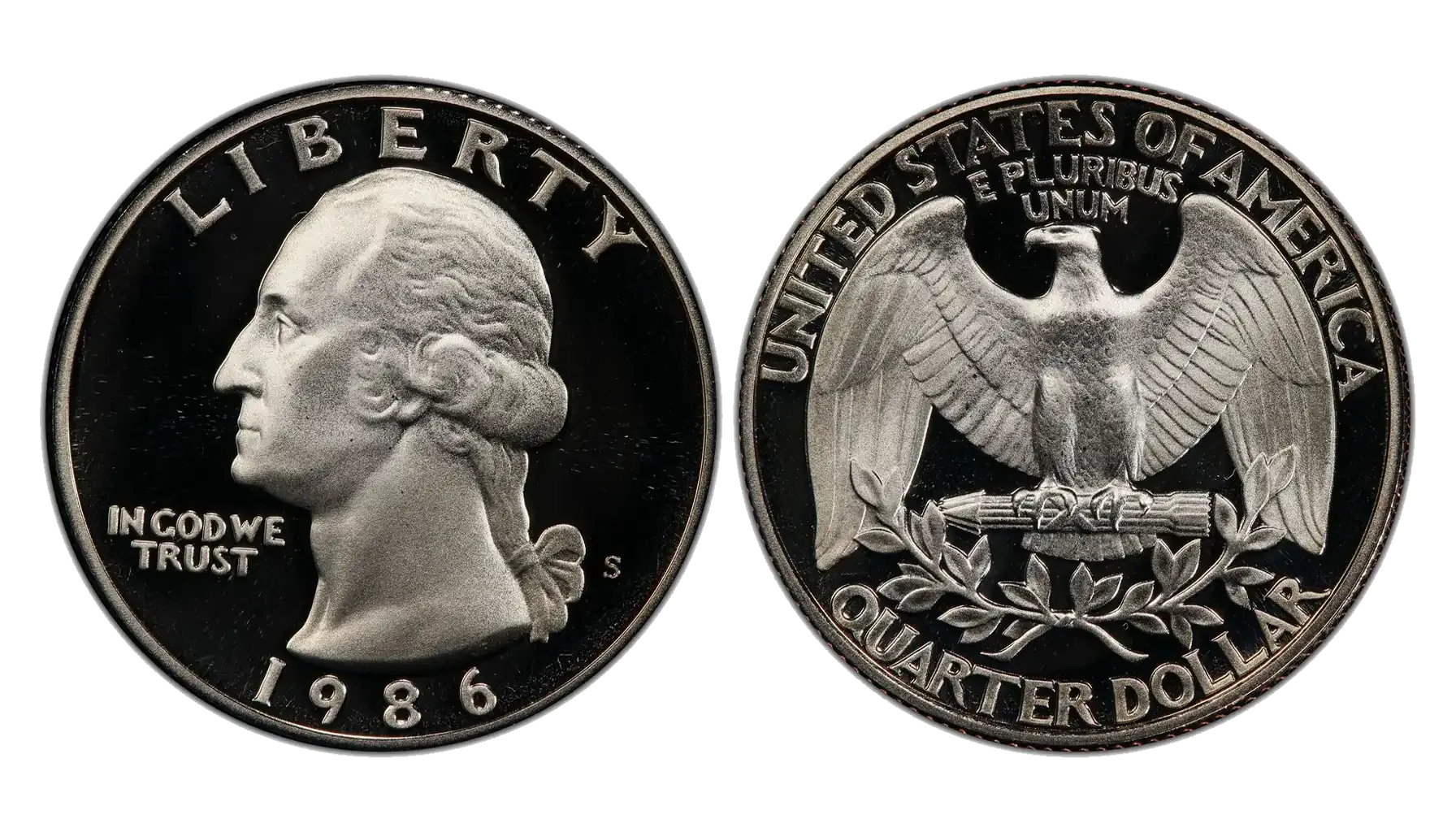
The total price depends on the coin's mintmark, condition and possible 1986 error quarters. Most circulated pieces are worth face value, but uncirculated and error coins can command much higher prices. Is a 1986 quarter worth anything in the numismatic field?
Coin Type | Mintage | Circulated Quarter 1986 Value | Uncirculated Value | Auction Record |
1986 quarter P | 551,199,333 | $0.25–$1.25 | $5–$15 | $2,880 (MS-67) |
D | 504,298,660 | $0.25–$1.50 | $4–$12 | $2,025 (MS-67+) |
S Proof | 3,010,487 | $2.50–$4.00 | $8–$15 | $552 (PR-70 DCAM) |
Philadelphia issues from the year are often found with mushy strikes. Finding one with sharp details is what separates a 25-cent coin from a $15 uncirculated piece. Do not remember about 1986 D quarter error list with pictures.
The S PR-70 DCAM (Deep Cameo) remains the gold standard. However, because thousands of these have been graded Perfect 70 by PCGS and NGC, the price has stabilized.
You can currently find PR-70 examples on the secondary market for $35 to $65, though the all-time high-water mark remains the $552 Heritage result from 2003. How much is a 1986 P quarter worth with defects?
Rare 1986 Quarter Errors List
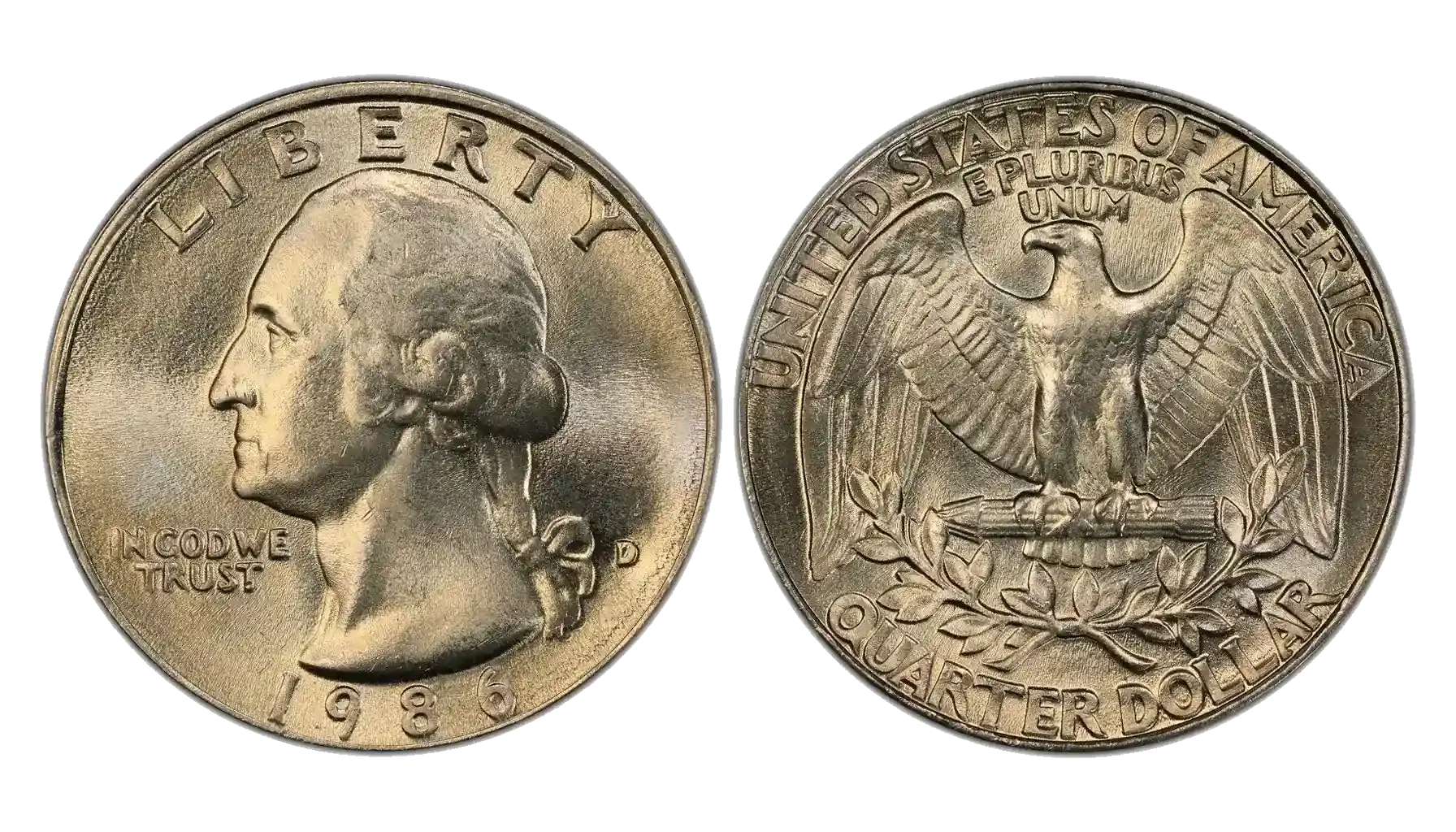
Error coins often are more expensive, and collectors actively seek them. Some rare 1986 P quarter errors list entries include doubled die errors, off-center strikes, broadstrikes, etc. Now we will talk about them in more detail.
Notable off-center strikes are where the coin’s design is shifted, leaving a blank space on one side. The value of 1986 quarter off-center items depends on how much of the design is missing—those with 50% off-center strikes and a visible date can be worth over $200.
Another sought-after error is the broadstrike, where the coin is struck without the retaining collar. This causes it to appear wider and flatter than usual. A broadstrike item can be valued at $20 to $50, depending on its condition.
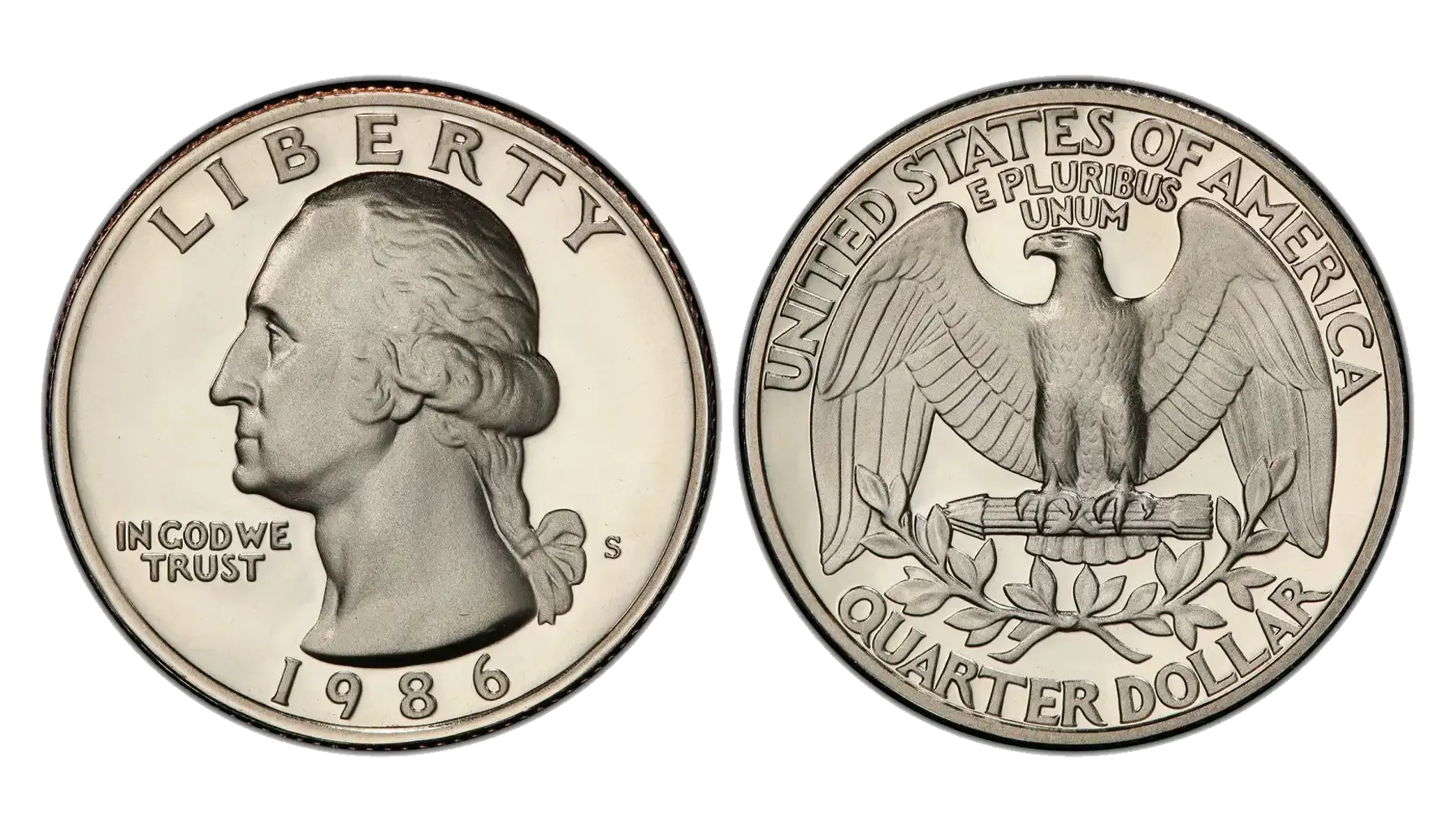
The missing reeded edge error occurs when the item is struck without its characteristic edge ridges. This error may be caused by excessive wear in vending machines or an actual minting issue. While post-mint damage pieces are worth face value, genuine missing reeded edge errors may sell for $30 to $75.
Note: Check the similar errors on the 1936 dime.
Most Valuable 1986 Quarter Errors Ever Found
P Struck on a 5-Cent (Nickel) Planchet
This is one of the most coveted wrong-planchet errors. A 1986 quarter die accidentally struck a blank intended for a Jefferson Nickel.
1986 quarter error value $800–$1,500
D Quarter Double Denomination
Extremely rare and visually stunning, this occurs when a D issue was struck over a Lincoln Cent that had already been minted. You will see the ghost images of Lincoln or the Lincoln Memorial peeking through Washington’s portrait or the eagle.
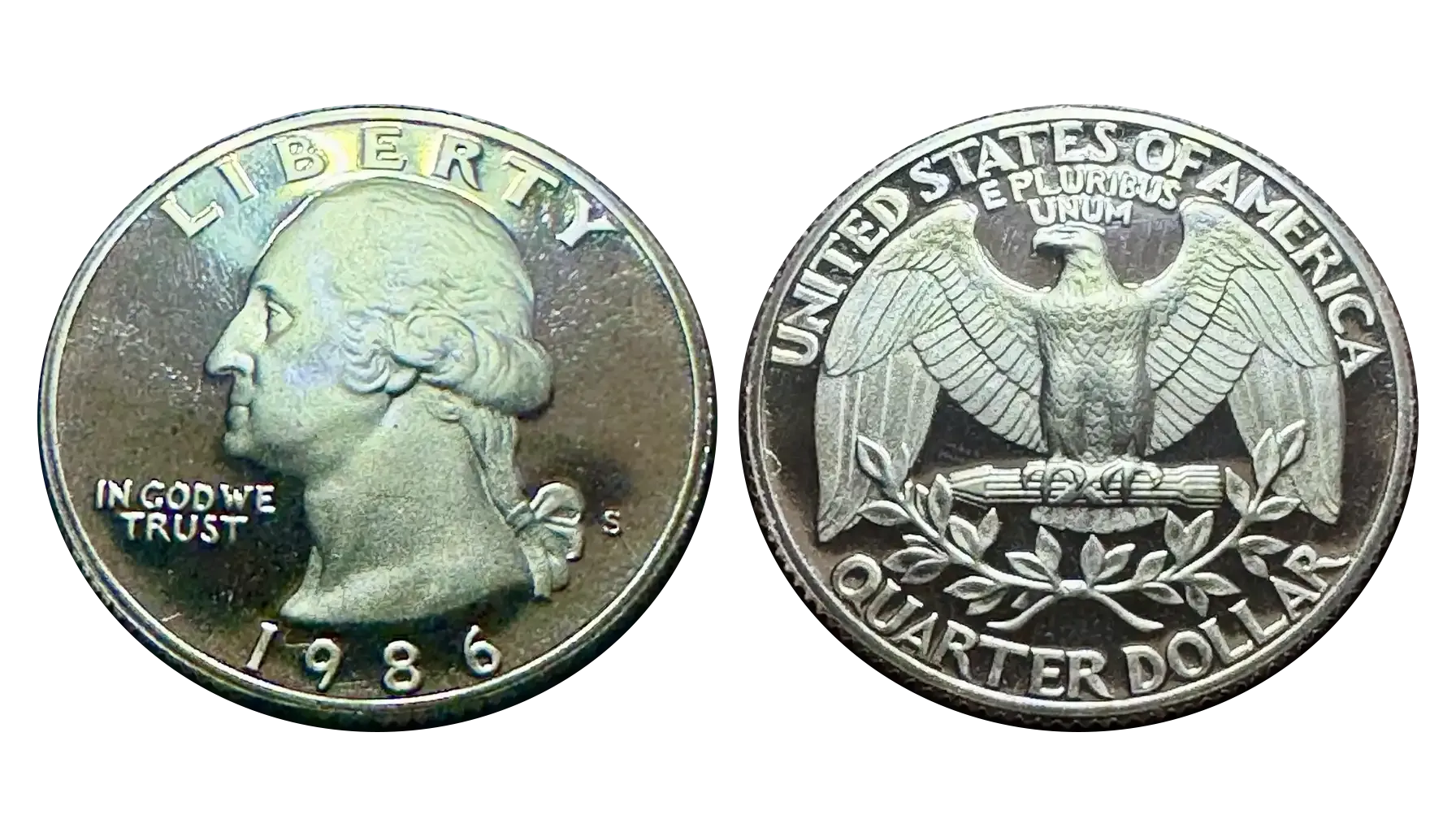
The coin will have a distinct copper color. What is a 1986 quarter worth with D double denomination?
1986 D quarter value today $2,000–$4,500+
P Missing Clad Layer
Issues are mix of nickel and copper. Sometimes, the outer nickel layer fails to bond, exposing the bright red copper core on one side. One side of the item looks normal (silver), while the other side is a vivid copper red. This must happen at the Mint; if someone just sanded the nickel off, the weight will be significantly lower than the standard 5.67g.
$150–$400
What Makes a 1986 Quarter Valuable?
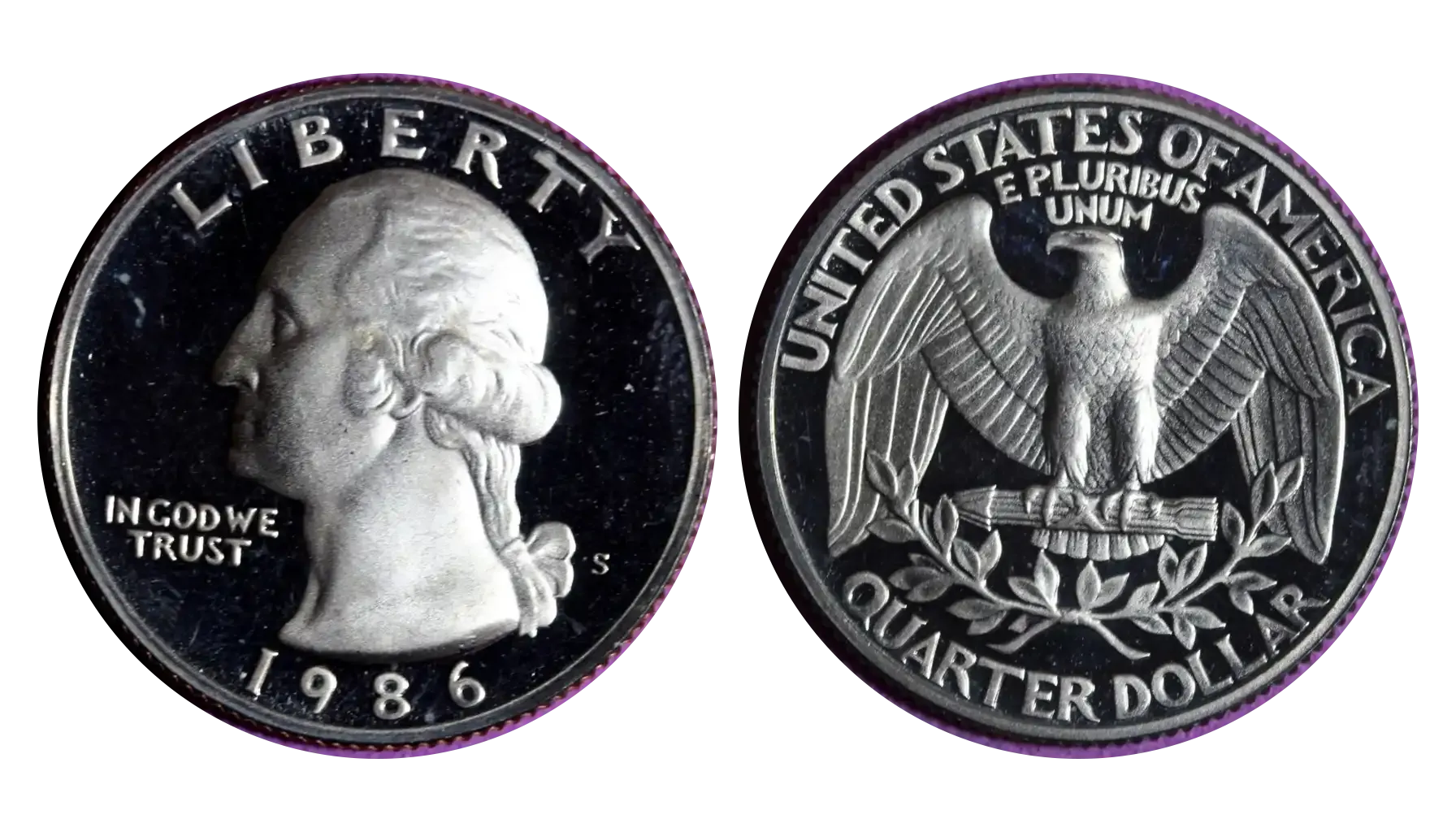
Philadelphia produced over 551 million coins of this type in the year. This means that they are relatively common. While a circulated 1986 P quarter value price remains at face value, uncirculated pieces can reach $3 or more. The most valuable P item sold for $2,880, graded MS-67.
Among P item error list entries, doubled die errors are the most sought after. Coins with noticeable doubling in the lettering or Washington’s eye may fetch $20 to $50. Off-center strikes (with 50% misalignment and full date visible) could reach $200+.
D Quarter Value and Errors
The 1986 D quarter value is slightly higher than the P-mint counterpart. An uncirculated specimen in MS-67 condition once sold for $900.
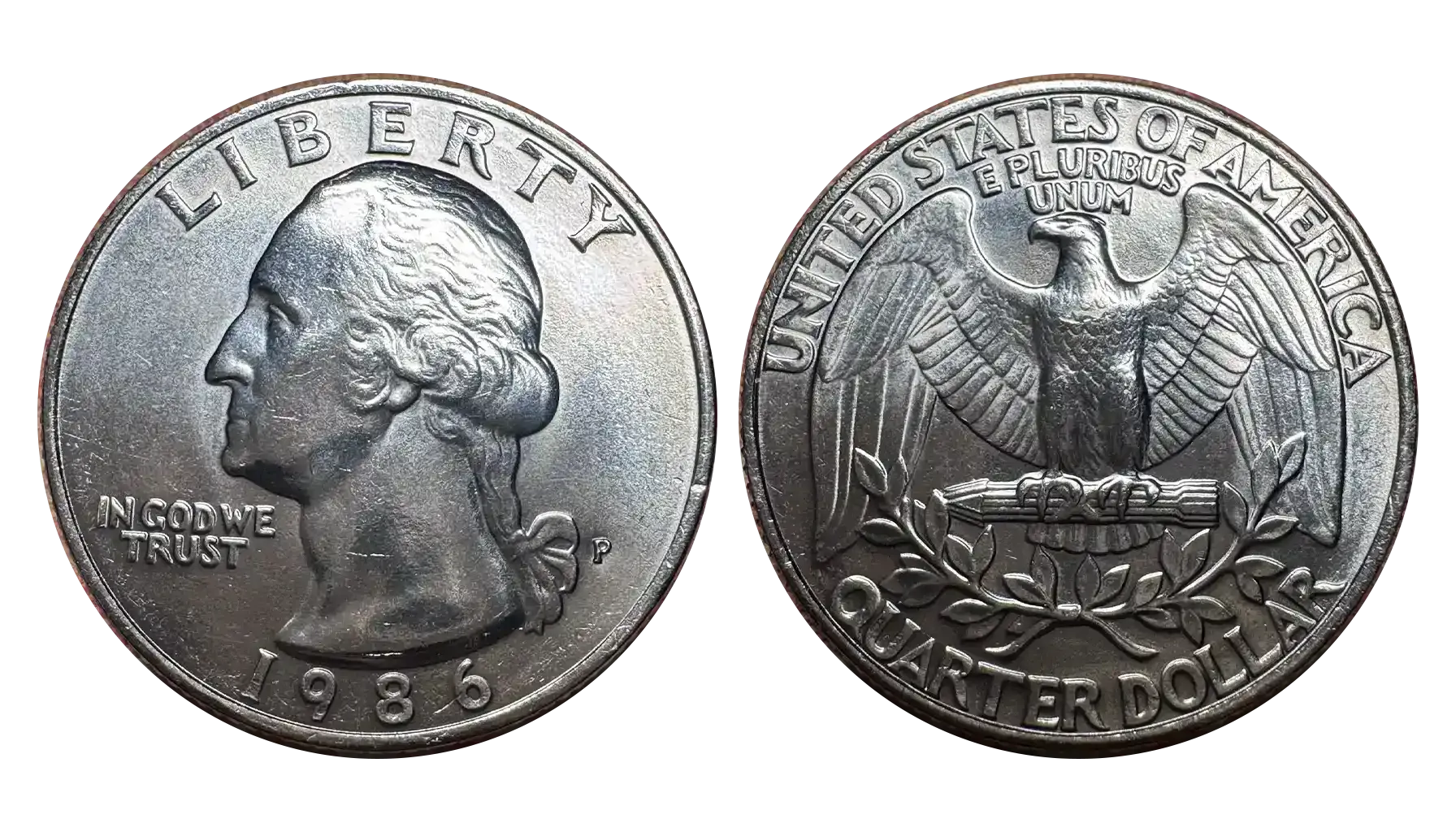
The D item error list includes broadstrikes, missing ridges and off-center strikes. Broadstrikes, where the collar fails to form the coin’s rim properly, can be worth $20 to $30. Coins missing their reeded edges due to striking issues might fetch $50+.
S Proof Quarter
The S proof item was minted in San Francisco for collectors, with only 3 million produced. They were never meant for circulation. A typical proof sells for $3 to $5, but a PR-70 Deep Cameo (DCAM) graded piece once commanded $552.
How to Identify a Rare 1986 Quarter
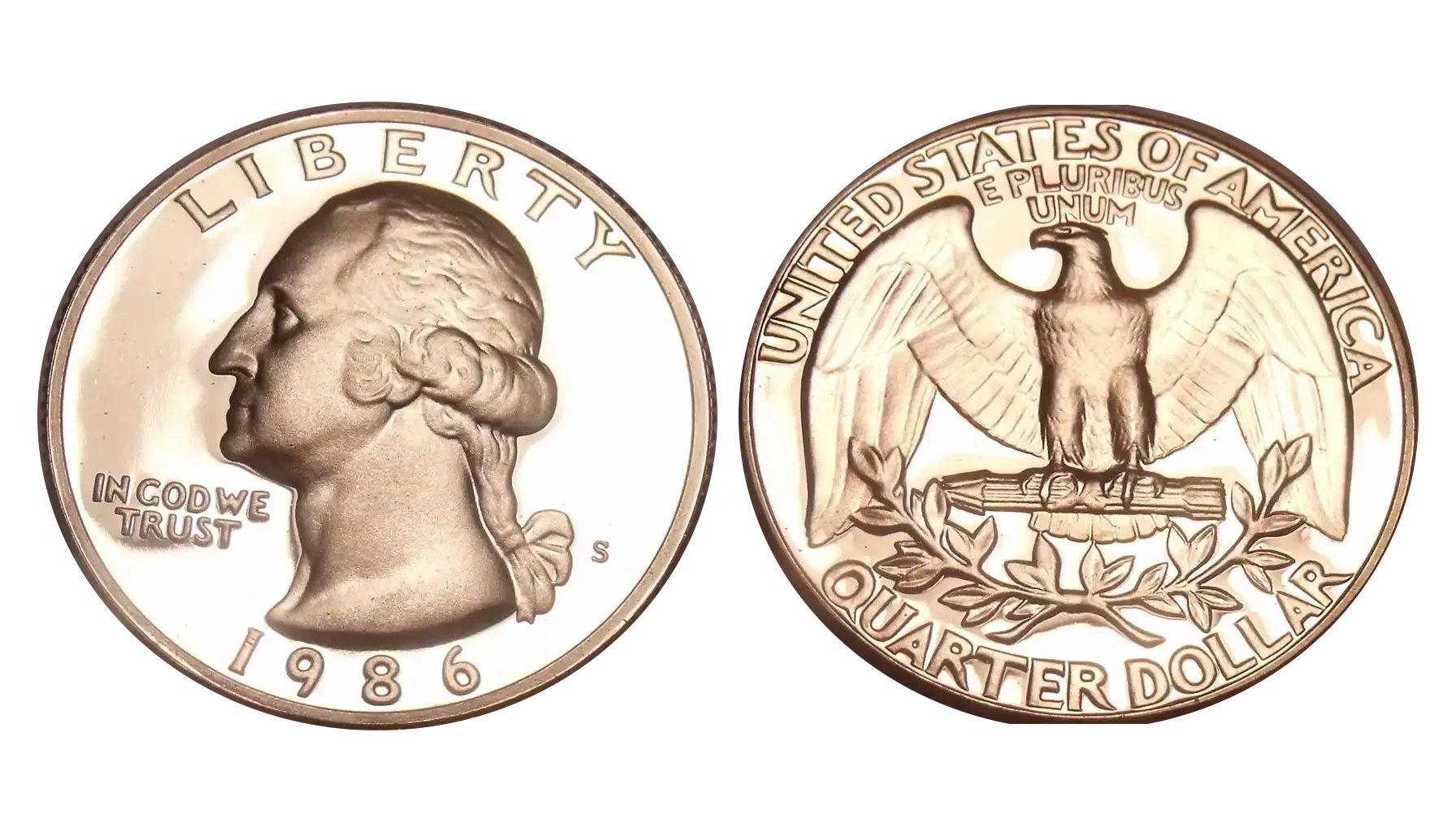
Step 1 – Check the Mint Mark
Look at the right side of Washington’s ponytail (the 4 o'clock position).
"P" Philadelphia – The most common, but also holds the highest record for condition rarity.
"D" Denver – often found with significant surface marks; a clean D is harder to find than a P.
"S" San Francisco – these are Proof coins. If it has an "S" and a mirror-like background, it was originally from a collector's set.
Step 2 – Check the High Grade
Most issues were struck with specific dies. A rare specimen is defined by its sharpness. Use a 10x loupe to check:
The Eagle’s Breast: Are the feathers individual and crisp, or do they look like a smooth blob?
The Hairlines: Check the hair around Washington’s ear. High-value coins will show distinct, deep lines.
Surface Marks: Even tiny scratches from other coins in a bag (contact marks) will disqualify a coin from being a rare high-grade. It must look virtually perfect to the naked eye.
Are 1986 Quarters Worth Anything?
A thorough analysis and inspection of your coin will help determine its value. Certain defects and nuances can instantly increase its value several times over.
The Spitting Eagle (Die Clash)
This is the most famous minor error for the P issue. Turn the coin to the reverse (back). Look at the eagle’s beak. A vertical line or gash extending downward from the beak. This was caused by the dies hitting each other (clashing) without a coin blank between them.
Wrong Color
If the coin looks like a different color or size, it could be a high-value error. Do you hear about gold quarters?
The Weight Test
A standard issue weighs 5.67g. If it weighs 5.0g, it may be struck on a Nickel planchet. If it weighs 3.11g and looks copper, it may be struck on a Penny planchet.
The Magnet Test
A genuine piece is not magnetic. If it sticks to a magnet, it has been altered or is a counterfeit.
FAQ
What makes a 1986 quarter worth money?
The MS-67 and items with unique defects are worth a lot of money.
Is there any silver in a 1986 quarter?
The item contains only copper and nickel clad.
What are the errors on 1986 quarters?
The notable 1986 D quarter errors are wrong planchet and spitting eagle.
Why is my 1986 quarter black?
The color change happen because of environmental damage or toning.
What is the most valuable 1986 quarter?
Philadelphia MS-67 item sold for $2,800+ dollars.
Are there any errors on 1986 quarters?
Many mechanical defect exist, such as off-center strikes. Check the 1986 P quarter error list with pictures.
What are the features of a 1986 quarter?
The George Washington portrait and culturular American symbols and inscriptions.
How many 1986 quarters were made?
The total mintage is over billion items.

 Facebook
  X (Twitter)
  Pinterest
  LinkedIn