Contents:
The 2003 Missouri State Quarter was issued as part of the U.S. Mint’s 50 State Quarters Program to honor the state's role in American history.
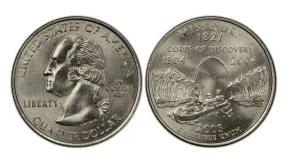
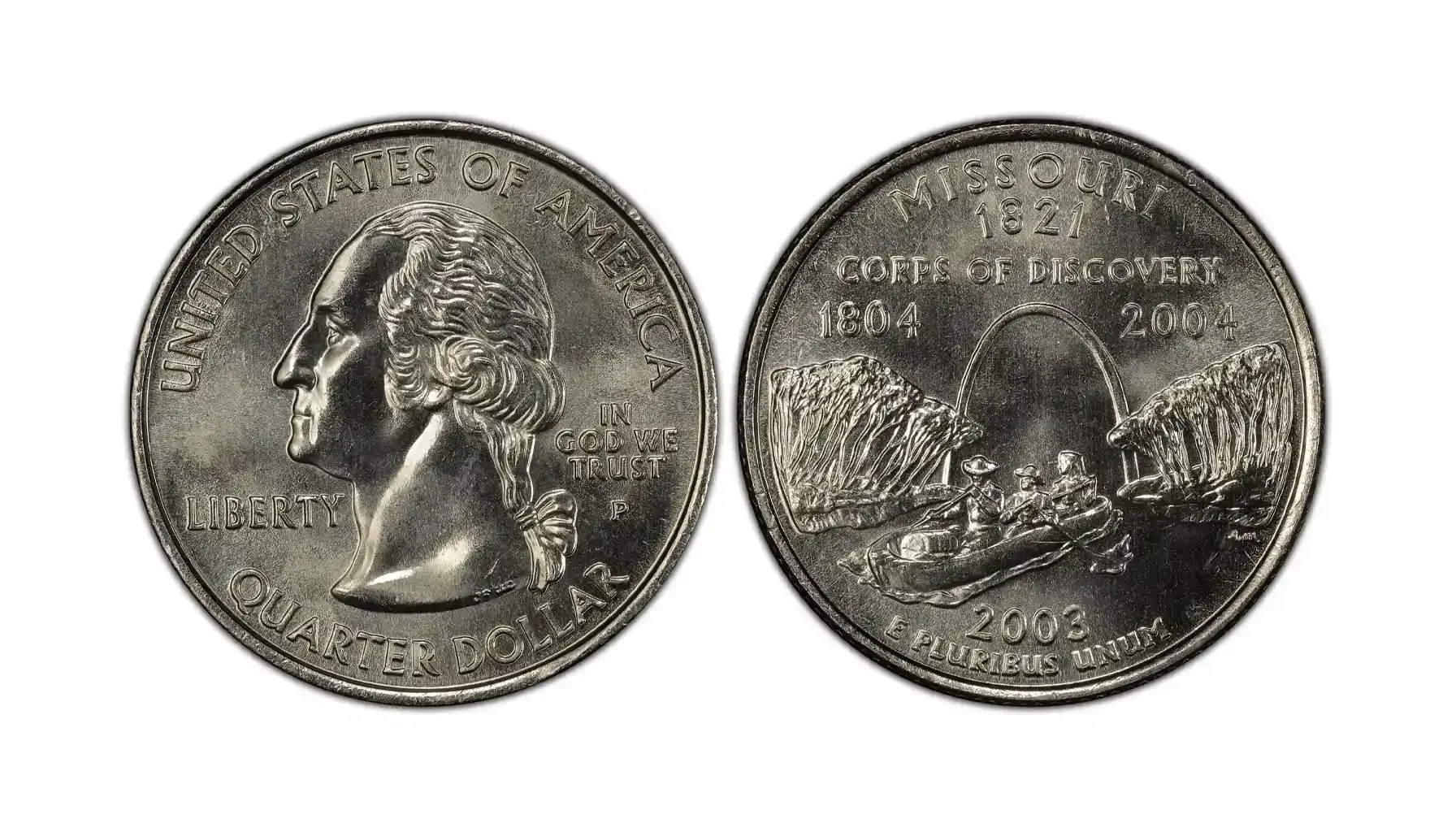
The image on the Missouri State quarter shows Lewis and Clark’s expedition and exploration of the American West.
Today, we are going to discuss the coin’s design, production details, and why collectors still check the value of coins like this one.
50 State Quarters Program
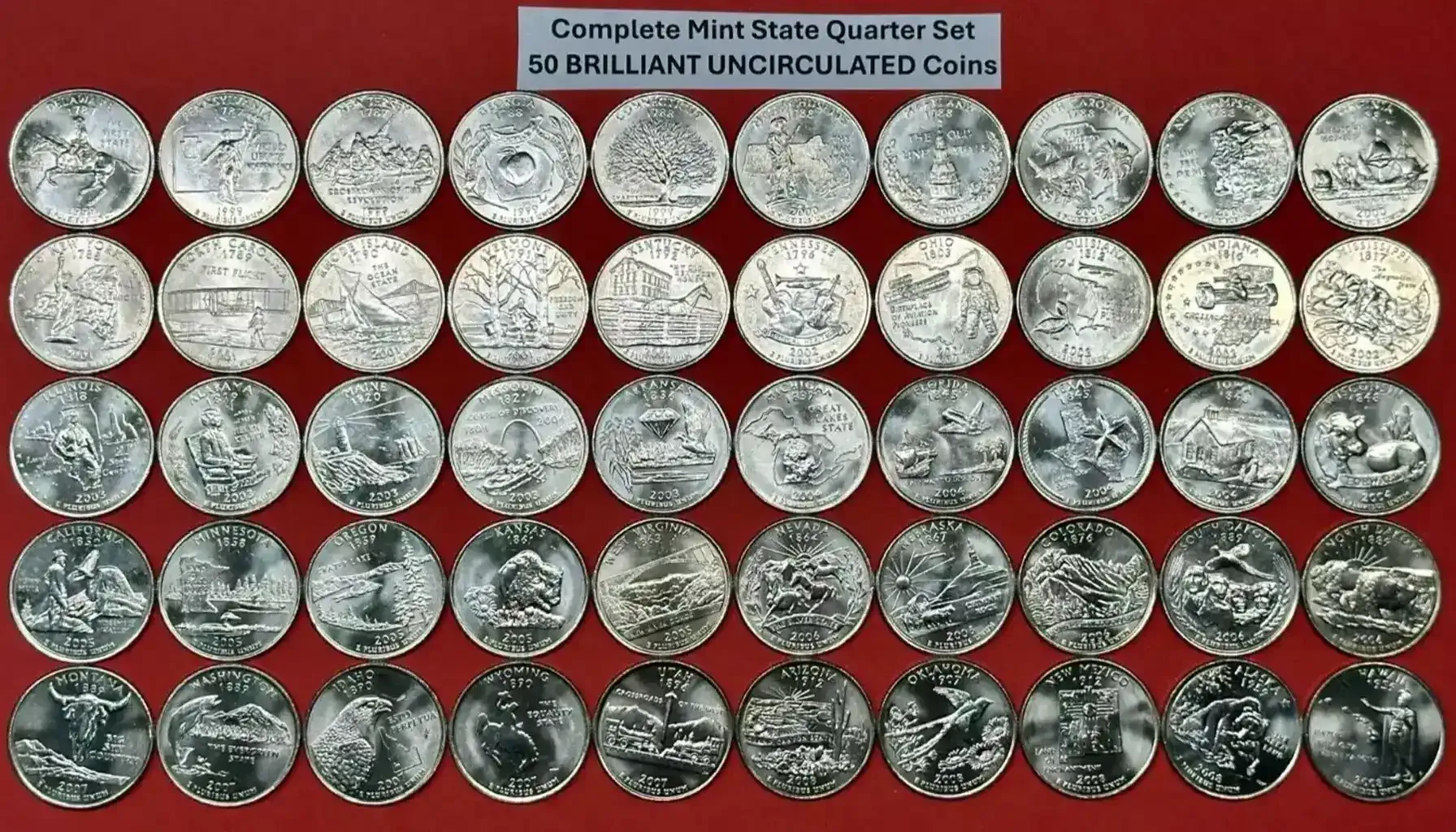
Between 1999 and 2008, the United States Mint released one of its most successful coin programs ever — the 50 State Quarters series. Each coin celebrated a different U.S. state, issued in the order that states joined the Union.
The idea was simple: give every American the chance to learn more about the country’s history thanks to coins they use every day.
Main facts about the program:
Released from 1999 to 2008, featuring all 50 states.
Each design is selected through public opinion and state governor approval (read more about the 2003 Arkansas piece).
Minted at the Philadelphia, Denver, and San Francisco Mints.
Designs reflected each state’s history, landmarks, people, or notable achievements.
The 2003 Missouri State Quarter
The Missouri quarter was issued as the 24th coin in the series and marked a moment of exploration and discovery. Released on August 4, 2003, the Missouri State quarter image honored the state’s connection to Lewis and Clark’s expedition and the Gateway Arch in St. Louis.
Image on a Missouri quarter | George Washington by John Flanagan |
Lewis and Clark Expedition, Gateway Arch, Missouri River | |
Designer (Reverse) | Alfred Maletsky |
Composition | Copper-nickel clad (outer layers) with a pure copper core for mass use and proofs. 90% silver + 10% copper for silver proofs. Gold Missouri quarters were never issued. |
Diameter | 24.26 mm |
Weight | 5.67 grams |
Edge | Reeded |
Mint Year | 2003 |
Mints | Philadelphia (P) Denver (D) San Francisco (S - Proof and Silver Proof) |
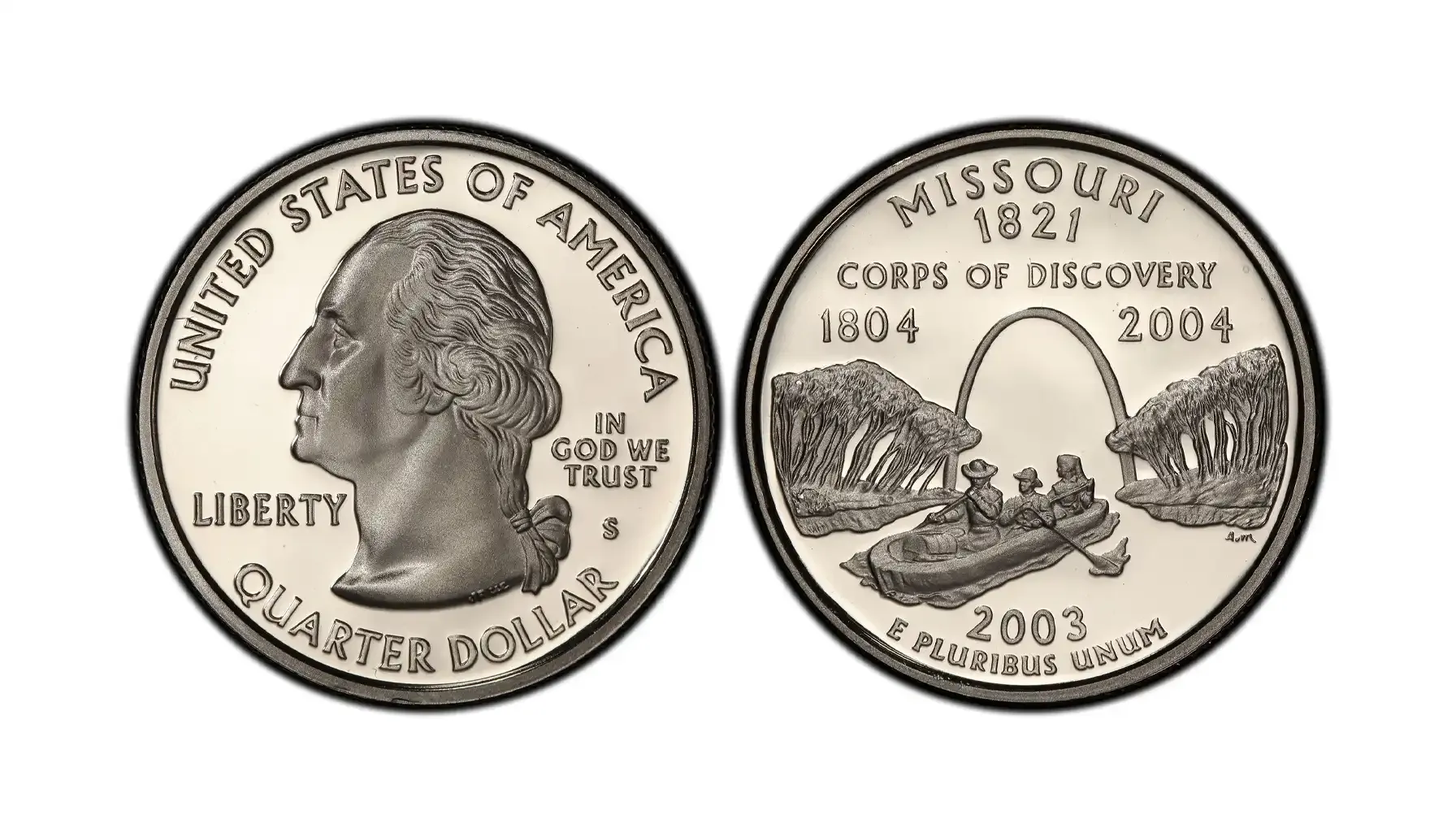
Each variation carries its own collecting interest with proofs and silver proofs that are especially sought after for their mirror-like finish and clear details.
Design and Symbolic Meaning of the Coin
On the reverse image on Missouri State quarter, you’ll see Lewis and Clark sailing up the Missouri River in their keelboat, passing beneath the Gateway Arch.
The coin's obverse carries the traditional portrait of George Washington by John Flanagan – it is the same image that appears in all other state quarters.
The design also includes several inscriptions:
“Missouri 1821” – the year Missouri joined the Union
“Corps of Discovery 1804–2004” – celebrating the bicentennial of the Lewis and Clark expedition
“E Pluribus Unum” and the mint year “2003”
Overall, the design shows people’s history, pride, honor, exploration, innovation, and the place that became known as the “Gateway to the West”.
“This may be the first US coin which has four dates on it. MISSOURI 1821 / CORPS OF DISCOVERY / 1804 2004 / 2003 / E PLURIBUS UNUM.”
– TreasureRealm Coins
Missouri State Quarter note
Mintage and Varieties
The image of Missouri state quarter may be the same across all issues, but mintage numbers and finishes differ across U.S. Mints:
Philadelphia (P): Circulation strike ≈ 225.0 M
Denver (D): Circulation strike ≈ 228.2 M
San Francisco (S): Proof (clad) ≈ 3.4 M; Silver Proof ≈ 1.1 M
As you can see, the 25-cent coins for mass use aren’t rare, while the proof versions (especially silver) remain popular among collectors thanks to their limited production and brilliant finish.
Thus, the Philadelphia and Denver issues are the ones most often found in pocket change, while San Francisco proofs were made exclusively for collectors and sold in special sets only.
Value and Collectibility
While this quarter is common enough in circulation, it still carries historical and aesthetic appeal. Most worn examples found in everyday change are worth 25 cents, but high-grade uncirculated or proof pieces can reach a higher cost, especially if it goes about pieces with errors.
Collectors often look for strong strikes, mirror-like surfaces, and coins certified by professional grading services. And even a coin as recent as 2003 can hold value if it remains in perfect condition or meets certain criteria.
What Determines the Value
Several factors influence how much a collector might pay for a certain piece. And below are some points to pay attention to before buying and adding to a collection:
Condition and wear — circulated coins usually hold only face value.
Grade and certification — coins graded MS65 or higher can be more desirable.
Proof or special version — silver proofs, draw higher interest.
Rarity or minting errors — unique mistakes can increase value.
Eye appeal — luster, toning, and sharp strike details can affect the value.
Below is an approximate value chart for standard and proof coins in different grades (as of 2025 market trends):
Type / Mint Mark | Circulated | MS60 | MS65 | Proof / Silver Proof |
2003-P | $0.25 | $1.00 | $3.00 | — |
2003-D | $0.25 | $1.00 | $3.00 | — |
2003-S Clad Proof | — | — | — | $4–$6 |
2003-S Silver Proof | — | — | — | $10–$15 |
While the coin is common in general circulation, pristine examples graded MS67 and higher may sell for $25–$50 and even more. Thus, according to PCGS, a 2003-P Missouri State Quarter in MS68 once sold for $4,313 at a Heritage Auction in 2007, proving how top-grade pieces can exceed expectations.
Even the 2003-D common issue, produced in huge numbers, reached $230 (maximum, also at a Heritage Auction in 2007) in the same grade. This is another reminder that conditions still make all the difference, especially for collectors familiar with how to get a coin certified and graded properly.
Missouri State Quarter Errors
As we already mentioned, errors on coins and minting flaws can turn an ordinary quarter Missouri into a valuable collectible and push its price higher than its usual counterparts.
Please refer to the table below to see a brief overview of the known error types on the 2003 Missouri Quarter:
Error Type | Main Feature | Approx. Value (USD) |
Waffle Cancellation (2003-P) | Defaced “waffle” surface | $35–$70 |
Copper Wash Missouri Quarter Error (2003-D) | Coppery tone, thin nickel layer | $80–$150+ |
Partial Collar (2003-D) | “Railroad rim” edge | $50–$100 |
Rim + Die Cracks (2003-D) | Raised rim, visible cracks | $40–$100+ |
Washington’s “Feathers” (2003-D) | Extra lines near the hairline | $25–$60 |
Struck Through Grease (2003-P) | Faded or missing details | $30–$75 |
Waffle Cancellation Error (2003-P)
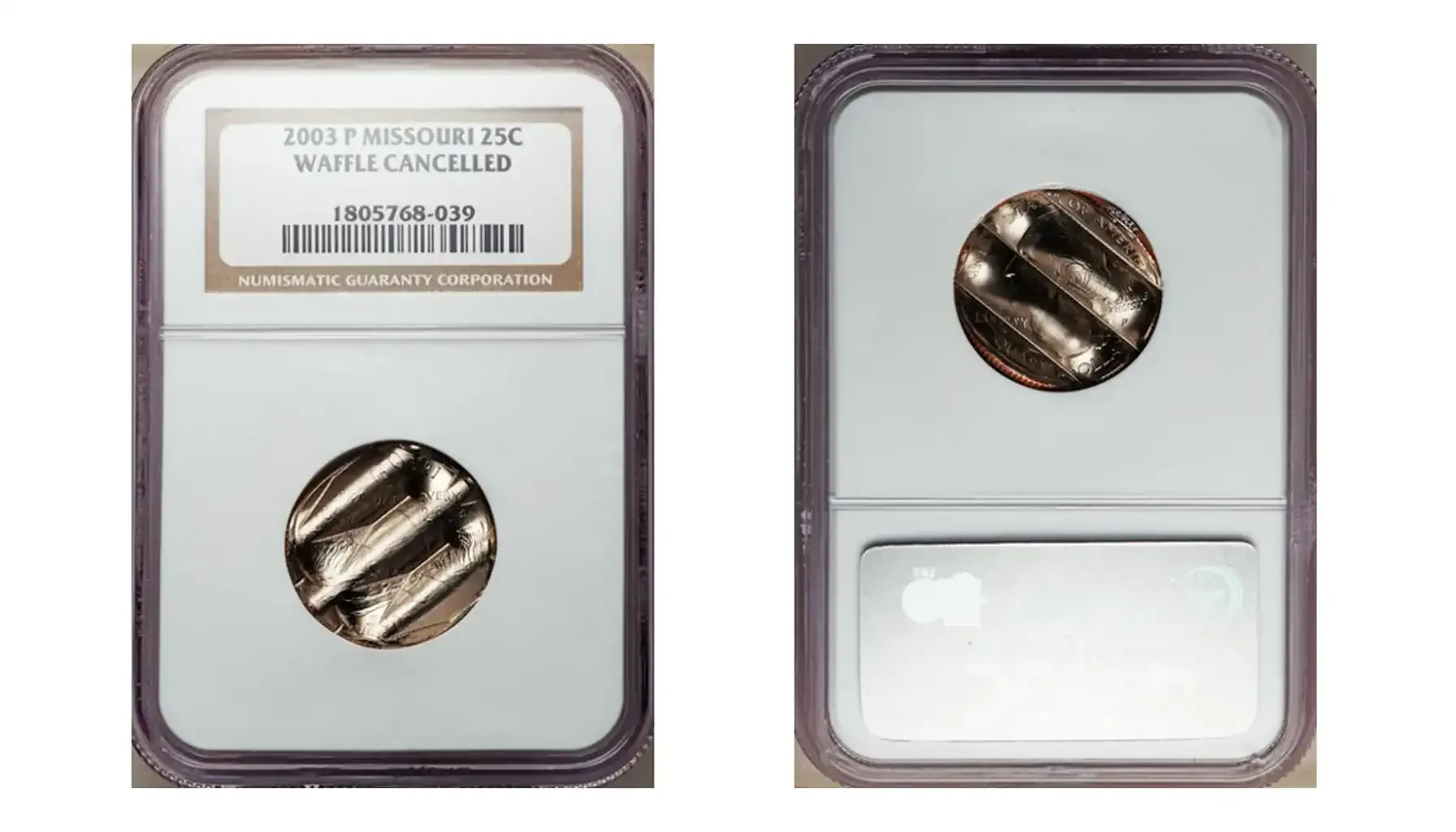
These coins were officially canceled at the Mint using a waffle press to prevent these pieces from entering mass circulation. However, some copies did survive and got outside the mint. Their crumpled surface and unusual look instantly catch attention and make them a desirable addition to error collections.
Copper Wash Error (2003-D)
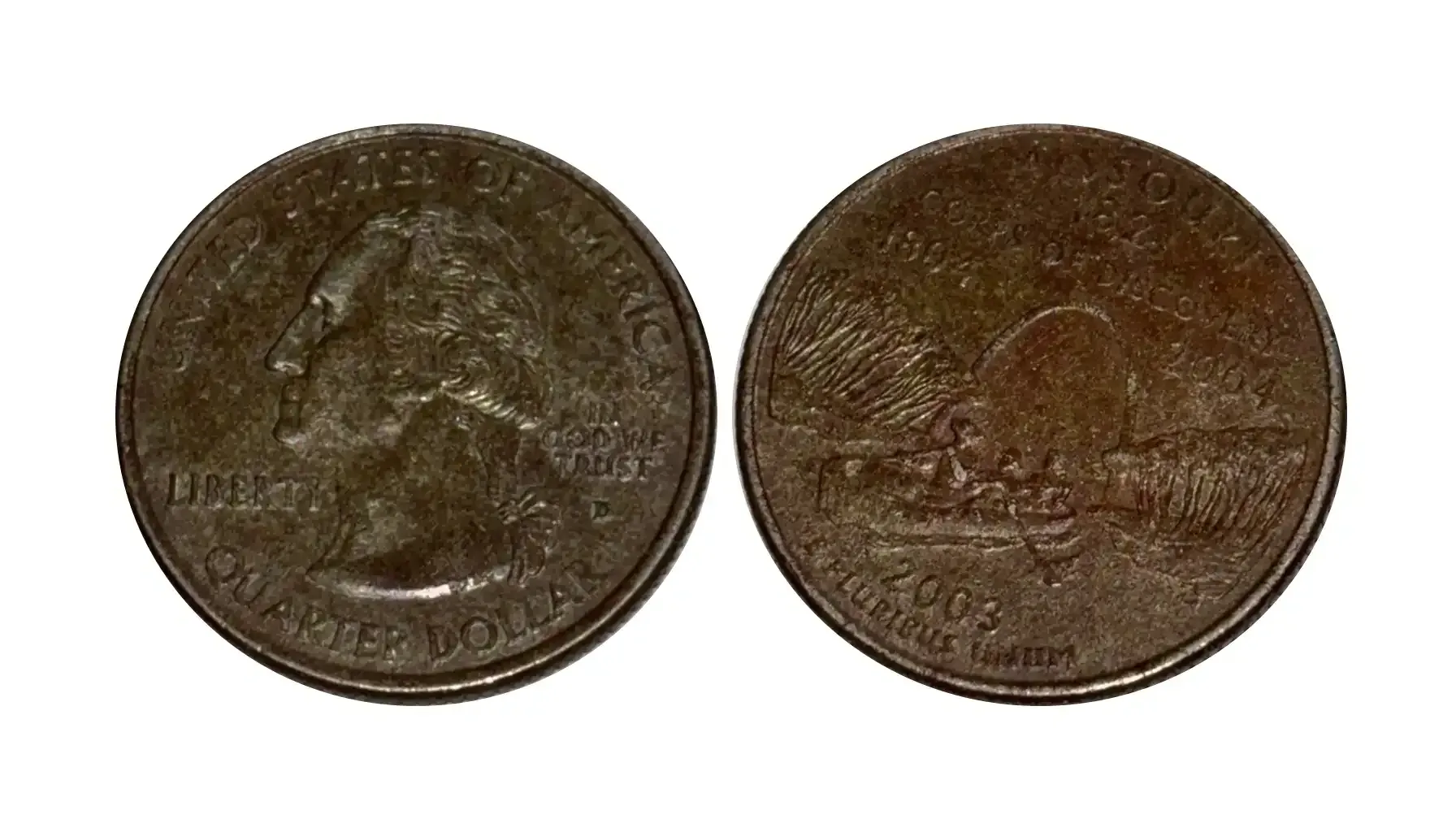
Because of a plating problem, the nickel layer didn’t fully cover the planchet and gave the coin an unusual orange-red hue (copper tone). At first glance, it can even look like a penny — which makes it one of the most noticeable Missouri errors.
Partial Collar Error (2003-D)
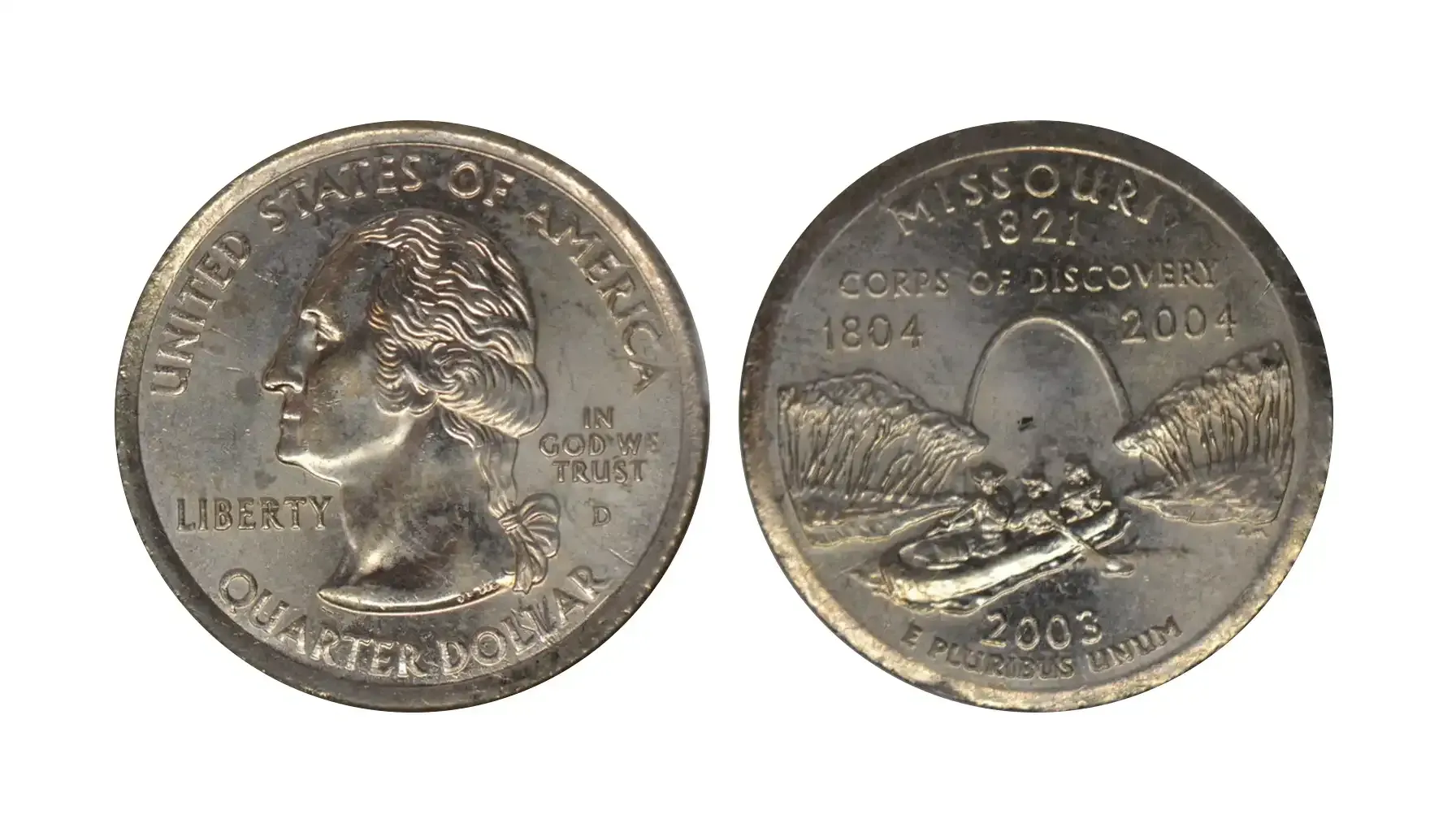
This flaw happens when the collar die doesn’t properly enclose the planchet during striking. As a result, the edge of the piece looks a bit wider or uneven — a “railroad rim”. It is not the rarest type, but still interesting for collectors who like minting issues.
Rim Error + Many Die Cracks (2003-D)
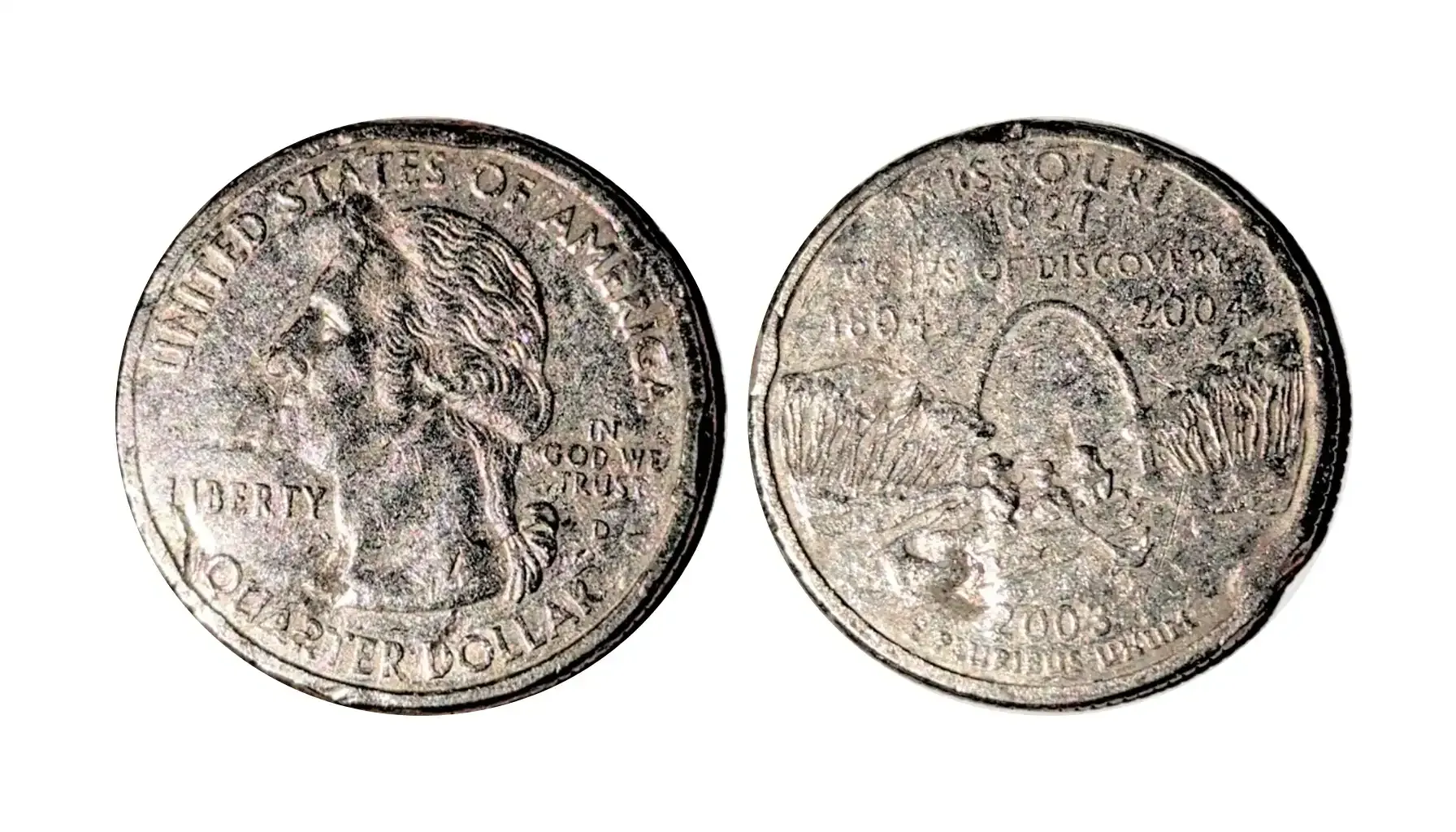
These coins show raised lines where the die broke under pressure. Multiple die cracks, along with an uneven rim, give each coin a unique appearance. They’re technically flaws — yet they are a good example of how imperfection can add value to a quarter.
Washington’s “Feathers” Error (2003-D)
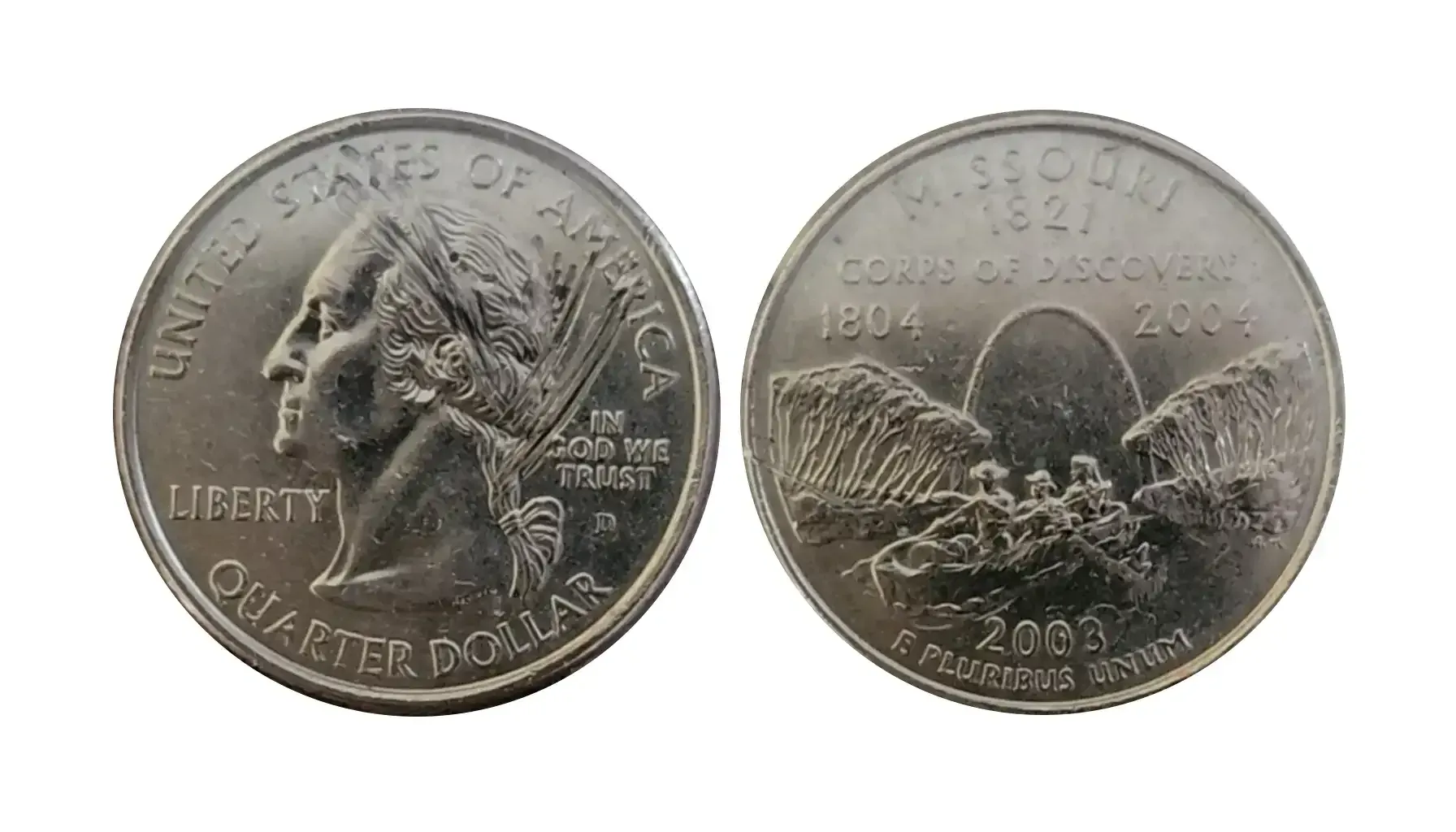
This nickname refers to extra metal lines appearing near Washington’s hairline, creating an effect that resembles feathers. It’s caused by worn dies and is often seen on Denver issues. Despite being quite common, collectors love these varieties for their visual oddity.
Struck Through Grease Error (2003-P)
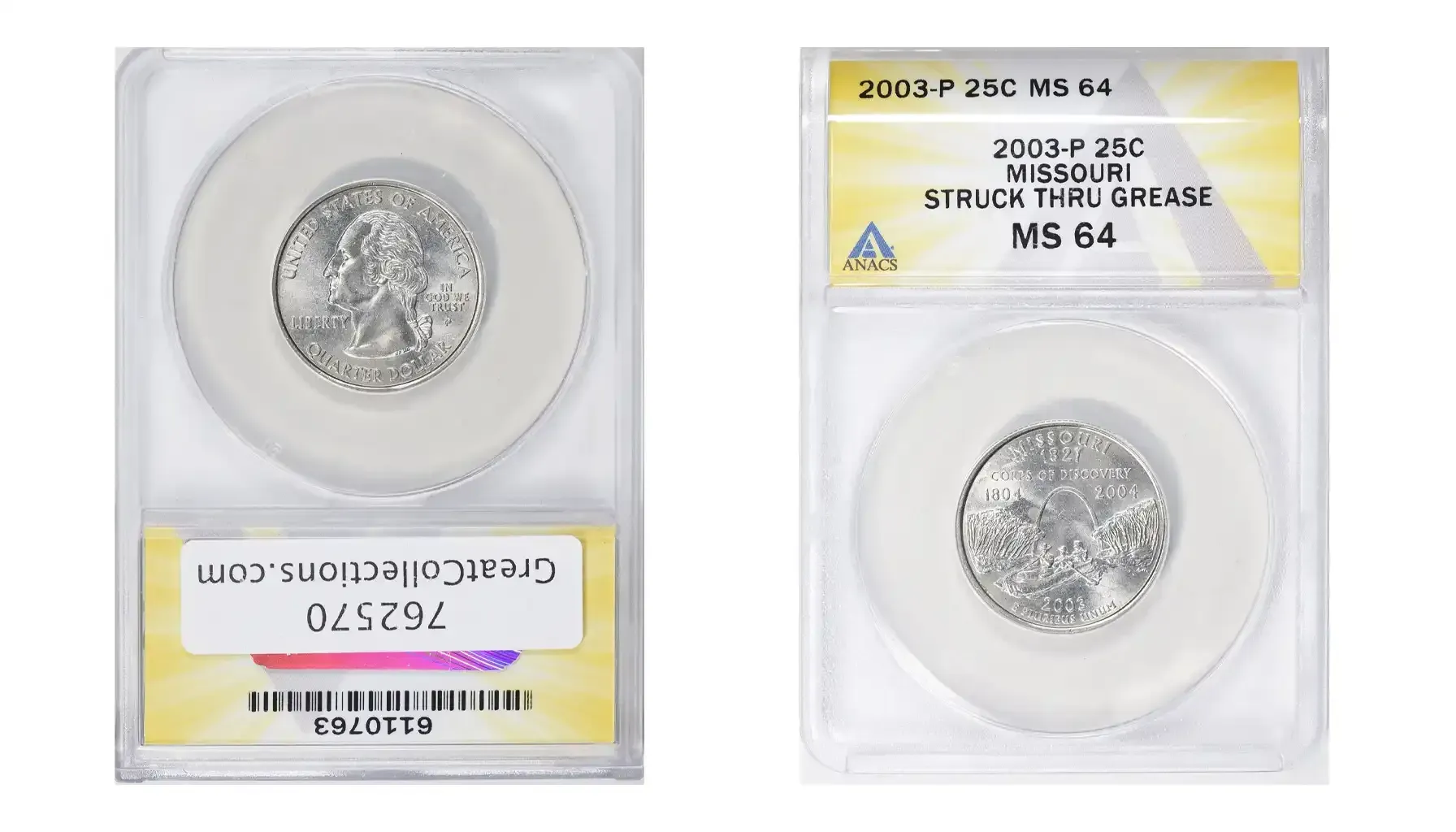
When grease fills the die, some parts of the design fail to strike properly, leaving flat or faded details. On the Missouri quarter, this sometimes affects the Arch or lettering. Clean examples graded MS64 or higher are quite desirable.
Is It Worth Buying?
The coin remains appealing for collectors because of its historical significance, known minting errors, and well-preserved examples that tend to hold high demand. Although it is not considered a rare one, certain varieties in top condition may offer long-term potential for collectors focused on gathering a historically significant collection.
Using Coin ID Scanner for Quick Coin Checks
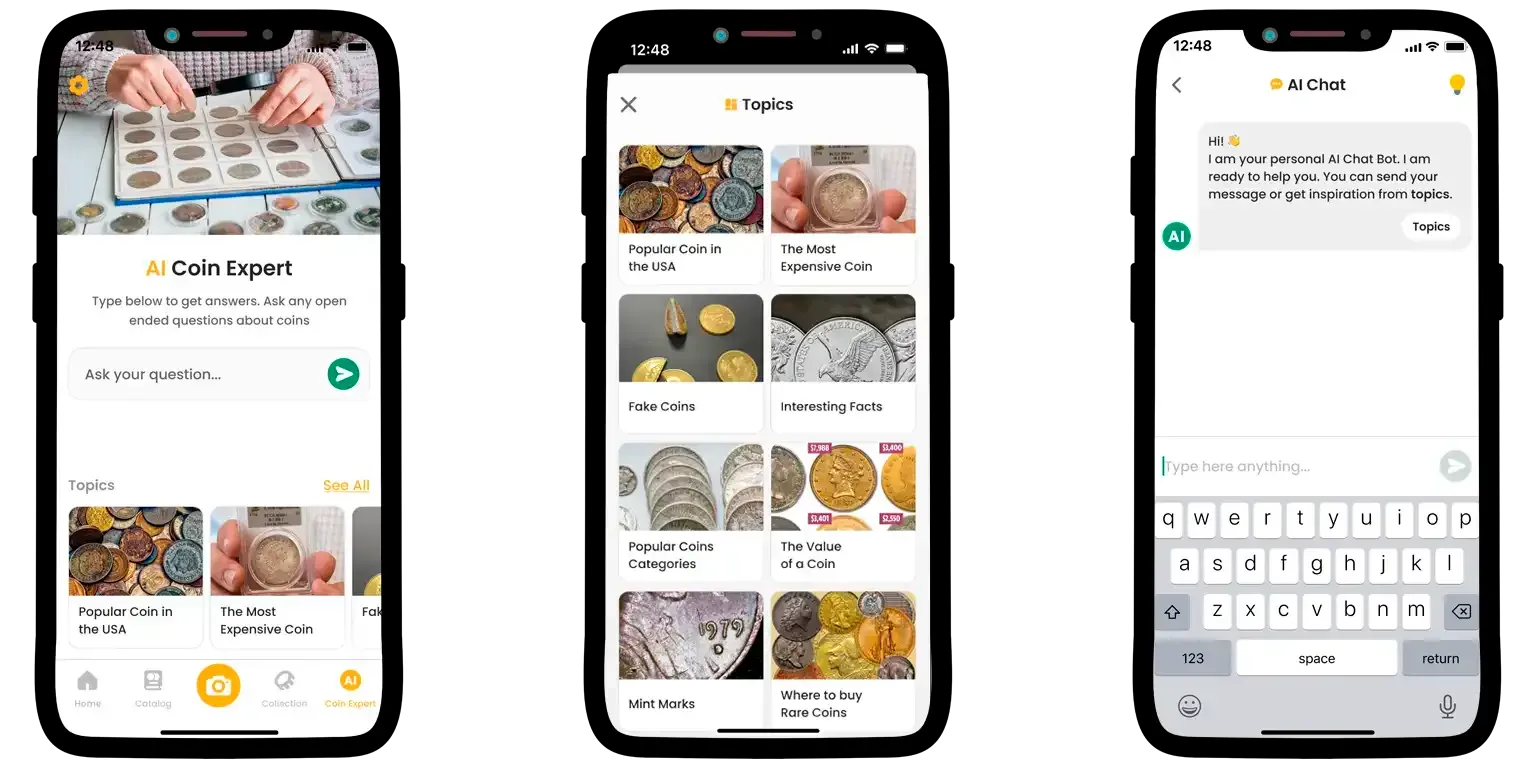
If you ever come across a Missouri quarter, or any other, like a 2004 Michigan one, and wonder about its characteristics, features, or condition, use the ID Scanner app to easily determine some nuances. With the app, users can:
Instantly take a photo and identify coins.
Learn some historical data and other minting and composition details.
Explore current market value estimates for quick reference.
Save all finds in a digital collection to manage info quickly and conveniently.
Ask the built-in advanced AI helper in case of any difficulties.
The app is a smart first step for any person interested in coins to learn more about their finds without special tools or manuals.

 Facebook
  X (Twitter)
  Pinterest
  LinkedIn