Contents:
The coin is part of the federal 50 State Quarters program, where each U.S. state received its own theme. The 2004 Michigan issue stands out for its combination of a state map and a distinctive lake motif.
Michigan State Quarter Overview

On the reverse, the focus is on the state’s outline and the chain of the Great Lakes. The artist went with a simple approach, using clean map lines and calm shifts in the relief. The inscription “Great Lakes State” points directly to the region’s geography.
Coin specifications:
Denomination: 25 cents
Year of issue: 2004
Series: 50 State Quarters
Composition: 91.67% Cu, 8.33% Ni
Weight: 5.67 g
Diameter: 24.26 mm
Edge: Fluted
Reverse: Map of Michigan + Great Lakes
Reverse artist: Donna Weaver
Mintage by mint:
Philadelphia (P): ~233,400,000
Denver (D): ~225,800,000
San Francisco (S) Proof: ~2,740,000
San Francisco (S) Silver Proof: ~1,760,000
When studying the issue itself, attention often turns to the minting technology used that year. The 2004 Florida quarter shows which design elements were more vulnerable to wear.
2004 Michigan Quarter Value Guide
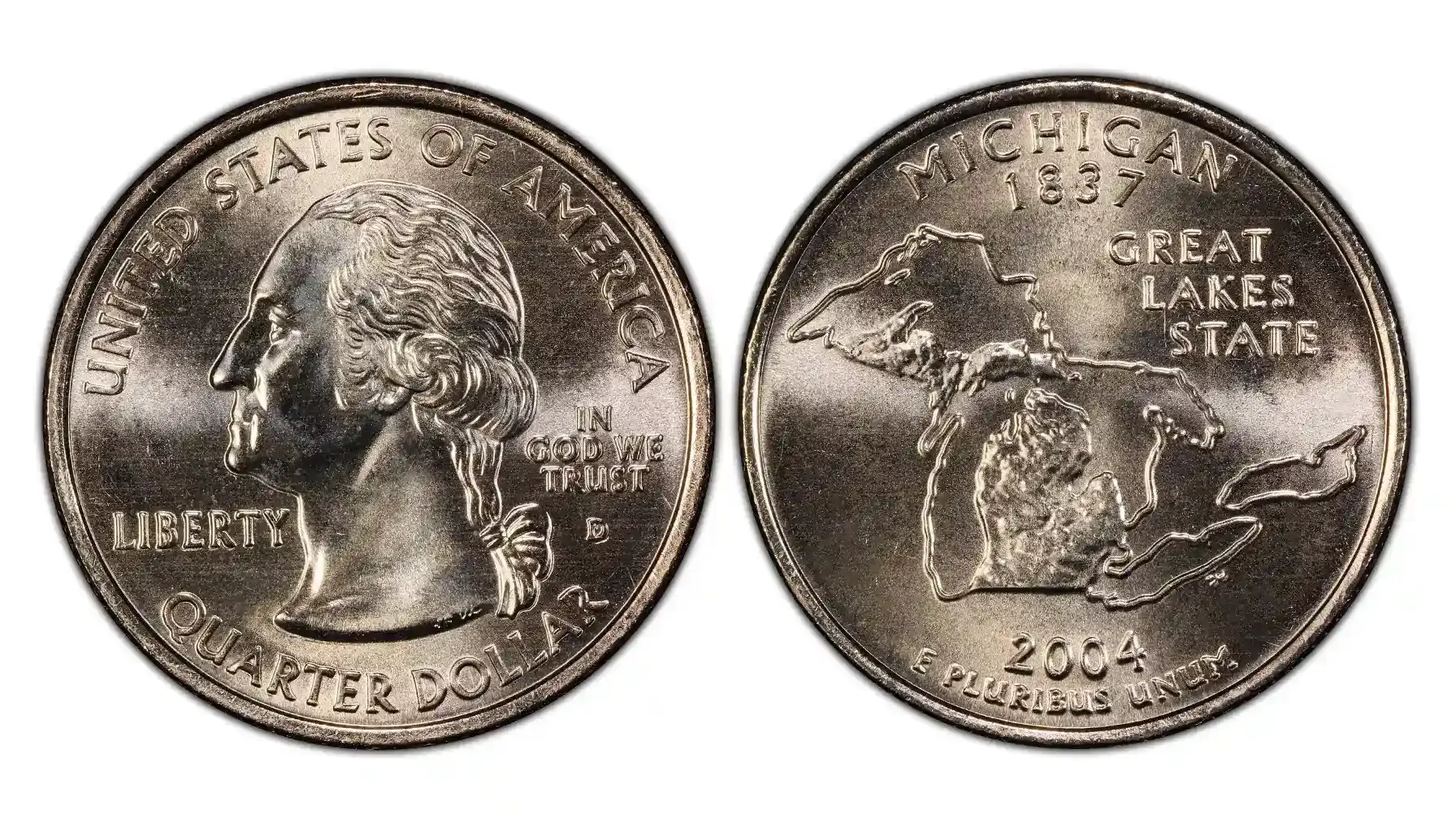
In circulation, a coin usually has little numismatic value. The key features are clean, unworn rims and a bright luster.
Condition | Approximate Price |
Circulated (P/D) | $0.25–$0.40 |
AU | $0.60–$1 |
MS60–MS63 | $1–$3 |
MS65 | $7–$12 |
MS66 | $18–$28 |
MS67 | $25–$60 |
S Proof (clad) | $4–$8 |
S Silver Proof | $10–$18 |
Rare MS68 | $120–$250 |
Value is determined by the number of surviving specimens in the top grades. Because of handling and storage, many of these coins end up with tiny contact marks, so finding a flawless piece isn’t easy. Even a small mint error can change the value quite noticeably.
“I've always been a coin collector, ever since my grandfather had some ancient coins that he passed down to me, it's just always been something.”
— Kellan Lutz, American actor
Quotefancy website
2004 Michigan Rare Error Varieties

Varieties are formed by three main factors: mint, strike level, and specific die variations. Dividing by mint helps us understand where rarer production features are found.
Philadelphia (P)
Localized thickening of the lake lines is sometimes encountered.
The 2004 p Michigan quarter error is often associated with slight cracks in the die.
MS67 from Philadelphia appears less frequently than from Denver.
Denver (D)
Harder dies resulted in the formation of clear, raised edges.
Some specimens have slightly noticeable shifts in the reverse centerlines.
In collections, highly lustrous D-mint strikes without dots or abrasions are prized.
Proof and Silver Proof
San Francisco coins have mirror-like surfaces, which highlight even the slightest imperfections.
The grading takes into account the cameo contrast depth, the definition of the lake lines, and the absence of streaks in the mirror-like areas.
Collectors note that the difference in the Michigan quarter's relief is most noticeable when examined next to the 2004 Texas quarter, where the composition is more central and massive.
If you've found a coin and want to quickly understand its potential, you can use the Coin ID Scanner app: a photo of the obverse and reverse allows you to get an approximate price range and check for rare varieties.
Typical errors that contribute to collector rarity:
Off-center strike;
Die clash–rare, noticeable on the reverse by the reflected lines of the portrait;
Severe die break along the lake border (rare);
Filled die on the letters "STATE".
Each of these defects falls within the general spectrum of what collectors call the 2004 Michigan quarter error, and value is determined individually, based on its visual severity.

 Facebook
  X (Twitter)
  Pinterest
  LinkedIn