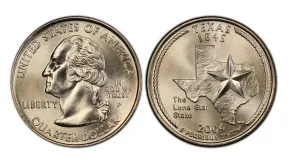
Contents:
The 2004 quarter Texas is part of the 50 State Quarters program. The issue has become a staple in state-specific collections, and individual varieties are sought after by collectors for their distinctive die features and rare errors.
Texas State Quarter Overview
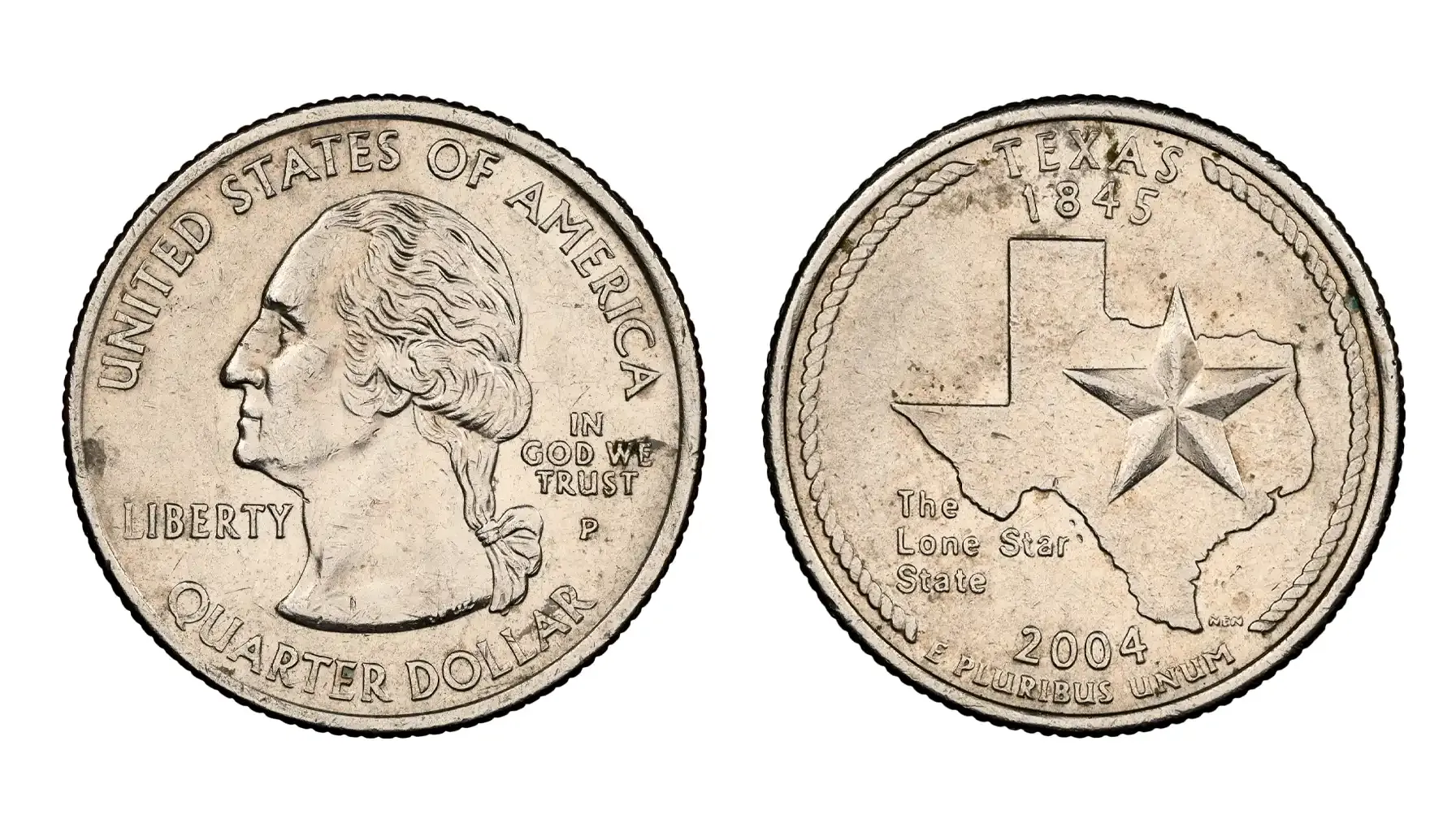
What is pictured on Texas state quarter? The reverse of the 2004 Texas quarter shows the state outline, a bold star at its center, and the familiar inscription “The Lone Star State.”
These issues were minted at mints Philadelphia and Denver. The die differences are slight, but the surface condition of the Denver pieces is traditionally more consistent.
Collectors who organize coins within the series sometimes designate collections as Texas research quarters when analyzing the strike quality and visual irregularities of early lots.
Within the 2004 series, Texas coins are often compared alongside issues from other states, including the 2004 Iowa quarter, to examine overall mintage trends for that year.
Parameter | Value |
Metal | 91.67% copper / 8.33% nickel |
Weight | 5.67 g |
Diameter | 24.26 mm |
Mints | Philadelphia (P), Denver (D) |
Edge | Reeded |
Year of Issue | 2004 |
2004 Texas Quarter Value Guide

The coin's value depends on:
mintage (P - 278.8 million, D - 263.6 million),
preservation,
the presence of rare errors.
Condition | Approximate Price |
Circulated | $0.25–$0.40 |
Uncirculated (MS63–MS65) | $3–$8 |
MS66 | $8–$15 |
MS67 | $18–$30 |
MS68 | $75–150+ |
For the Philadelphia issue, MS65–MS66 are the most common, while perfect MS68s are much rarer. Among the Denver issues, high grades occur more regularly, but the market values them in roughly the same range.
Collectors also consider year-to-year trends. For example, coins in high condition can be compared to the market behavior of the 2004 Wisconsin quarter to understand the relative demand within the series.
“Money is history you can hold in your hands. Each coin and banknote ever produced has a story to tell.”
— Thomas J. Uram, president of the American Numismatic Association
Coins weekly website
2004 Texas Quarter Rare Errors
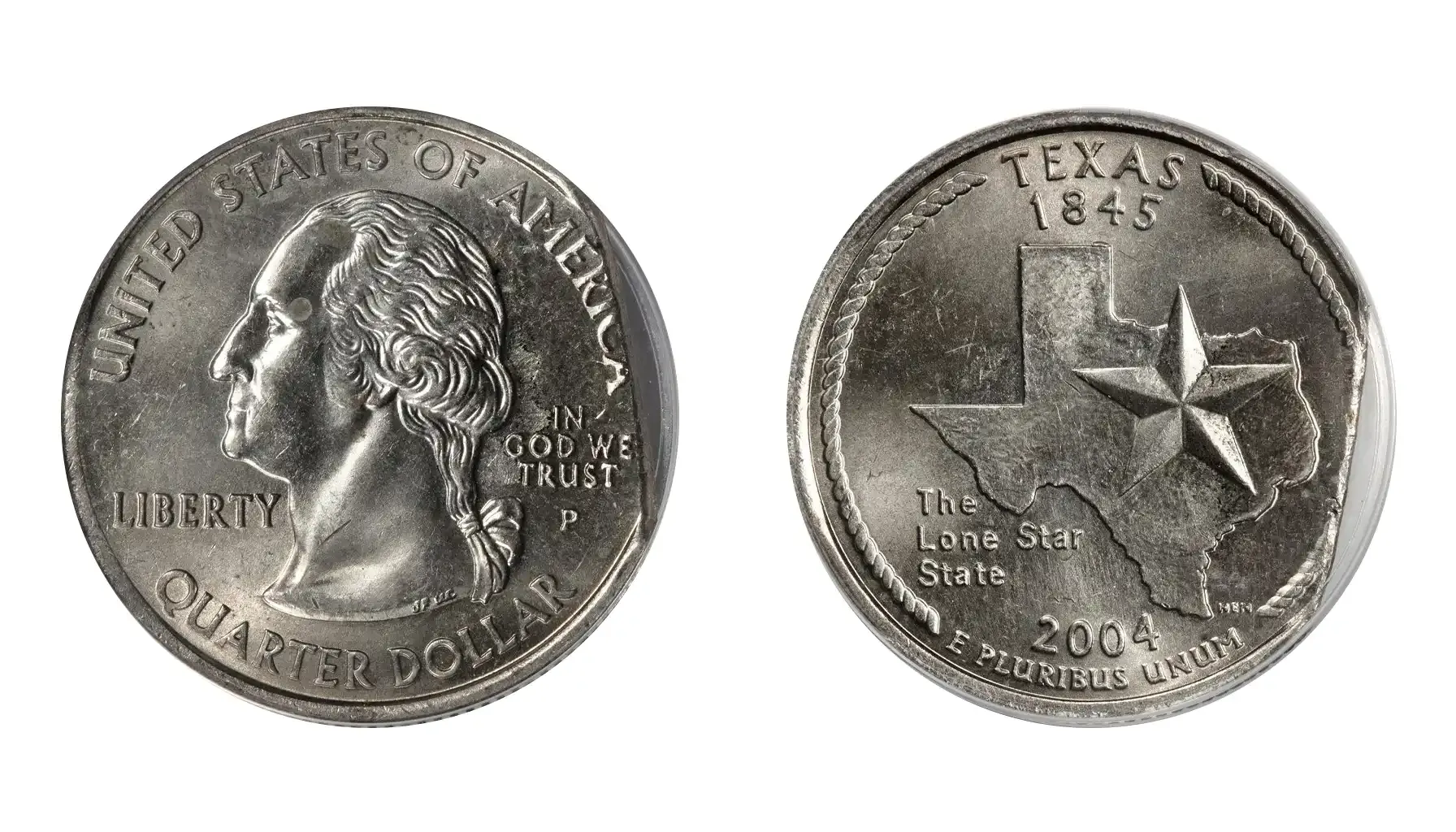
The possibility of seeing the 2004 Texas quarter error is less common than some of the early series releases, but the following options may exist:
Off-Center Strike
Image shifts of 5–15% are rare. Depending on the severity, the cost can increase to $40–$150.Die Chip / Die Break
A metal bulge forms around the star or along the Texas map. Coins with large chips are valued higher than the standard price—up to $20–$40.Strike-Through Error
If a foreign particle gets between the die and the planchet, part of the relief will appear “knocked out” or under-formed.Clad Layer Missing (rare)
The absence of the outer layer results in a copper tint on one side of the coin. Auction prices for such variants can exceed $150–300.
If you need to quickly determine a coin's value, identify die differences, or identify signs of errors, the Coin ID Scanner app is convenient. It recognizes coins from photos, displays their characteristics, and provides price benchmarks for various conditions.
2004 Texas Quarter Rare Varieties
In addition to errors, varieties distinguished by die features or strike quality have collectible value. These include:
Differences between mints.
Denver specimens are more often found with a clear map outline. To systematize variations, collectors analyze the differences between P and D lots in the definition of relief lines and the field smoothness.
Early and late stages of die wear.
In early stages, the map lines and stars appear sharper. Later stages exhibit slight swelling of the outline. This difference allows the coin to be classified into a specific group of varieties.
Weak strike in the star area.
Sometimes sections of the rays appear shortened. This is a common feature of specific lots, but collectors distinguish such variants in separate collections.

 Facebook
  X (Twitter)
  Pinterest
  LinkedIn