Contents:
John Quincy Adams was the sixth president of the United States, serving from 1825 to 1829.
He was the son of John Adams and spent most of his life in public service. Long before the presidency, he worked as a diplomat in Europe, later served in the Senate, and then became secretary of state, where he helped shape early U.S. foreign policy.
Adams was president for one term and never gained strong political support. After leaving office, he did something unusual: he returned to Washington as a member of the House of Representatives. There, he became a persistent opponent of slavery and remained in Congress until his death in 1848.
“Few men in American public life have possessed more independence, more public spirit, and more ability than did Adams. Still, throughout his political career he was handicapped by a certain personal reserve and austerity and coolness of manner that prevented him from appealing to the imaginations and affections of the people.”
— Samuel Flagg Bemis, editor
Encyclopaedia Britannica
John Quincy Adams $1 Coin Overview
What coins are worth money? Those that are devoted to personalities.
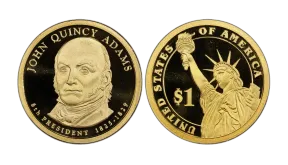
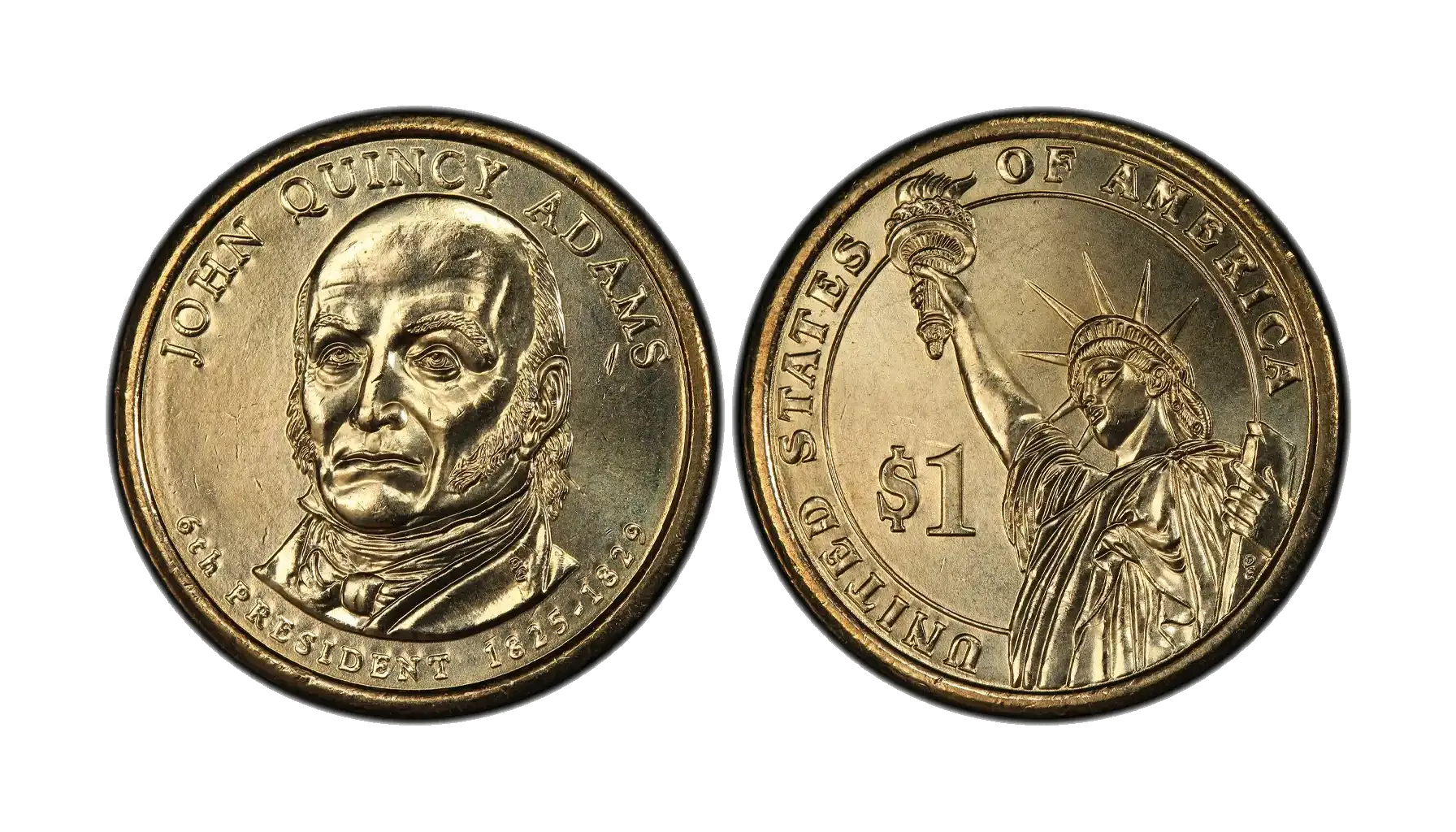
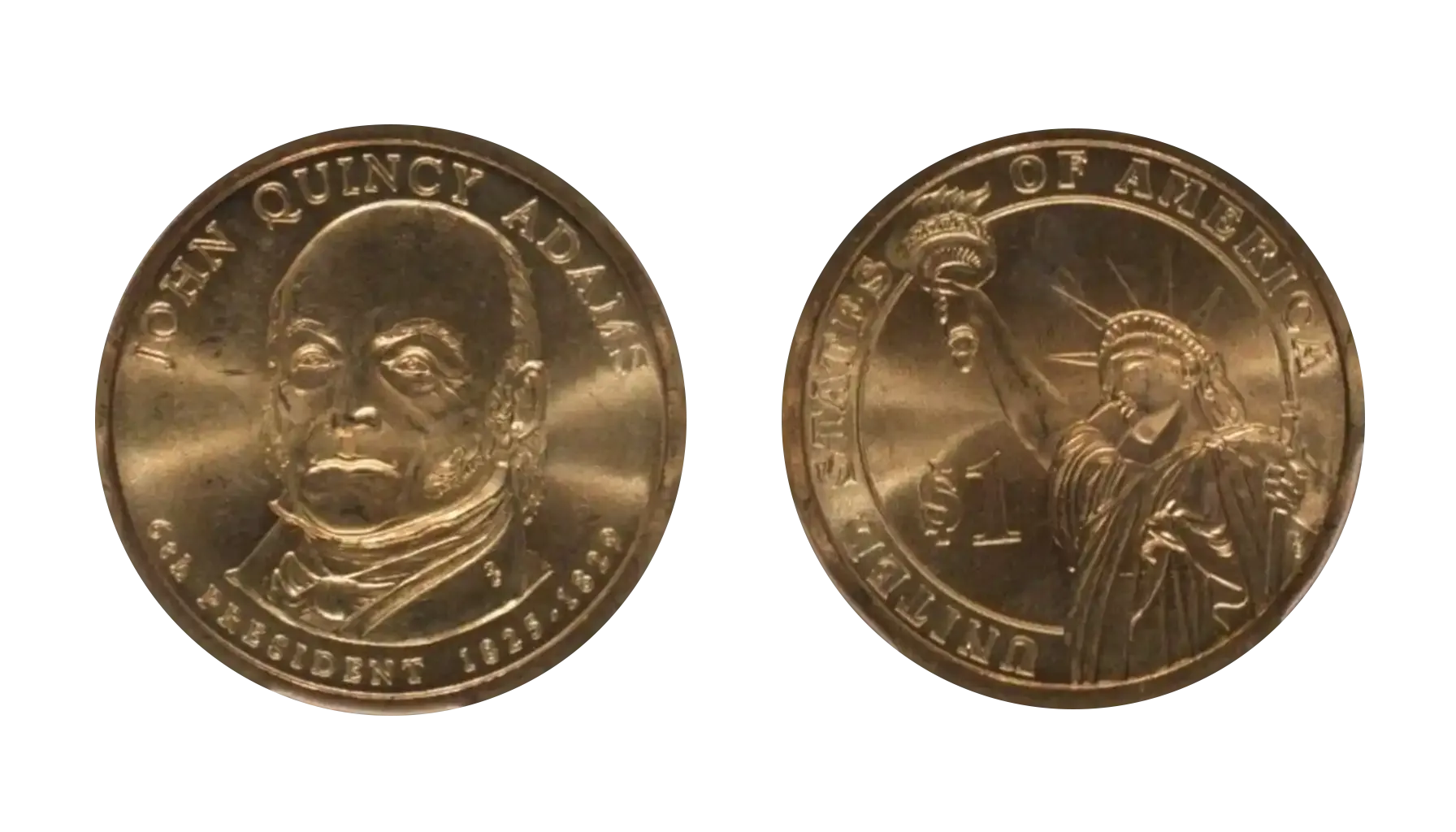
A 1 dollar coin John Quincy Adams is a modern U.S. dollar piece issued to honor John Quincy Adams, who served as president from 1825 to 1829. It was released in 2008 as part of the Presidential $1 Coin Program, a long-running series that featured deceased U.S. presidents in the order they held office.
Year issued | 2008 |
Denomination | $1 (One Dollar) |
Composition | Manganese-brass clad (copper core) |
Weight | 8.1 g |
Diameter | 26.5 mm |
Edge | Plain with incused lettering |
Edge inscriptions | Year, mint mark, E Pluribus Unum |
Obverse | Portrait of John Quincy Adams; name, order, term dates |
Reverse | Statue of Liberty |
Mint marks | P (Philadelphia), D (Denver), S (San Francisco – proof) |
Finish types | Business strike (P, D), Proof (S) |
The John Quincy Adams one dollar coin was not made for circulation in everyday change. By the time it was issued, dollars were already used mostly for collectors, vending systems, and government stockpiles. As a result, most John Quincy Adams dollars were saved in uncirculated condition from the start.
One detail that sets them apart from older U.S. coins is the placement of information. The date, mint mark, and the motto E Pluribus Unum are not on the front or back. Instead, they are stamped as edge lettering around the side of the coin. This feature also created collectible varieties, such as different lettering positions and occasional missing-edge errors.
They were struck at:
Philadelphia (P)
Denver (D)
San Francisco (S) for proof versions made specifically for collectors
Today, the John Quincy Adams $1 coin is mainly valued as a series piece. Most examples are common and trade close to face value. Proofs, high-grade certified pieces, and confirmed mint errors attract stronger collector interest.
John Quincy Adams Dollar Coin Values
Grade | Value |
Circulated (common) | $1.25 – $2.50 |
Uncirculated (raw) | $3 – $6 |
Proof (S, raw) | $8 – $15 |
Certified MS65 | $10 – $25 |
Certified MS66 | $25 – $50 |
Certified MS67+ | $75 – $150+ |
John Quincy Adams dollar coin error | $30 – $150+ |
The John Quincy Adams dollar coin value 1825 to 1829 varies with condition, certification, and market demand at the time of sale. Higher certified grades and well-documented errors tend to attract stronger prices among collectors.
Most of these specimens never circulated much, so pieces that show wear aren’t rare. So, how much is a John Quincy Adams dollar coin worth? They sell just above face value because demand is low and supply is high.
John Quincy Adams Dollar Coin Errors
Errors on Presidential dollars are not common, but they do exist and can attract interest from collectors. Most of the mistakes relate to the edge lettering, because Presidential dollars use an unusual method where the year, mint mark, and E Pluribus Unum are stamped into the edge rather than on the face.
Note that John Quincy Adams dollar coin no date on its obverse is not a minting error but a standard piece. Look at its edge to understand whether it really has something irrational.
Missing Edge Lettering
This is the most discussed error for Presidential dollars. If a specimen misses all or part of the edge inscriptions, it can be genuine evidence that the blank passed through the striking press but did not go through the edge-lettering collar properly. Collectors pay more attention to these because edge lettering is a standard feature of the series. Well-documented missing-edge examples can sell for several times the John Quincy Adams 1 dollar coin value of a standard piece.
Weak or Partial Edge Lettering
Not all missing lettering is complete. Sometimes only part of the date or mint mark shows. These partial defects occur when the edge lettering collar or die fails to impress evenly. The value increase depends on how obvious and complete the defect is.
Off-Center Strikes
A piece struck off-center will have part of the design shifted from the intended position. Minor off-centers are usually noticeable only under magnification, while more dramatic shifts create items that attract error collectors. The overall John Quincy Adams dollar coin value depends on how far off center the strike is.
Broadstrikes and Collar Errors
If the collar that holds the coin in place fails, the strike can expand the diameter slightly. These broadstrike errors are less common but are recognized by specialists and can boost value compared to a normal example.
Die Breaks and Die Cracks
Small cracks or breaks in the die can leave raised lines or blobs on the surface. These are minor varieties rather than headline errors, but well-defined die features can interest collectors who focus on die progression and mint manufacturing quirks.
What Collectors Should Know
Not all odd coins are true errors. Some appear that way due to damage or wear after leaving the Mint. True John Quincy Adams dollar coin 1825 to 1829 errors are confirmed by consistent characteristics and, ideally, by certification from a grading service.
Certification helps value. Confirmed errors that are certified by major services (NGC, PCGS) typically sell for more than raw error pieces.
Demand varies. Some errors are of interest mainly to specialized error collectors; others draw broader interest depending on rarity and visual impact.
FAQ
Is a John Quincy Adams dollar coin worth anything?
Yes, but most are common. Value rises with proof finish, high grade, or a confirmed mint error.
How much is a 2008 John Quincy Adams $1 coin worth?
Uncirculated ones usually sell for $3–$6. Proofs cost $8–$15. Top-grade certified pieces can bring more.
Where is the date on a John Quincy Adams dollar coin?
The date is on the edge, along with the mint mark and E Pluribus Unum.
Is the John Quincy Adams dollar coin real gold?
No, there is no gold dollar coin John Quincy Adams. It’s manganese-brass clad with a copper core. The gold color is the alloy, not precious metal.
What is the error on a John Quincy Adams coin?
The most known error is missing or weak edge lettering. Off-center strikes and broadstrikes also exist.
How many John Quincy Adams coins were made?
Millions were struck in 2008 at Philadelphia and Denver, with additional proofs from San Francisco. Most were saved.

 Facebook
  X (Twitter)
  Pinterest
  LinkedIn