Contents:
Is there a currency (and a denomination) more iconic than a dollar? Hard to say. The dollar banknote became an icon, but what about its coin version? Those have been getting rarer and rarer over the years.
Are one-dollar coins still made? What lowered their mintage? How do coin versions look and what metal are they made of? This article will explore these questions.
Collecting is also about trading, and what do traders need? A free coin identifier. Such a tool helps identify a promising coin and find its value.
Are US Dollar Coins Still Made
Let’s get straight to the point. Are 1 dollar coins still made? Yes, the U.S. Mint continues to produce dollar coinsю However, they are indeed not made in large quantities for everyday circulation anymore. This situation is not unique. Vietnam coins, too, are almost completely outperformed by the banknote version.
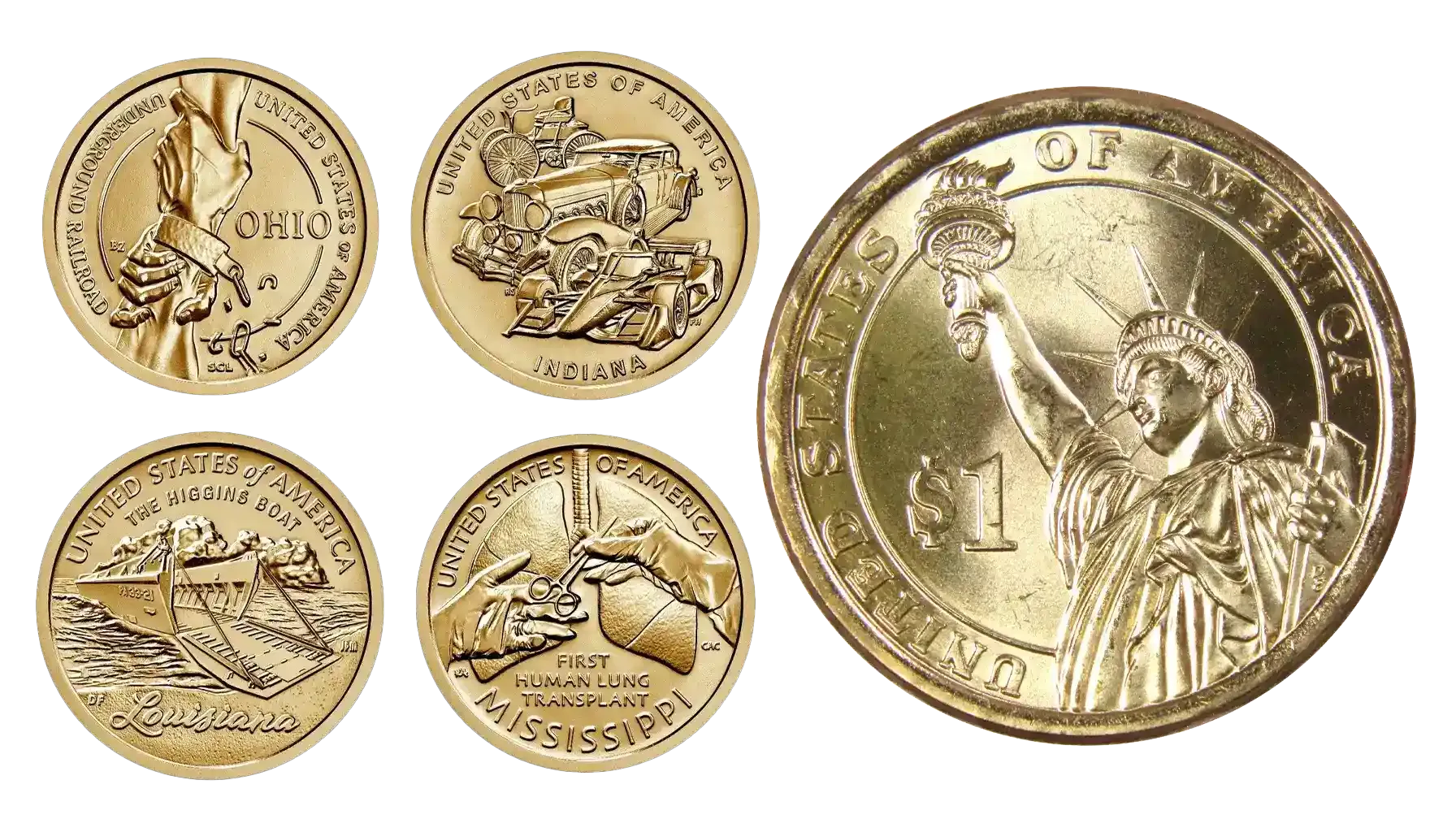
How does the dollar situation look in the U.S.? Today, the U.S. Mint issues two simultaneous dollar series, the Native American $1 and the American Innovation $1. They are commemorative coins in nature, made not for circulation, truly, but rather for remembrance.
The native American series commemorates Native American roots, the past, and the Innovation series looks into the future and technological progress.
American $1 (2025) Specifications | |
Country (Issuer) | United States |
Years of Minting | 2009–present (issued in 2025) |
Type | Circulating $1 coin (collector-focused production) |
Shape | Round |
Diameter | 26.49 mm |
Metal Composition | Copper core with manganese-brass cladding (88.5% Cu, 6% Zn, 3.5% Mn, 2% Ni) |
Weight (Total) | 8.100 g |
Interesting fact: While dollars had their numbers reduced, pennies were discontinued altogether.
History of US Dollar Coins
The one-dollar coin has a long history. It is almost as old as the United States itself:

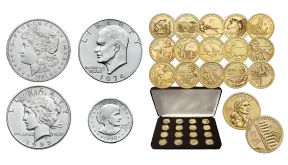
The first U.S. dollar coins were struck in the 1790s. They were silver and highly valuable compared to modern issues. The Flowing Hair series from the 1790’s is still beloved today.
The 19th and 20th centuries continued to make silver dollars (like the Morgan and Peace series). The inflation started affecting them closer to the end, and most were hoarded.
The Eisenhower series (1971–1978) was the first modern base-metal dollar coin.
Susan B. Anthony series (1979–1981) was a promising series, but the changed size confused them with quarters, so the series didn't catch on. In fact, the release was so disastrous that Canadian Loonie designers took notes and measures to make their coins as little confusing as possible.
The Sacagawea series (2000–2008) was a popular design. This size introduced a golden color to distinguish it, but it still saw limited circulation.
Presidential $1 series (2007–2011) honored U.S. Presidents, and overall had a successful run.
The Native American $1 series (2009–present) features annually changing reverse designs celebrating contributions by Native Americans.
American Innovation $1 series (2018–2032) honours innovations from states and territories.
“The US dollar is the official currency of the United States and its overseas territories. It is a Federal Reserve Note, made up of 100 smaller cent units. After more than 200 years in circulation, the dollar remains the currency most used in international transactions and is the world's most prevailing reserve currency...”
— EBSCO
Official Website
Current One Dollar Coin Production
It's not a secret anymore that over the years, the dollar production dwindled. Let’s see it with our own eyes, how the mintage went in the last three years, and compare it to last year's issue.
Year | Denver Mint ($1) | Philadelphia Mint ($1) | Total Mintage |
2002 | ~3,732,000 | ~3,865,610 | ~7,597,610 |
2023 | ~1,120,000 | ~1,120,000 | ~2,240,000 |
2024 | ~1,120,000 | ~1,120,000 | ~2,240,000 |
2025 | ~2,520,000 | ~2,660,000 | ~5,180,000 |
Compared to the situation over 20 years ago, the mintage was reduced by almost by 300%. However, you can see growth in the 2025 issue.
Why Dollar Coins Are Less Common
The dollars might still be in ongoing production, but their numbers are dwindling. It’s high time we find out why this denomination is becoming less and less common:
1. The dollar bill remains dominant:
The United States continues to issue and widely circulate the $1 bill. People and businesses prefer bills over coins for convenience. Bills are lighter and more transportable. Therefore, the U.S. Mint has to cut the coin numbers for the majority's convenience.
2. Past overcirculation:
Back in the 2000’s and 2010’s, they were in the U.S. The Mint made more bits than people actually needed. The Federal Reserve stopped ordering bits in 2011 once inventories exceeded demand.
3. Lack of a policy to phase out dollar bills:
With policies, Canada has successfully introduced high-value bits that outperformed some banknotes. In the U.S., the higher-ups, just like consumers, have shown little incentive to support coin versions over the bills.
5. Limited public familiarity:
Many Americans simply aren’t accustomed to using dollar coins in daily transactions. They, too, imagine a bill rather than a coin when thinking about this currency. Therefore, people treat the coin versions as collectibles and not a real way to spend money.
Conclusion
Perhaps one day the dollar will return to its coin-based roots. However, for it to happen, many things will have to change, including inflation. Even with dwindling mintages, no one can take away the collector's favourite Presidential, Sacagawe, and Peace issues.
Coin ID Scanner can identify almost any world's currency, and the dollar is one of them. This app can identify almost any dollar issue and tell its mintage year and values.

 Facebook
  X (Twitter)
  Pinterest
  LinkedIn