Contents:
The 2010 Mount Hood Quarter is the fifth and final release of the America the Beautiful Quarters issued that year. It is devoted to the National Forest in Oregon. But why, and is this coin valuable enough to become any collector’s specimen?
Overview — The 2010 Mount Hood Quarter
Mount Hood is Oregon’s highest peak and a landmark that has anchored local life for centuries. This dormant volcano dominates the skyline of the northern part of the state. Its snowfields feed rivers, support the forest around it. It creates the conditions for climbing, skiing, and backcountry travel.
Protection of the land began in the late 1800s, when the federal government set aside large forest areas in the Pacific Northwest.
These places later formed Mount Hood National Forest. It’s now known for its lakes, trails, and thick tree cover.
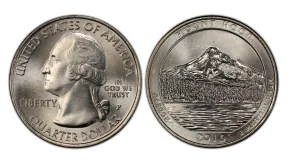
The view chosen for the coin—Mount Hood reflected in Lost Lake—is one of the region’s most familiar scenes. Visitors have camped, paddled, and taken the same photograph for generations.
“Each time Americans see this coin, they will connect with Mount Hood’s magnificent beauty, humbling presence, and the spiritual qualities that beckon to us today as they did to early inhabitants.”
— Andy Brunhart, United States Mint Deputy Director
Launch press release, Nov. 17, 2010
The 2010 Mt Hood Quarter was struck at three U.S. Mint facilities.
P — Philadelphia Mint. Found on circulation coins struck for everyday use. These pieces are the most commonly encountered in change.
D — Denver Mint. Also used on circulation coins. Denver issues often show slightly different strike characteristics due to equipment and die use, but they carry the same design.
S — San Francisco Mint. Appears only on proof and silver proof versions. These coins were made for collectors, not circulation. The clad proof has a sharp mirrored finish, while the silver proof is struck in 90% silver.
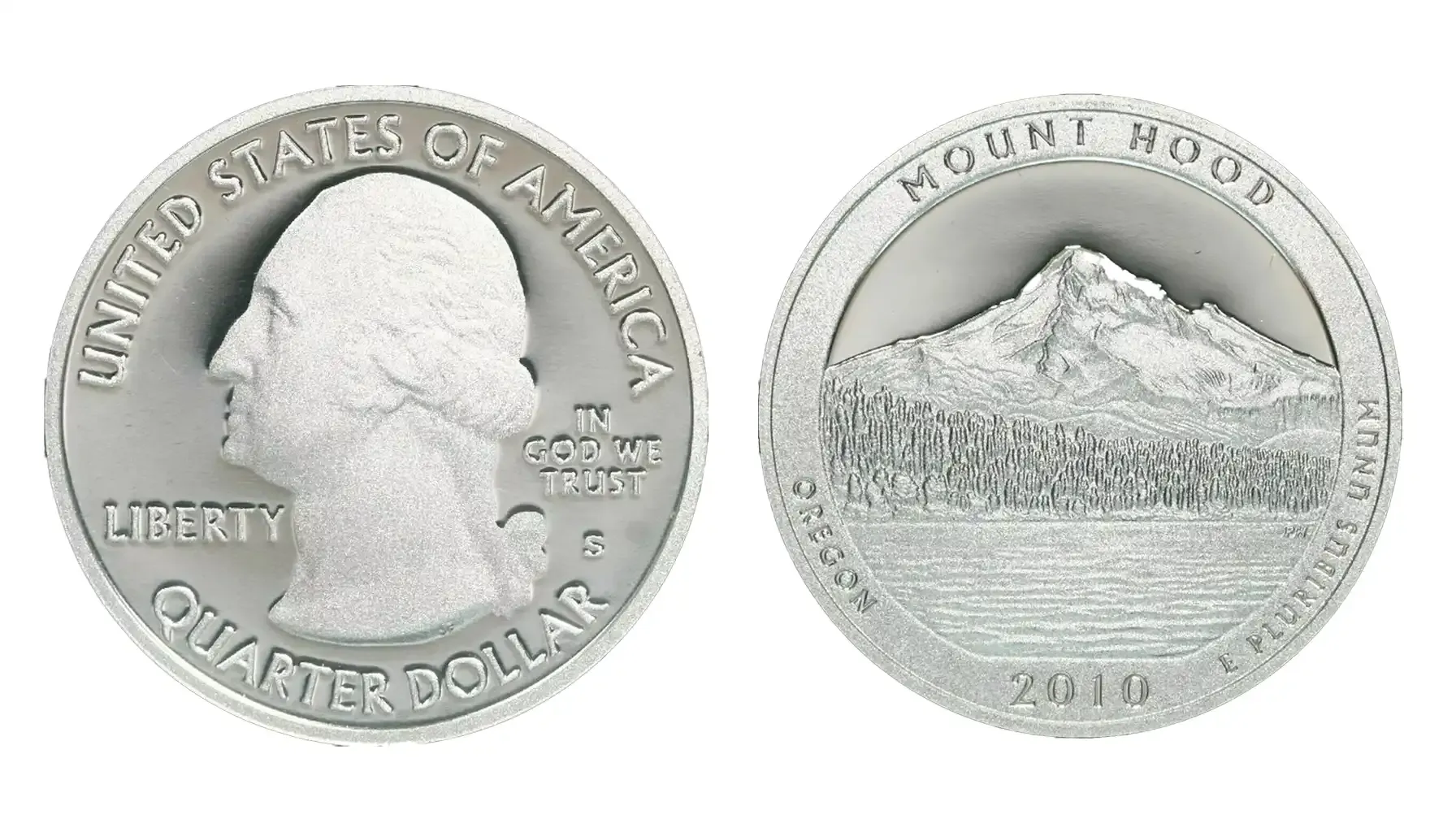
The mint mark is located on the obverse side of the coin, to the right of Washington’s portrait.
2010 Mount Hood Quarter Specifications
Year of Issue | 2010 |
Series Position | 5th coin in the ATB series (the next issues were the 2011 Gettysburg Quarter and the 2011 Glacier Quarter) |
Obverse Designer | John Flanagan (modified by William Cousins) |
Reverse Designer | Phebe Hemphill |
Composition (Circulation) | 91.67% Cu, 8.33% Ni |
Composition (Silver Proof) | 90% Ag, 10% Cu |
Weight (Clad) | 5.67 g |
Weight (Silver Proof) | 6.25 g |
Diameter | 24.26 mm |
Thickness | 1.75 mm |
Edge | Reeded |
Mintage (P) | ~33.5 million |
Mintage (D) | ~34.0 million |
Mintage (S Clad Proof) | ~1.7 million |
Mintage (S Silver Proof) | ~700,000 |
2010 Mount Hood Quarter Value Chart
Version | Grade | Value |
2010-P (Philadelphia, circulation) | Circulated (G–VF) | $0.25 – $0.40 |
Uncirculated (MS60) | ~$0.60 – $1.00 | |
Uncirculated (MS63) | ~$1.00 – $3.00 | |
Uncirculated (MS65) | ~$7.00 – $15.00 | |
2010-D (Denver, circulation) | Circulated (G–VF) | $0.25 – $0.40 |
Uncirculated (MS60) | ~$0.60 – $1.00 | |
Uncirculated (MS63) | ~$1.00 – $3.00 | |
Uncirculated (MS65) | ~$6.00 – $14.00 | |
2010-S Clad Proof | Proof finish (non-silver) | ~$2.00 – $5.00 |
2010-S Silver Proof (90% silver) | Proof finish (silver) | ~$7.00 – $14.00 |
Satin Finish (Mint Set) | Uncirculated satin finish | ~$2.00 – $7.00 |
Disclaimer: Local markets, dealer premiums, and online sales can differ from these ranges. These figures are intended only as a reference, not a guarantee of what any individual coin will sell for.
The regular circulation issues are very common, so unless the grade is high, they trade near face value.
Proof versions, especially the silver proof, are where you’ll see meaningful premiums.
Condition and eye appeal matter too: coins with full detail and no spotting cost more. However, prices shift with market demand, silver spot prices (for silver proofs), and certification grade.
2010 Mount Hood Quarter Errors and Varieties
You can find different production mistakes that came from planchet issues, worn dies, or problems during the strike. Most examples are ordinary, but certain errors stand out and are worth keeping.
Off-Center Strikes
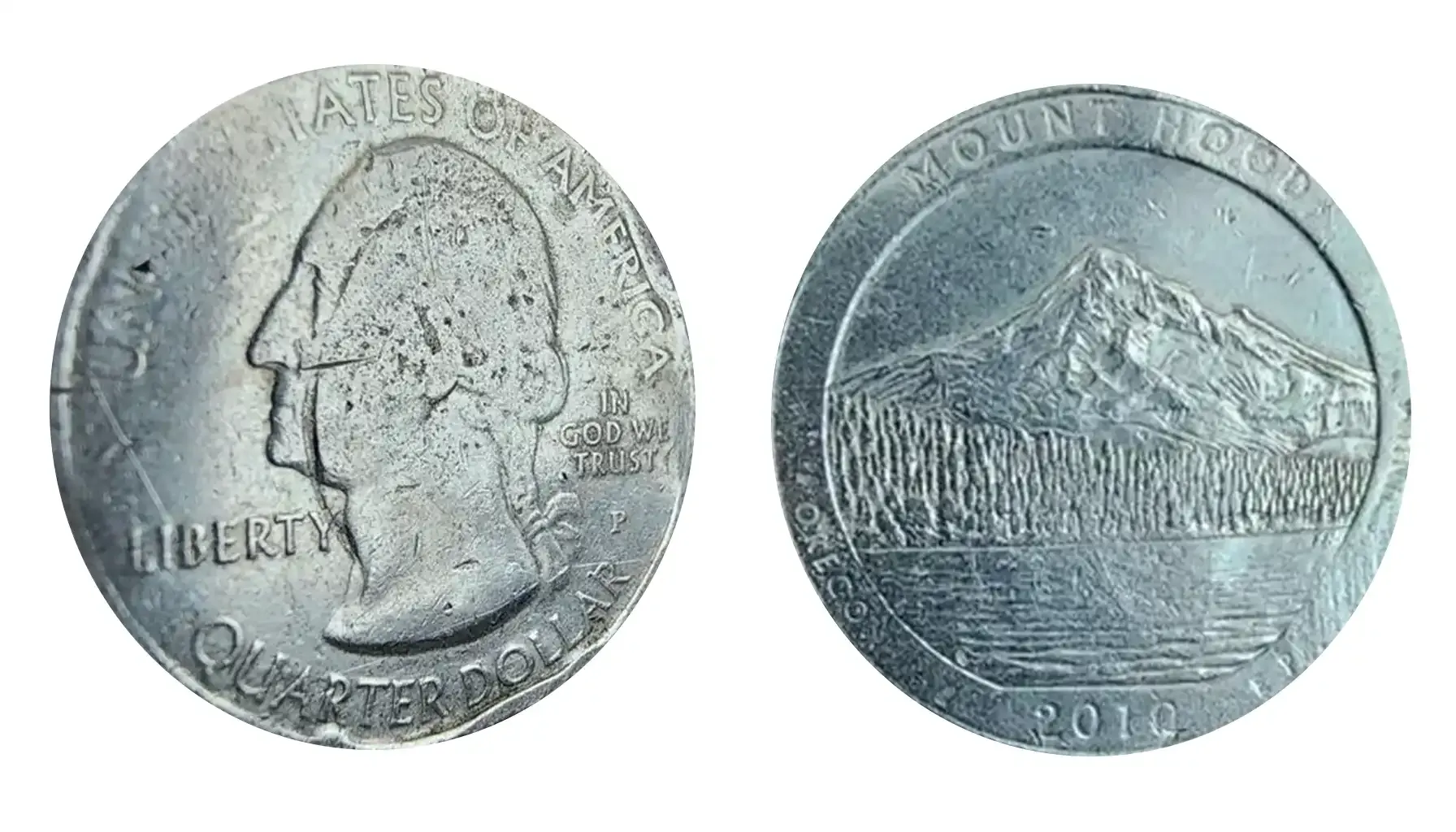
This 2010 Mount Hood quarter error appears when the blank isn’t centered in the collar. Small shifts are easy to find; wide, clean off-centers with the date still visible are much rarer and bring stronger interest.
Broadstrikes
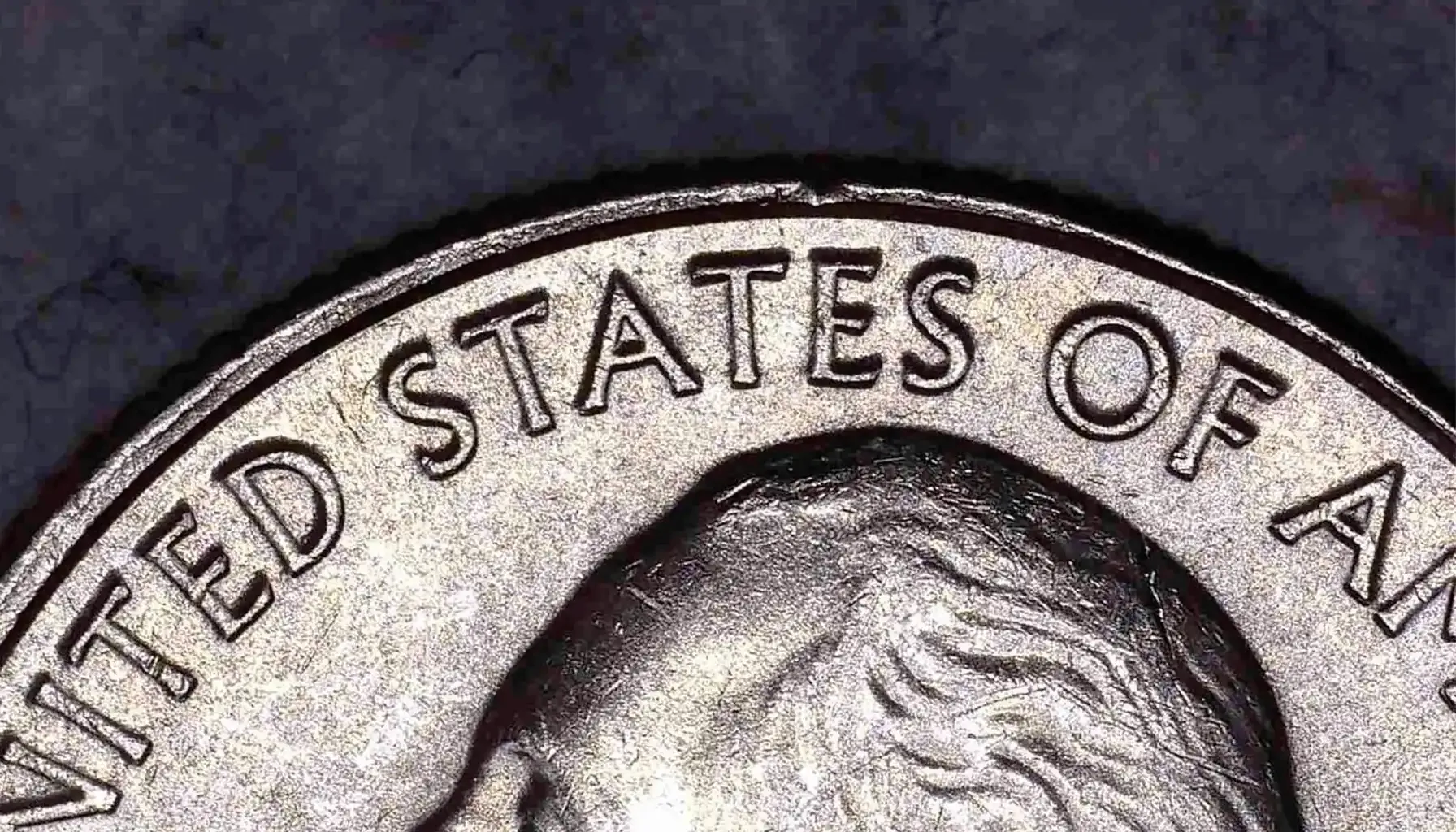
A broadstrike happens when the collar doesn’t contain the metal during the strike. The design looks normal, but the rim spreads out and loses its usual shape.
Die Cracks and Small Breaks
Heavy die use can cause splits that leave raised lines on the coin. On Mount Hood quarters, cracks often show along the rim or within the tree area near the base of the design.
Clipped Planchets
A clipped planchet has a curved section missing from the edge because the blank was cut incorrectly. Full, well-shaped clips are the most desirable.
Struck-Through Debris
Anything caught between the die and the planchet—dust, metal chips, grease—can leave shallow marks or missing detail.
Double Strikes
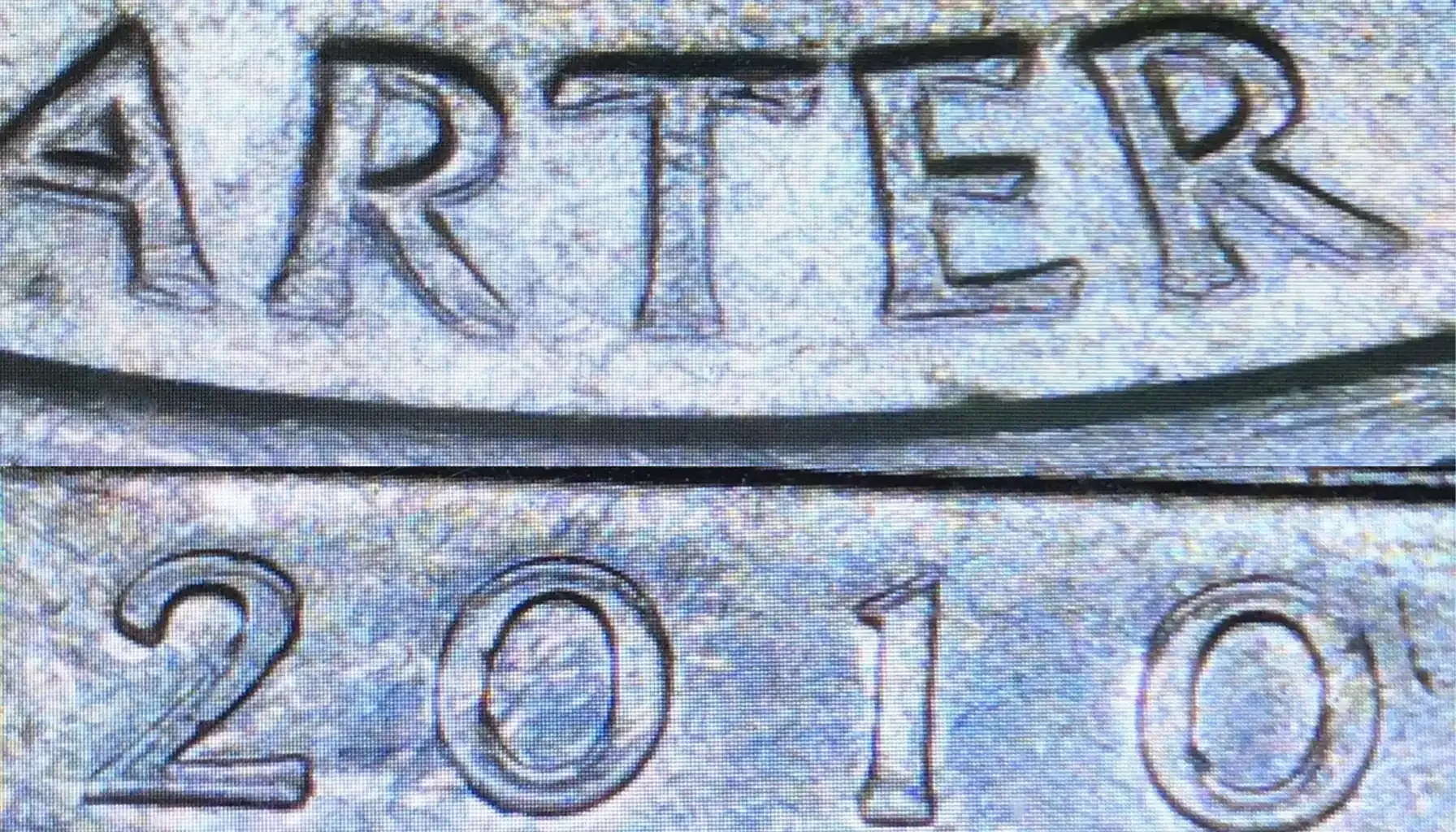
A small number of quarters received two impressions. When the second strike lands at a different angle, the result is easy to spot.
Missing Clad Layer
If the outer nickel layer fails to bond, part of the coin shows the exposed copper core. These pieces are visually obvious and uncommon.
Light Machine Doubling
Some coins show extra thickness on letters or numbers due to die wear or loose equipment. These pieces are collected as minor varieties.
Error coins can sell for more than regular pieces, but the premium depends on how dramatic, rare, and clean the mistake is. Small factory slips bring little added value; bold errors attract far more interest.
Conclusion
The Mount Hood 2010 Quarter is common in circulation, but certain versions and errors offer room for selective buying. For most traders, the regular P and D coins hold steady near face value, so returns come mainly from high-grade pieces, proofs, and standout errors. Silver proof versions combine collector demand with metal content.
Collectors who specialize in modern errors look for wide off-centers, full clips, and missing clad layers. These pieces don’t appear often, and clean Mint State examples are the ones that hold value best over time. Proof errors from the San Francisco Mint are harder to find and usually draw higher interest when they appear on the market.
Coin ID Scanner is helpful here because it keeps the process organised. You can photograph each coin, identify it, and store it in a digital collection. Value examples make it easier to decide which coins to keep and which ones to move. It’s literally a useful habit for both collectors building sets and traders who work through rolls or bulk lots.

 Facebook
  X (Twitter)
  Pinterest
  LinkedIn