Though Maine became a state relatively late, its territory was one of the first to be settled. The State Quarters program celebrated this land in 2003. Let’s give this coin the overview it deserves.
Maine State Quarter Overview
As the 23rd coin in the U.S. Mint’s 50 State Quarters Program, the Maine 2003 quarter was released. In 2003, it was a middle release, and a few other coins (like the Missouri State quarter) were issued.
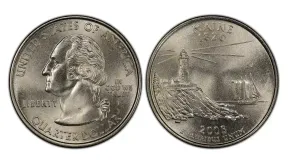
Maine’s quarter design highlights the coastal position of the state and its landmarks. The obverse was made by John Flanagan, and the reverse by Donna Weaver.
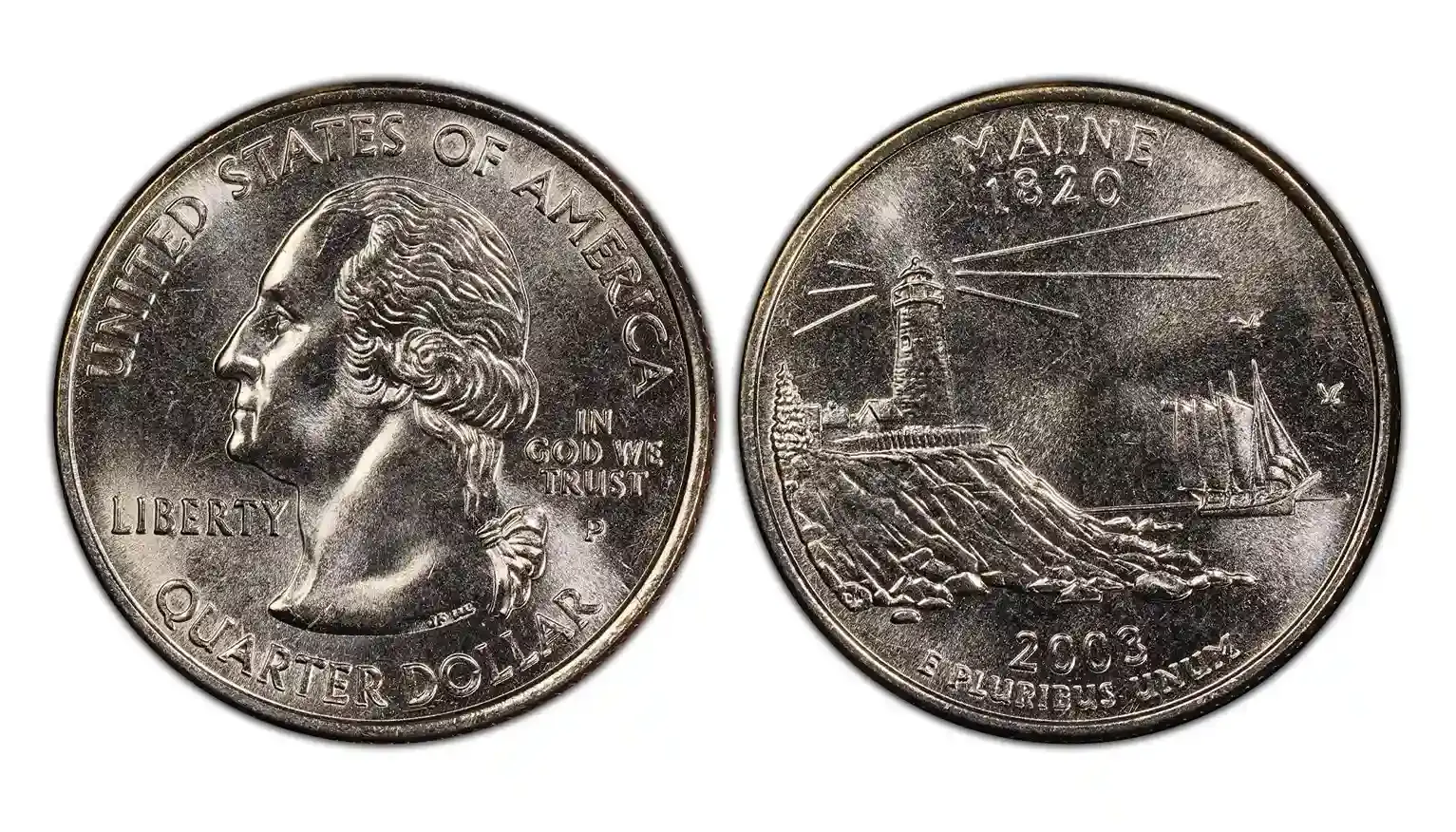
The obverse features a portrait of George Washington, used throughout the State Quarter series.
The reverse design shows Maine’s coastline, along with the Pemaquid Point Lighthouse ( a popular landmark). The lighthouse stands on rocky cliffs, and a large ship sails in the background. Together, these images represent the state’s connection to seafaring, trade, and navigation.
"As Americans enjoy their summer vacations, they will be buying ice cream cones with quarters featuring one of the picturesque lighthouses they love to visit."
— Henrietta Holsman Fore, the U.S. Mint Director
Maine Quarter Launch
2003 Maine Quarter Value Guide
Most circulated 2003 Maine quarters are still common today, which doesn't help gain a high value. However, an uncirculated (high-grade) 2003 quarter Maine is worth more:
Variety | Circulated Value | Uncirculated (MS60–MS64) | High Grade (MS65–MS67+) |
2003-P (Philadelphia) | Face value ($0.25) | $0.50–$1 | $2+ |
2003-D (Denver) | Face value ($0.25) | $0.50–$1 | $2+ |
2003-S Clad Proof | N/A | N/A | $6 |
2003-S Silver Proof (90% silver) | N/A | N/A | $20+ |
The San Francisco quarter stands as the most valuable variety, excluding errors. The same goes for almost every other State quarter, including other 2003 releases (e.g., the Arkansas quarter).
Maine Quarter Error Types
As this quarter was mass-produced, several pieces came out with errors. Some mishaps are more valuable than others.
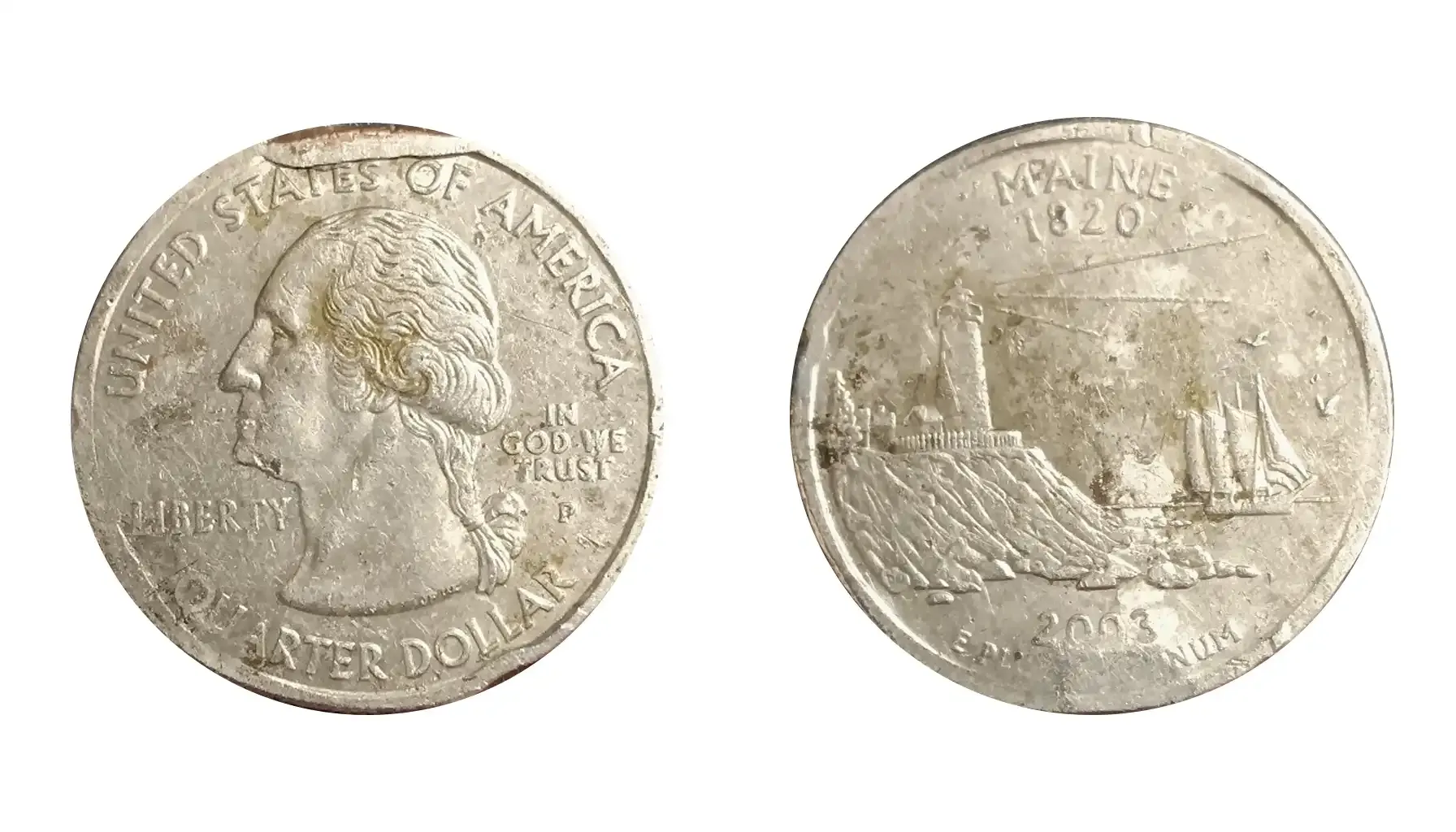
The 2003 Maine quarter error list includes:
1. Off-Center Strikes
These errors occur when the coin is not properly aligned within the press, leading to a design that appears shifted.
Minor (5–10%) off-centers are often worth $20–$40, but major (20–60% examples are worth $100+.
2. Die Cracks and Die Breaks
Small cracks in the die can leave raised lines or blobs of metal on the coin (called cuds).
Die cracks and breaks may appear along the edge of the cliffs, or on the obverse. Common cracks may be worth a few dollars, but big die breaks can be worth $20–$50 or more.
3. Doubled Die Errors
A doubled die results from a misalignment during hubbing, causing doubled lettering or design elements.
Though rare for this year, any true doubled die Maine quarter can bring from $50 to several hundred dollars, depending on strength and visibility.
4. Missing Clad Layer
Clad coins have nickel and copper layers. When one of the nickel layers fails to bond to the copper core, the coin appears copper-colored on one side or both.
When the layer is missing only partially, the coin could be worth $75–$150, but if a double-sided layer is missing, it could be worth $200+.
5. Strike-Through
Foreign objects (grease, metal shavings, etc.) can accidentally get stuck in the metal. These coins show irregular depressions or missing detail.
Minor grease-filled dies are worth $3–$10, but if the stuck object is easy to notice, then the value can be $50+.
With errors or not, the Maine quarter is still precious to all of us, especially those who consider this state their home.

 Facebook
  X (Twitter)
  Pinterest
  LinkedIn