Contents:
- Understanding Your 1977 Nickel: Basic Facts
- Mint Marks and Their Significance: P, D, S
- Grading Your 1977 Nickel: Condition is Everything
- Current Market Value: 1977 Nickel Price Chart
- Practical Identification Guide: Step-by-Step Process
- From Knowledge to Action: Next Steps for Collectors
- Frequently Asked Questions
Have you found a 1977 nickel and wonder about its true value? Numismatists know that this issue varies from common 5¢ to thousands of dollars. All you need to know is a set of characteristics that define the market price. This article will help you to identify coins via those special signs.
Understanding Your 1977 Nickel: Basic Facts
Let’s start from the history and close observation of this Jefferson nickel in detail. Later, it will help us evaluate it precisely.
Design Elements and Historical Background
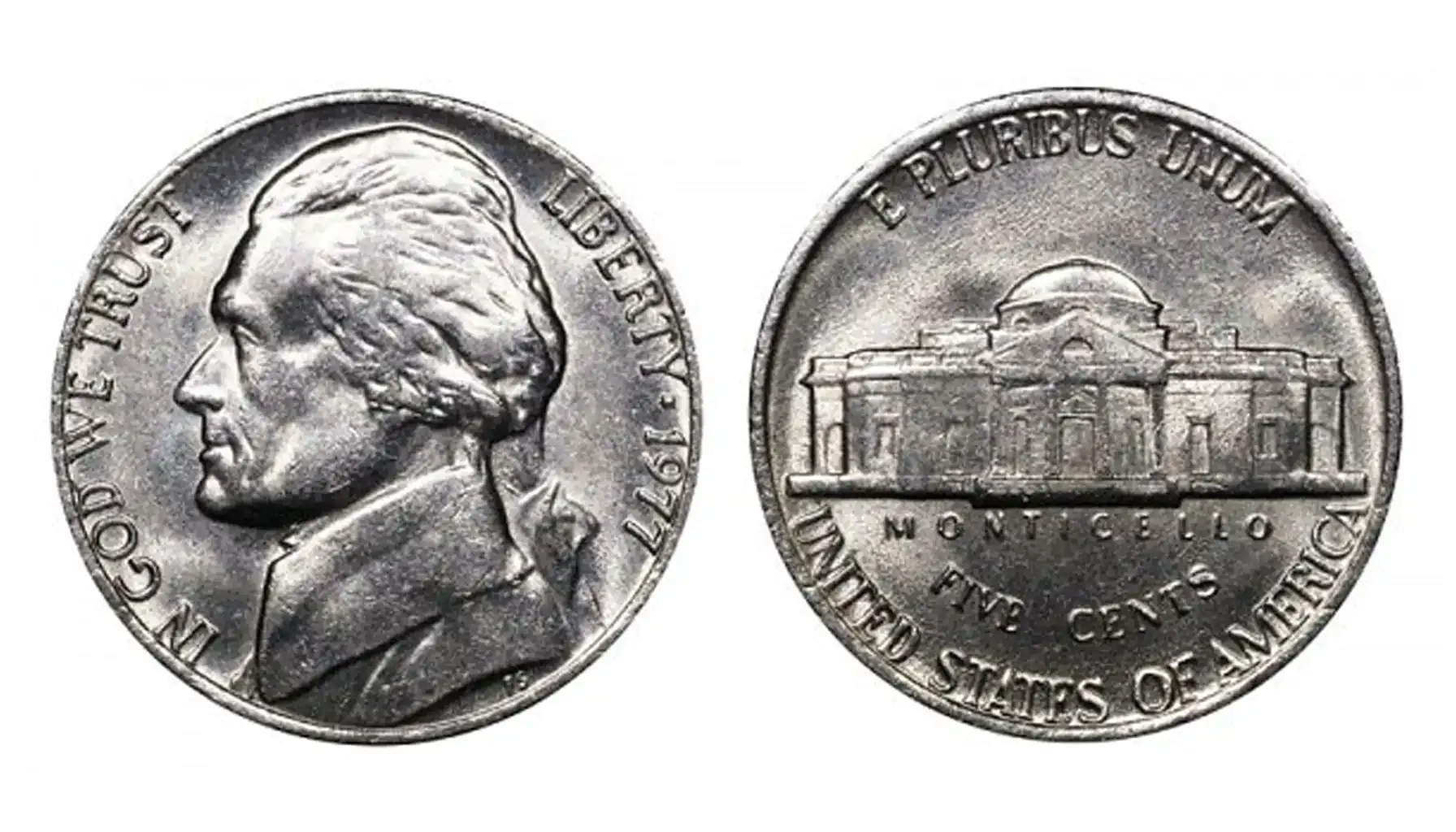
The 1977 Jefferson nickel carries on a design invented in 1938 by sculptor Felix Schlag. The obverse displays a left-facing portrait of Thomas Jefferson, and the reverse showcases his famous residence Monticello in Virginia.
By the late 1970s, the Jefferson nickel remained in circulation for over six decades without changing the design. As a result, it captured many epochs and included many iconic issues. The only next change came in 2004 with the Westward Journey series.
Technical Specifications and Composition
The 1977 nickel follows the U.S. Mint’s post-World War II standard alloy:
Composition: 75% copper, 25% nickel
Weight: 5.0 grams
Diameter: 21.2 mm
Edge: Plain (no reeding)
It contains no silver, but its cupronickel composition offers excellent durability and resistance to wear, which kept these nickels in circulation until today. Based on 2025 metal prices, each coin’s melt value hovers around $0.06, slightly above its face value. Because of its low intrinsic value, collectors often focus on strike quality, mint marks, and rare varieties rather than metal content when valuing this issue.
Mint Marks and Their Significance: P, D, S
The first step in accessing the quality is knowing where your coin was minted.
How to Locate and Identify Mint Marks
The mint mark on a 1977 Jefferson nickel appears on the obverse of the coin, just to the right of Jefferson’s portrait, below the inscription “IN GOD WE TRUST.”
No mint mark: Philadelphia Mint
D: Denver Mint
S: San Francisco Mint (Proof only)
Evaluation tip: Use a magnifying lens for clear identification, as weak strikes or circulation wear can make mint marks difficult to read. A missing or faint mark can significantly influence the coin’s collectible status.
Production Numbers and Rarity Factors
Mint Location | Mint Mark | Mintage | Type |
Philadelphia | None | 585,376,000 | Circulation |
Denver | D | 297,313,460 | Circulation |
San Francisco | S | 3,251,152 | Proof Only |
The 1977 nickel no mint mark is the most common, Denver coins are moderately scarcer and can hold added value in mint condition. San Francisco proof nickels, struck with specially polished dies, were sold exclusively to collectors and never intended for circulation. They are the rarest and hold the highest prices.
Grading Your 1977 Nickel: Condition is Everything
Even the rarest variety might lose its cost due to bad preservation. Here comes the system of coin grading which gives you keys to understanding numismatic prices.
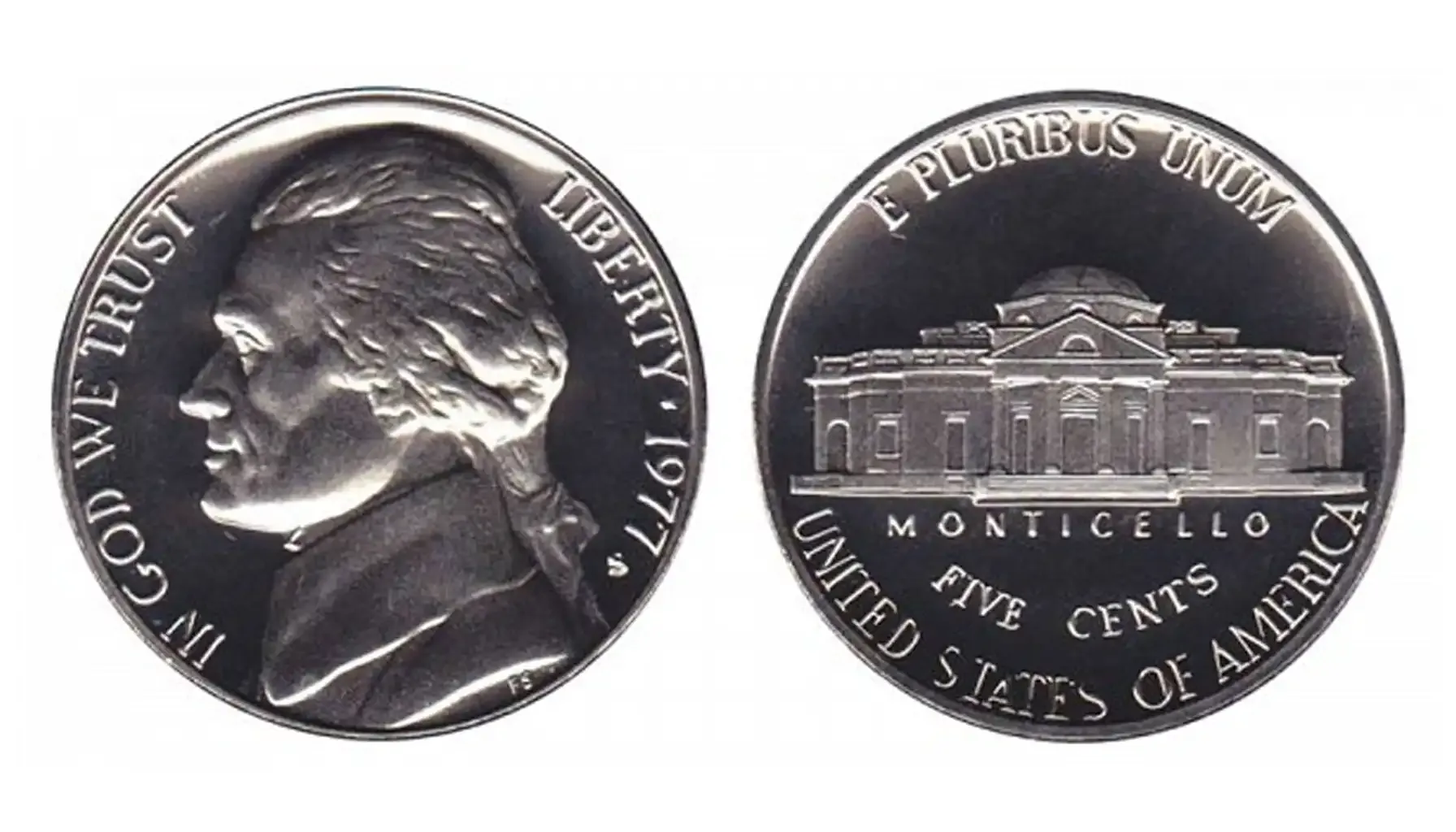
Circulated vs Uncirculated: Visual Comparison
Condition is the most critical factor in determining a 1977 nickel’s worth.
Circulated coins often show dull luster, surface marks, and wear on Jefferson’s cheek, jawline, and the steps of Monticello.
Uncirculated (Mint State) coins retain sharp details, clean surfaces, and bright metallic luster. Even minor contact marks can impact grading.
Uncirculated coins graded MS65 or higher are the most sought-after by collectors. These often come from mint sets or carefully preserved rolls.
The "Full Steps" Designation and Why It Matters
A defining feature for Jefferson nickels is the Full Steps designation in Monticello on the reverse. Coins showing five or six uninterrupted, sharply defined steps qualify for this premium status for their exceptional strike quality.
Market Note: For instance, a 1977-D Jefferson nickel with Full Steps achieved $4,320 at a Stack’s Bowers auction in 2021, proving that even modern nickels can become high-value collectibles under the right conditions.
Current Market Value: 1977 Nickel Price Chart
The value of a 1977 Jefferson nickel depends primarily on mint mark, condition, and the Full Steps designation. Circulated coins typically sell for face value, uncirculated and certified pieces achieve significant premiums in today’s collector market.
“The 1977-D Jefferson nickel value ranges widely—from under a dollar in circulated grades to over $100,000 for top-mint-state examples certified by major grading agencies. Most pieces hold nominal face value, but preservation, strike quality, and rarity of high-grade specimens can substantially raise their market worth.”
— NGC Coin Explorer Expert Team
From the Guide to Evaluating Jefferson Five Cents 1977
Value by Mint Mark and Grade
Mint / Type | Circulated | MS60 | MS65 | Full Steps (FS) | Auction Record |
1977 (P) | $0.05 | $1 | $16 | $75–$440 | $1,725 (2003) |
1977-D | $0.05 | $1 | $12 | $90–$200 | $4,320 (2021) |
1977-S Proof | — | — | $6 (PR67) | $15 (PR69) | $1,840 (2007) |
*Prices are based on NGC Auction Archives, CoinValueChecker, APMEX (as of 2025).
Philadelphia (no mint mark): Common and usually near face value in lower grades. MS65+ coins are scarce, especially with Full Steps.
Denver (D): Slightly better-struck on average, but Full Steps examples remain rare. Top-graded specimens have historically achieved four-figure results.
San Francisco (S) Proofs: Collector-only issues with mirror-like surfaces. Deep Cameo (DCAM) or Ultra Cameo designations greatly enhance appeal and price.
Rare Varieties to Look For and a 1977 Nickel Error List
The 1977 nickel series lacks major die varieties like no date Indian Head series, but certain minting errors still command strong premiums:
Double Die Obverse or Reverse — doubled lettering or dates, typically visible under magnification.
Die Cracks and Cuds — raised lines or blobs of metal from die fatigue.
Off-Center Strikes partial designs missing due to misaligned striking; values range from $50–$200+.
Repunched Mint Mark (D over S) — rare and desirable, depending on clarity.
Collector’s Tip: If you expect one of these errors to present in your coin, firstly check it via Coin ID Scanner and then authenticate via PCGS or NGC services.
Practical Identification Guide: Step-by-Step Process
You don’t always need to pay for pro grading to identify and evaluate your nickels. With this brief instruction, you can quickly understand your 1977 D nickel value.
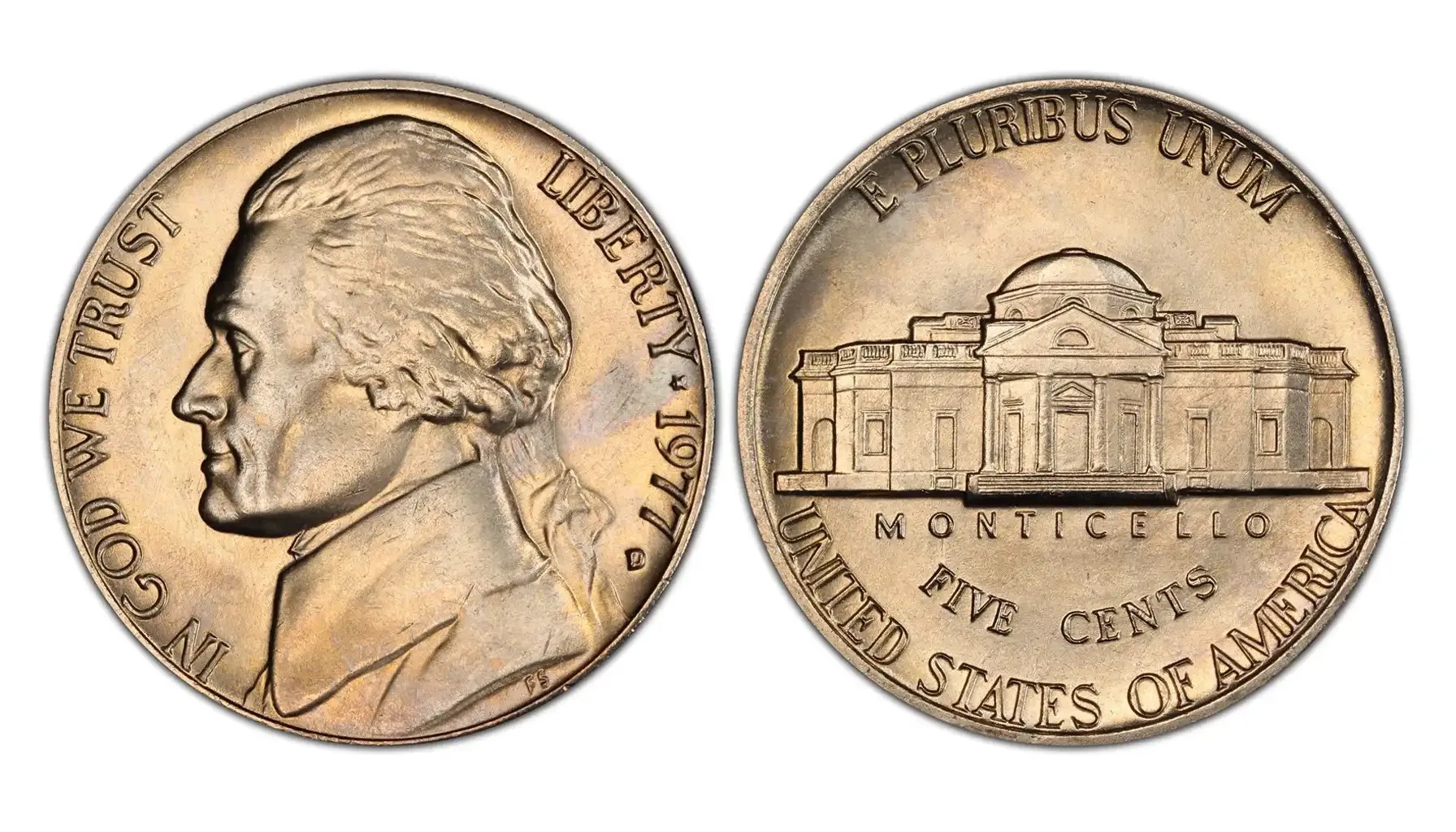
Examining Your Coin: What to Look For
Check the Date and Mint Mark — Confirm 1977 and identify “D,” “S,” or no mint mark.
Inspect for Wear — Examine Jefferson’s cheek, jawline, and Monticello steps under bright light.
Evaluate Strike Quality — Look for visible, separated lines on the Monticello steps for the Full Steps designation.
Search for Errors — Rotate the coin and use magnification to detect doubling or cracks.
Compare Values — Cross-check your observations using reputable sources or Coin ID Scanner for real-time estimates.
Common Mistakes in Self-Assessment
Beginners often misread faint mint marks, confuse strike weakness for wear, or overestimate grade due to lighting or angle. Always use magnification, handle coins carefully in gloves, and when in doubt, consult a professional grader or rely on Coin ID Scanner for accurate digital identification if 1977 nickel value no mint mark.
From Knowledge to Action: Next Steps for Collectors
Professional Appraisal Options
If you believe your coin has strong strike details, minimal wear, or shows the Full Steps designation, it’s worth submitting for professional grading. Reputable services like:
PCGS (Professional Coin Grading Service)
NGC (Numismatic Guaranty Company)
offer certification, grade assignment, and tamper-proof encapsulation. Graded coins come with unique serial numbers and online verification for strong authenticity insurance.
In many cases, professionally graded 1977 nickels have doubled or tripled in price upon resale. Certified coins are also easier to trade online and are accepted by major auction houses and dealers without dispute.
Using Technology for Coin Valuation
Modern numismatics now relies heavily on digital helpers for quick and accurate identification. The most reliable among them is Coin ID Scanner, designed for coin collectors of all levels.
How Coin ID Scanner Works:
Snap a Photo: Take a clear picture of your 1977 nickel’s obverse and reverse.
Automatic Analysis: The app detects the year, mint mark, and type using advanced image recognition.
Instant Valuation: It estimates market value based on current auction records, grade trends, and demand data.
Save and Track: Users can store results in a personal digital portfolio to monitor appreciation or compare with similar listings.
In addition to Jefferson nickels, Coin ID Scanner supports thousands of U.S. and world coin types for authentication, error detection, and market tracking.
Frequently Asked Questions
Is a 1977 nickel worth any money?
Circulated examples are face value, but mint-state or Full Steps coins can sell for $10 to over $4,000, depending on grade and rarity.
What is the composition of a 1977 nickel? Does it contain silver?
All 1977 nickels are 75% copper and 25% nickel, with no silver content.
Where is the mint mark located on a 1977 nickel?
On the obverse, to the right of Jefferson’s portrait, just below IN GOD WE TRUST.
What are the different 1977 nickel varieties (P, D, S) and which one is the most valuable?
The 1977 nickel was struck in Philadelphia (no mint mark), Denver (D), and San Francisco (S). The 1977-D Full Steps variety is the most valuable, often selling for $4,000+ in top condition.
How much is a 1977 no mint mark nickel from Philadelphia worth?
Most 1977 Philadelphia nickels are worth 5–30¢ in circulation and up to $400+ for top-grade Full Steps examples.
What is a 1977-D nickel, and is it rare?
The 1977-D nickel is common in circulation but rare in MS66+ Full Steps, where prices can exceed $4,000 at auction.
Are there any rare errors or special finishes for the 1977 nickel, like proof coins?
Yes. The 1977-S proof features a mirror finish, and rare mint errors like double dies or off-center strikes can be worth hundreds of dollars.
While the 1977 nickel is still new, just the year alone won’t bring you a huge paycheck. Yet, with certain varieties, it can be sought-after by many collectors. Train your eye to notice these tiny hints and use digital tools to help you — this kind of practice will turn you into a pro from a novice.

 Facebook
  X (Twitter)
  Pinterest
  LinkedIn