Contents:
Coins that have been released decades ago usually draw a lot of attention. For the sake of the most immaculate pieces, collectors are often ready to pay thousands of dollars, no matter how rare or obscure the coin may seem. This is particularly true about the 1977 one dollar coins and their half-value counterparts.
At first, 1977 may not look like a special year, yet in reality, it was the period of bright innovations, extraordinary errors, and designations that conceal the real worth. Let us briefly explore the 1977 dollar coin value, half dollar peculiarities, and the main features that identify these coins as genuine collectibles.
The 1977 Eisenhower Dollar Coin Overview
First, let us start with the basics. The series was launched in 1971 with the introduction of the 1971 Eisenhower Dollar. The idea of this release was rather simple: to replace a bit of a trite Peace Dollar and commemorate both President Dwight D. Eisenhower and the Apollo 11 moon landing on the same coin.
Although it was originally intended for everyday use, its immense size and weight made it less popular in circulation, which is why many pieces were saved by collectors in AU to MS conditions all over the country.
Design of the One Dollar Coin 1977
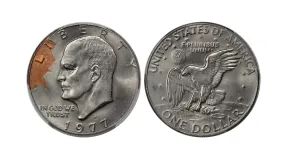
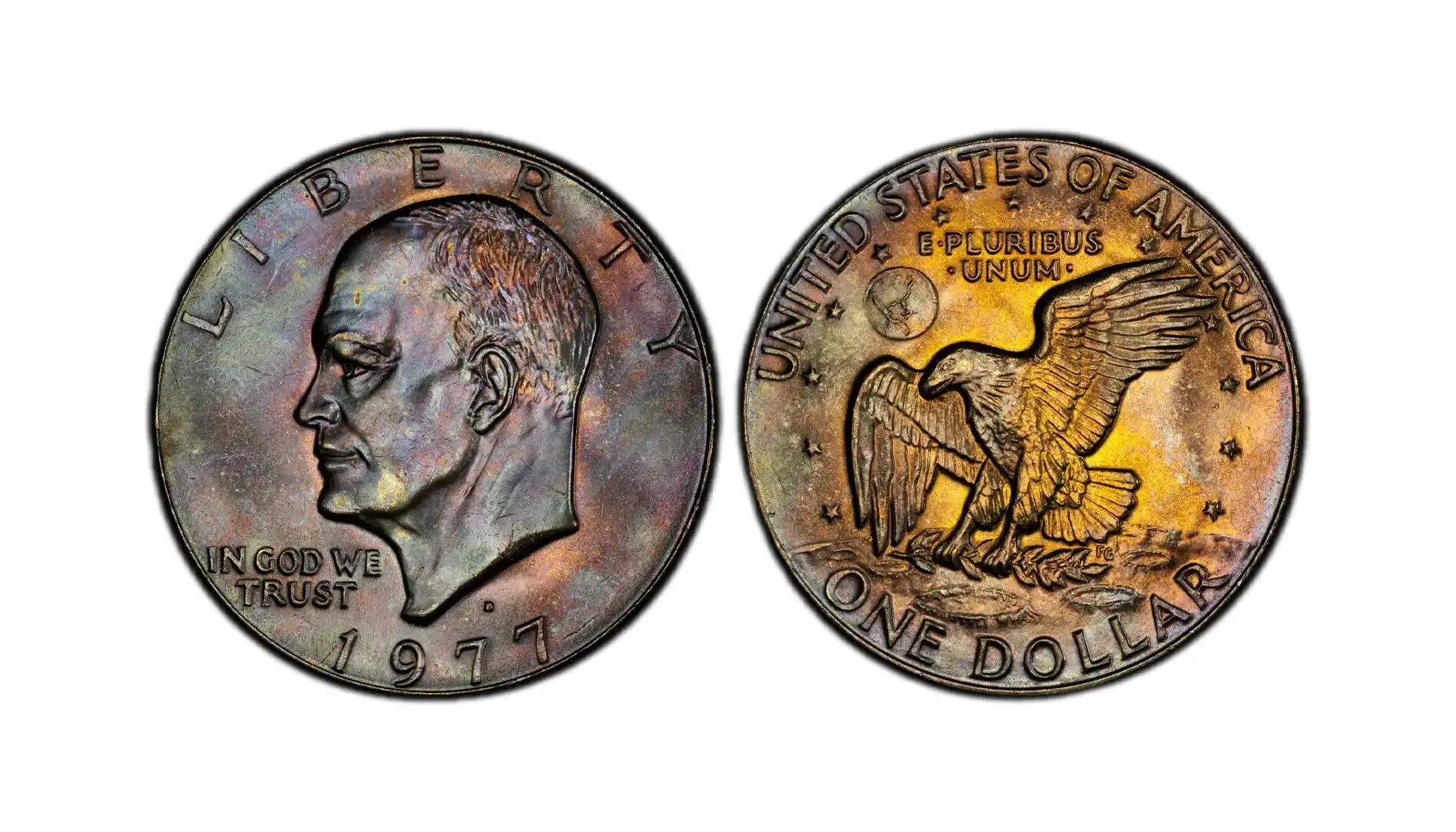
Obverse: Features a left-facing profile portrait of President Dwight D. Eisenhower, along with the inscriptions "LIBERTY" (top), "IN GOD WE TRUST" (lower left), and the year 1977 along the bottom rim.
Reverse: Introduces an eagle landing on the Moon while holding an olive branch, surrounded by the inscriptions "UNITED STATES OF AMERICA" (top), "E PLURIBUS UNUM" (above the eagle), and "ONE DOLLAR" (bottom).
The Main Features | |
Composition | 75% copper, 25% nickel over a pure copper center |
Weight | 22.70 grams |
Diameter | 38.1 mm |
Thickness | 2.58 mm |
Edge | Reeded |
Designer | Frank Gasparro |
Mintage Information
Just like its predecessors, the 1977 1 dollar coin was produced by their major minting facilities, i.e.,:
Philadelphia Mint: 12,596,00 pieces
Denver Mint: 32,983,006 pieces
San Francisco Mint: 3,251,152 pieces (only proofs)
Among these, Denver was the most productive, while San Francisco, primarily intended for collections and investments, was more sought-after by collectors.
Errors That Matter
Partial Missing Clad Layer (12%)
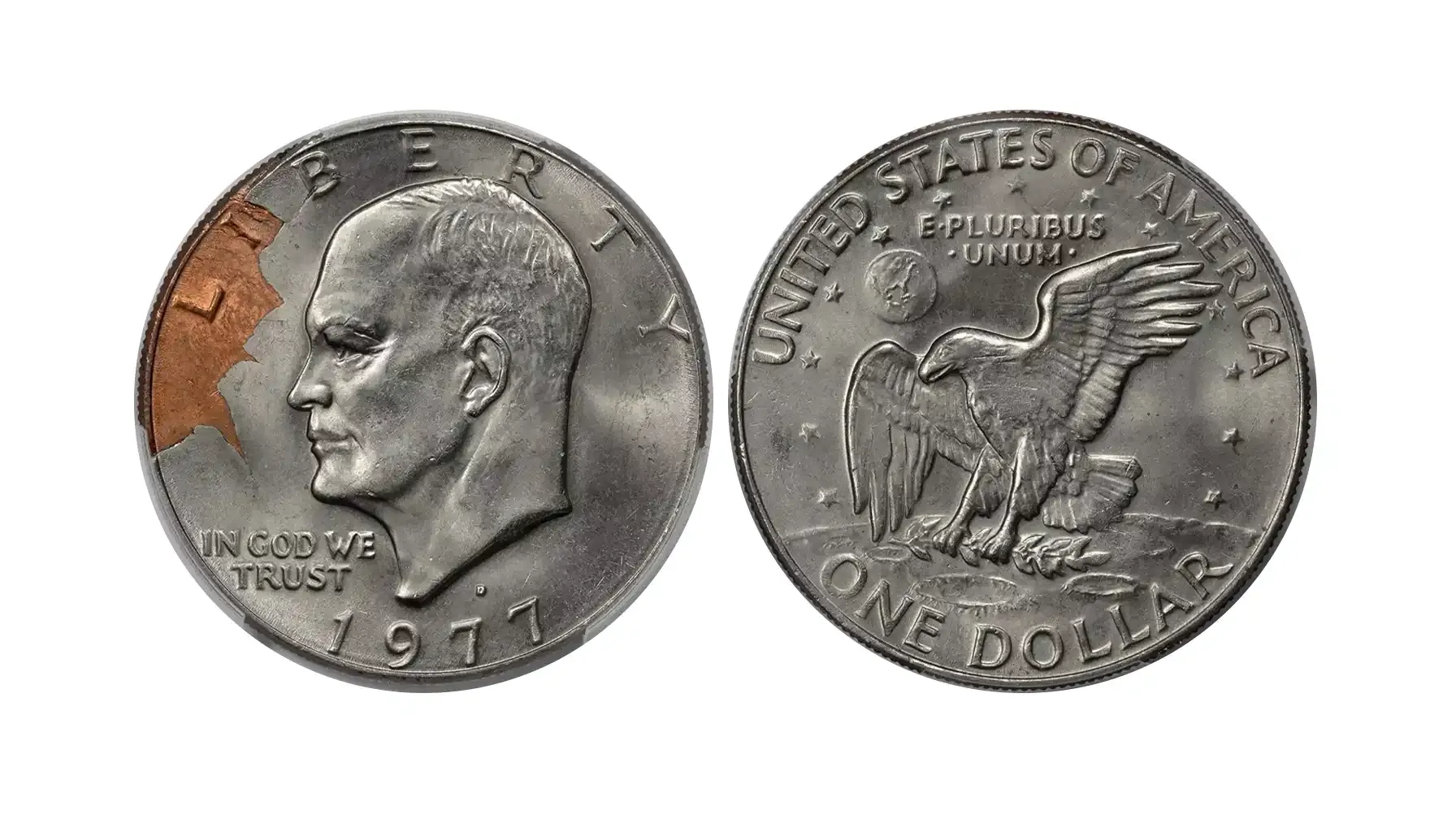
Estimated Value: $1,400
Sometimes, errors may only affect the layering of the coin, rather than its specific design details. This error, for instance, occurs when the nickel-clad layer fails to fully bond to the copper core, which is why an area of the surface may expose the reddish copper beneath. At first glance, it is a decent deviation, for it is obvious, aesthetically fulfilling, and distinctive to spot.
Struck Through Reeding
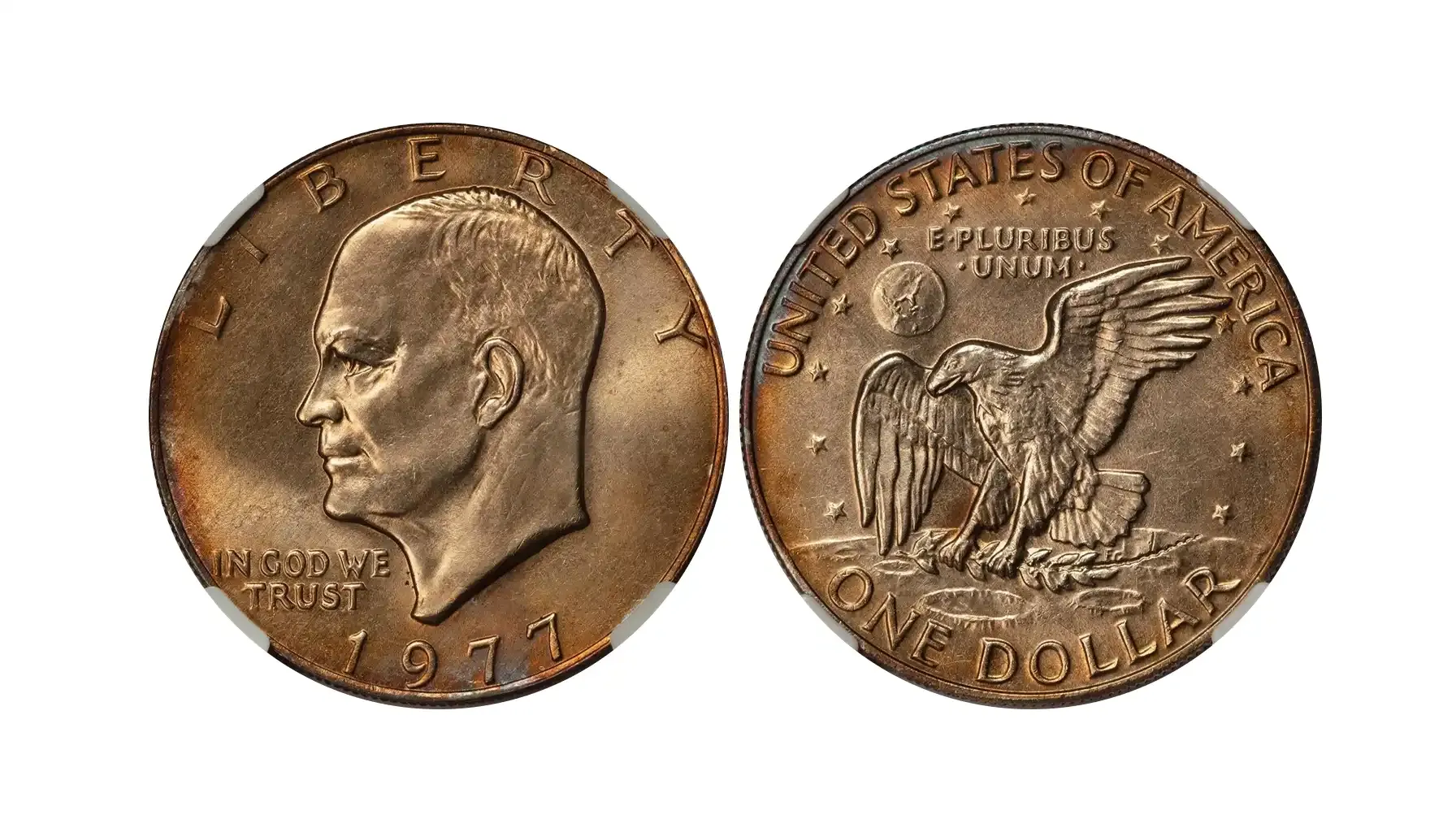
Estimated Value: $850
Here comes another flaw where a reeded edge fragment/striking debris is forced into the coin during minting. The end result is a sequence of deep, uneven grooves or imprints that run across the design with a warped, unique appearance.
Double Curved Clips
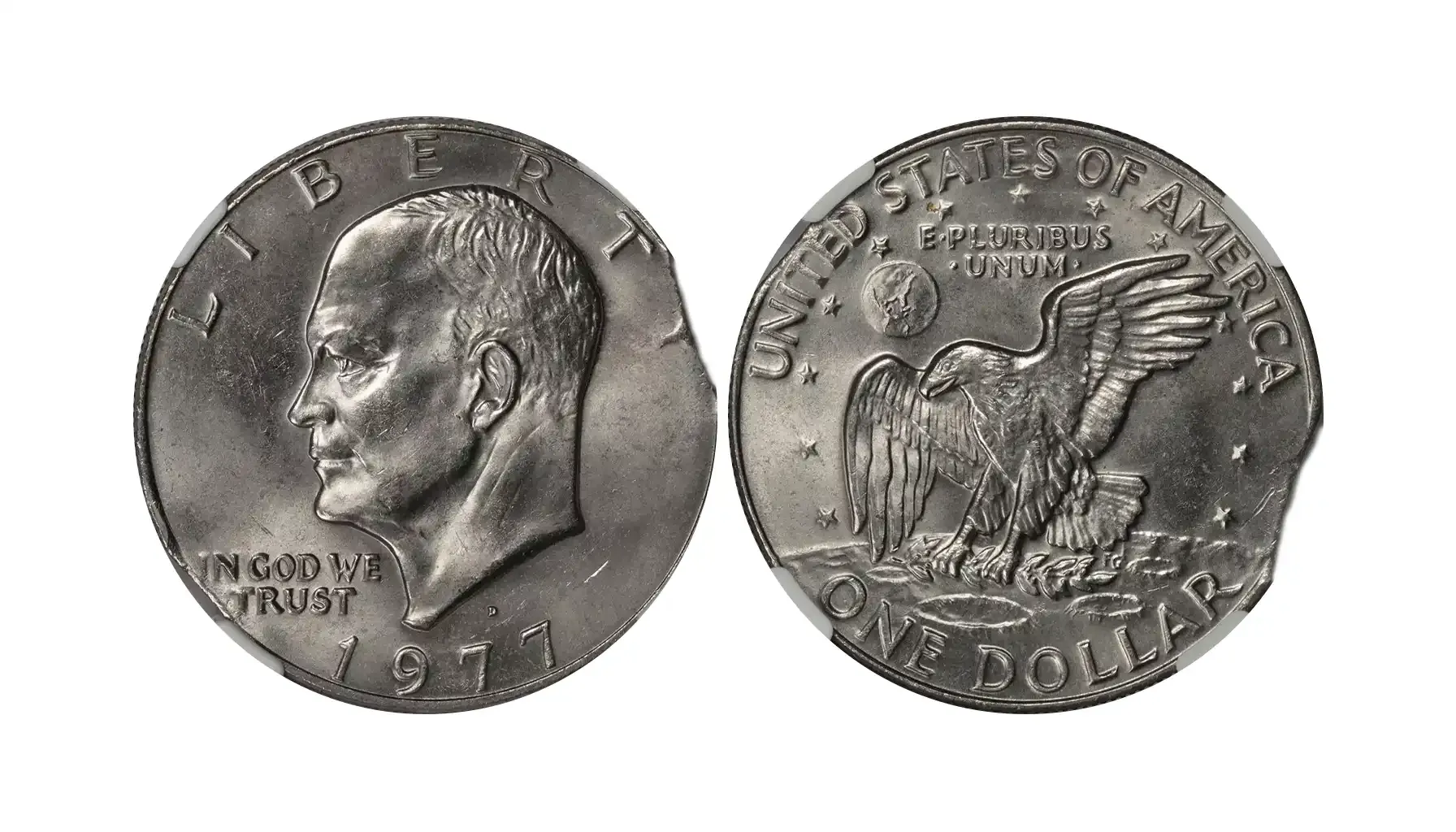
Estimated Value: $350
When the unity of the coin is violated, there might appear blank spots without part of the coin at all. This usually happens when the planchet is misfed into the cutting or striking process, which leaves two or more sections of the rim absent. Although one may believe that only a perfect shape of the coin may gain premiums, it is not particularly true – any error may boost the 1977 one dollar coin value significantly.
Off-Center Strike
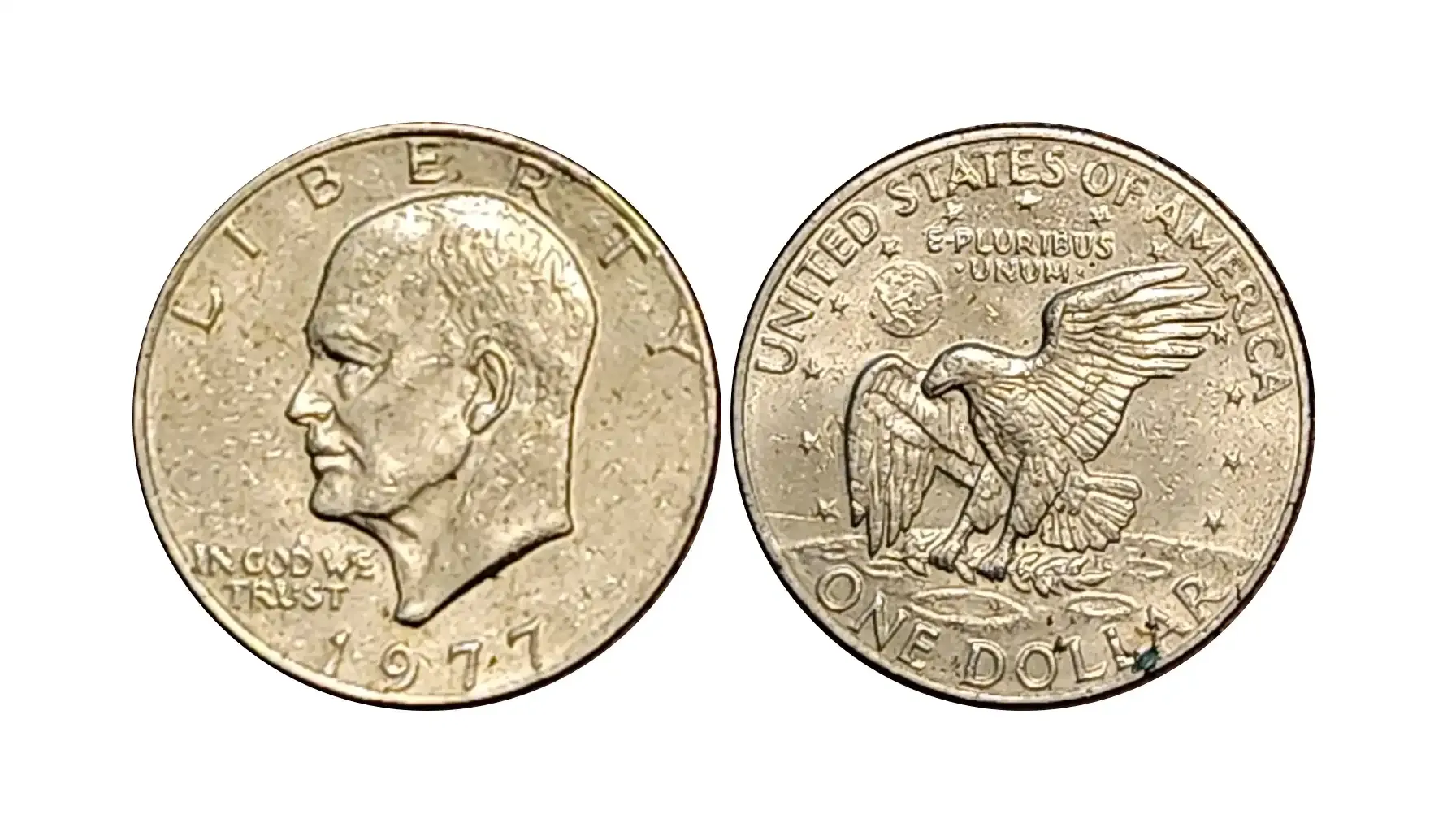
Estimated Value: $50
Among the most widespread minting errors is definitely an off-center strike that may boast a shifted design. Depending on the degree of the misalignment, some of the decorative elements may be missing, while staying within the framework of the original shape. The more dramatic the off-center, the greater the collector appeal and value – this is the rule.
How Much Is a 1977 Dollar Coin Worth?
The 1977 dollar coin value today is a continuously changing variable that depends on several factors, i.e., mint mark, condition (grade), and the erroneous nature of its appearance. Indeed, average pieces from circulation are worth face value only, yet higher-grade examples, as well as proof issues and those with intriguing backgrounds, may be sold for thousands of dollars.
Anyway, let us focus on creations that cannot boast anything outstanding but their appearance and the beauty of their preservation.
Grade | 1977-P | 1977-D | 1977-S (Proof) |
Fine (F12) | $1.05 | $1.05 | – |
Extremely Fine (XF40) | $1.25 | $1.25 | – |
About Uncirculated (AU50) | $2 | $2 | – |
Mint State (MS60) | $5 | $5 | – |
Gem (MS65) | $50 | $45 | – |
Proof / PR65 | – | – | $12-$20 |
Note: Prices are subject to change. For the most accurate and up-to-date results, please consult numismatic auction platforms, use apps like Coin ID Scanner, or refer to reputable coin-grading services, e.g., NGC or PCGS.
The 1977 Half Dollar Coin Overview
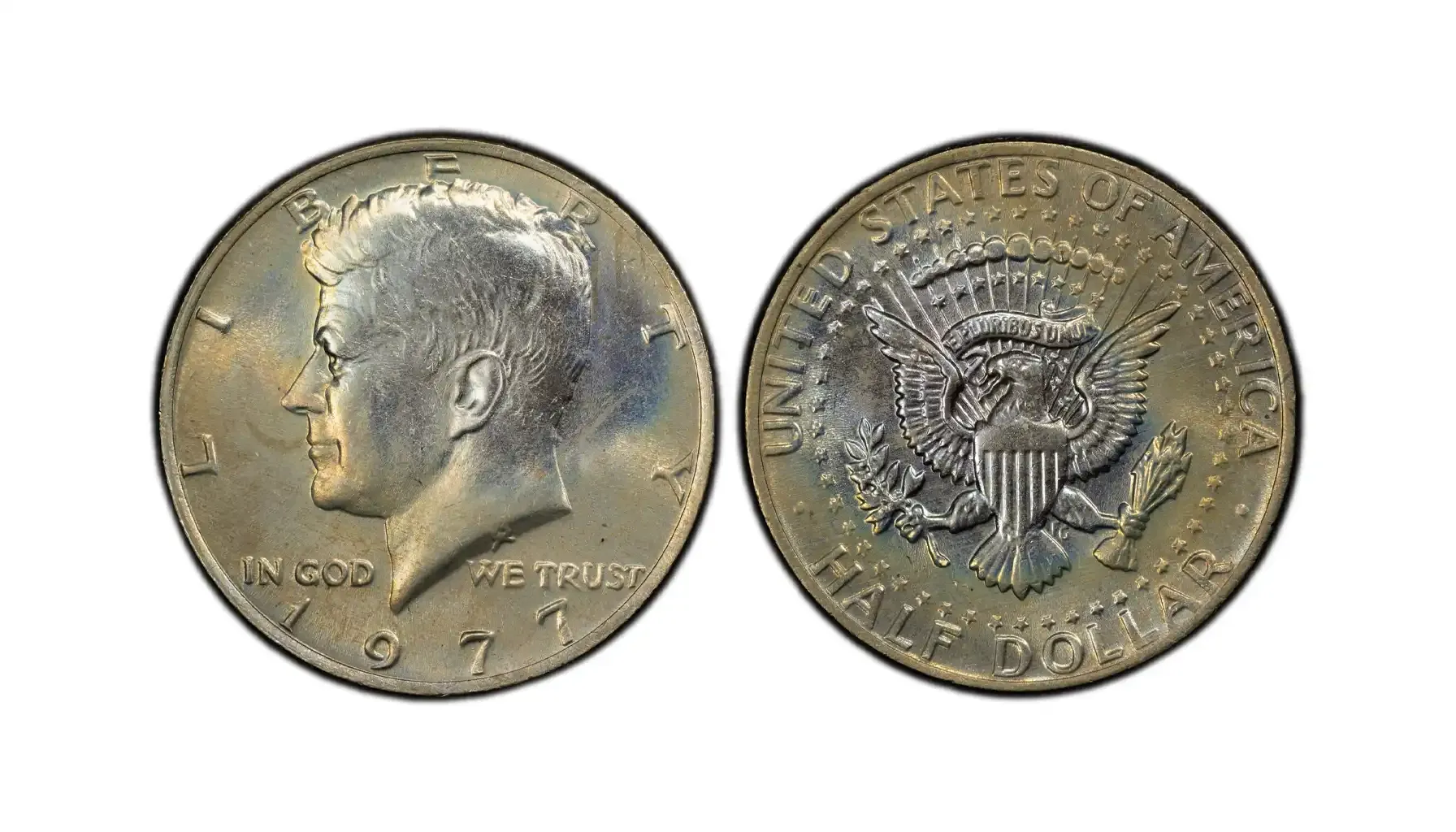
The second-largest coin denomination in the US currency is a half dollar. The Kennedy Half Dollar, one of the greatest programs in coinage history, was first issued in 1964, a few months after the assassination of beloved President John F. Kennedy.
Initially, these numismatic creations contained 90% silver, yet by 1971 the series shifted permanently to a copper-nickel clad composition because of shortages and rising precious metal prices. The half dollar coin 1977 can be proudly named a favorite choice for collectors who look for barely circulated pieces of the past.
Related article: 1964 Kennedy Half Dollar Value: Key Dates, Mint Marks & Market Trends
Design of a 1977 50-Cent Coin
Obverse: Depicts the portrait of President John F. Kennedy, designed by Gilroy Roberts, along with the inscriptions "LIBERTY" (around the top), "IN GOD WE TRUST" (split, lower left and right), and the year "1977" (along the bottom edge).
Reverse: Demonstrates the Presidential Seal, i.e., a heraldic eagle with a shield on its chest, clutching an olive branch and arrows, surrounded by a circle of stars. The image is supported by the inscriptions "UNITED STATES OF AMERICA" (top), "E PLURIBUS UNUM" (right above the eagle’s head), and "HALF DOLLAR" (bottom).
The Main Characteristics | |
Composition | 75% copper, 25% nickel over a pure Copper center |
Weight | 11.34 grams |
Diameter | 30.6 mm |
Thickness | 2.15 mm |
Edge | Reeded |
Designer | Gilroy Roberts |
Mintage Information
Just like the 1977 United States one dollar coin, half dollar was also produced in three major US Mint, which include:
Philadelphia Mint: 43,598,000 pieces
Denver Mint: 31,449,106 pieces
San Francisco Mint: 3,251,152 pieces (only proofs)
As usual, it was the Philadelphia Mint that struck the highest number of coins, though the numbers were not as impressive as those of other denominations and coin types.
Errors That Matter
Off-Center Strike
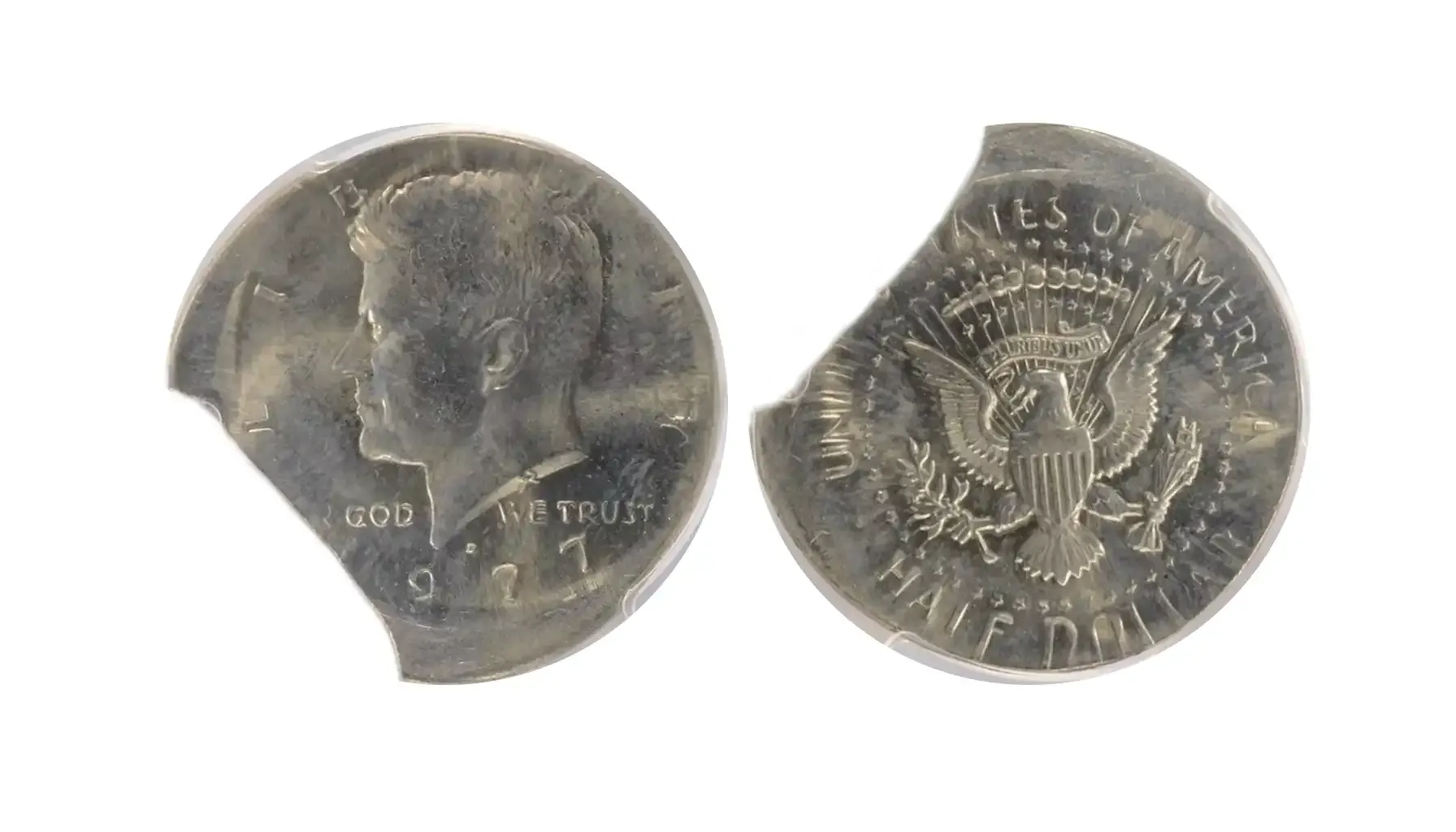
Estimated Value: $995
As we have mentioned before, sometimes, coins may exhibit misaligned designs, but the degree of this misalignment may vary. When it is coupled with other errors like clipped planchets, both the value and appeal increase significantly. The more dramatic, the better.
Curved Clip
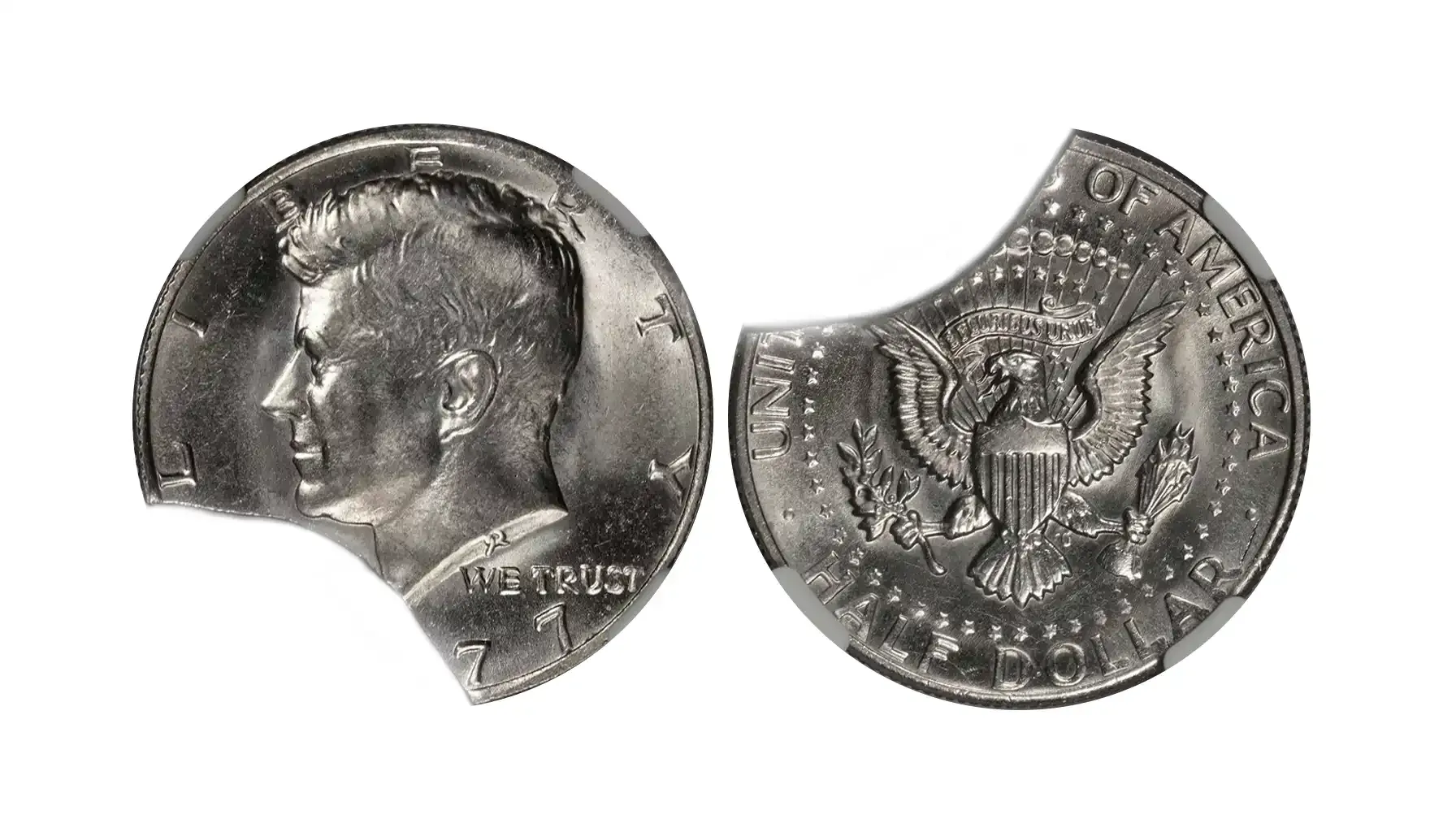
Estimated Value: $750
Should the coin blank be partially clipped during the cutting/feeding process, there might appear a curved missing section along the rim. This, in turn, can be subject to speculation, as such errors are relatively easy to counterfeit.
Double Die Reverse
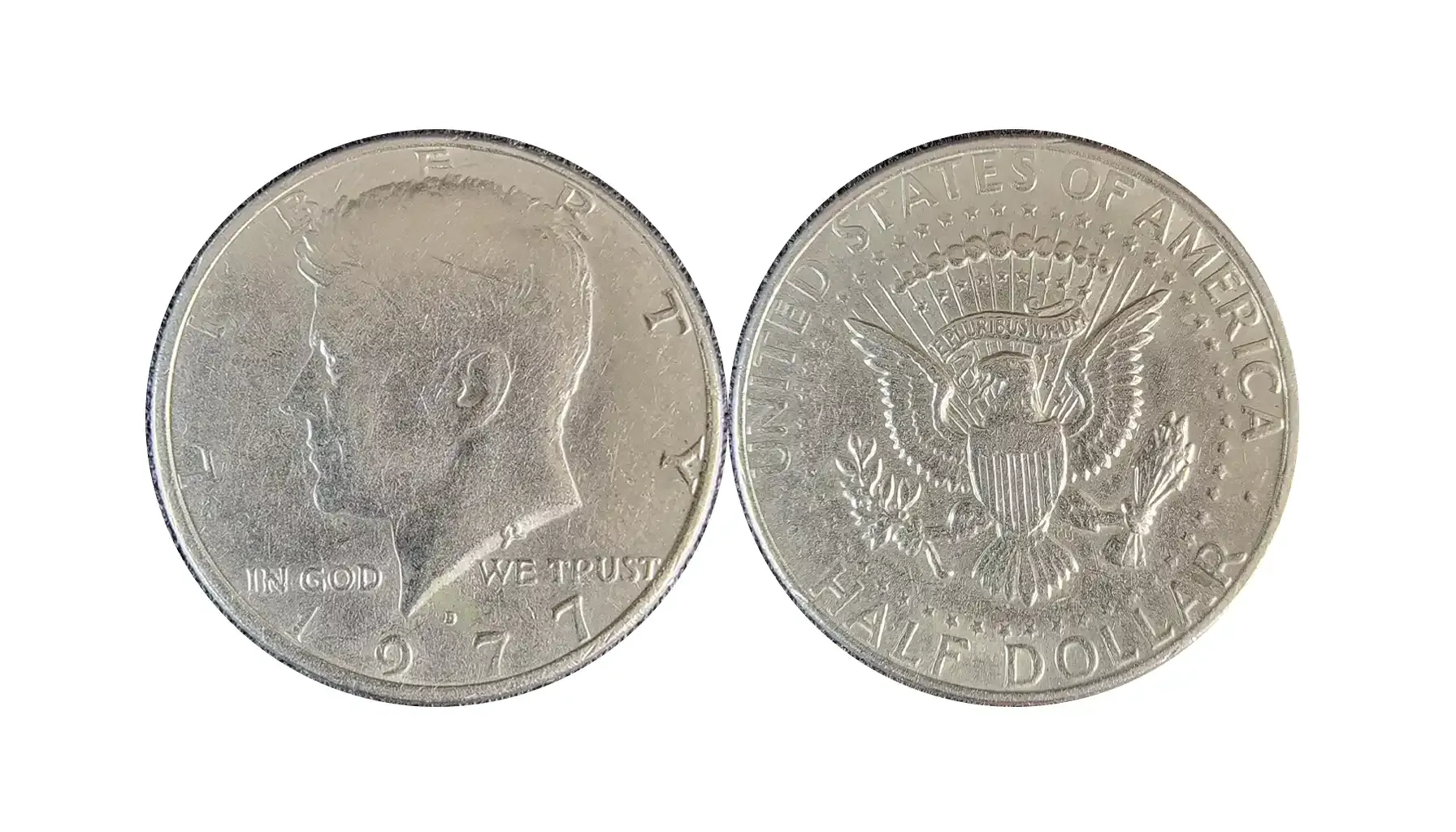
Estimated Value: $350
This is definitely one of the most common minting deviations when the die imprints the design twice in slightly different positions. As a result, one may see a noticeable doubling of design elements on the reverse side, often visible in lettering or the eagle’s features (the same could happen on the obverse side, too).
What Is the 1977 Half Dollar Coin Value?
The 1977 half dollar coin value is not really different in terms of its formation. Since the year was not marked with important numismatic events, it is unlikely that these units will be praised for their historical relevance. Nevertheless, it is all about the appearance, preservation, full luster, and eye appeal in general.
Grade | 1977-P | 1977-D | 1977-S (Proof) |
Fine (F12) | $0.50 | $0.50 | – |
Extremely Fine (XF40) | $0.55 | $0.55 | – |
About Uncirculated (AU50) | $0.65 | $0.65 | – |
Mint State (MS60) | $1 | $1 | – |
Gem (MS65) | $6 | $6 | – |
Proof / PR65 | – | – | $10–$15 |
Note: Prices are approximate and may fluctuate with market demand.
$1 or 50C?
But which coin to collect first? It is definitely a difficult question, for this depends on personal preferences, overall collection goal, and current situation on the numismatic market. To make the selection more thoughtful, we highly recommend that you use Coin ID Scanner for full coin analysis, numismatic explorations, and collection management. What if, one day, this app helped you strike numismatic gold?
Feature | 1977 $1 | 1977 50C | Tip |
Size & Weight | Large, heavier | Medium, lighter | Dollar is visually impressive; half is easier to store |
Face Value | $1 | $0.50 | – |
Common Errors | Partial Clad, Struck Thru Reeding, Double Curved Clips, Off-Center | Off-Center, Curved Clip, Double Die, Missing “FG” | Dollar errors are more striking |
Circulation Availability | Lower | Higher | Half dollars are easier to find in high grade |
Collector Appeal | High for novelty and errors | High for condition and classic design | – |
Value Potential | $50-$1,400+ | $20-$995+ | Dollar can reach higher top-end prices |
The coins from 1977 may seem distant, but their beauty, rarity, and value are much closer than you think…

 Facebook
  X (Twitter)
  Pinterest
  LinkedIn