Contents:
The realm of American coinage is a vivid combination of beauty, controversy, and legacy trapped in the metal plates. Its minting tradition, which may comprise numerous design patterns, striking techniques, regional variations, and political influences, was mainly about allegorical representations of peace and liberty, as well as commemorations of presidents who shaped the nation’s prosperity.
Nevertheless, beyond presidents, there were other figures honored with a place on US coins.
One of them is Benjamin Franklin, i.e., the Founding Father and a prominent political philosopher of the past. In 1948, Franklin became the face of a new half dollar series, though its dominance did not last long. In this material, we have compiled general information about the so-called 1953 Ben Franklin half dollar value and the features that identify this coin as unique. So, let us see.
The Origins of the Franklin Half Dollar Series
As usual, the history of the coin started with an idea of acknowledging, praising, and commemorating an outstanding person who managed to contribute to the development of the country. In this context, it is vital to refer to Benjamin Franklin, a Founding Father renowned for his intellect and diplomatic endeavors.
This aspiration originated with Mint Director Nellie Tayloe Ross, who admired Franklin and wished to immortalize his legacy on an object of daily use, i.e., a coin. In part, Ross was inspired by a 1933 medal designed by chief engraver John R. Sinnock, which depicted Franklin himself. She believed that although Franklin had opposed portraits on numismatic creations during his lifetime, he might have approved of a posthumous tribute celebrating his influence.
Having been commissioned to develop a new design, Sinnock alluded to his earlier medal design for the obverse, which was based on a bust by the renowned sculptor, Jean-Antoine Houdon. Nonetheless, the work was never meant to be done. After Sinnock’s death in 1947, the reverse design was completed by his successor, Gilroy Roberts, for the coin to be released as intended.
Despite initial objections from the Commission of Fine Arts, which unanimously questioned the depiction of the cracked Liberty Bell and the diminutive eagle on the reverse, the Treasury Department approved the design anyway. This is how the Ben Franklin half dollar 1953 was actually born.
Related article: 10 Most Valuable Franklin Half Dollars: Everything You Need
Design Features of the 1953 Benjamin Franklin Half Dollar
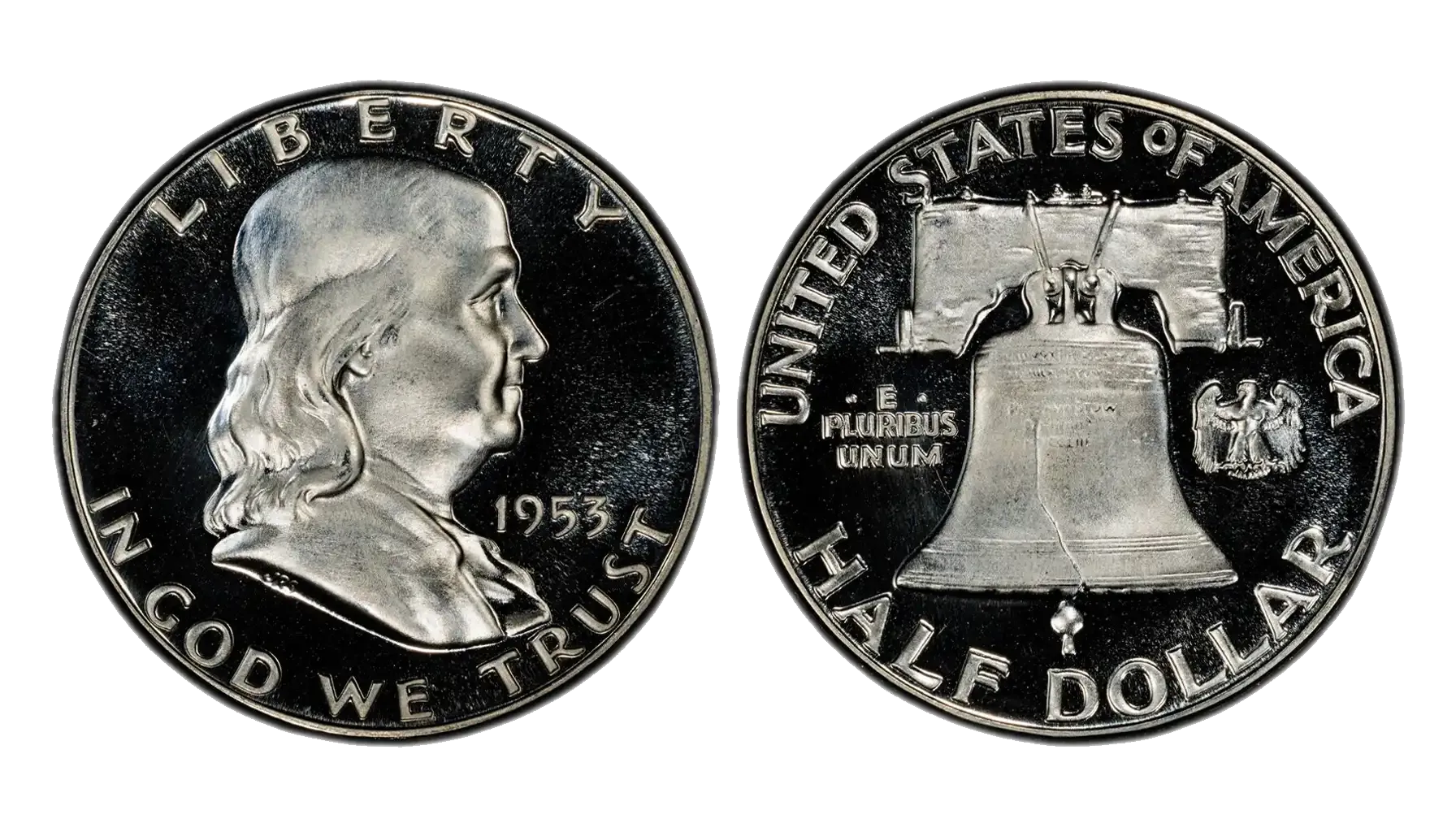
Obverse: The obverse side features a detailed right-facing portrait of Benjamin Franklin with his distinctive furrowed brow, spectacles, and flowing hair. As for the inscriptions, this side may demonstrate “LIBERTY” along the upper rim, the year “1953” located beneath Franklin’s chin, and “IN GOD WE TRUST” along the bottom edge.
Reverse: The reverse showcases the Liberty Bell, a symbol of American independence, with an iconic crack, along with a small soaring eagle to the right (as a measure to comply with U.S. coinage law requiring an eagle on all half dollars without exceptions), the inscriptions “UNITED STATES OF AMERICA” along the top edge, the denomination “HALF DOLLAR” along the bottom edge, a mint mark just above the bell, and the national motto “E PLURIBUS UNUM” to the left.
The Main Characteristics | |
Composition | 90% silver, 10% copper |
Weight | 12.50 grams |
Diameter | 30.6 mm |
Thickness | 2.15 mm |
Edge | Reeded |
Mint Marks | None for Philadelphia “D” for Denver “S” for San Francisco |
Obverse Designer | John R. Sinnock |
Reverse Designer | John R. Sinnock / Gilroy Roberts |
Years of Issue | 1948-1963 |
1953 Half Dollar Coin Types and Mint Marks
1953 50C
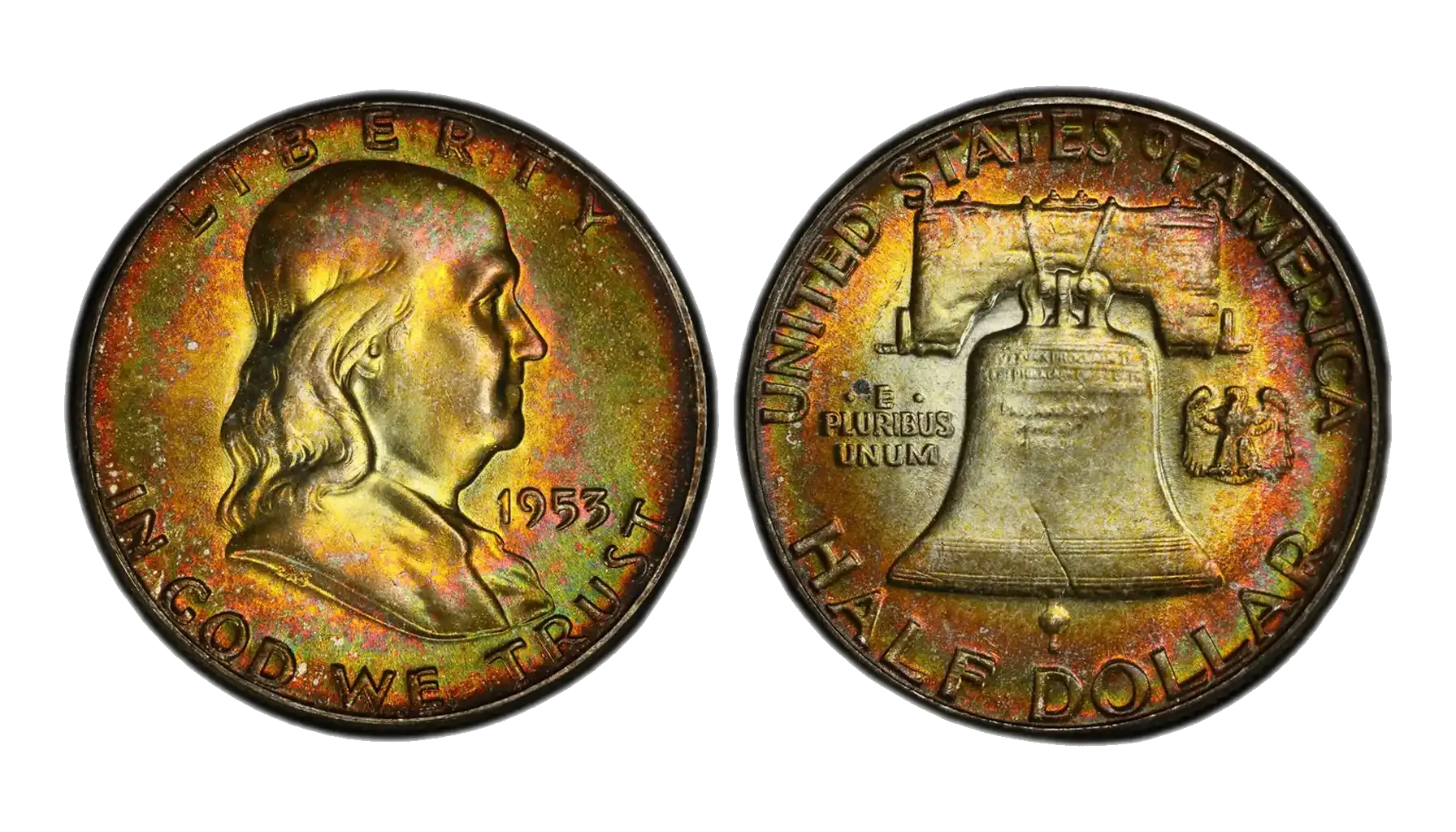
Produced by: Philadelphia Mint
Designations: MS, FBL
Mintage: 2,668,120
Auction Record: $19,200 for MS67FBL
Although the Philadelphia Mint is usually considered the primary minting location, the working load reserved for half dollar production was significantly lower than that of the Denver Mint. These circulation strikes, by tradition, do not bear any mint mark and may boast two main designations, i.e., MS and FBL (the latter refers to sharp, unbroken lower bell lines, which are scarcer than the first type).
1953-D 50C
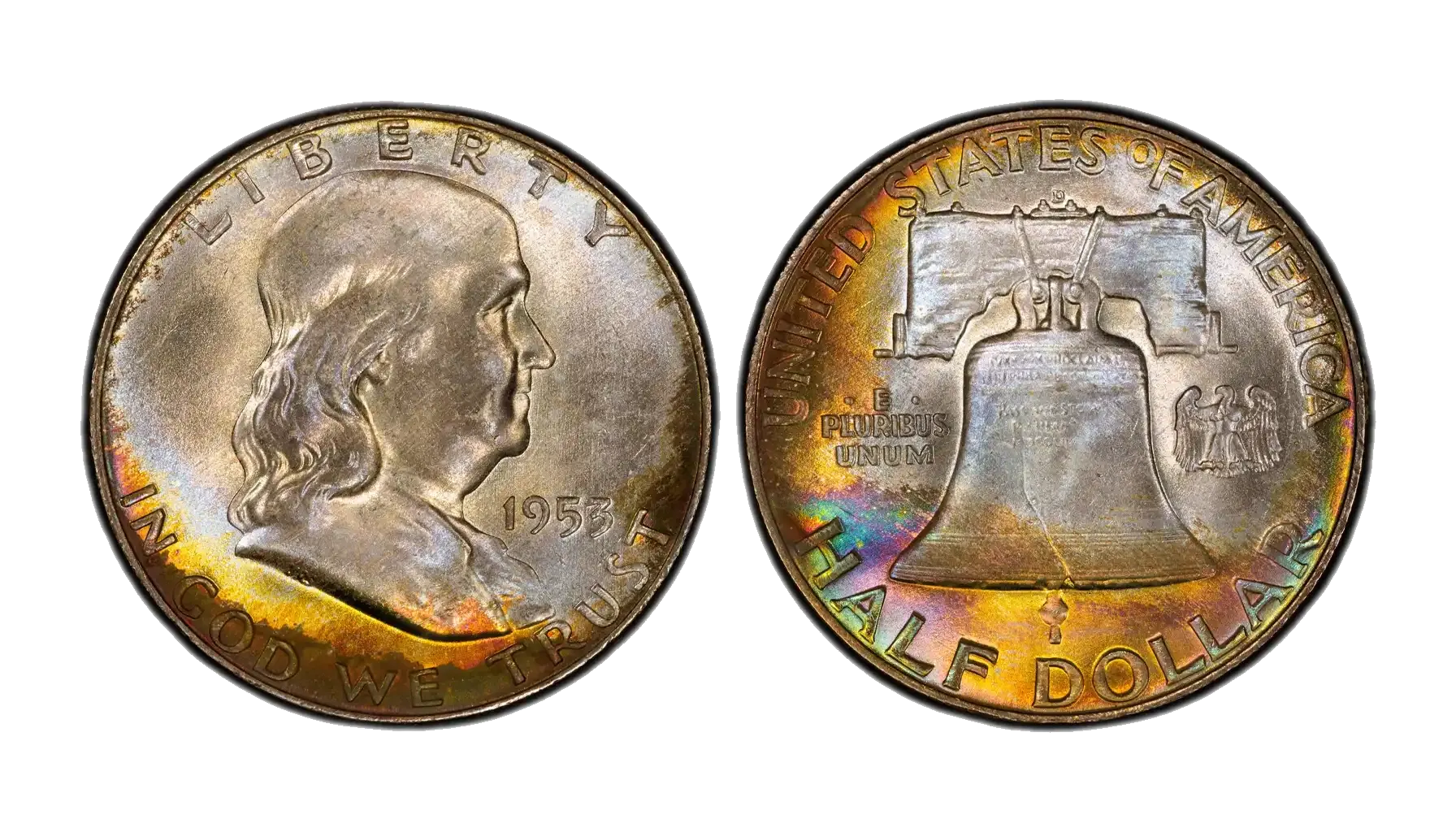
Produced by: Denver Mint
Designations: MS, FBL
Mintage: 20,900,400
Auction Record: $30,550 for MS67
The Denver issue is among the most fruitful batches within the entire series, which is generally known for lively mint luster and comparatively stronger strikes than its West Coast counterpart. Those who care about the 1953 D Franklin half dollar value may rest assured: these are decently priced items, and they are still available but require careful selection first.
1953-S 50C
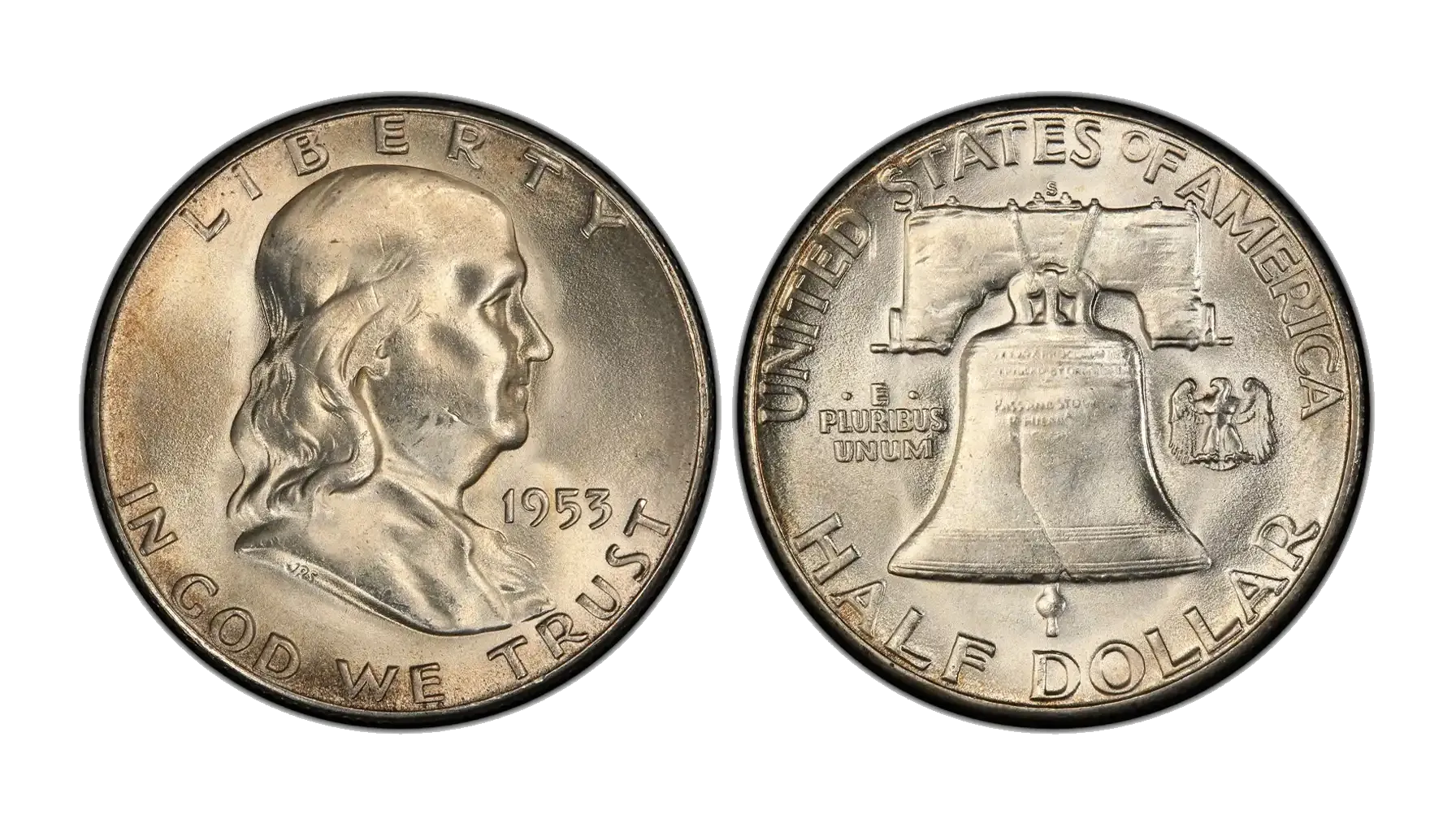
Produced by: San Francisco Mint
Designations: MS, FBL
Mintage: 4,148,000
Auction Record: $69,000 for MS66
The 1953 S Franklin half dollar is by far the most valuable, key circulation issue for FBL specialists. As a rule, strikes tend to be soft, especially on the Liberty Bell’s lower lines and the eagle’s feathers, which makes true FBL pieces exceedingly elusive (only a very small population is known to exist, and most were likely struck from fresh dies early in production).
1953 50C (Proof)
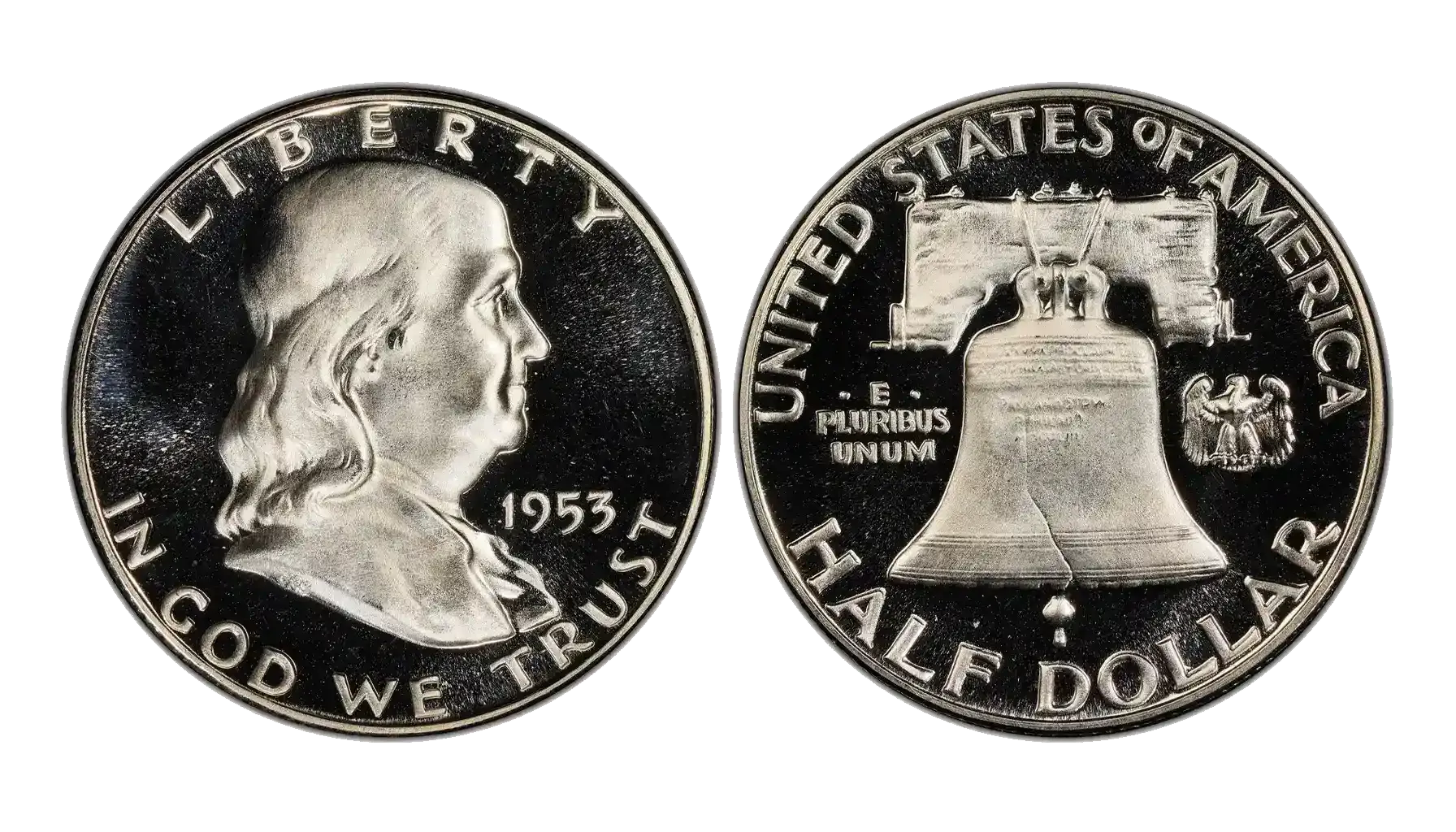
Produced by: Philadelphia Mint
Designations: PR, CAM, DCAM
Mintage: 128,800
Auction Record: $63,250 for PR68
The proof issues of the Franklin 50 cents were quite rare and could not be released each year. However, 1953 was a lucky year, with magnificent 1953 proof half dollars having been produced with mirror-like fields and needle-sharp details from specially prepared dies. As per PCGS, the coin may be characterized by three designations, i.e., PR proper, Cameo (CAM), or Deep Cameo (DCAM).
Notable 1953 Half Dollar Errors and Their Worth
“Bugs Bunny” Die Clash Error
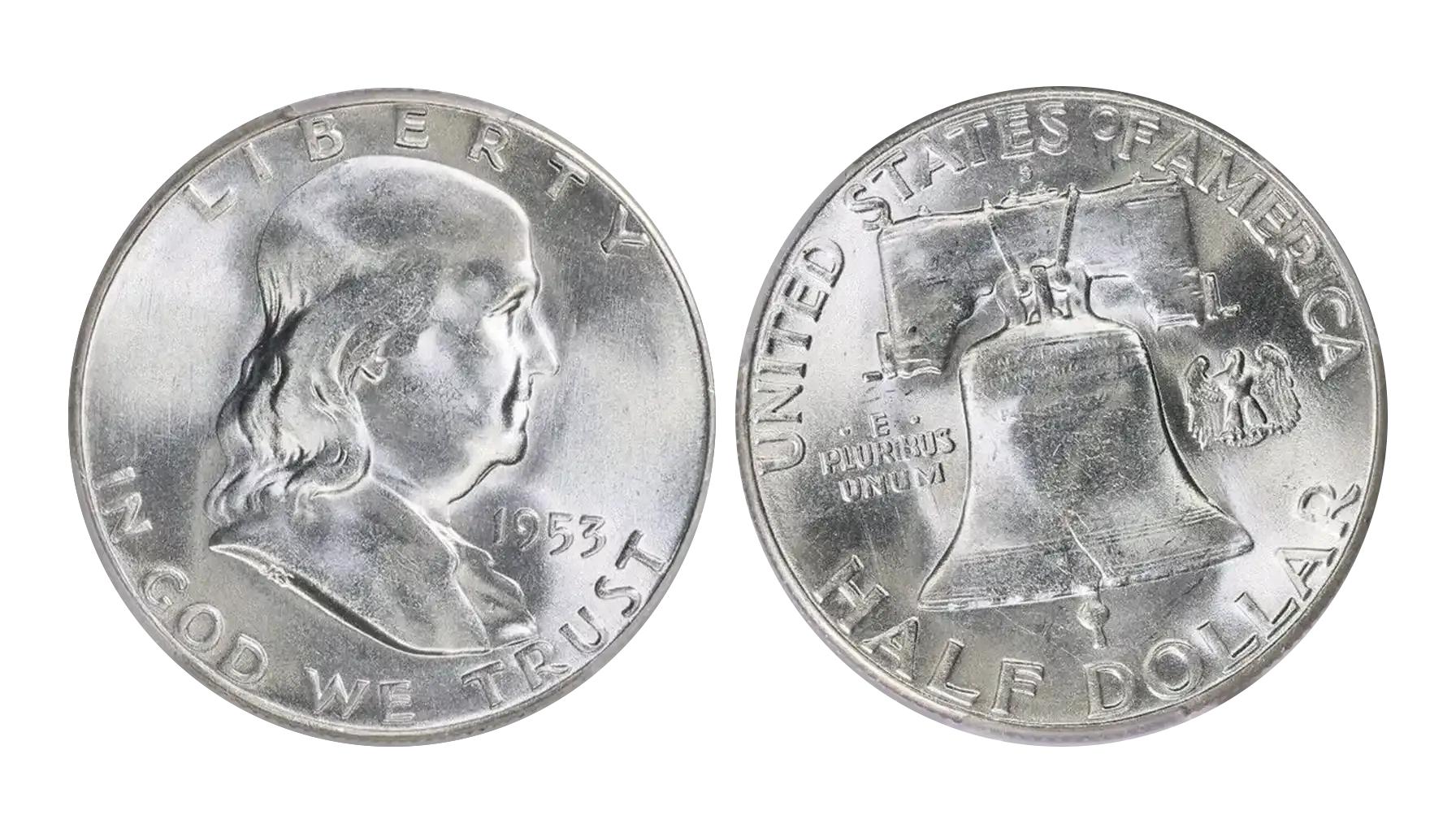
Estimated Value: $520
Here is probably one of the most interesting erroneous coins that one may find on the market these days. As intriguing as it sounds, this numismatic creation features a die clash error, which means that the obverse die clashed with the reverse die, leaving marks on Franklin’s mouth that might resemble protruding teeth.
Struck-Through Error
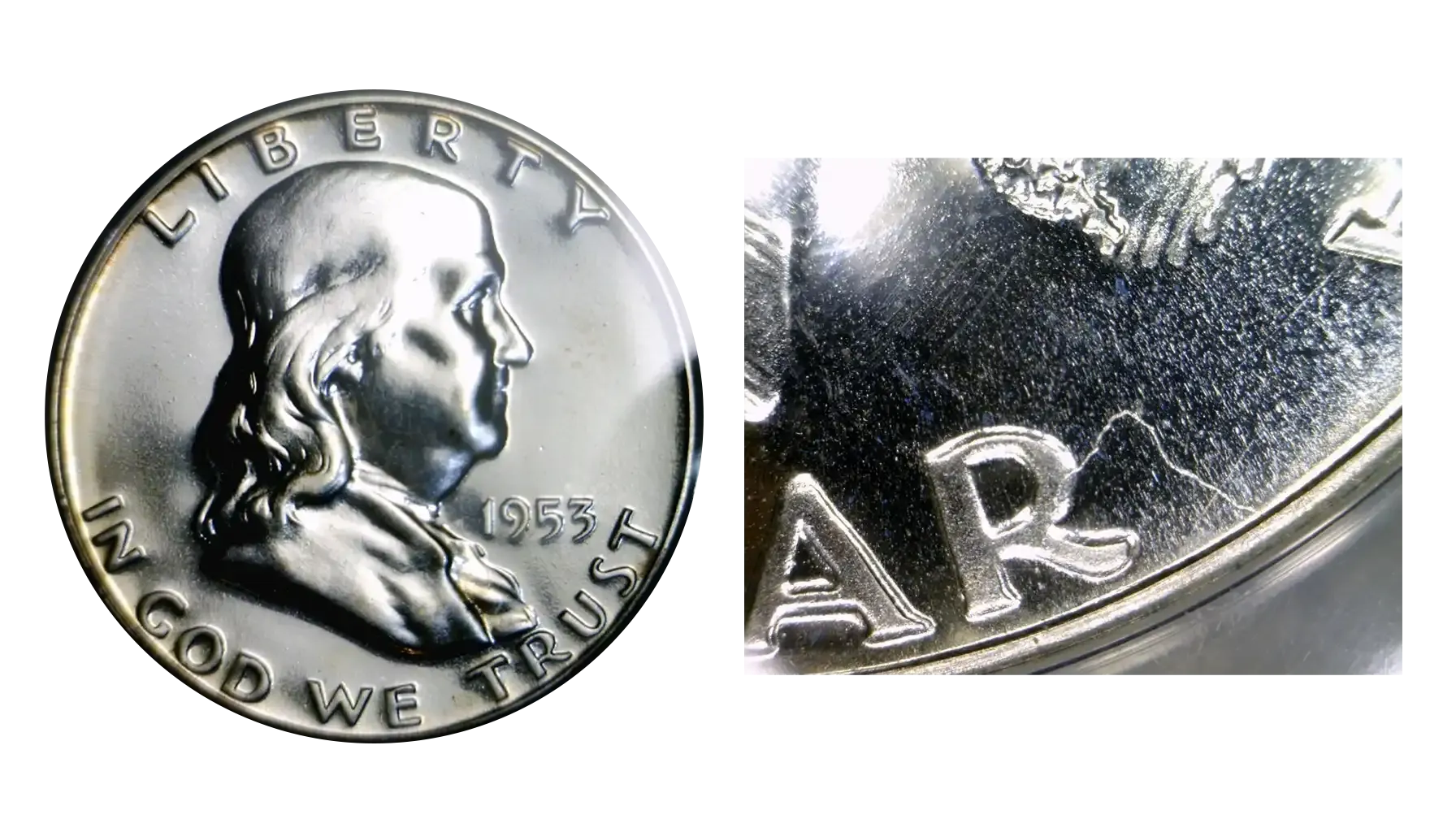
Estimated Value: $215
Strike thru errors are relatively common in general, but the location of the deviation and its severity may boost the 1953 D half dollar value for good. This presupposes that a foreign object, such as cloth, wire, or grease, came between the die and the coin planchet during striking, leaving behind an indentation or unusual surface texture.
Lamination Flaws
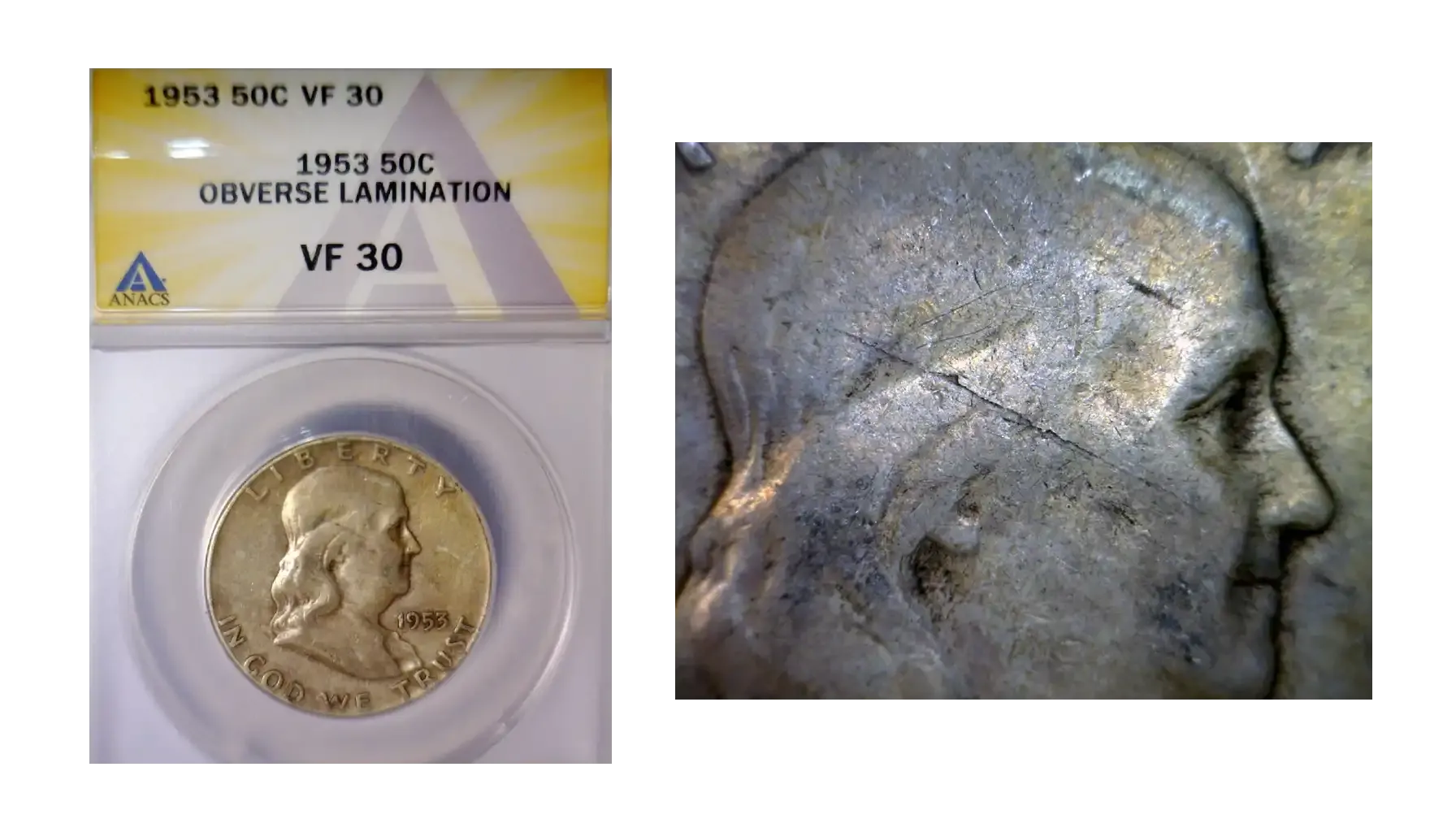
Estimated Value: $52
Sometimes, anomalies do not affect separate design features but refer to the surface as a whole. These are usually called lamination errors, i.e., alternations that occur when impurities or weaknesses in the planchet’s metal cause a thin layer to peel, split, or flake off. Consequently, the 1953 S Franklin half dollar value may go up, even though the anomaly is rather minor.
The 1953 Franklin Half Dollar Value by Grade
For those who wonder what the 1953 half dollar value today is, it is important to understand the main constituents of pricing and its tendencies. By and large, the value is determined by several factors, e.g., its silver content, condition, mint mark, and collector demand.
Since these are composed of 90% silver, each piece carries an intrinsic melt value based on current silver prices (generally around $9-10 at today’s bullion rates). Nonetheless, most pieces are still worth significantly more, especially when preserved in higher grades. So, how much is a 1953 half dollar worth per grade?
Grade | 1953 (P) | 1953-D | 1953-S | 1953 Proof |
G-VG (Good-Very Good) | $11-13 | $11-13 | $13-15 | – |
F-VF (Fine-Very Fine) | $13-15 | $13-15 | $15-18 | – |
XF (Extra Fine) | $15-18 | $15-18 | $18-22 | – |
AU (About Uncirculated) | $18-25 | $18-25 | $25-35 | – |
MS60-MS63 | $30-50 | $30-60 | $45-100 | $40-70 |
MS64-MS65 | $75-150 | $100-200 | $250-600 | $100-250 |
MS66+/FBL | $500-2,000+ | $600-3,000+ | $3,000-25,000+ | $500-3,000+ |
Proof (PR65-PR67) | – | – | – | $150-800 |
Proof (PR68/CAM/DCAM) | – | – | – | $1,500-10,000+ |
See also: Silver Price Predictions 2030: How High Could It Go?
For Those Who Have Questions…
Barely do collectors think of external help. They believe that suffering in this intricate numismatic way is ok, but here is the truth: support is vital, and having it does not diminish the experience; it enhances it.
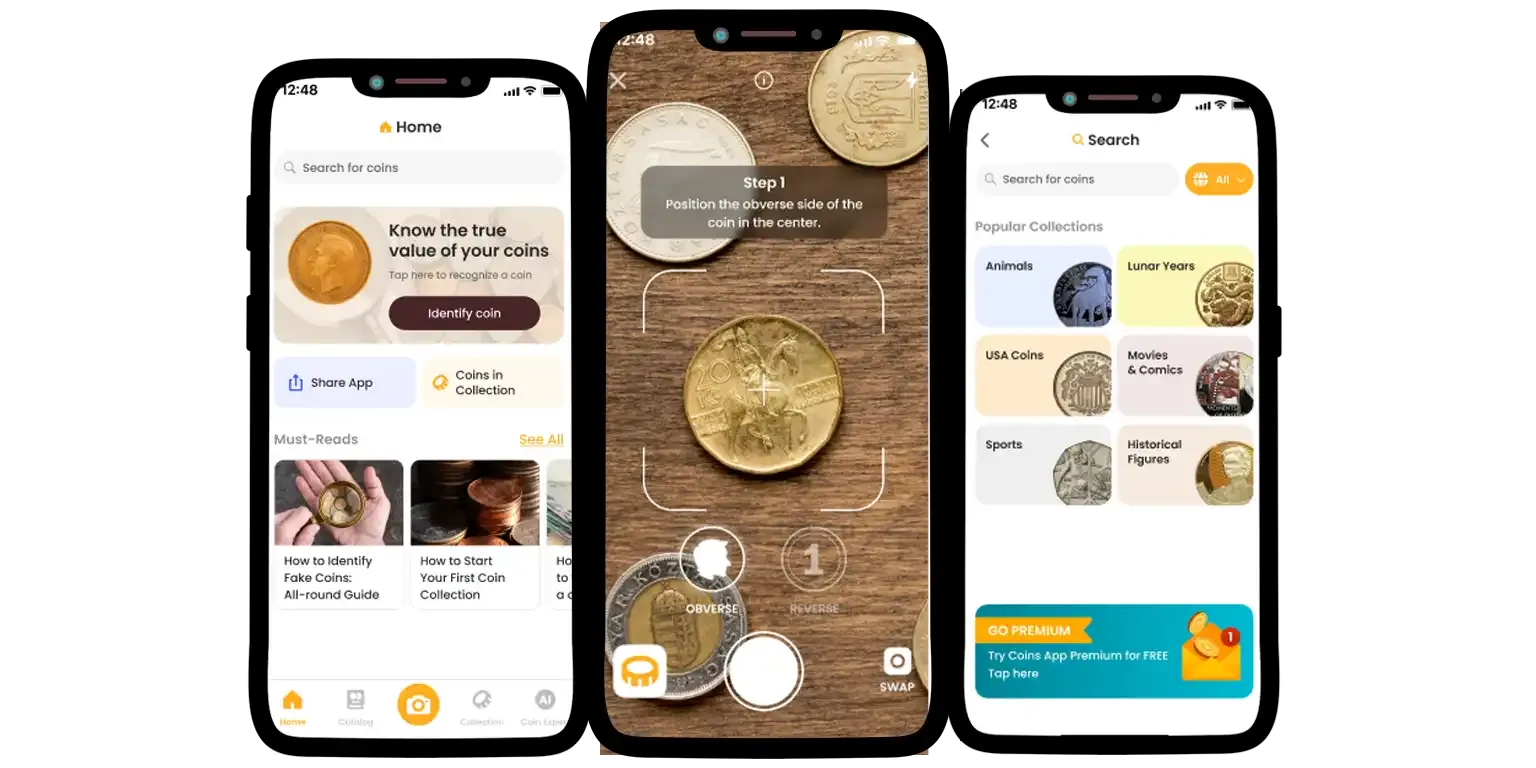
The market has lots of digital options to offer, but designated apps like Coin ID Scanner are still the most appropriate to employ. Coin ID Scanner, on its part, is an innovative tool for quick coin identification, collection management, and numismatic explorations – all in one place. But what exactly does it offer?
Instant Coin Recognition: Take a picture or insert the name manually to identify your coin within seconds.
Accurate Value Estimates: Review price ranges based on grade, rarity, and market trends.
Comprehensive Database: Access detailed information on US and world coins, including mintage and historical context.
Collector’s Toolkit: Save scans, create digital inventories, and track your collection’s value over time.
Coins may be small, and their face values may not be impressive at first. Explore what this or that coin may offer, and let your heart (not wallet) guide your way.

 Facebook
  X (Twitter)
  Pinterest
  LinkedIn