Contents:
The coin saw extensive circulation across the United States. It remains readily available for examination and historical documentation. The 1951 D nickel value attracts numismatists who reevaluate mid-20th-century base metal coinage.
What is the best coin identifier app?
1951 Jefferson Nickel Overview
Initially, the item we use today is not exactly what Schlag originally intended. The Mint and the Federal Commission of Fine Arts forced several changes.
Schlag originally drew Monticello from a three-quarters angle with a more modern feel (including a palm tree). The Mint demanded a flat, frontal view.
His original lettering was a stylized, Art Deco script. The Mint replaced it with the more formal, traditional font we see today.
Unlike many designers, Schlag’s initials (FS) did not appear on the coin for the first 28 years. It wasn't until 1966 that the Mint finally added them to the obverse, just below Jefferson's shoulder.
Period | Since 1938 |
Composition | Copper / Nickel |
Edge | Plain |
Diameter | 21.2 mm |
Weight | 5 g |
Designer | Felix Schlag |
Note: The same year, the Roosevelt dime weighs half as much.
Identifying the 1951 Jefferson Nickel
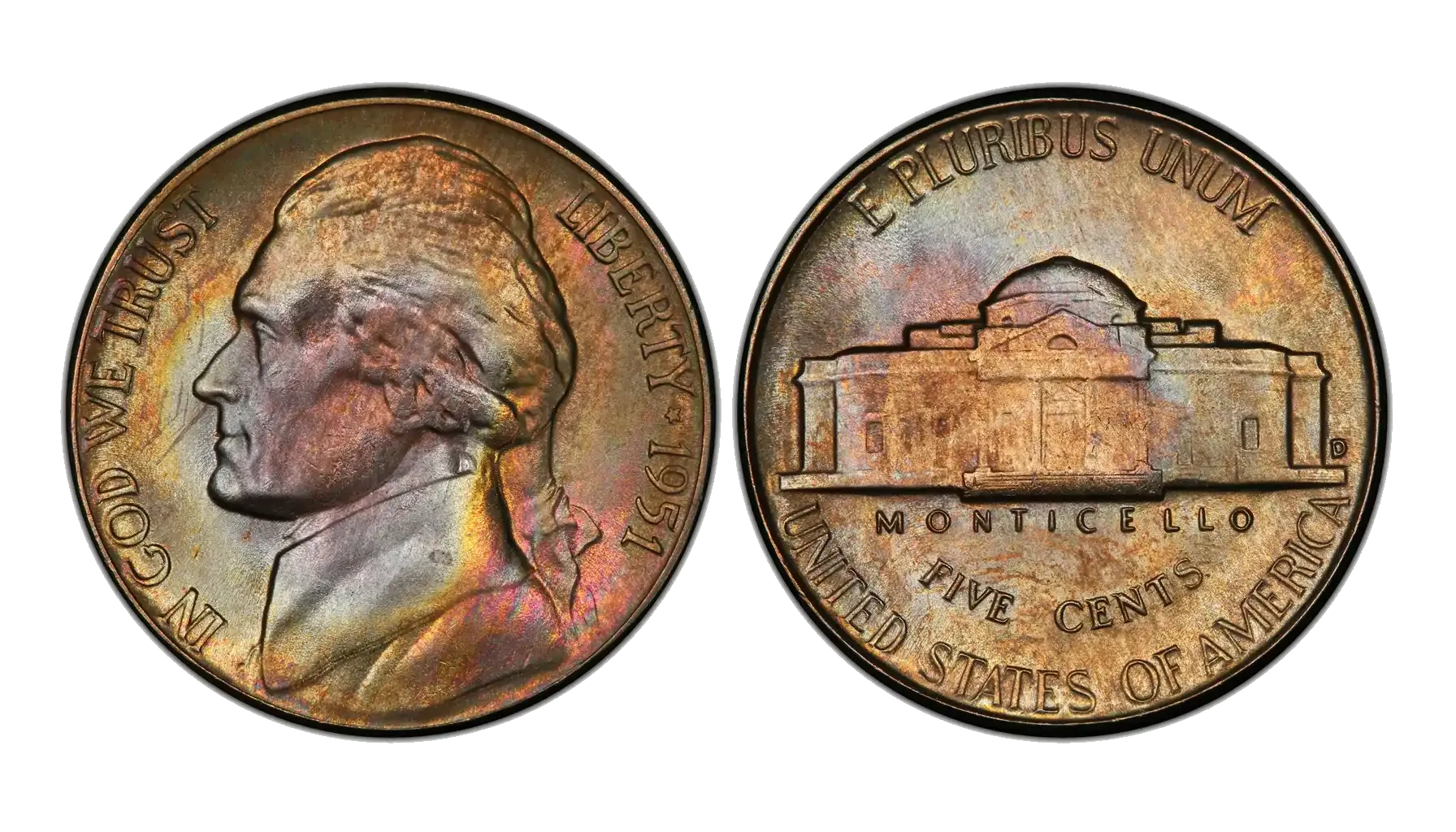
Obverse
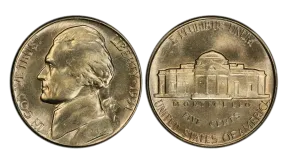
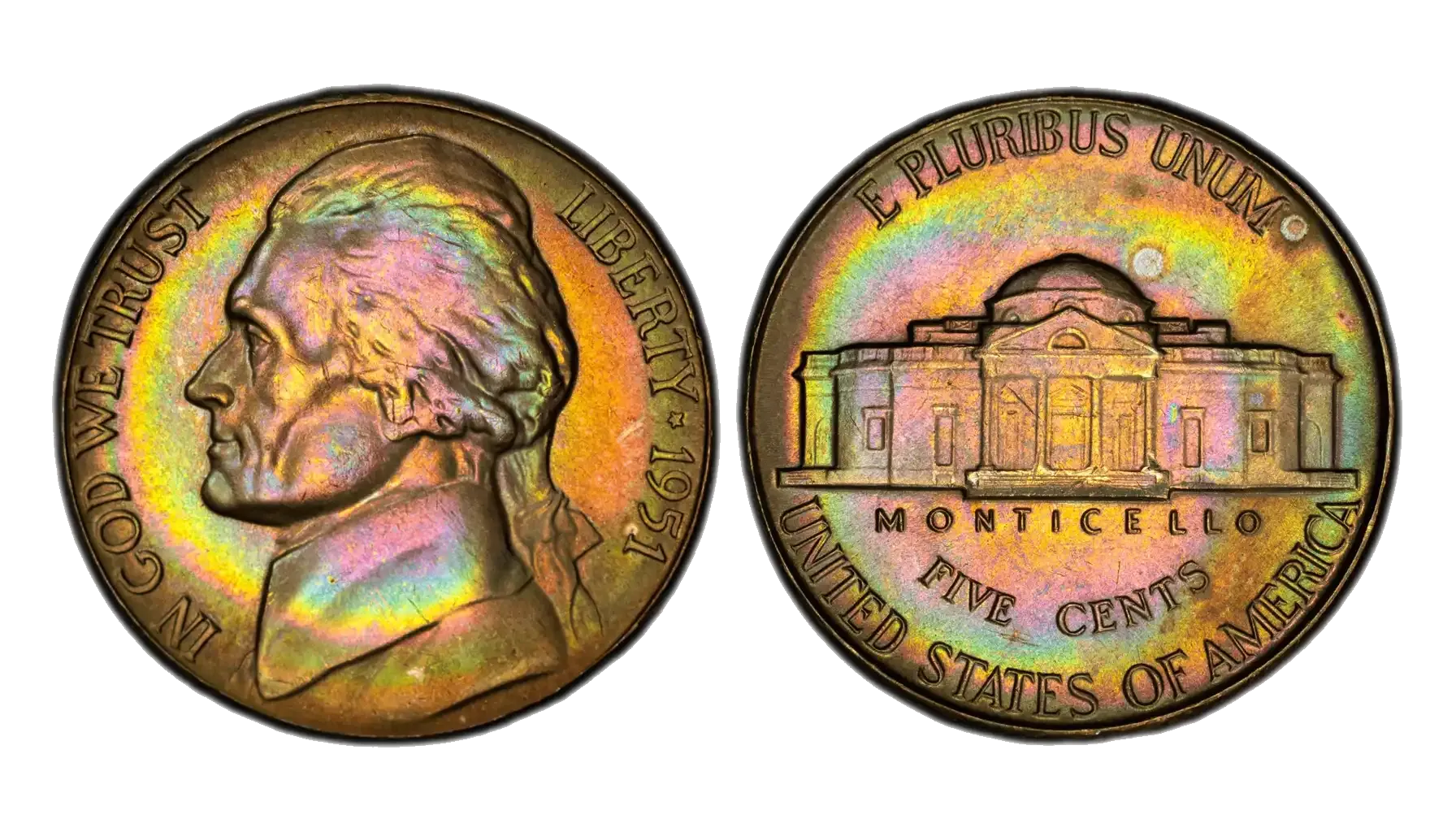
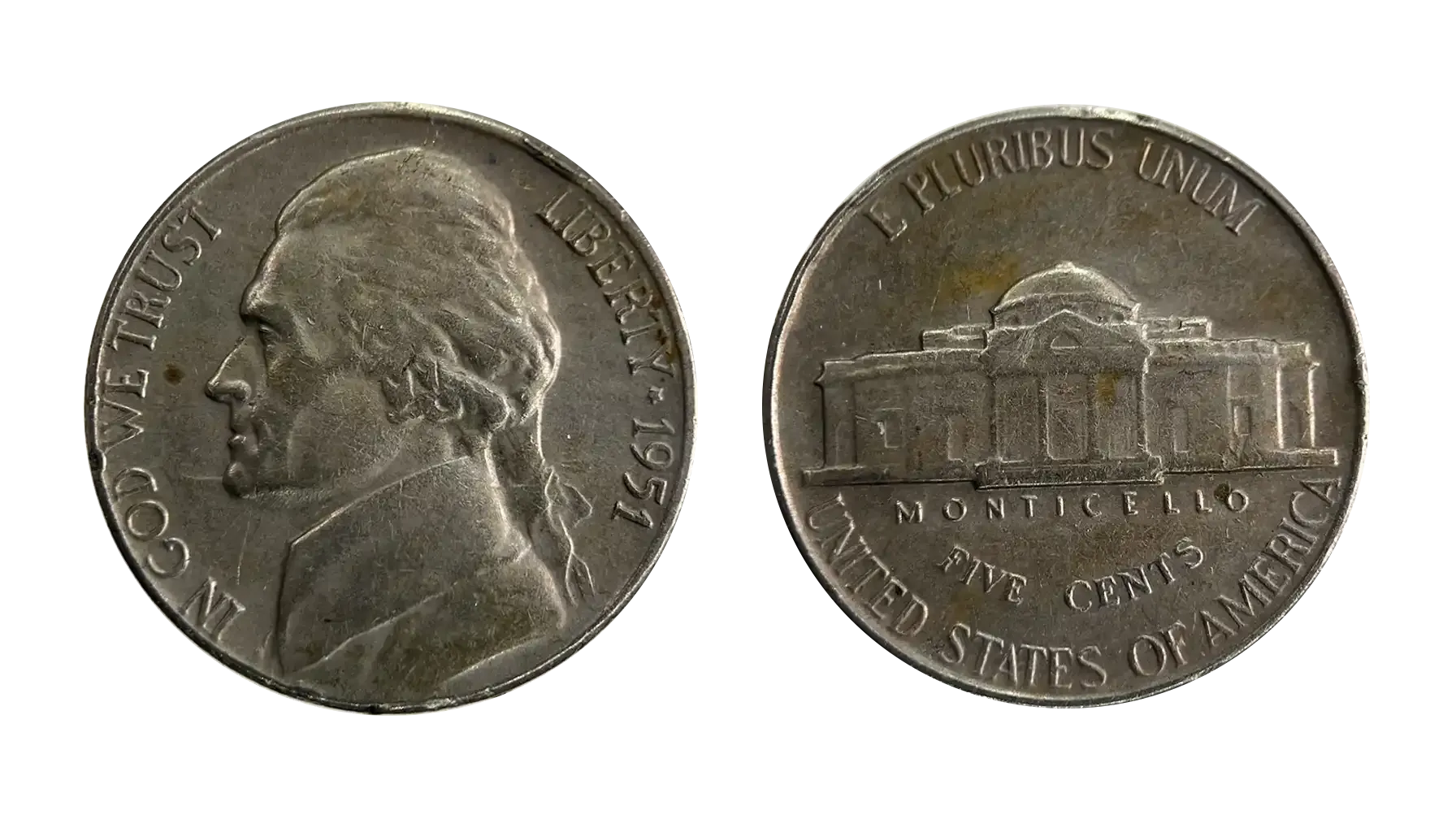
The obverse shows the Thomas Jefferson portrait, and includes important inscriptions for the United States.
Reverse
The depiction of Monticello on the Jefferson item is the classic, front-facing view of Thomas Jefferson’s Virginia estate.
By this year, this design had been in circulation for 13 years and represented the standard look that Felix Schlag was forced to adopt after the Mint rejected his more artistic original sketches.
Warning for Collectors
Do not confuse with another year's item – Franklin half dollar – because on the obverse presents analogous inscriptions of the year, Liberty, and In God We Trust.
And the portrait of one of America’s Founding Fathers, Benjamin Franklin.
Mint Marks and Varieties of the 1951 Nickel
Three mints produce this rare item – the 1951 nickel D issue from Denver. The lowest mintage from San Francisco, but as a unique silver composition (silver proof ones).
Location | Mint Mark | Mintage | General Availability |
Philadelphia | None | 28,552,000 | Common |
Denver | D | 20,460,000 | Common |
San Francisco | S | 7,776,000 | Moderately available |
Is a 1951 nickel worth anything nowadays? According to standard numismatic practice, the 1951 D nickel commands higher values when graded in superior mint states.
Circulated 1951 S nickel specimens routinely trade at values approximating face value.
Attention: Although minor die variations are documented, such variations do not warrant major catalog status.
Design Features and Metal Composition
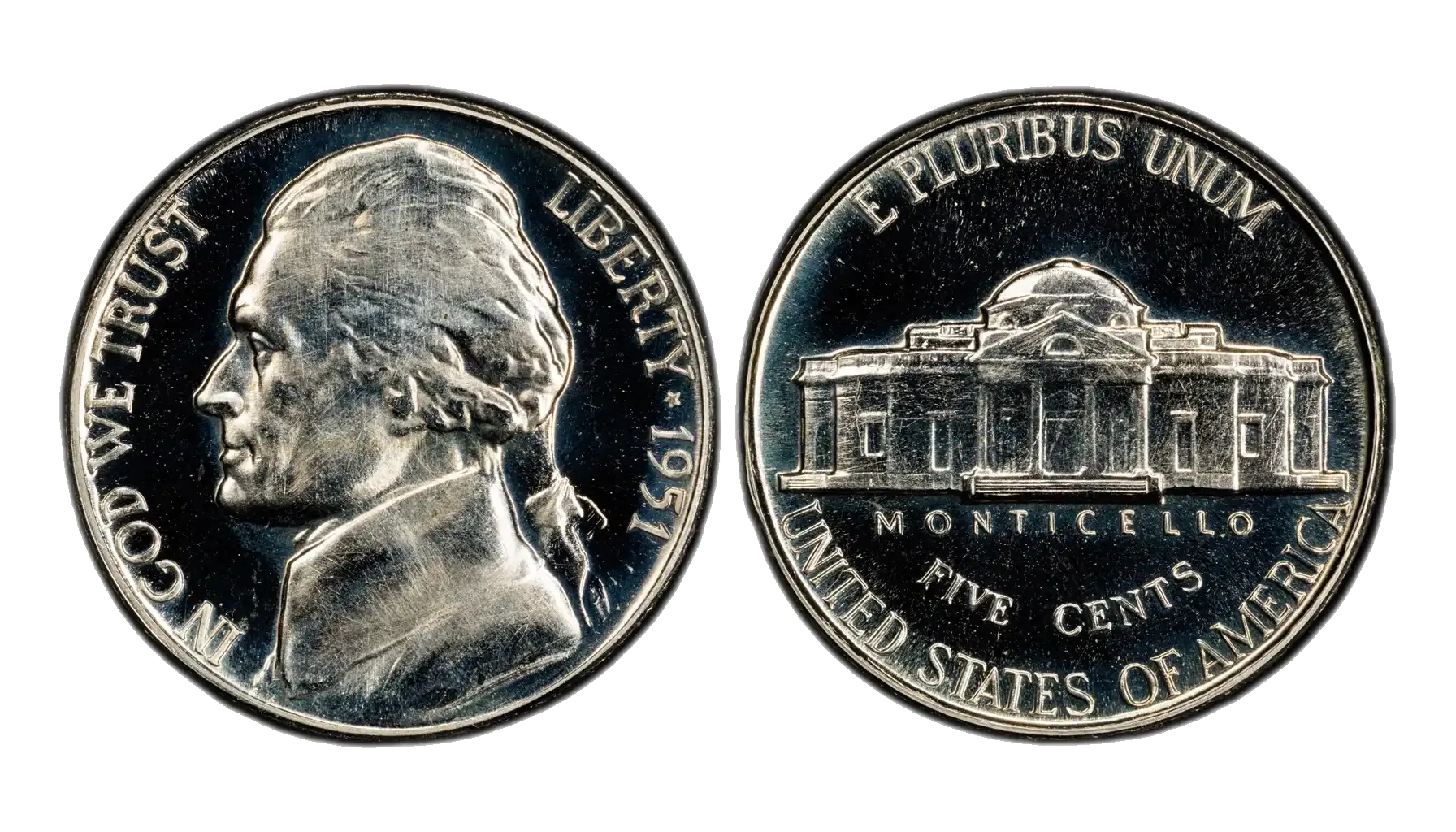
The Jefferson design is the work of Felix Schlag. It presents a classical profile and employs subdued symbolic elements. The Monticello design on the reverse demonstrates proportional balance and readable inscriptions.
The condition of the steps on Monticello serves as a common indicator of strike quality for enthusiasts.
The Composition: Is a 1951 Nickel Silver?
Silver appeared in items only during World War II. Why was this necessary process for civilians? The reason is simple: this metal, opposite to silver, was vital for making armor and military tools.
When the war finished in 1945, the Mint quickly switched back. In 1946, coins returned to the usual metal mix. The 1951 nickel silver content in the past, it consists of 75 percent copper.
1951 Jefferson Nickel Value by Condition and Mint
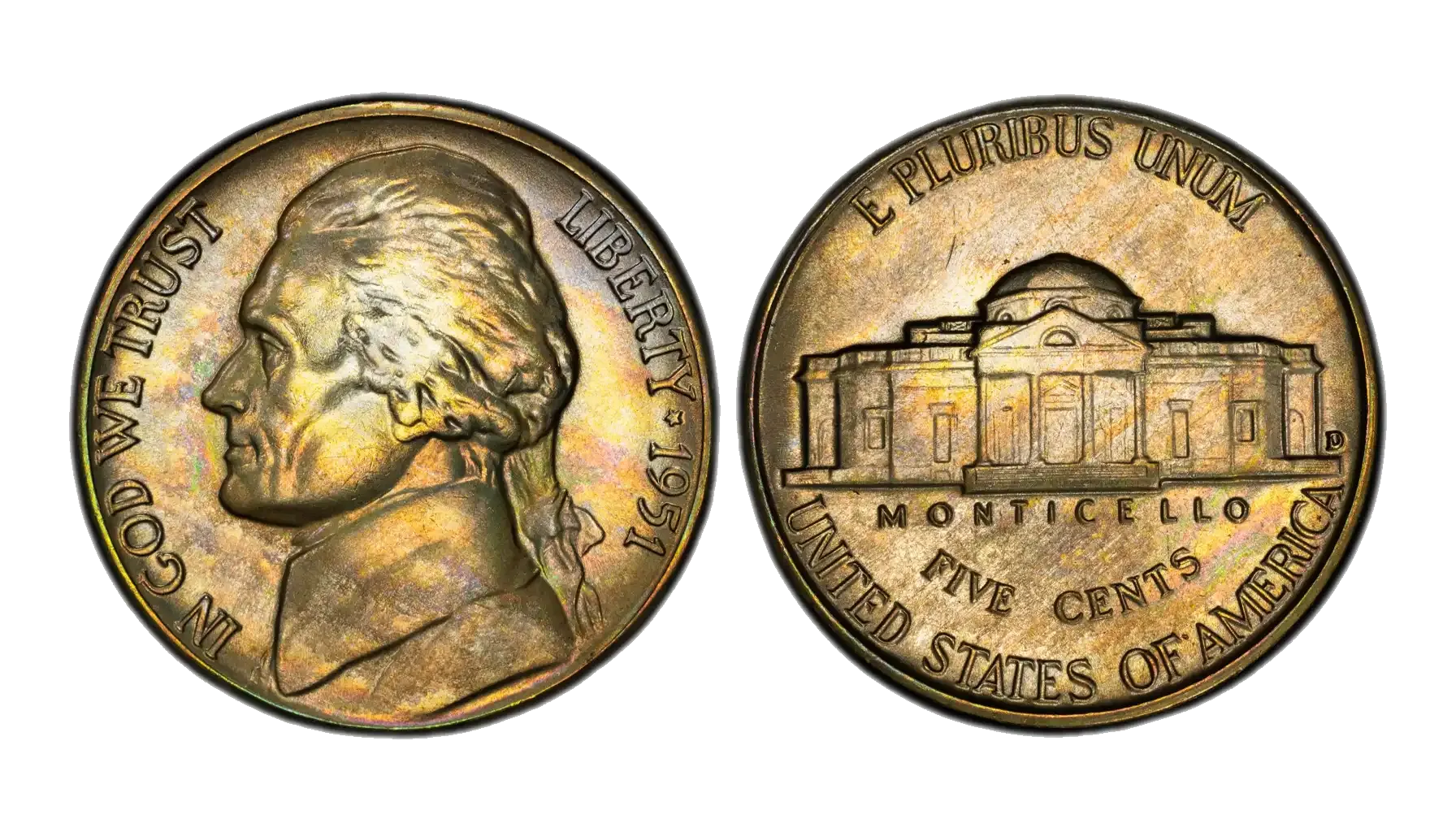
What is a 1951 nickel worth in a modern collection?
How much an item is worth depends more on its condition than on how many were made. Three things affect the price: how worn the item is, how shiny it is, and whether there are marks on the surface.
“The 1951-S Jefferson nickel is a semi-key date in the series. While not as rare as the 1950-D, its low mintage for the era makes it a prize for budget-minded collectors looking to complete a set.”
– James Bucki, a numismatist
The Spruce Crafts
If you have a 1951 nickel value no mint mark and it has been used (circulated), it will not be worth very much. But if the item has been certified as being in mint condition, its price will go up much more.
Mint | 65 | 66 | 66+ | 67–67+ |
Philadelphia | $24–$26 | $30 | $85 | $1,500 |
Denver | $20–$22 | $26 | $45 | $215 |
San Francisco | $285–$375 | $950 | $2,000 | $5,750 |
Note: No mint mark (Philadelphia) red penny in MS-67 almost catches up to this item in the same characteristics.
Factors That Affect the Value of a 1951 Nickel
A 1951 nickel no mint mark is worth more money if an independent grading company says it has Full Steps. Full Steps (FS) is a grading designation for collectors. If the steps on the back of Monticello are perfectly struck and distinct (not blurry), the item is labeled Full Steps.
Example: A regular 1951 S nickel value might be worth $10, but an S MS67 FS (Full Steps) can sell for over $15,000 because it is incredibly rare to find that level of detail from that year.
How much is a 1951 nickel worth with errors? What elements influence the price range?
1951 Nickel Errors
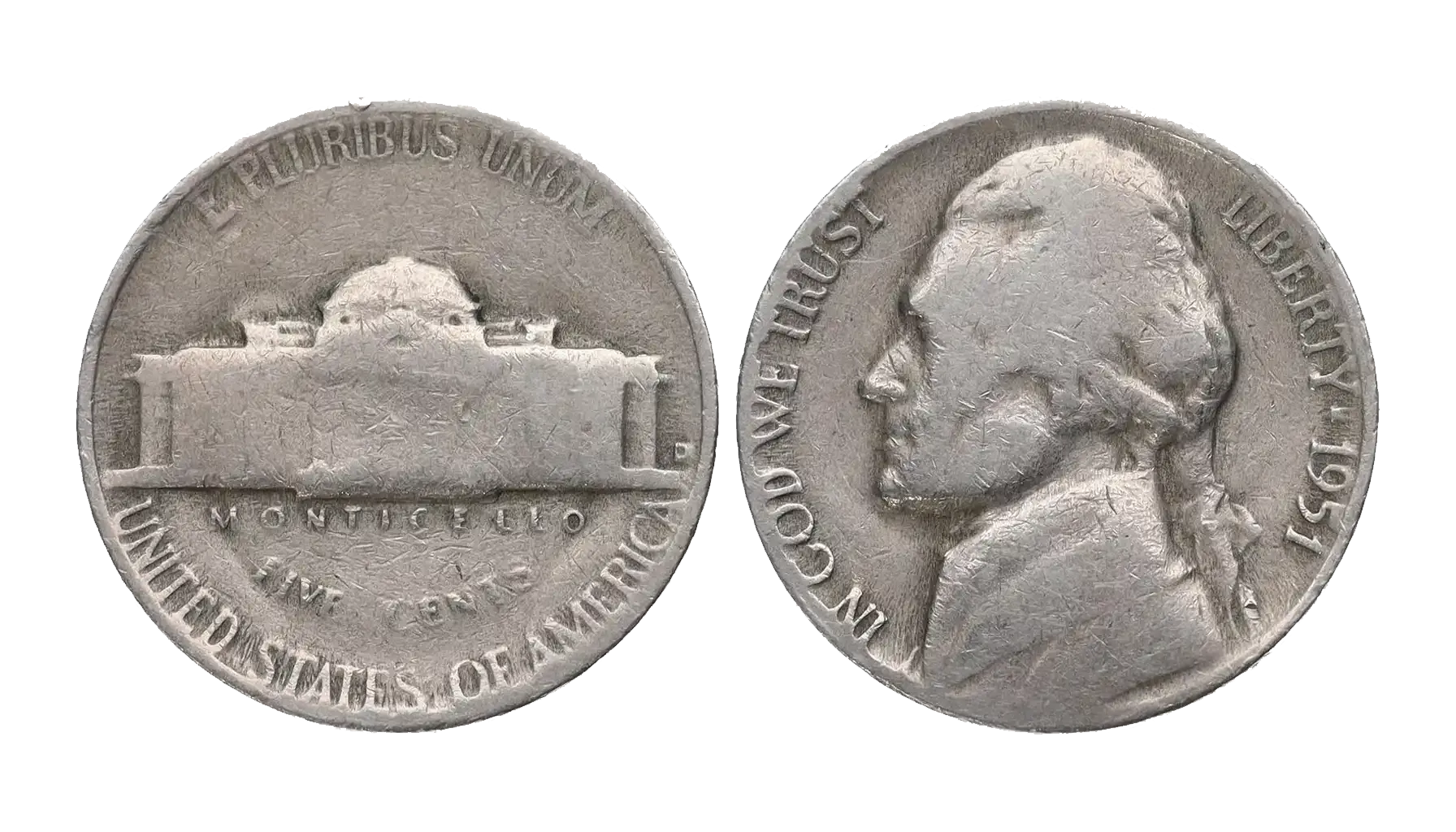
Doubled Dies
Proof Doubled Die Obverse (DDO) – Look for distinct tripling or doubling on the letters of In God We Trust and Jefferson's profile.
Doubled Die Reverse (DDR) – The doubling is most noticeable on the words Monticello and Five Cents.
D D/D (Repunched Mint Mark) – A "D over D" error where the Denver mint mark was punched twice. You will see a small shadow of another D slightly offset from the main one.
Striking and Planchet Errors
Clipped Planchet is a portion of the item that is missing, leaving a curved or straight bite out of the edge. A 17% curved clip on a D recently sold for a significant premium.
Lamination Cracks look like the surface of the coin is peeling off. This happened when impurities in the metal caused the copper alloy to flake.
Off-Center Strikes is the process in which the item was not centered in the press, leaving a portion of the design missing and a blank crescent of metal on one side.
Die Chips and Cuds as the steel dies wore out this year, small pieces of the die would break off. This results in raised metal blobs on the item. Look for these on the roof of Monticello or near the date.

 Facebook
  X (Twitter)
  Pinterest
  LinkedIn