Contents:
Before the nation turned to the decimal system, it completely relied on the pound, shilling, and pence monetary structure inherited from Britain. This traditional system served as the foundation for the earliest years of Australian coinage, and for a reason. Although the denominations, as well as the representatives of each, are diverse, one may pay special attention to the 1919 penny.
As a rare Australian penny, it could boast a unique background and features that make it so desirable to obtain, i.e., the exquisite appearance and low mintage figures. But what makes this coin so special, and which rarities to look for?
Introduction to the 1919 Australian Penny
Control of a far land cannot be permanent: by 1919, Australia had finally taken steps toward an independent currency system, with minting facilities located on the territory of the country. The 1919 issue, as well as the 1920 Australian penny, could be called one of the first iterations of the coin produced by the Melbourne Mint.
The 1919 penny Australia value says it all on its own: higher prices presuppose that the coin is still valuable, and collectors from all over the world strive to obtain a century-old piece to expand their collections for good. But what do these numismatic creations look like?
“For the Australia Penny coinage, the die production occurred at the Royal Mint in London. The hubs were kept there and never shipped to mints in Australia for the coinage of 1919 or 1920. Instead, completed dies were shipped to the Melbourne Mint from both the London and Bombay Mints.”
— Dylan Dominguez, Associate World Coin Grader
The Enigmatic Australia 1919 and 1920 Dot Penny Coins”, 2020 PCGS News
Design Features and Specifications
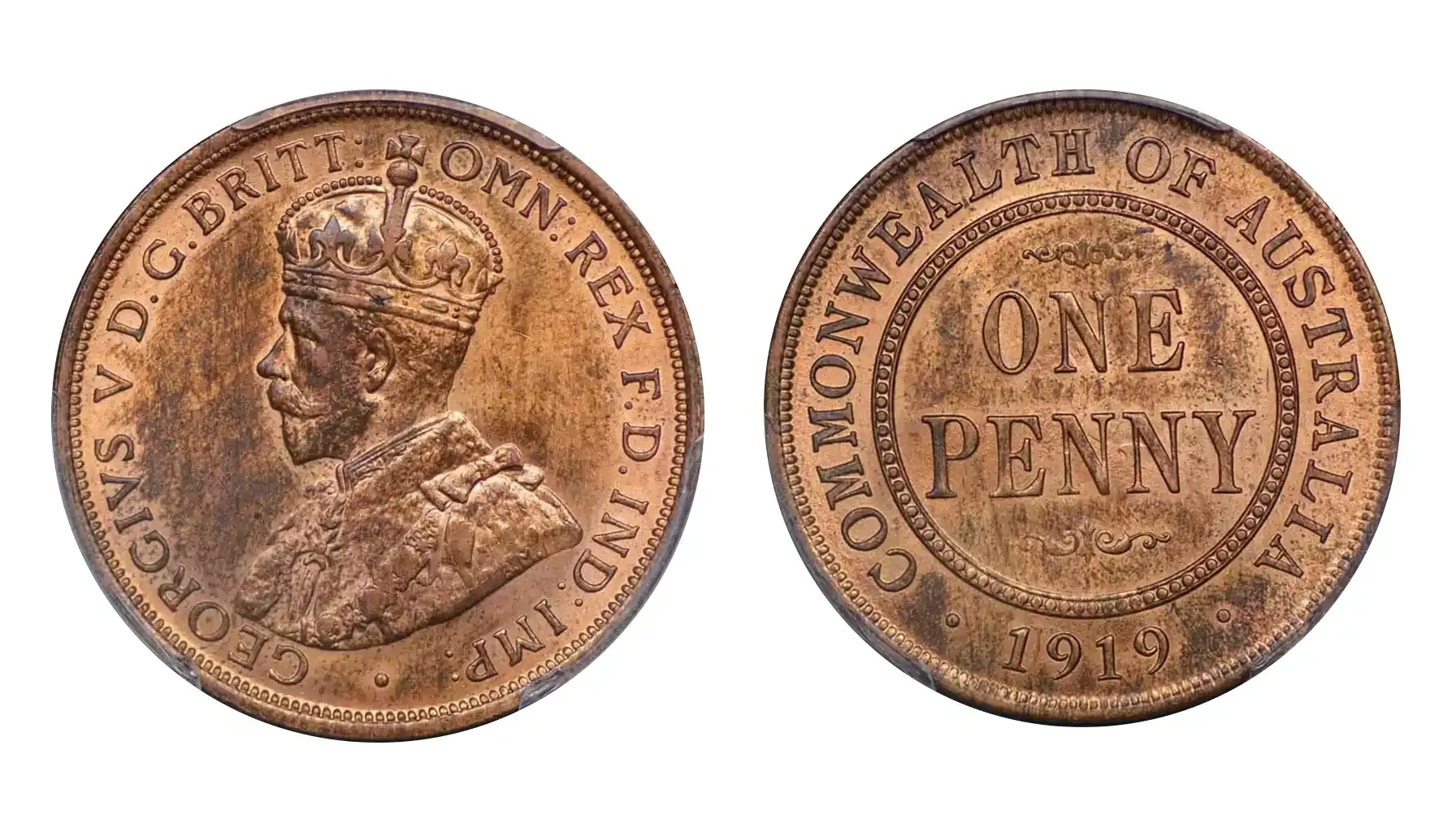
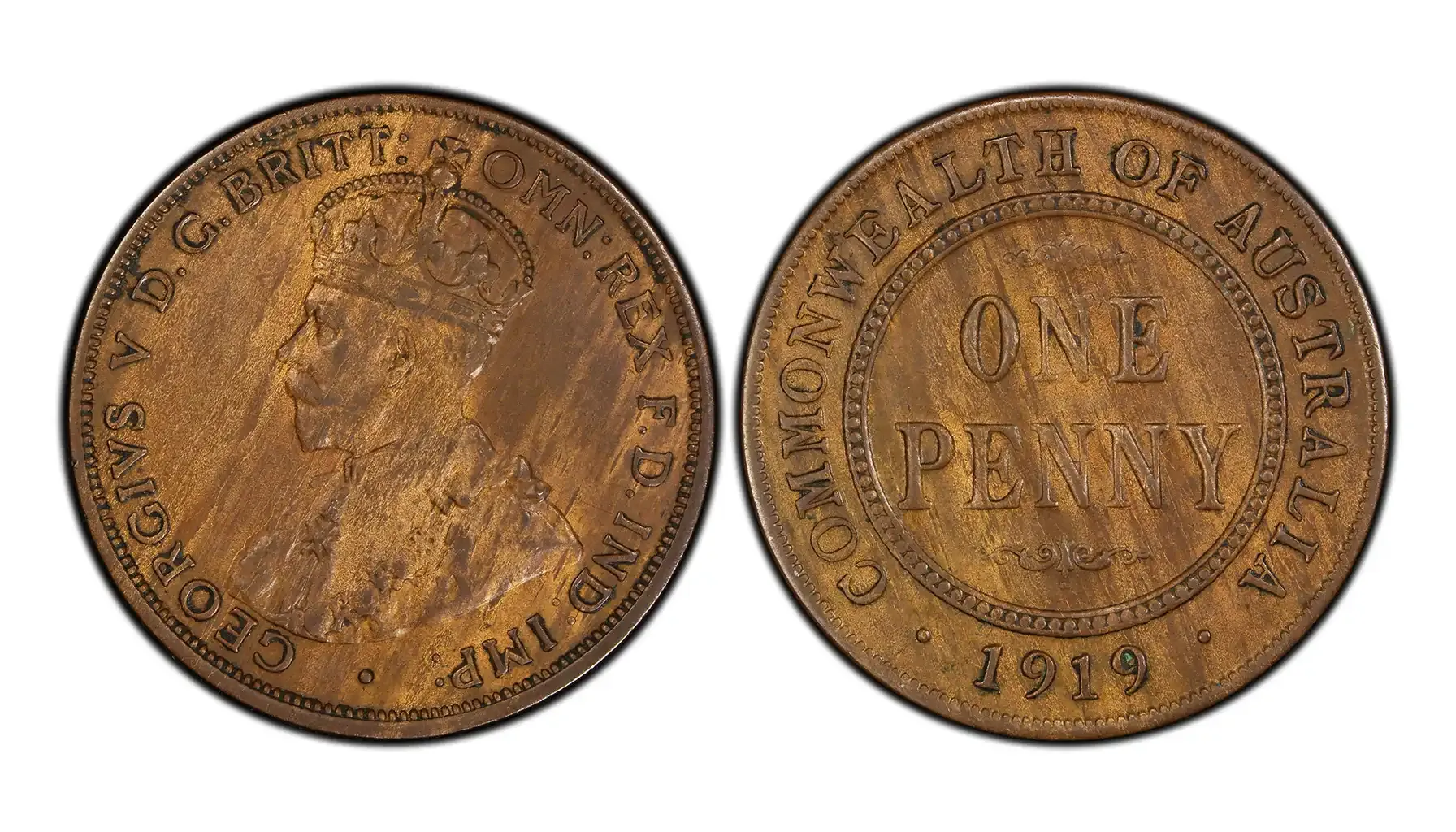
Obverse: Similarly to the 1921 Australian penny, it features a left-facing profile of King George V, surrounded by the inscription “GEORGIVS V D.G. BRITT: OMN: REX F.D. IND:IMP:”, which means “George V, by the Grace of God, King of all the Britains, Defender of the Faith, Emperor of India”.
Reverse: Introduces the coin's denomination “ONE PENNY”, as well as the inscriptions “COMMONWEALTH OF AUSTRALIA” and the date “1919”.
Main Specifications | |
Years | 1911–1936 |
Diameter | 30.8 mm |
Thickness | Approximately 1.6 mm |
Mass | 9.45 g |
Composition | Bronze (97% copper, 2.5% zinc, 0.5% tin) |
Edge | Plain |
Designer (Obverse/Reverse) | Bertram Mackennal/W.H.J. Blakemore |
1919 Penny Value and Market Insights
The 1919 one penny Australia value may at times impress, for it reveals the demand and collectible worth of a coin that had been released more than a century ago. Nonetheless, the concept of the 1919 Australian penny value consists of several aspects, which usually come down to condition, design peculiarities, and any unique variations or minting errors, if present. So, how much would these coins cost?
Grade (Condition) | Description | Approximate Value |
Poor/Fair (P/F) | Very worn; major details indistinct | $5 – $15 |
Good (G) | Significant wear, inscriptions visible | $15 – $30 |
Very Fine (VF) | Moderate wear; most details clear | $30 – $60 |
Extremely Fine (EF/XF) | Light wear; sharp design details | $60 – $120 |
About Uncirculated (AU) | Minor signs of circulation | $120 – $250 |
Uncirculated/Mint State (MS) | Full mint luster; no circulation marks | $250 – $800+ |
Collecting and Preservation Tips
Handle with care: Try not to touch the coins so as to avoid leaving fingerprints and scratches on the surface.
Store properly: Employ only acid-free holders, capsules, or albums that are regularly sold on global marketplaces, and the rest.
Control environment: Keep coins in a cool, dry place away from direct sunlight and high levels of humidity.
Inspect regularly: Check your collection for signs of tarnish or damage over time.
Use digital assistants: Identify, study, and manage your coins with advanced apps like Coin ID Scanner.
Avoid cleaning: Refrain from using chemicals or abrasive materials that can reduce value.
Label and document: Record purchase details and notable features for each coin. Certification is also recommended.
Keep an eye on the numismatic creations you own – they may be of high collectible importance after all.

 Facebook
  X (Twitter)
  Pinterest
  LinkedIn