Contents:
The history of the Australian coinage can be divided into several periods, and each is responsible for its own national peculiarities, economic changes, and social shifts as well. The pre-decimal era, for instance, presented numerous outstanding pieces, some of which had been released long before the greatest global transformations took place, and the 1921 penny Australia value can prove it on the spot.
As soon as the worth of the rare Australian pennies may be fluctuating over time, some things remain consistent: the appeal, the design, and the way people accept it all over the world. So, why do these numismatic creations draw so much attention? What do they look like, and how much would they cost?
Introduction of the 1921 Australian Penny
Although we cannot call the century-old coin production genuinely early, within the spectrum of Australian history, it actually is. In fact, the 1921 issue, as well as the 1920 Australian penny, was struck during the pre-decimal era, under the reign of King George V. Its popularity is usually associated with the aura of the post-war recovery and the early days of independence of the country.
“Because of the very high standard set in manufacture, such coins are slow to make and relatively expensive to produce.”
— Greg McDonald, an American writer and coin collector
Listing “Proof 1921 Penny Struck as a Coin of Record at the Melbourne Mint”
Design Features and Specifications
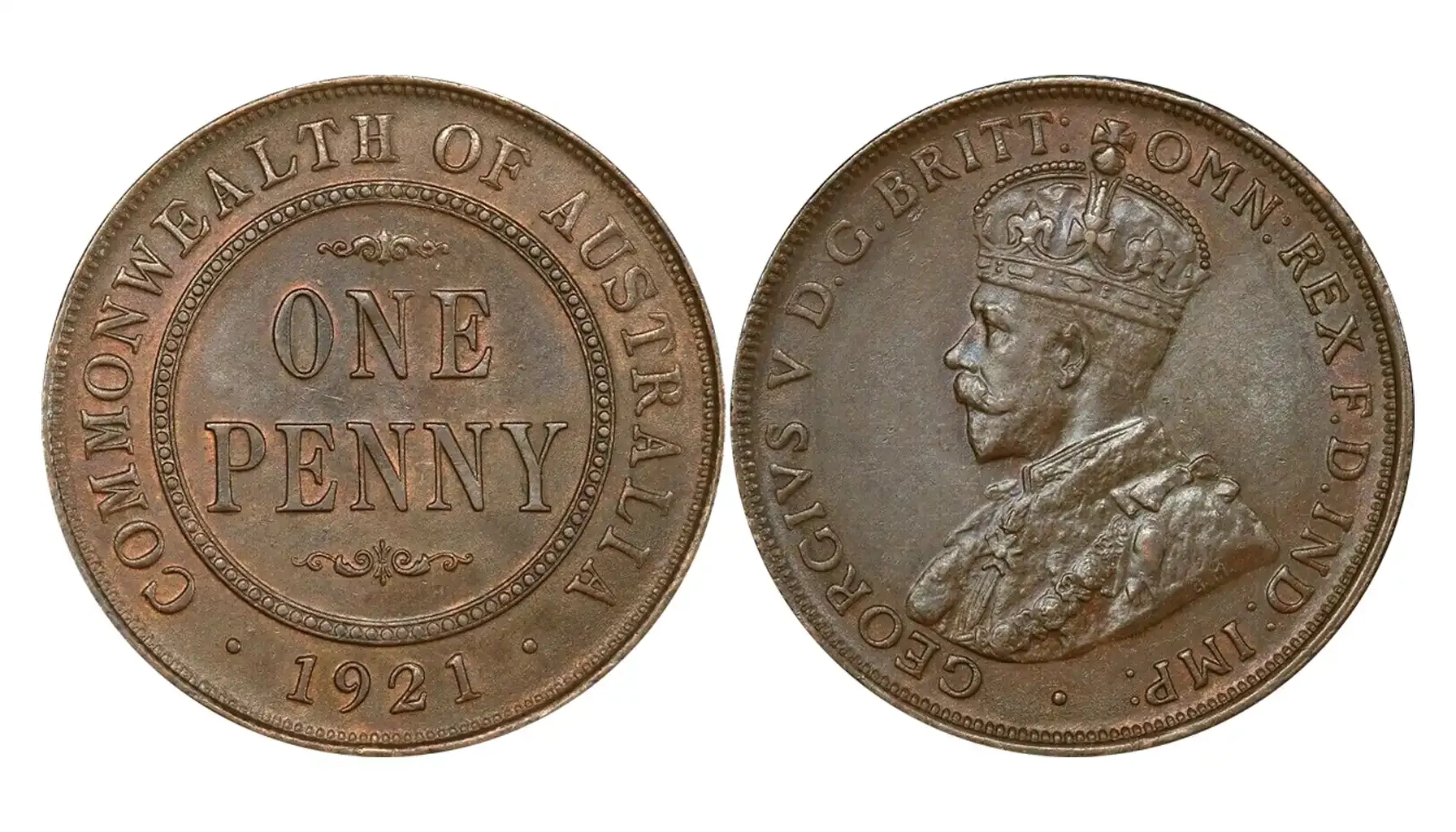
Obverse: Features the left-facing portrait of King George V (by Bertram Mackennal), along with the inscription “GEORGIVS V D.G. BRITT: OMN: REX F.D. IND: IMP:”, which means “George V, by the Grace of God, King of all the Britons, Defender of the Faith, Emperor of India”.
Reverse: Demonstrates the denomination “ONE PENNY” in large capital letters, surrounded by the inscriptions “COMMONWEALTH OF AUSTRALIA” and the year of minting “1921”.
Main Specifications | |
Years | 1911–1936 |
Monarch | King George V |
Composition | Bronze (97% copper, 2.5% zinc, 0.5% tin) |
Weight | 9.45 grams |
Diameter | 30.8 mm |
Thickness | Approximately 1.6 mm |
Edge | Plain |
Mints | Melbourne, Sydney |
1921 Australian Penny Value Overview
The example of other issues (e.g., the 1950 Australian penny) shows that the worth of a coin is usually determined by a variety of factors, including the attributed grades, condition, scarcity, and overall demand. For the most objective representation, let us focus on the value ranges per grade for the average (yet certified) coins of this type to see how much they may cost today.
Grade | Approximate Value (AUD) |
Good (G-4) | $1 – $3 |
Fine (F-12) | $5 – $10 |
Very Fine (VF-20) | $15 – $25 |
Extremely Fine (EF-40) | $40 – $70 |
About Uncirculated (AU-50) | $90 – $130 |
Uncirculated (MS-60 and above) | $150 – $300+ |
Proof or Special Strike | $400+ |
Anyway, the worth should never be the only measure of its appeal: they should be appealing on their own, and this numismatic creation certainly has plenty of it.

 Facebook
  X (Twitter)
  Pinterest
  LinkedIn