Contents:
This year's issue marks an early period for this coin series. Because of World War I, production volumes and quality suffered. Nowadays, the price ranges from $3 to $1,000 or more at professional coin shops.
How Much Is a 1918 Dime Worth Today?
By the year, three main mint facilities formed:
Philadelphia produced no mint mark coins.
Denver, producing coins with a letter “D”.
San Francisco, producing coins with a letter “S”.
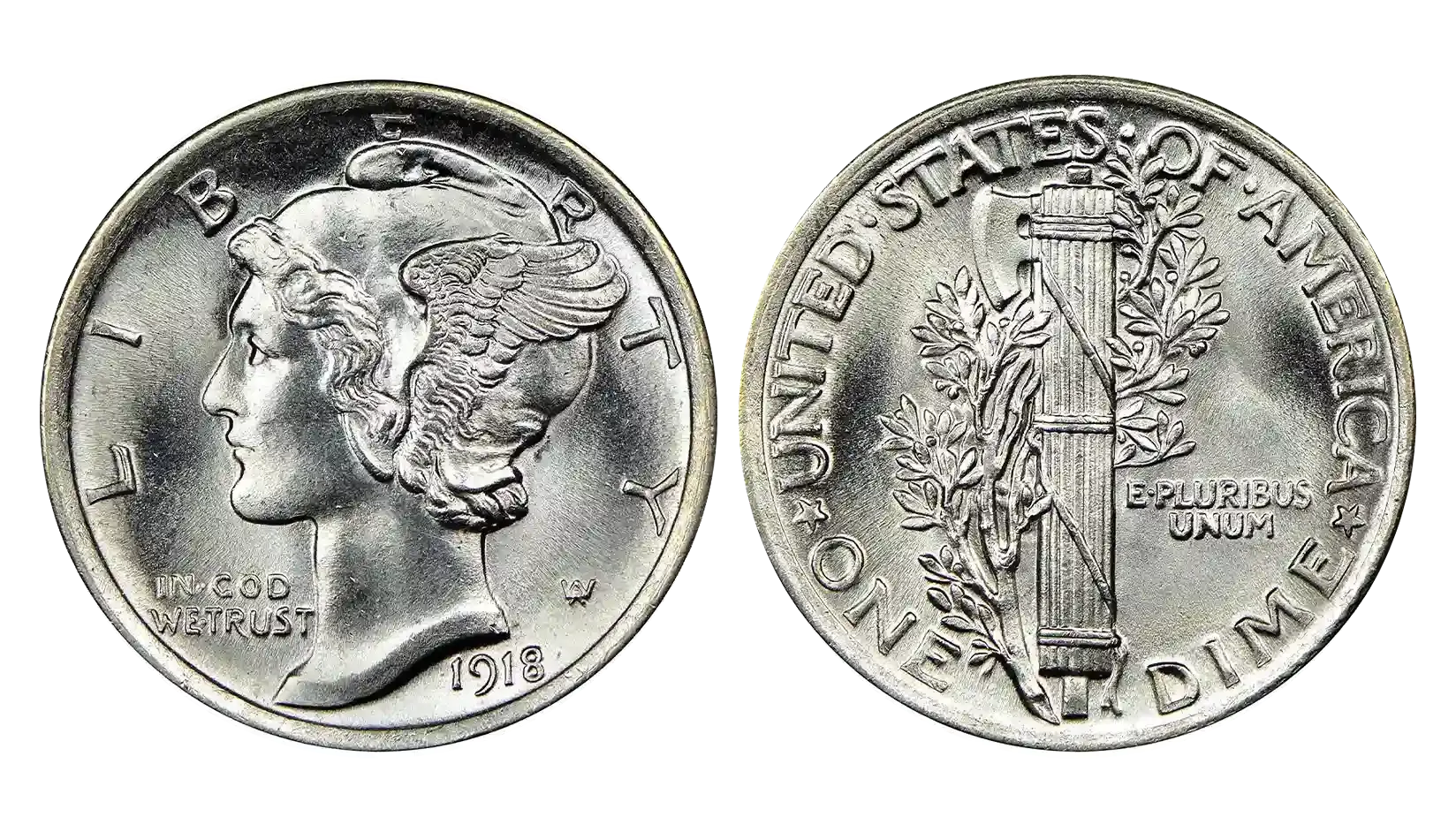
1918 Mercury Dime No Mint Mark Value
How to identify: Go to the obverse and look at the spot under Roosevelt’s neck. It should be blank.
26,680,000
Estimated 1918 Dime Value Today: $2+. In mint state, it can go over $75.
Most coins that year came from the Philadelphia mint. The 1918 penny, too, commonly came from the Philadelphia mint.
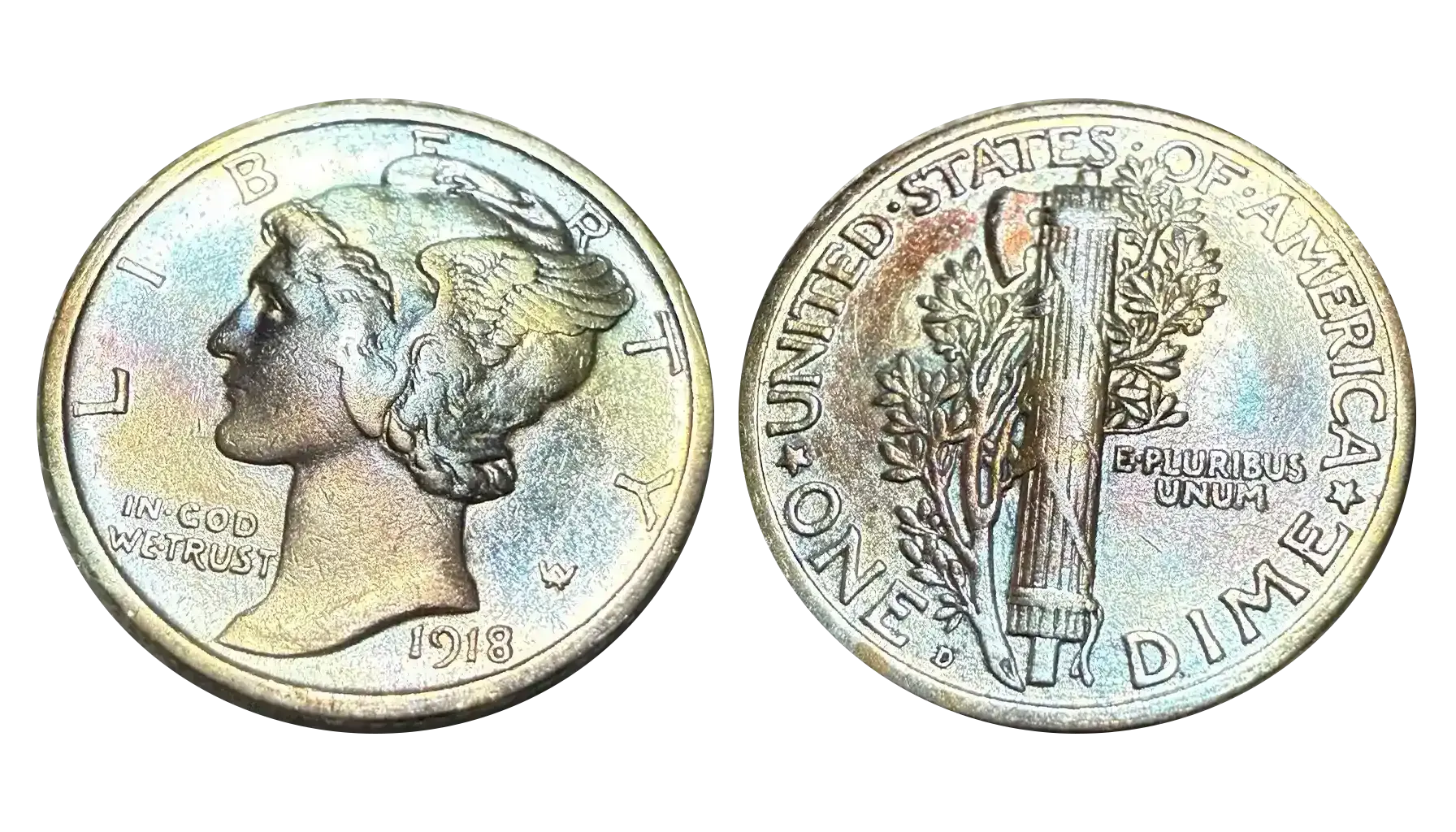
1918 D Mercury Dime Value
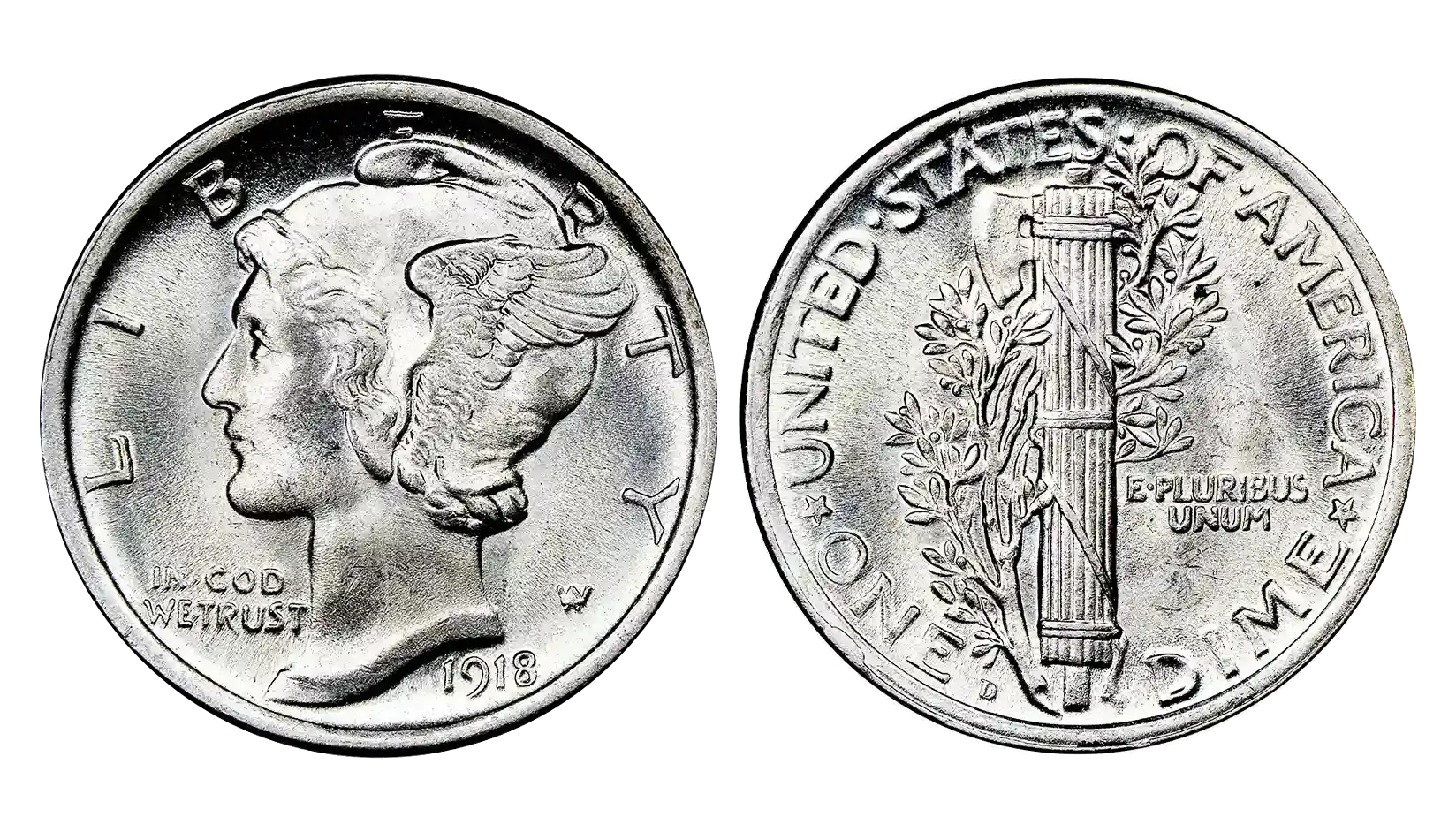
How to identify: Go to the obverse and look at the spot under Roosevelt’s neck. It should have a letter “D”.
22,674,800
1918 Mercury Dime Value Today: $3+. In mint state, it can go over $140.
Fewer coins came from Denver. While there are not many, they have one thing over Philadelphia coins. A special error 18 overdate variety from the Denver mint, which is a small collector’s rarity.
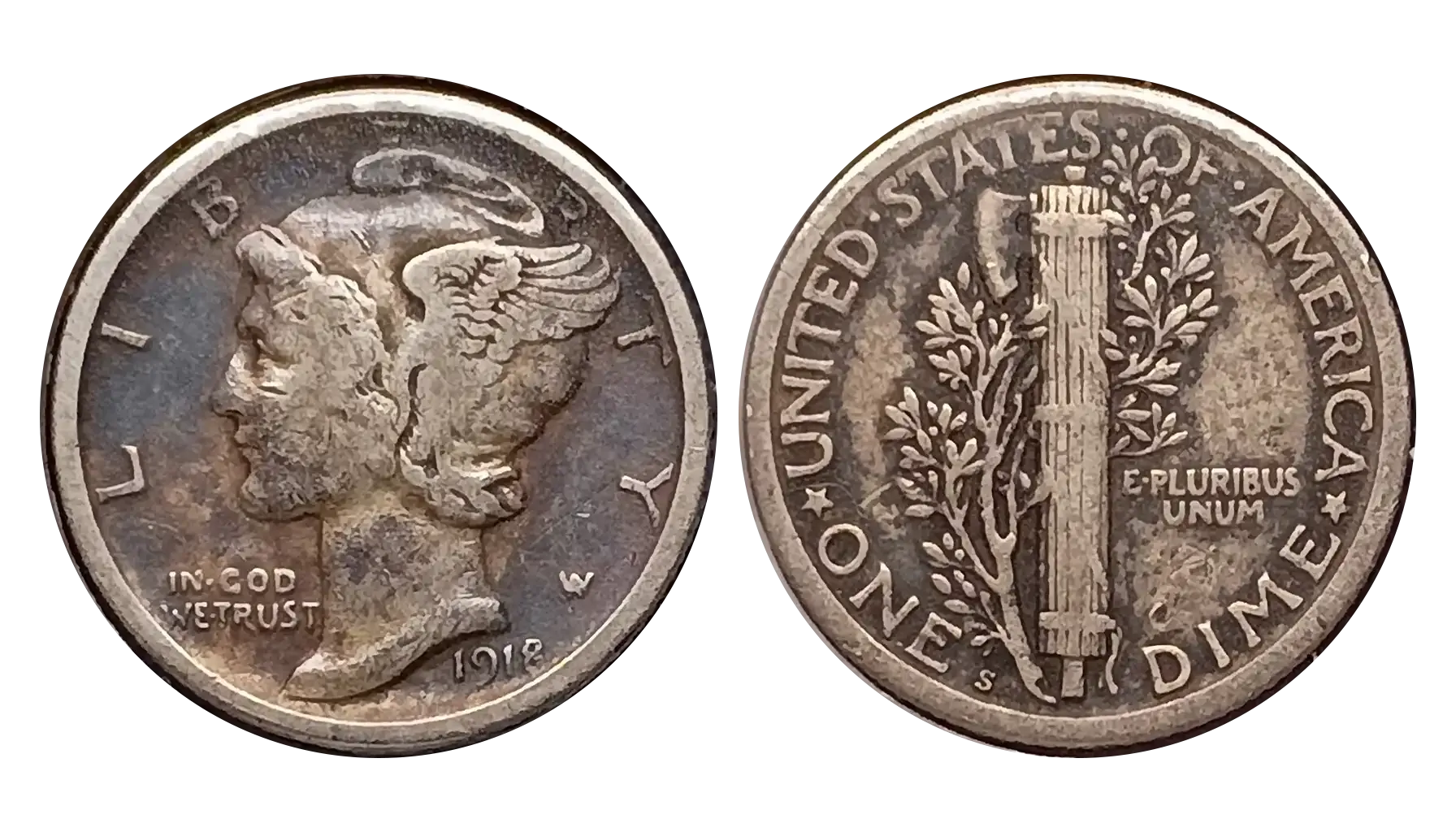
1918 S Mercury Dime Value
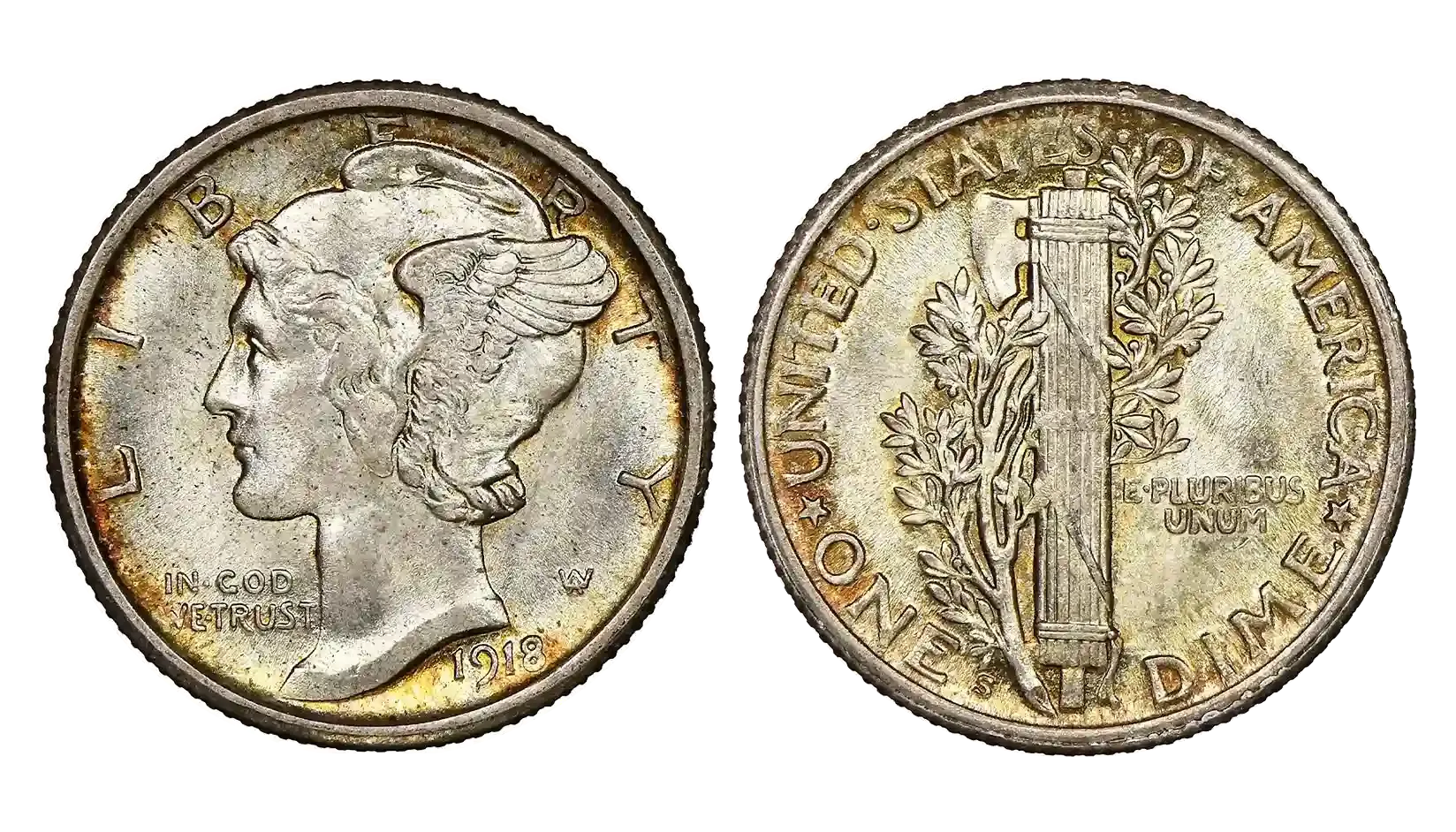
How to identify: Go to the obverse and look at the spot under Roosevelt’s neck. It should have a letter “S”.
19,300,000
Estimated Value: $3+. In mint state, it can go over $130.
San Francisco made the smallest number of coins. Instead of quantity, the mint facility went for quality and mainly made proof coins.
1918 Mercury Dime Overview
The Mercury 1918 dime is part of the Mercury item series that started in 1916.
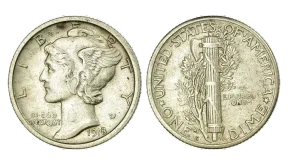
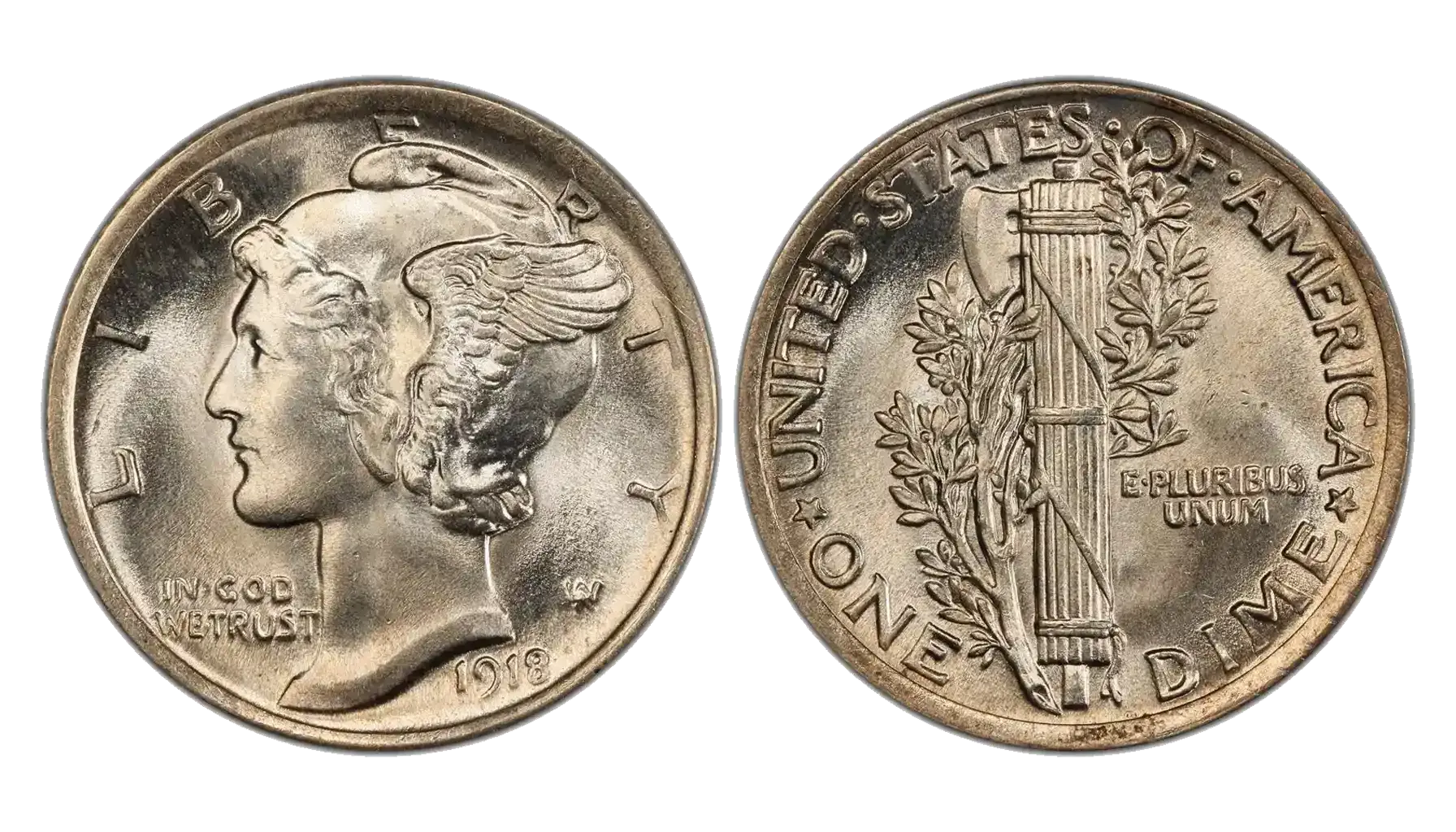
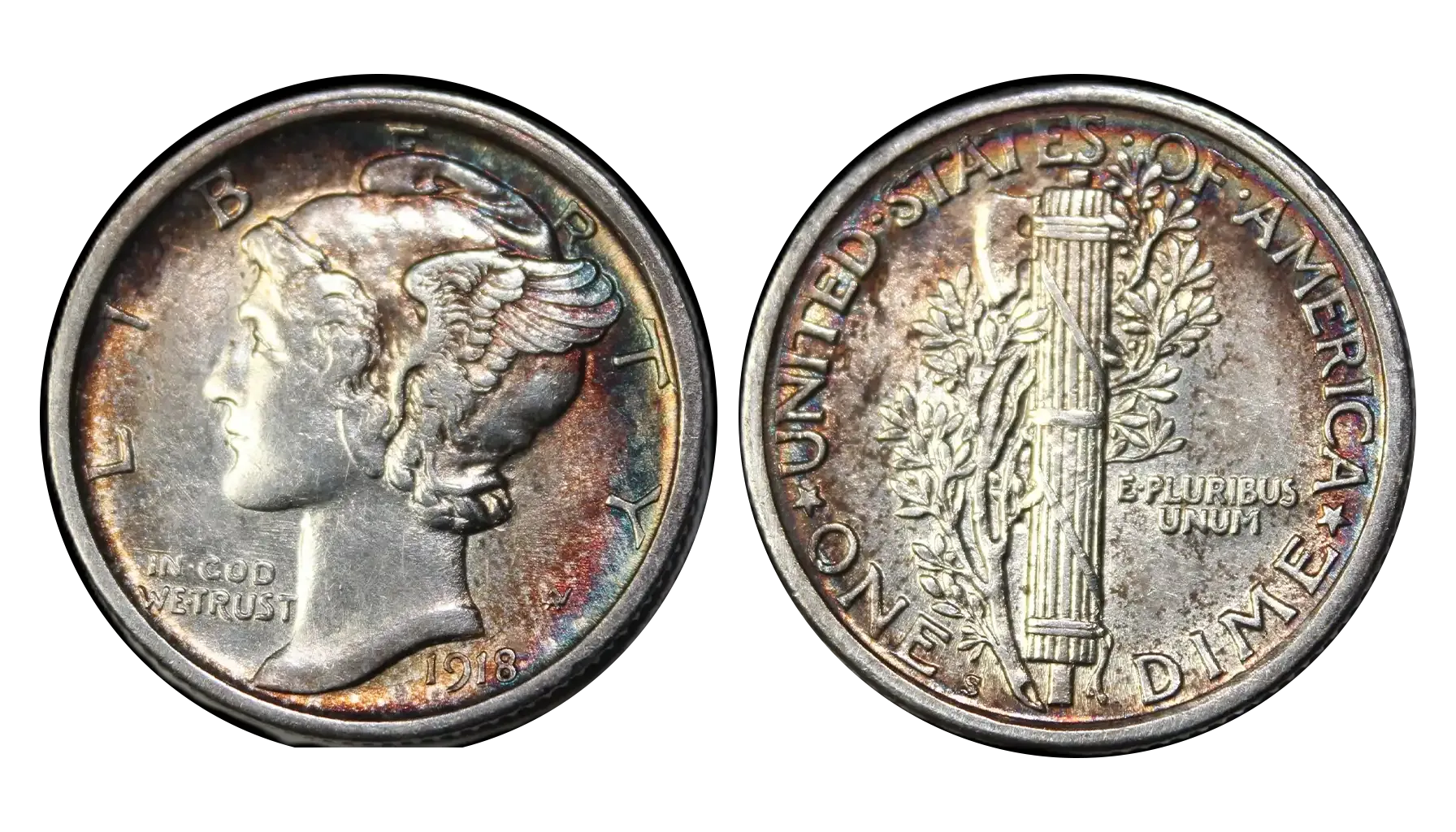
Obverse – portrait of Liberty wearing a winged cap, the date is at the bottom.
Reverse – pasces (a bundle of rods with an axe) symbolizing strength and unity.
Weight | 2.50 g |
Diameter | 17.90 mm |
Thickness | 1.35 mm |
Edge | Reeded |
Designer | Adolph Weinman |
1918 Dime Value Chart
What do collectors want in their cons? Rarity. And what coins are rare? Very often, coins in a great state are rare. Especially if they are more than a century old.
Grade | P | 1918 D Dime Value |
Good–Fine | $3–$15 | $4–$20 |
Very Fine | $25–$40 | $35–$55 |
Extremely Fine | $55–$85 | $75–$110 |
Uncirculated | $110–$160 | $180–$275 |
MS-63 | $325–$450 | $550–$750 |
MS-65 | $1,100–$1,400 | $1,800–$2,500 |
Generally, S-dimes take the crown in terms of 1918 Liberty dime value, but on various grades, Denver-made pieces end up winning, too. All in all, the Mercury dime 1918 is a very valuable coin, and even in the lowest grades, it exceeds its face value. Do not confuse with the 1918 dime W mint mark; W is the designer’s initial.
1918 S Dime Value Chart
Good–Fine – $5–$25
Very Fine – $40–$65
Extremely Fine – $85–$130
Uncirculated – $210–$350
Mint State – $650–$900
Mint State+ – $2,200–$3,500
"For collectors pursuing Full Bands, the 1918-S represents one of the most demanding issues in the series."
– Charles Morgan, author
CoinWeek
Rare 1918 Mercury Dime Errors List
7-D Overdate
This is not just an error; it is one of the most famous errors in the history of the U.S. Mint. It occurred when a die was accidentally hubbed with a 1917 design. Look at the "8" in the date.
You will see a distinct horizontal bar and the top loop of a "7" protruding from the upper left and middle of the 8. The "7" is also visible under the "1" in some high-grade pieces.
$500–$6,000+
Doubled Die Obverse (DDO)
While rare compared to the overdate, true hub doubling exists for the year. Look for doubling on the letters of "IN GOD WE TRUST" and the date digits.
$150–$800
Die Cracks & Cuds
The dies were often pushed to their limit to meet wartime demand. For identifying die cracks, look for raised, thin lines zig-zagging across Liberty's face or through the fasces on the reverse. Cud is a major die break at the rim.
$100–$250
Repunched Mint Marks (RPM)
Specific to Denver (D) and San Francisco (S) issues. Look for a secondary mint mark shadow or a thickened, distorted letter.
20%–50% bonuses
Striking & Planchet Errors
Errors also make their own varieties. The most valuable error dimes are worth a few hundred dollars if they have a rare error and retain an above-average grade. Here is the list of the most common errors found on items:
Defect | Price | Details |
Off-Center Strike | $150–$750 | The item is shifted |
Broadstruck | $45–$130 | Struck without the collar |
Mirror Brockage | $1,000–$2,500+ | A struck item stuck to the die strikes the next blank |
Clipped Planchet | $35–$120 | A curved or straight missing “piece” from the edge |
Lamination Crack | $15–$60 | A flake or crack in the silver surface caused by poor metal mixing |
What Makes a 1918 Dime Valuable?
The 1918 Mercury dime value can be determined not only by its 90 % silver content, but also by its status as a relative rarity. Although more than 68 million of these coins were minted across all three mints, several factors can make it a valuable asset.
The Full Bands (FB)
Because the dies were often overused during the industrial pressure of World War I, most coins have "mushy" or merged bands. A coin with perfectly separated, crisp middle bands is extremely rare, especially for the S (San Francisco).
The value of S in MS-65 without Full Bands might sell for $800, but the same coin with the FB designation can easily reach $20,000 to $40,000+.
Condition Rarity
Because items circulated heavily during the post-war economy, finding them in Mint State is difficult. Most pieces in average routine condition are worth $3–$15.
Once a coin hits uncirculated value MS-67 or MS-68, it enters the set market. Today, a Philadelphia strike in MS-67+ can command $1,100+, while a Denver or San Francisco strike in that grade is a multi-thousand-dollar rarity.
How to Identify a 1918 Mercury Dime
Several steps you should take for the best item identification:
Obverse / Reverse identification
The mint mark location
Full Bands factor
How to Find Your Item on the Online Market?
Before you can search for a price, you need to know exactly what you have. In the year, several high-accuracy apps can identify your coin from a photo:
PCGS CoinFacts – now the numismatic standard. It combines high-resolution imaging with their price guide and auction history.
AI Apps – applications use AI to identify the coin and provide an estimated grade (Sheldon Scale) and rarity detection for errors.
The Basic Item Checklist – always note the date and mint mark.
Research Real-Time Market Value
Don't rely on prices from current listings, which can be inflated. Instead, look at what people are actually paying:
Go to eBay, search for your coin, and filter by Sold Items. This gives you the most accurate street price for the year.
Heritage Auctions and other auctions – use for higher-value or rare coins. They provide deep historical data on professional-grade coins (PCGS / NGC grading services).
NGC Coin Explorer is a great tool for checking rarity and survival estimates for specific grades.
Is a 1918 Dime Worth Anything Today?
The price of the coins has fluctuated over the past several decades. This has been largely due to the random production of coins with unique anomalies. Below are the main periods of price change for this coin.
The Circulation Period
During the year 1964, the item was simply a ten-cent piece used for daily transactions. Millions were in circulation. Only the 7-D Overdate was recognized by early numismatists as a rarity, but even those could occasionally be found in change for ten cents until the late 1930s.
The Silver Shock & Early Collecting
In 1965, the U.S. stopped using silver for items. This created the first major floor for coins.
1960s – collectors began hoarding silver pieces.
1970s – as silver prices climbed toward the 1980 peak, the item’s melt value became its primary driver. By 1976, an uncirculated S was being offered for $150, reflecting early interest in high-grade specimens.
The Grading Revolution
The 1986 launch of PCGS truth grading and NGC changed the market. MS coins and Full Bands (FB) strikes are much more valuable.
1980s: A standard uncirculated item was worth $30–$50.
1990s: The gap between standard and Full Bands widened. In 1996, a top-tier MS-68 FB specimen sold for $22,000. It signals that high quality was now more important than the coin's age.
The Registry Set Boom
Online registry sets allowed collectors to compete for the best-known coins, causing prices for high-grade items to explode.
2002: A PCGS MS-67 FB sold for $44,850.
2019: That same coin (or one of equal quality) realized $144,000. The common item in average condition stayed relatively stable around $2–$5, but the elite coins became institutional-grade investments.
The Modern Period
The current period is defined by extreme 1918 silver dime volatility and a renewed interest in tangible assets.
2021–2024: Silver prices began a steady climb. The melt floor for a piece rose from $1.50 to over $4.00.
FAQ
How much is my 1918 dime worth?
For the San Francisco item, the actual Good–Fine price is $5–$25.
Where is the mint mark on a 1918 Mercury dime?
You should look for the reverse item side.
What does a 1918 dime look like?
The item shows a left-facing portrait of Liberty with a winged cap. The item also shows inscriptions and a date.
Who is on the 1918 dime?
On the item, you can see a Lady Liberty portrait.
How much is a 1918 dime worth today?
The price ranges from $3 to $1,000 or more dollars on the online auctions and markets.
How much silver is in a 1918 dime?
90 % of the item is silver.

 Facebook
  X (Twitter)
  Pinterest
  LinkedIn