Contents:
It has been over a century since 1858, when the cent appeared. The coin might be old, but it is as viable and valuable as ever.
How much is a 1858 penny worth? What makes it valuable? About that and much more, you can learn here.
For old bits, we suggest using a free old coin value checker. Yes, apps nowadays can help you with identification!
1858 Penny Design and Overview
This coin technically was a member of two different series. First and foremost, it was a continuation from the 1857 cent, and a part of the Flying Eagle series.
And yet it was also a pattern coin for the Indian Head series. In case you don't know, a pattern coin is sort of a test run, meaning it was produced as a trial or experimental piece and not intended for general circulation. These coins were struck to test new designs or compositions.
In this article, we will concentrate on the Flying Eagle penny 1858, since it was the officially running one. The coin was designed by James B. Longacre, Chief Engraver of the U.S. Mint.
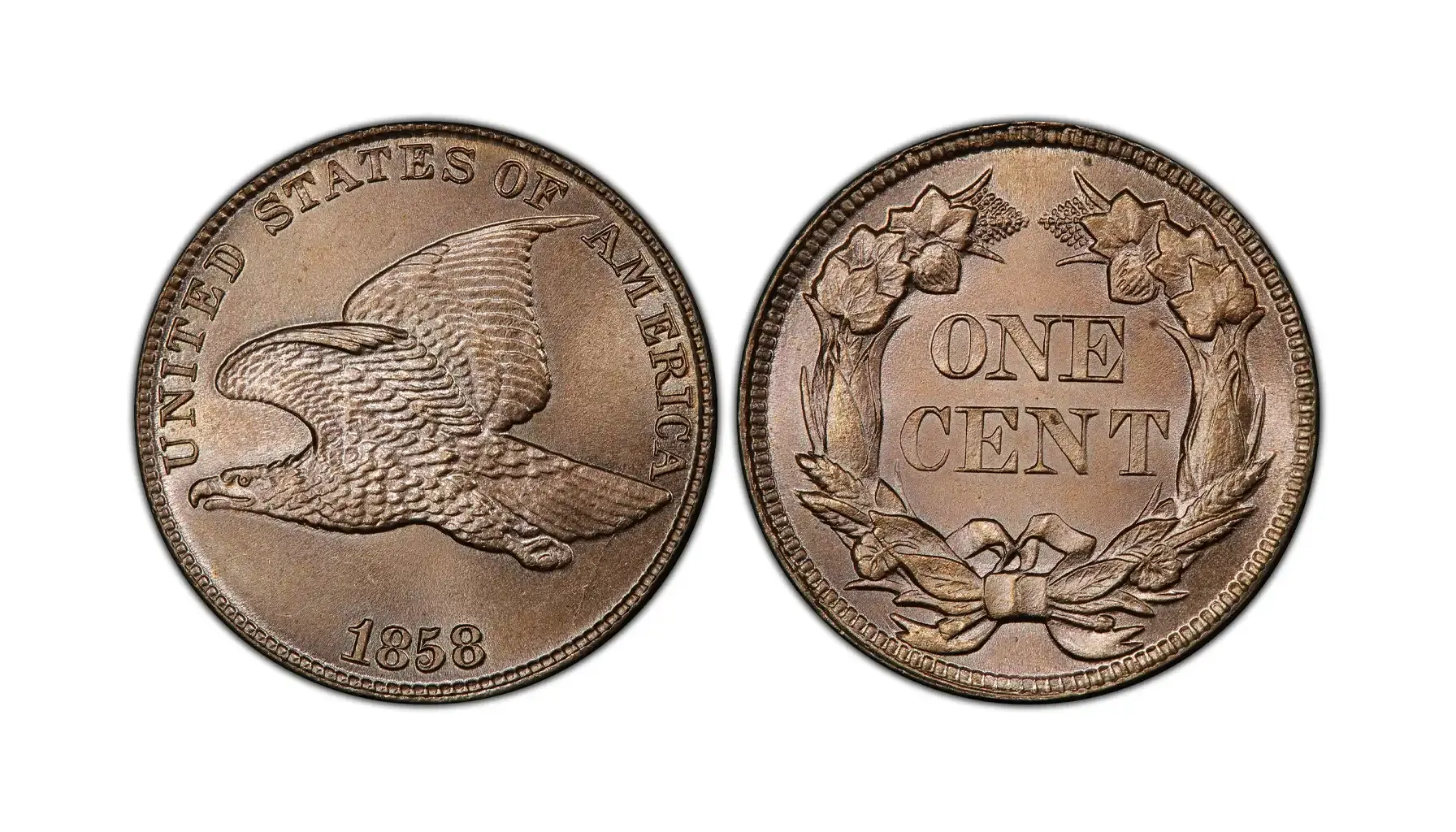
The Obverse features a flying eagle in flight, facing left. The eagle is raising its wings. You will find inscriptions like “UNITED STATES OF AMERICA” around the rim, and the date “1858” appears below the eagle.
The Reverse features a simple wreath of oak leaves surrounding the words “ONE CENT”. The wreath is composed of finely detailed oak leaves and acorns. At the base, it is tied by a ribbon.
This design was made to show off the American independent spirit and endurance. Yet, the design was too voluminous and hard to mint, and therefore didn't last long on the presses.
1858 Eagle Penny Overview | |
Country | United States |
Years of Minting | 1856–1858 (1856 was a pattern issue 1857–1858 were regular circulation coins) |
Type: | Circulating |
Shape: | Round |
Composition and metal content | 88% copper, 12% nickel |
Diameter | 19 mm |
Weight | 4.67 grams |
Mint Facilities | The Philadelphia US Mint |
Please note: Don’t confuse these old pieces with the recent 2025 Silver Eagles. They have somewhat similar names, but come from different series and have different materials.
Letter Varieties
Most coins nowadays are categorized according to mint marks. Back then, only one Mint facility was actively working, the Philadelphia US Mint.
Old coins had other quirks. This 1858 US penny had differently sized letters. We mainly deal with two types, each one roughly making up half of the whole mintage (24,600,000).
Large Letters
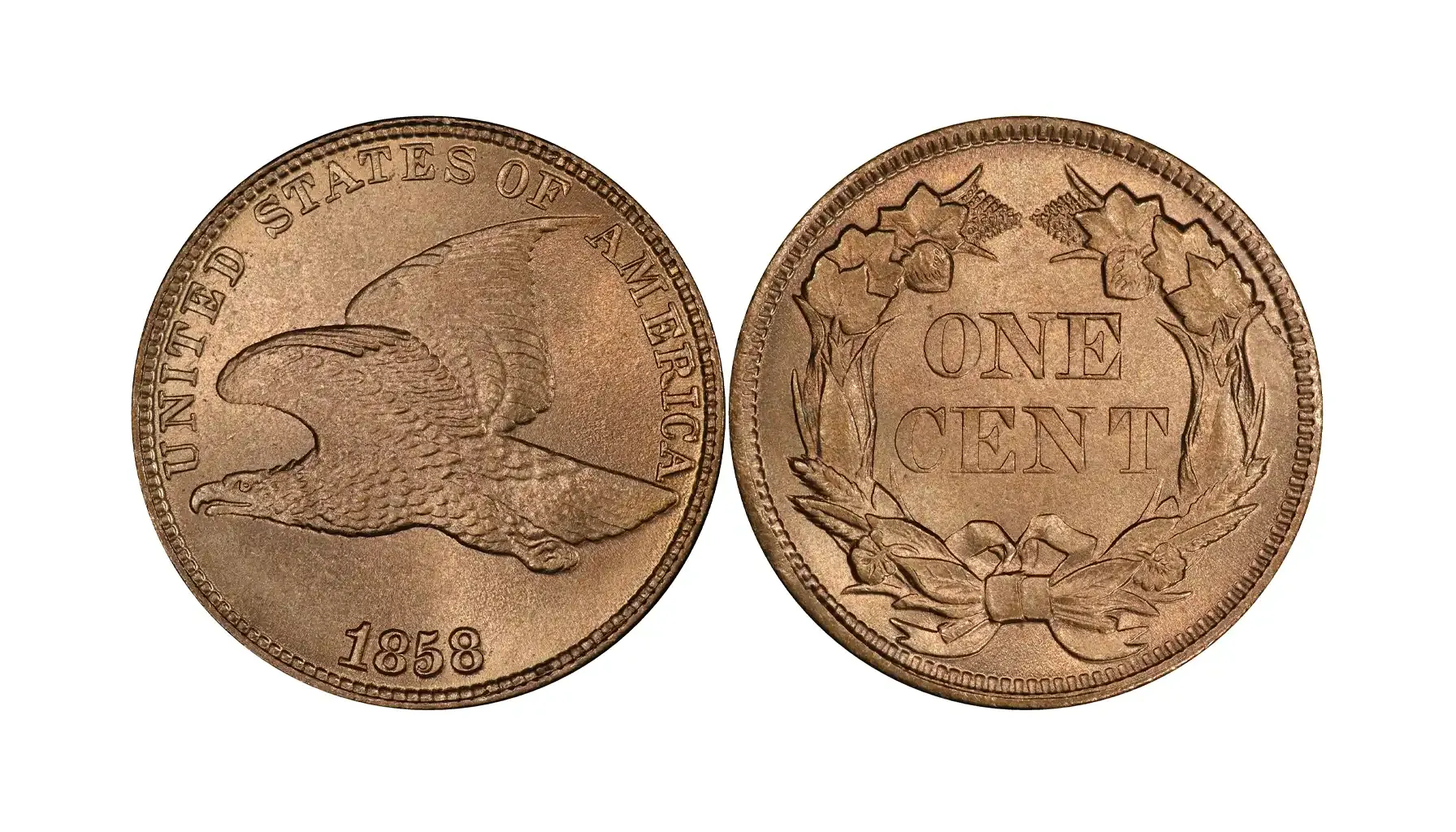
Initially, the coin was minted with bigger, taller, and more prominent letters.
The inscription “UNITED STATES OF AMERICA” takes a bit more space on the rim. Date digits are taller and sometimes more sharply struck. The reverse letters in “ONE CENT” are larger, almost bold.
Yet the main sign is the way how letters “A” and “M” in “AMERICA” touch each other.
This large letter variety is worth a bit less than the small one.
Small Letters
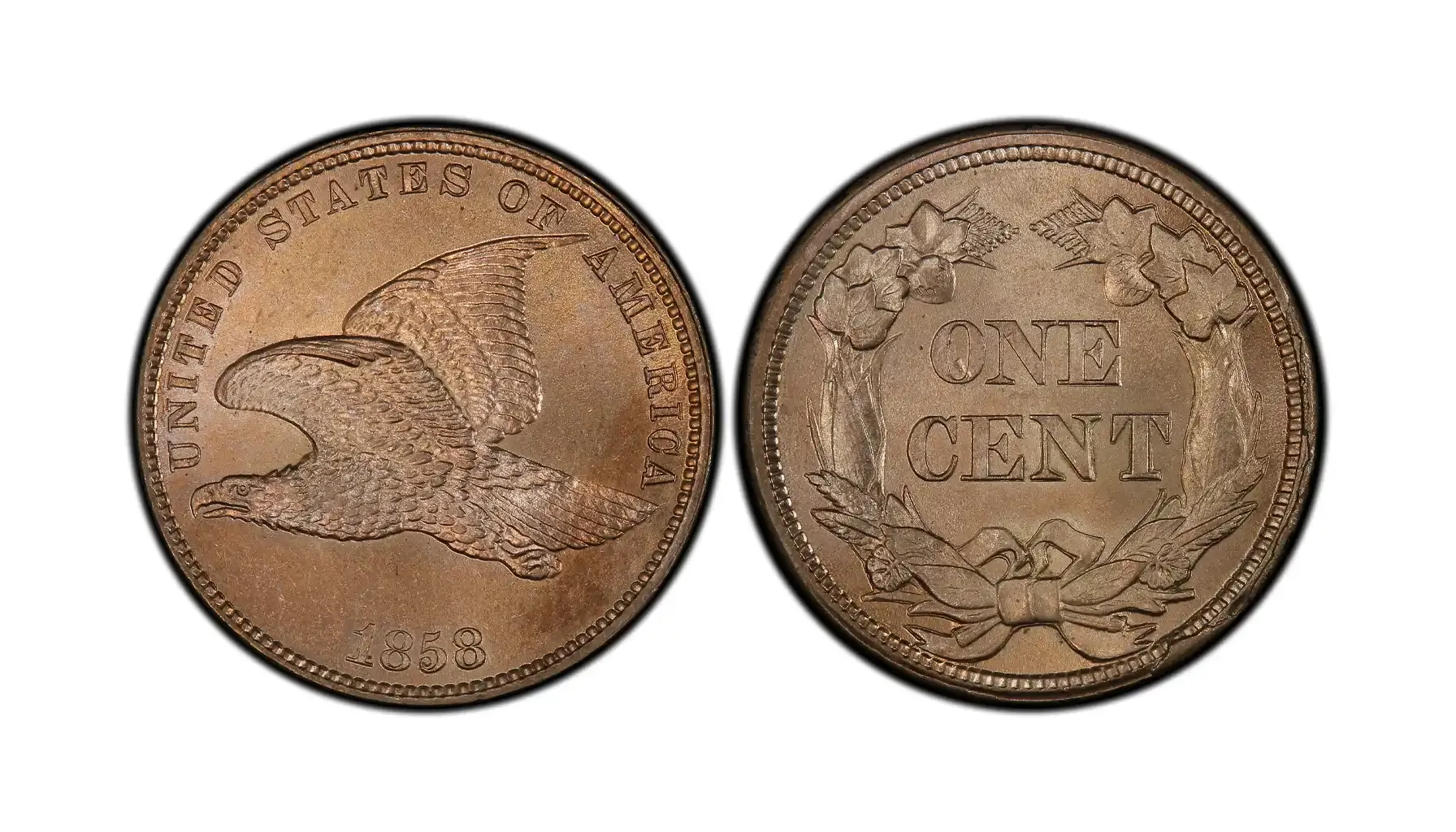
For his variety, the lettering in “UNITED STATES OF AMERICA” is slightly smaller and more compact.
How can you identify it? The letters are thinner and closer together. Date digits (1858) appear slightly shorter in height. The reverse oak wreath letters are also slightly smaller.
The main sign is that the letters “A” and “M” in “AMERICA” do not touch each other.
This variety is worth a bit more.
1858 Penny Errors
Сontrary to expectations, errors are something good for the coinage. Coins with errors could be worth 10x their usual price, as long as the error is dramatic and rare.
1. Die Cracks: Small raised lines appear on the coin due to cracks in the die. Commonly found across the eagle’s wings or near the date. Minor die cracks are common; large or dramatic ones can add value.
2. Die Clashes: The obverse and reverse designs partially strike each other when the dies collide without a planchet between them. Appears as faint impressions of the eagle on the reverse or wreath on the obverse. Relatively uncommon.
3. Repunched Date (RPD): The date “1858” may appear doubled, especially on the last digits, due to multiple punches. High-grade coins with noticeable doubling can be worth multiple hundred dollars.
4. Off-Center Strikes: The design is not fully centered on the planchet. Slight off-center strikes are common, but coins missing significant portions of the design are very rare.
5. Double Die Varieties: Some 1858 cents were struck from dies that had doubled on letters or the date. Doubling can appear on the inscriptions “UNITED STATES OF AMERICA” or “ONE CENT” on the reverse. Very collectible and can increase the coin’s value substantially.
6. Planchet Flaws: Imperfections in the metal disk before striking, such as laminations (peeling metal) or clippings (thin spots).
1858 Flying Eagle Penny Value
Grading is one of the biggest contributors to the 1858 eagle penny value. Therefore, we present the value table according to the grading.
Condition | Small Letters | Large Letters |
Good (G4) | ~$25 | ~$25 |
Fine (F12) | ~$65 | ~$60 |
Very Fine (VF20) | ~$75 | ~$75 |
Extremely Fine (EF40) | ~$115 | ~$110 |
About Uncirculated (AU55) | ~$375 | ~$350 |
Mint State (MS60) | ~$650 | ~$500 |
MS65 | ~$4,200+ | ~$4,000+ |
MS67 | ~$2,500–$3,000 | ~$2,500–$3,000 |
The value of the 1858 Flying Eagle penny is a respectable one, especially for the small letter variety.
If you’ve acquired a piece in your collection, we recommend getting the coin graded officially by NGC or PGC. Most authentic traders use their official grading services to appear reliable. Plus, official grading lets you increase the price.
Coin ID Scanner
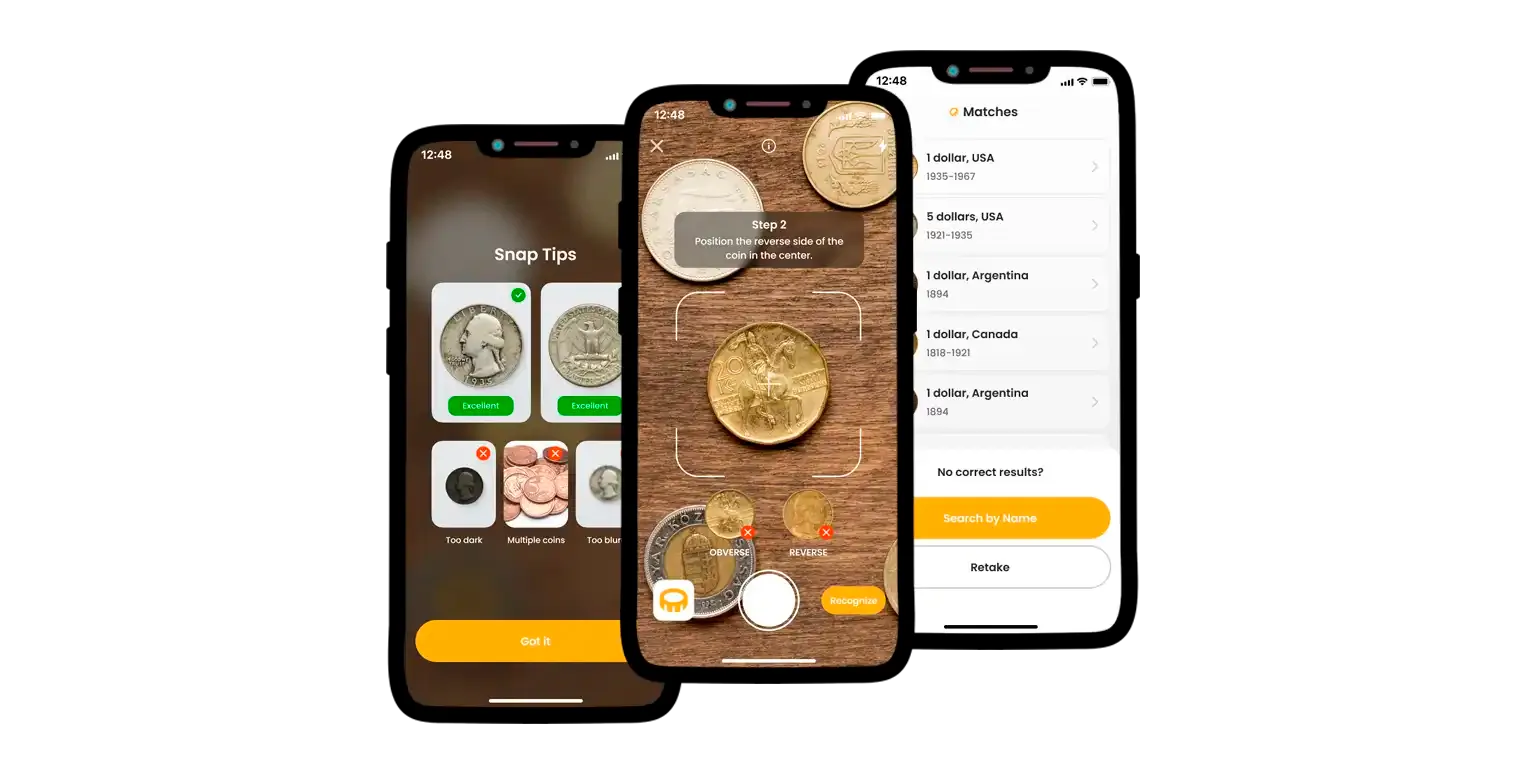
Coin ID Scanner is an app and a tool. What does it do? It helps users identify and assess the value of coins from around the world.
Here's an overview of the main features:
AI-Powered Coin Identification: Users can take or upload a photo of a coin, and the app's advanced image recognition technology will instantly identify the coin, providing details such as its country, denomination, year, and other relevant information.
Extensive Coin Database: The app boasts a database of over 150,000 coins, encompassing a wide range of global and historical coins, including rare and commemorative pieces.
Value Estimation: The app provides estimated market values, helping users gauge the worth of their collections.
Coin ID Scanner is a free app, and you can download it today on iOS and Android.
FAQ
Is the Flying Eagle Penny 1858 Value High?
Yes. The 1858 Flying Eagle cent is considered rare and collectible, especially in high grades (AU or MS). In lower circulated grades, it might sell for $25–$75. In uncirculated condition, values range from $300 up to several thousand dollars, depending on letter size (small vs large letters) and die variety.
What Is the 1858 Indian Head Penny Value?
The Indian Head penny was not circulating yet in 1858. It was minted, but only for test purposes, so we cannot know its value. If it is found by a collector, it might be very valuable. We have an example. One of the most valuable coins in the UK is the 1937 5 pence. It also didn’t circulate but was discovered and sold for $2,280,000 USD.
Was 1858 Cent a Flying Eagle or an Indian Head?
1858 saw both types minted. The Flying Eagle cent was the main issue until the Indian cent replaced it in 1859. Flying Eagle featured a flying eagle on the obverse, and an oak wreath on the reverse. The Indian Head cent shows Liberty wearing a Native American headdress on the obverse, and a laurel wreath on the reverse.

 Facebook
  X (Twitter)
  Pinterest
  LinkedIn