Contents:
Sometimes, coins may bear dates that do not correspond with the actual year of mintage – it is quite normal, since any design is meant to reflect a historical event rather than the moment it was created.
The so-called “United States of America Louisiana Purchase 1803 nickel” is a fine example of such confusion: despite its seemingly ancient date, it rolled off the mint presses only in 2004, when the “Westward Journey” design was in its prime. Nonetheless, the coin attracted attention not for the event it commemorates, but for the intriguing date stamped on its reverse.
Anyway, however impressive this far-gone year may seem, one should not be disappointed because of its actual production date. The coin was created to honor an important milestone, and this is where its true value begins. So, what is the Louisiana Purchase nickel value? Which features identify this coin as unique, and did any real nickels from 1803 really exist?
Historical Reality: No US Nickels in 1803
In truth, seeing "1803" on a coin can be quite misleading, for those who do not know the origins of this creation may confuse it with an authentic early-nineteenth-century issue. As a matter of fact, in 1803, 5-cent pieces had not been introduced yet – their first appearance came only in 1866 (see Shield nickels design).
However, during the beginning of the 19th century, the US Mint was still young, and coinage primarily consisted of copper cents, half cents, and silver or gold coins such as half dimes, dimes, and eagles. This means that any coin dated “1803” and labeled a “nickel” is, by definition, a modern creation.
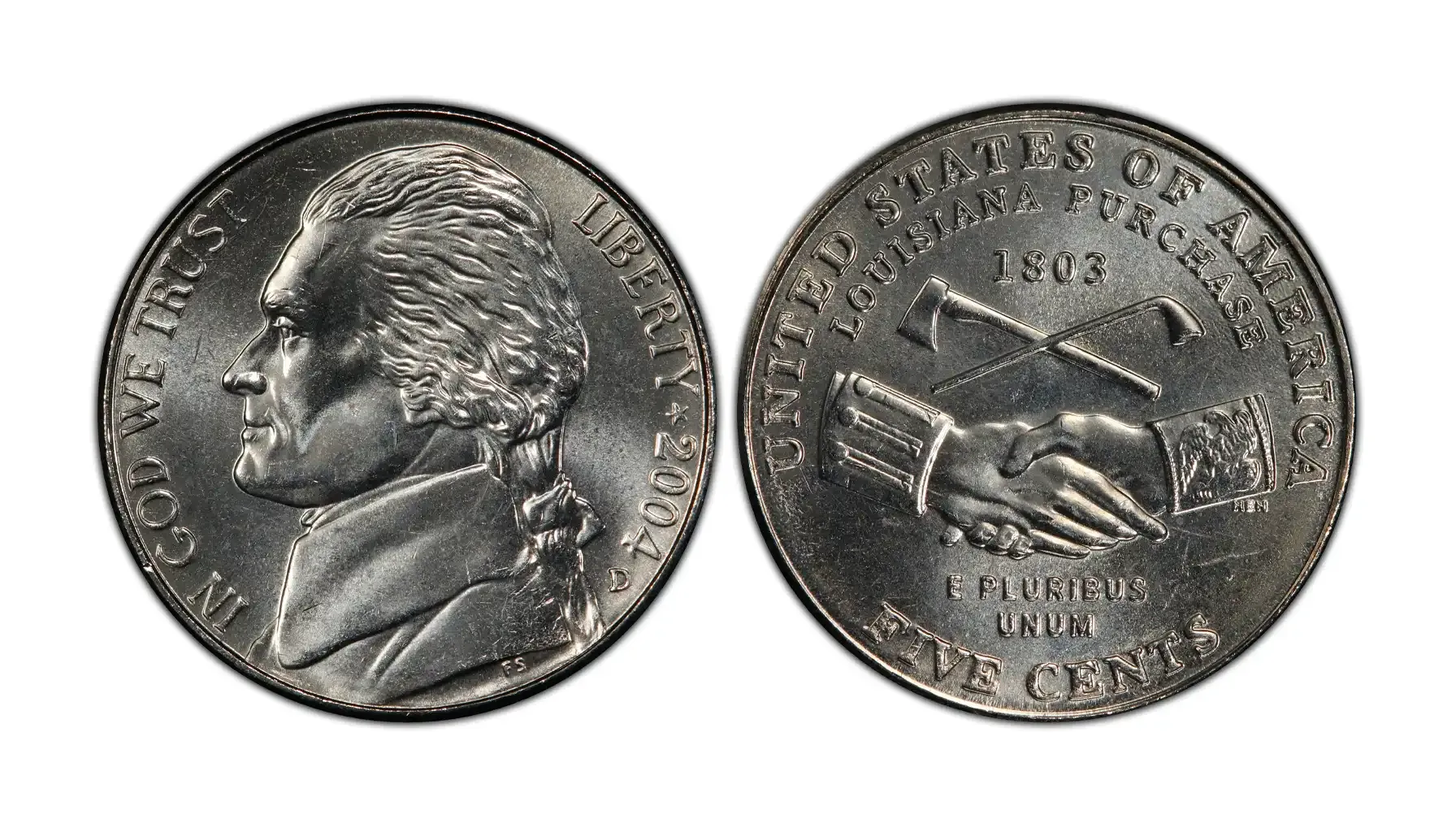
In fact, the 1803 nickel Louisiana Purchase is the product of the 2004 Westward Journey Series issued by the US Mint to commemorate the bicentennial of the Louisiana Purchase and the Lewis and Clark Expedition. And its original name is the Peace Medal. This is what we are going to focus on today, either way.
Related article: Lewis and Clark 2004 Nickel: Errors, Values & Rare Varieties
Design Features of the (2004) 1803 Nickel
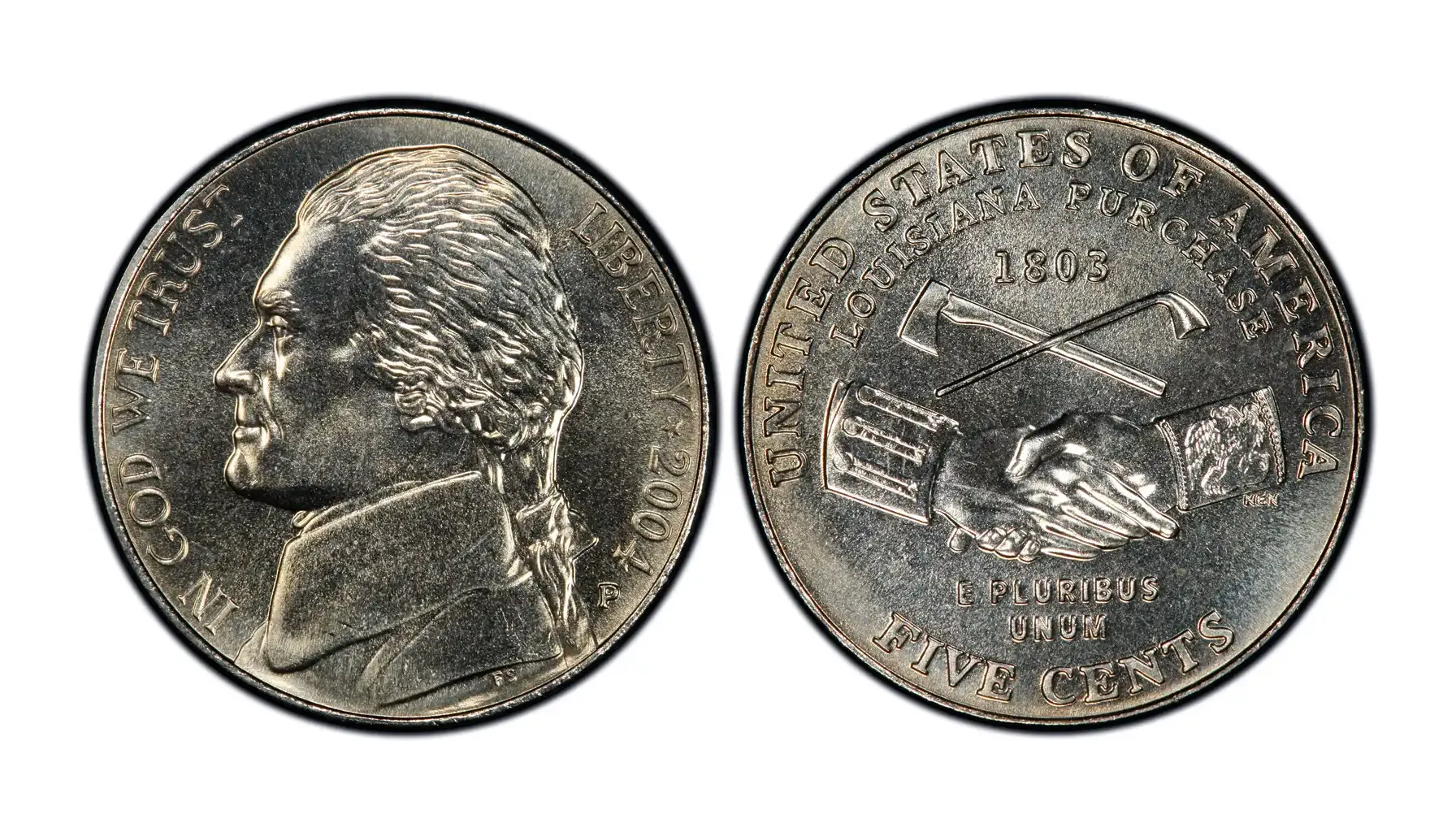
Obverse: Features a portrait of President Thomas Jefferson by Felix Schlag, along with the inscriptions “IN GOD WE TRUST” along the left rim, “LIBERTY” and the year “2004” to the right of the profile, and the mint mark just below the date.
Reverse: Introduces an image of the handshake between two forearms (one representing a US military officer in a uniformed sleeve, and the other a Native American wearing a traditional beaded wristband) by Norman E. Nemeth, as well as the inscriptions “UNITED STATES OF AMERICA” around the top rim, “LOUISIANA PURCHASE” and “1803” above the hands, “E PLURIBUS UNUM” below the handshake, and the denomination “FIVE CENTS” at the bottom rim.
The Main Features of the Nickel Louisiana Purchase 1803 (2004) | |
Official Name | 2004 Jefferson Nickel “Peace Medal” |
Series | Westward Journey Series (1st issue) |
Composition | 75% copper, 25% nickel |
Weight | 5.00 grams |
Diameter | 21.21 millimeters (0.835 inches) |
Thickness | 1.95 millimeters (approx.) |
Edge | Plain |
Mint Marks | “P” for Philadelphia “D” for Denver “S” for San Francisco (proof) |
Years of Issue | 2004 |
Theme | Commemoration of the Louisiana Purchase (1803) |
(2004) Nickel 1803 Louisiana Purchase Types by Mint
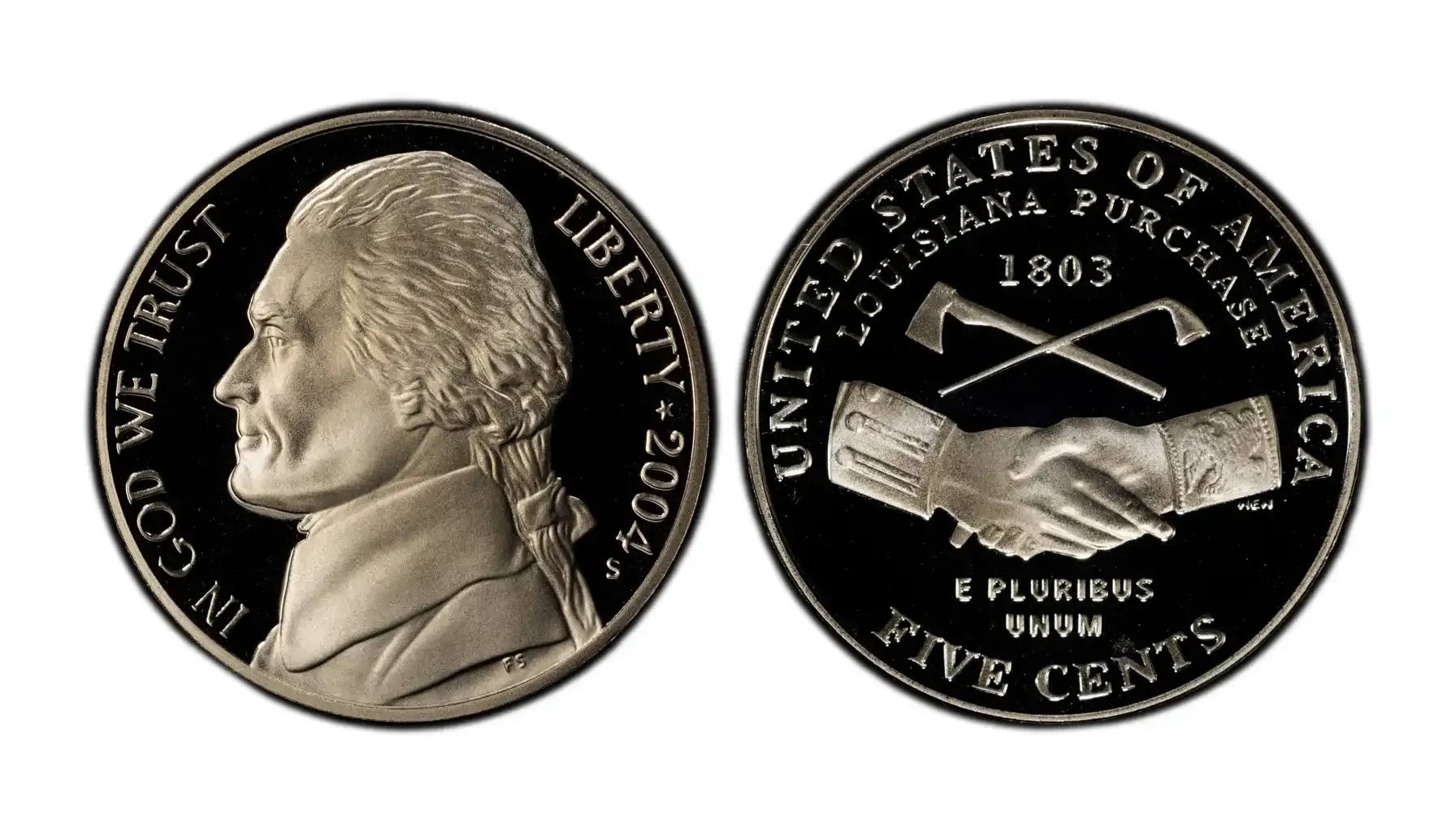
The 2004 Peace Medal was struck at three major US Mint facilities, and just like with other numismatic creations, Philadelphia and Denver produced coins for general circulation, while San Francisco issued high-quality proofs for collectors.
Mint Types and Mintages:
2004-P (Philadelphia Mint): 361,440,000 coins
2004-D (Denver Mint): 372,000,000 coins
2004-S (San Francisco Mint, Proof): 2,992,069 coins
How Much Is a 1803 Nickel Worth? The 2004 Release Revealed
Although the 1803 nickel value can mistakenly sound overly promising, the truth is far more modest. Its commemorative nature suggests that the main part of the release should have been well-preserved, which makes the hunt not a great challenge to take. Hence, most examples hold only face value, though uncirculated or proof issues can be a bit more profitable to own. So, here is what one should know about the 1803 nickel 2004 worth.
Type | Grade | Estimated Range | Notes |
2004-P (Philadelphia Mint) | Circulated (G–XF) | $0.05 – $0.10 | Common issue; face value in most grades. |
Uncirculated (MS60–MS65) | $5 – $17 | Minor collector premium for clean strikes. | |
Gem Uncirculated (MS66–MS68) | $35 – $2,750 | Premium examples with full luster. | |
2004-D (Denver Mint) | Circulated (G–XF) | $0.05 – $0.10 | Readily available in rolls and sets. |
Uncirculated (MS60–MS65) | $5 – $18 | Slightly scarcer than the Philadelphia issue. | |
Gem Uncirculated (MS66–MS68) | $28 – $900 | Collectible in top mint-state condition. | |
2004-S (San Francisco) | Proof (PR63–PR67) | $1.50 – $2.00 | Sold in official US Mint proof sets. |
Deep Cameo Proof (PR68–PR70) | $3.00 – $26 | High-grade mirror finish proofs |
*Prices are approximate and may fluctuate daily. So as to make sure you are aware of current coin rates, employ additional tools like Coin ID Scanner to check info about specific numismatic creations, manage collections, and even access educational content to make your experience rich.
Fun Historical Note
By the way, did you know that the “Peace Medal” design on the 2004 nickel is inspired by actual medals given by President Thomas Jefferson to Native American leaders during the early 1800s? These medals were symbols of friendship and diplomacy, intended to establish peaceful relations and alliances as the United States expanded westward.
Even the 1803 nickel should be called modern – it is the fate of pieces that commemorate history to exist as reflections of the present rather than artifacts of the past.

 Facebook
  X (Twitter)
  Pinterest
  LinkedIn