Contents:
Is there a 10000 dollar bill? Yes, there once was a $10,000 bill in the United States, one of the highest denominations ever printed for public currency.
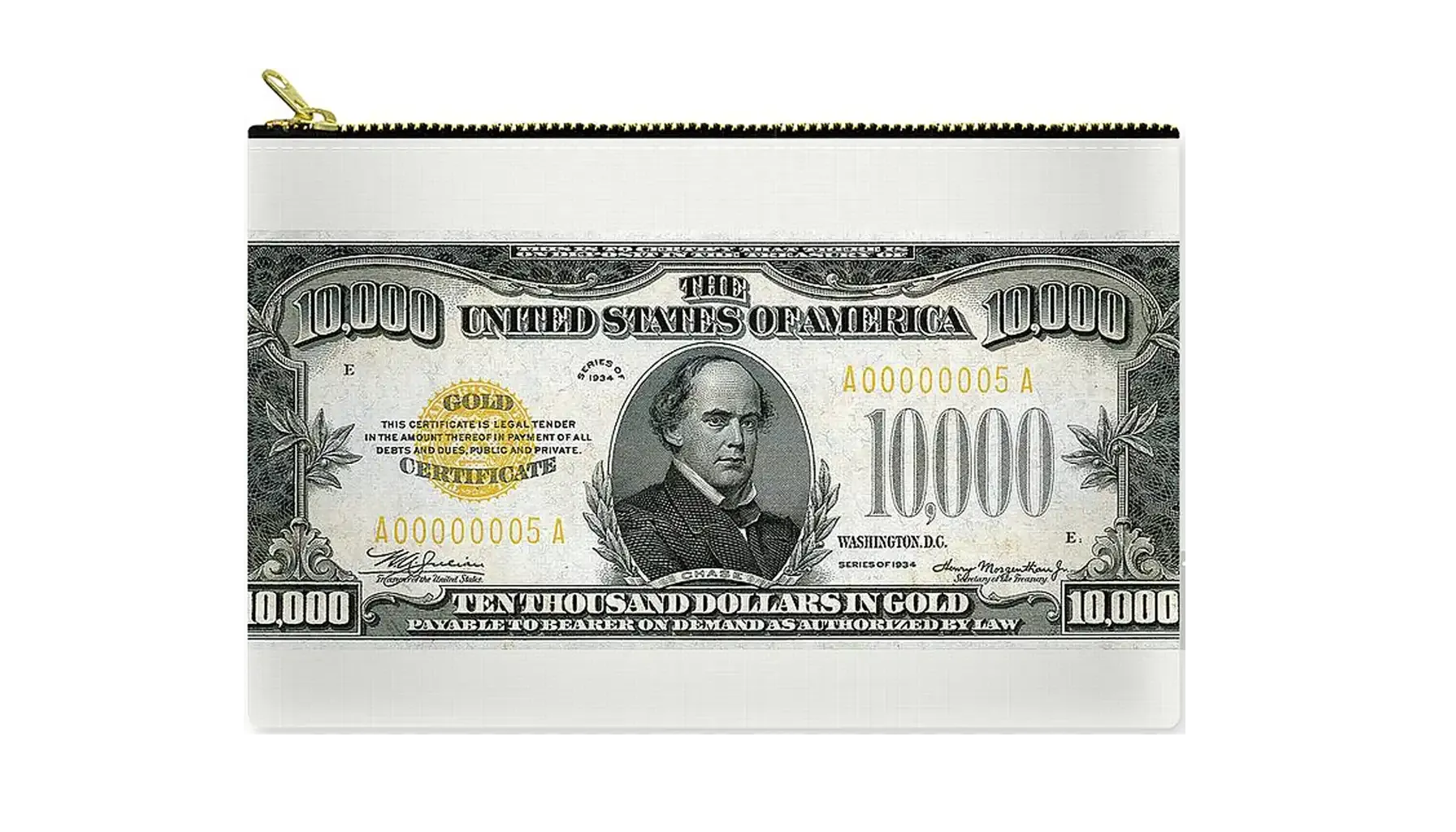
Who is on 10000 dollar bill? It featured Salmon P. Chase, the Treasury Secretary during Abraham Lincoln’s presidency, and was used mainly for bank transfers rather than everyday transactions.
Although it was officially discontinued in 1969, it is the 10000 dollar bill real piece that remains legal tender and is now a rare collector’s item valued far above its face value.
The Coin ID Scanner team is going to tell you everything about it.
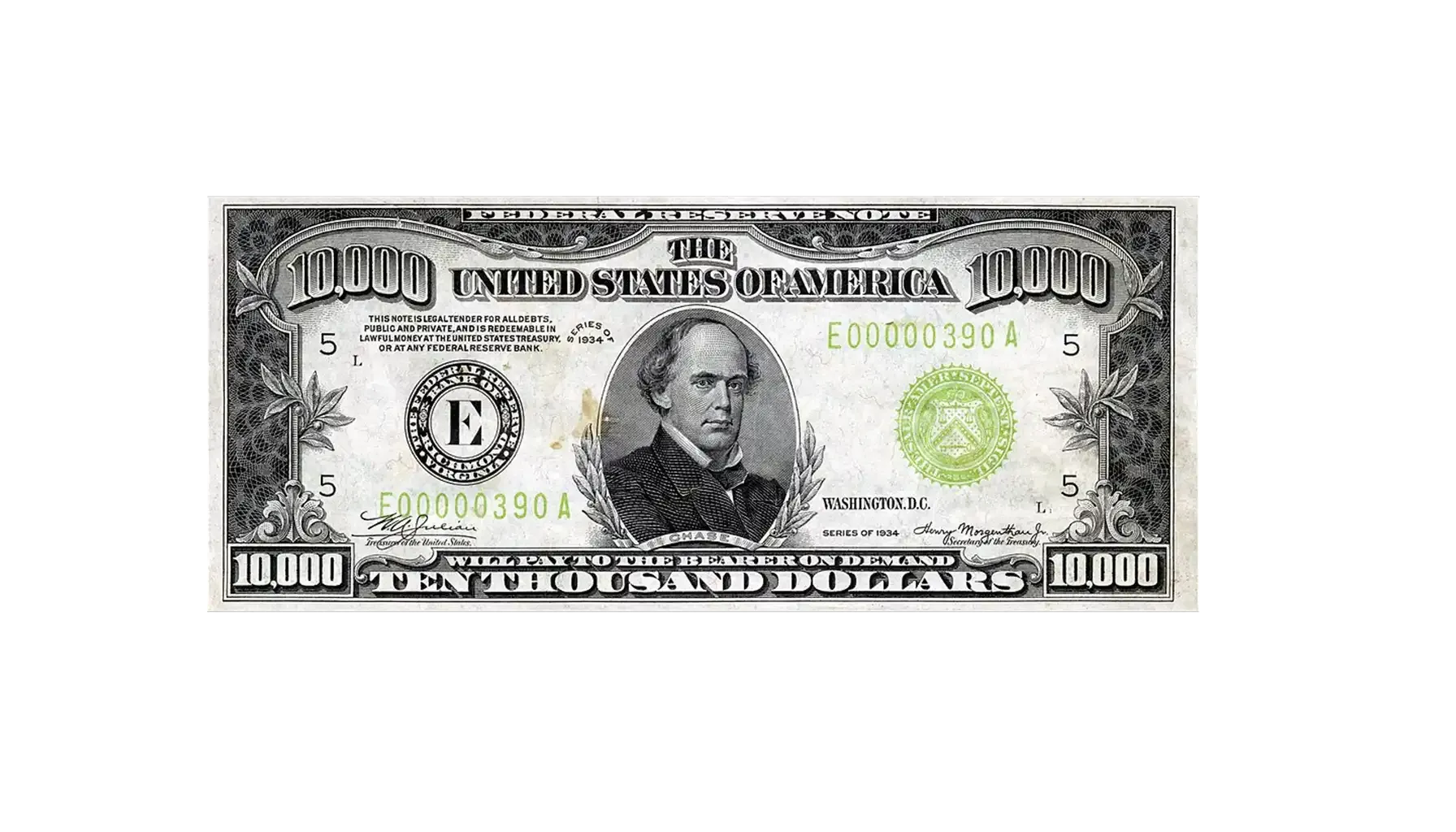
Feature | Details |
Who Is on the 10000 Dollar Bill? | Salmon P. Chase |
Series Issued | 1928 and 1934 |
Issuing Authority | United States Federal Reserve |
Material | Cotton-linen blend (standard U.S. currency paper) |
Dimensions | 156 × 66 mm (6.14 × 2.61 in) |
Color Scheme | Green and black with intricate engravings |
Primary Use | Bank and Federal Reserve transactions |
Withdrawal from Circulation | 1969 |
Current Legal Status | Legal tender, but no longer issued |
History
So, was there ever a 10000 dollar bill? Yes, it was created during a time when the United States depended on paper money for nearly all major financial transactions. Before electronic transfers existed, large sums between banks had to be moved physically, so high-denomination notes simplified the process.
The first specimens were printed in 1918 as Gold Certificates, backed by reserves held in the U.S. Treasury. Later, the Federal Reserve released updated versions in 1928 and 1934.
Who's on the 10000 dollar bill? Each note featured Salmon P. Chase, who served as Secretary of the Treasury during the Civil War and established the national banking system and the first uniform paper currency.
Between all series, approximately 336,000 pieces were printed. However, fewer than 350 known examples are believed to survive today, most of them held in government collections, museums, or private vaults. The rest were destroyed after their official withdrawal in 1969.
Ordinary citizens rarely saw this paper money. They circulated mainly between Federal Reserve Banks and large financial institutions to settle debts quickly and efficiently. As banking systems modernized and electronic transfers became common, the need for such large bills disappeared.
In 1969, the Treasury withdrew all high-denomination currency from circulation, including the $500, $1,000, $5,000, and $10,000 notes.
Who Is on the $10000 Dollar Bill?
It features Salmon P. Chase, who served as Secretary of the Treasury under President Abraham Lincoln and later became Chief Justice of the United States Supreme Court.
Whos on the 10000 dollar bill and why are they important? Chase was important in creating the National Banking System and introducing paper currency during the Civil War to stabilize the Union’s finances.
Who Was on the 10000 Dollar Bill Else?
Throughout U.S. history, only one person has ever appeared on officially issued notes as a face on 10000 dollar bill.
Earlier pre-Federal Reserve high-denomination notes (before 1914) sometimes featured different designs and figures, such as allegorical or symbolic characters — not presidents or real individuals.
No figure on the 10000 dollar bill has ever been a president though.
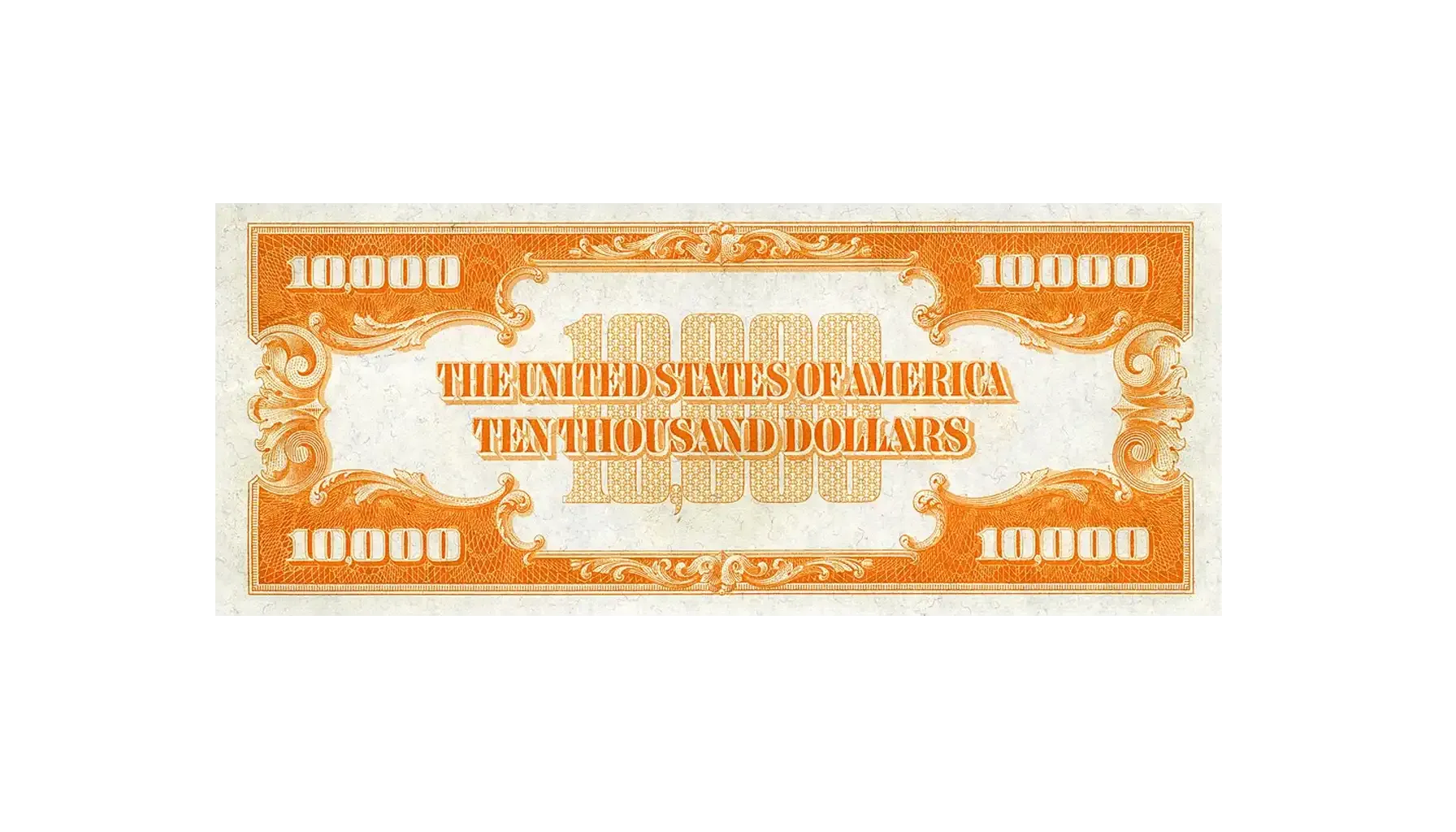
Reverse
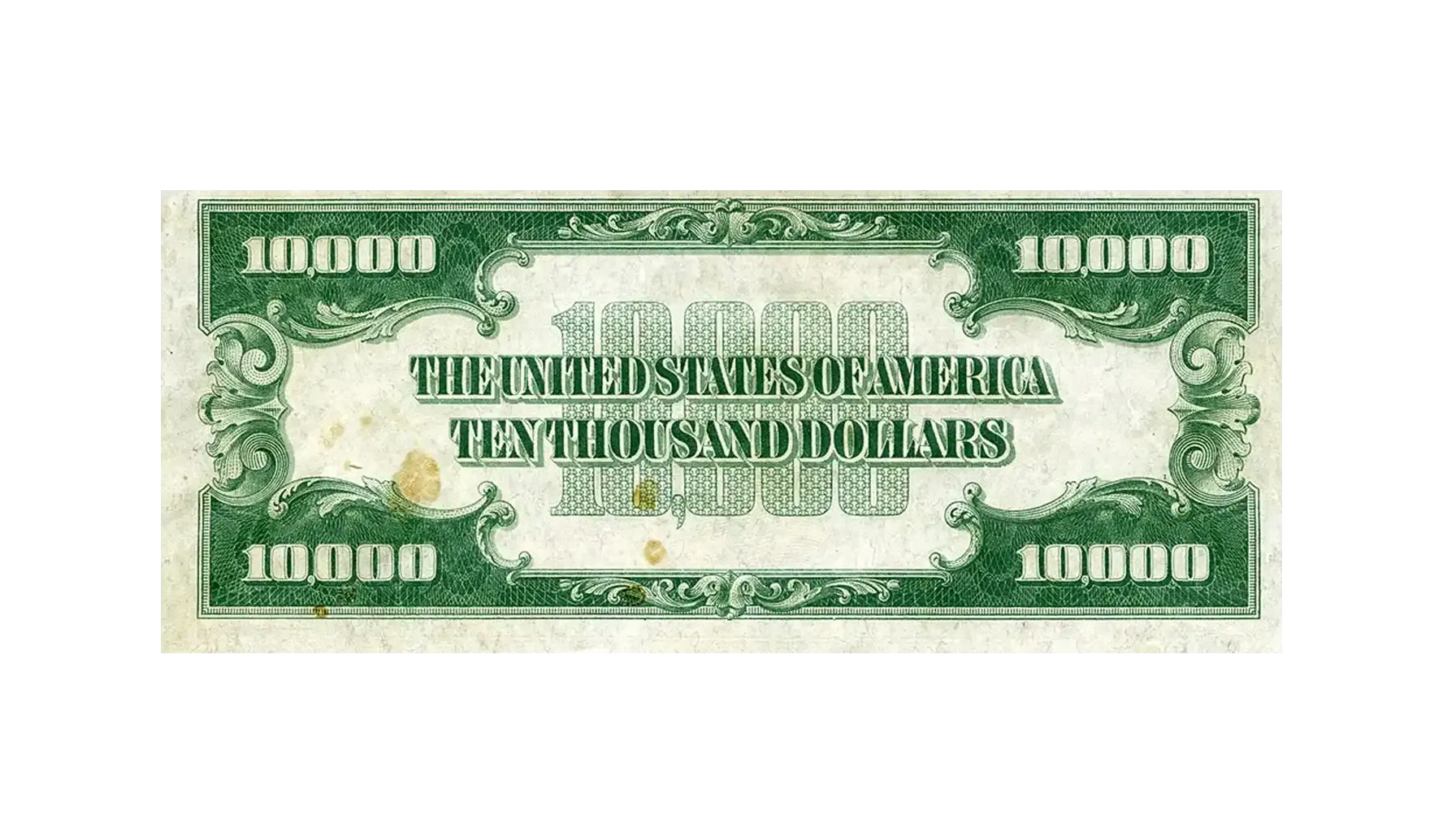
The reverse features an elaborate and symmetrical design dominated by the large engraved denomination “TEN THOUSAND DOLLARS” at the center.
The background shows scrollwork and ornamental line patterns typical of early 20th-century U.S. currency. Unlike lower denominations, it does not display a historical scene or monument—its design focuses on formality and anti-counterfeiting precision. The back color is traditional green, which gave rise to the nickname “greenback.”
High-denomination notes like this predated modern security technology. Their protection relied on engraving complexity, special paper, and ink formulation - important paper money parts.
Intricate line engraving by the Bureau of Engraving and Printing, nearly impossible to copy by hand.
Distinctive watermarked paper made from a cotton-linen blend.
Serial numbers and Treasury seals printed in unique ink shades.
Raised intaglio printing, giving the surface a textured feel recognizable to the touch.
At the time, these techniques were sufficient to deter most forgers.
Were There Design Differences Between the 1928 and 1934 Series?
The 1928 series was the first small-size issue after the U.S. reduced paper-money dimensions to the modern standard. The 1934 series retained the same basic layout but had subtle updates:
The Treasury seal changed from red (on Gold Certificates) to green (on Federal Reserve Notes).
The signatures of Treasury officials were updated.
Slight differences in lettering, serial number placement, and color tone appeared.
10000 dollar bill who is on it changed? The portrait remained the same.
How Much Is a 10000 Dollar Bill Worth?
Type | Series | US 10000 Dollar Bill Value* (USD) |
Fine (F–VF) | 1928 or 1934 | $60,000 – $100,000 |
Extremely Fine (XF) | 1928 or 1934 | $100,000 – $150,000 |
Uncirculated (UNC) | 1928 or 1934 | $150,000 – $250,000 |
Star Note (★) | 1934 | $300,000 – $500,000 |
Federal Reserve Note | 1918 | $150,000 – $400,000 |
Gold Certificate | 1900 | $200,000 – $500,000 |
Specimen / Proof | Any | $500,000+ |
*The prices of a real 10000 dollar bill may differ due to various factors. Averages are provided.
Rarest Serial Numbers and Printing Errors
Low Serial Numbers
Notes with serial numbers beginning with zeros, such as 00000001 to 00000100, are rare. The very first printed notes from any Federal Reserve district are among the most valuable and often retained by officials or institutions.
Solid and Repeater Numbers
Patterns like 11111111, 22222222, or repeated sequences such as 12344321 or 10011001 hold high collector appeal. Such symmetry is extremely uncommon, particularly for high-denomination notes that had small print runs.
Star Notes (★ Replacement Notes)
A star at the end of the serial number indicates a replacement for a damaged or misprinted note. Since $10,000 notes were printed in limited numbers, star notes are among the rarest of all U.S. currency issues, often worth several times more than regular notes of the same condition.
Printing Errors
Authentic paper money misprints on $10,000 notes are almost unknown because these notes underwent strict inspection at the Bureau of Engraving and Printing. However, if verified, errors such as:
Misoriented seals or serial numbers,
Ink smears,
Overprints on wrong paper types,
can make a 10000 dollar bill US specimen unique and more valuable.
Uncut Sheets or Mismatched Serial Pairs
A few uncut sheets or mismatched serials are rumored to exist, though most remain in institutional collections. If confirmed, these would represent some of the rarest pieces of U.S. paper money ever discovered.
Conclusion
So, is a 10000 dollar bill real? Indeed. Every surviving note is special.
Such paper currency now belongs to history, although not available as a 10000 dollar bill for sale, and collectors continue to seek accuracy and detail when studying U.S. money.
If you are focused on coins rather than notes, tools like Coin ID Scanner make that process easier. The app helps identify rare coins, determine their value, and organize personal collections—all essential steps for anyone who appreciates numismatics.
Also read: Easy Dollar Bill Origami.
FAQ
Is the $10,000 bill still legal tender?
Yes. It remains legal tender in the United States, meaning it could technically still be used for transactions. Was there a 10000 dollar bill that survived? Some did. However, because of its extreme rarity and high collector value, no one spends them. Most are preserved in private collections, museums, or Federal Reserve archives.
Why did the U.S. discontinue large denominations?
In 1969, the Treasury and Federal Reserve decided to end the issuance of all high-denomination notes because they were no longer needed. Electronic transfers and wire systems had replaced large cash transactions, and the government wanted to curb the potential for money laundering and organized crime.
Who is a 10000 dollar bill president?
It features Salmon P. Chase, who was not a U.S. president. He served as the U.S. Secretary of the Treasury under President Abraham Lincoln and later became the Chief Justice of the United States Supreme Court. So, what president is on the 10000 dollar bill? None.
How does the $10,000 bill compare with the $5,000 or $100,000 bill?
The $5,000 one featured James Madison, and like the $10,000 note, it was used for interbank transfers (note that who is on a 10000 dollar bill differs). The $100,000 one, issued in 1934, displayed Woodrow Wilson and was a Gold Certificate used exclusively within the Federal Reserve System—never for public circulation. The $10,000 bill remains the highest denomination ever available to the public, though only in theory.
Which countries have issued higher-denomination notes?
Several countries have produced notes of higher face value, often during periods of inflation. Examples include Zimbabwe’s 100 trillion dollar note, Germany’s 1920s hyperinflation Reichsmarks, and Hungary’s 1946 pengő, the highest ever at 100 quintillion. However, these currencies had little real-world purchasing power, unlike the 10000 US dollar bill, which retained its value.

 Facebook
  X (Twitter)
  Pinterest
  LinkedIn