Contents:
The $50 dollar bill isn’t the most common note in circulation, you see far more twenties and hundreds, but it has an important place in U.S. currency history. It has been printed in various forms since the 1860s, and over time, it has carried portraits of leaders like Alexander Hamilton, Benjamin Franklin, and others before settling on its current design.
A free old coin value checker is a great way to know how to deal with different coins and, if you by any chance have in your collection some pieces you would like to check out quickly, it’s a good way. But still, you would need a specialist in numismatics to grade it.
Who Is on the $50 Dollar Bill?

So, who is on the 50 dollar bill today? The face belongs to Ulysses S. Grant. He is a Civil War general and 18th President of the United States. His portrait has appeared on the $50 since the early 20th century and continues to this day.
That puts Grant in the company of other presidents on U.S. notes, Washington on the $1, Jefferson on the $2, Lincoln on the $5, Jackson on the $20, and so on.
Collectors, though, know the story. The design has changed many times, with large-size notes from the 1800s having other figures, and small-size issues since 1928 carrying Grant alongside changing reverses. The old 50 dollar bill market is diverse, and values depend on the year, series, and condition.
The portrait of Ulysses S. Grant has appeared on the obverse of the $50 dollar bill since 1913 on gold certificates and 1914 on Federal Reserve Notes. Grant, remembered as the Union general who led the North to victory in the Civil War, later served as president from 1869 to 1877.
What can you do with modern bills beyond collecting or spending? Check out Dollar Bill Origami: Simple Instructions for Beginners.
Facts:
50 dollar bill president: Ulysses S. Grant
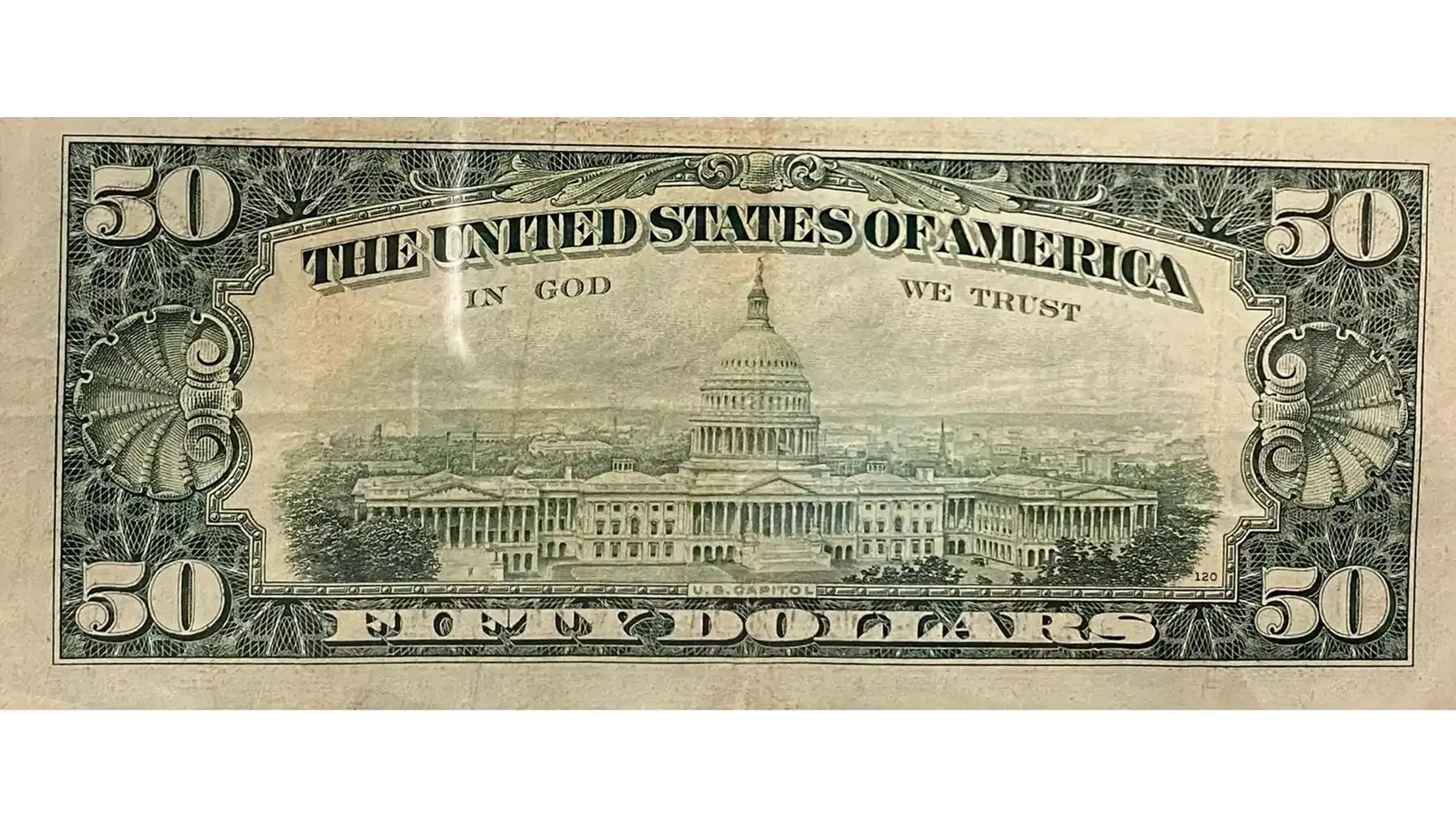
Reverse design: U.S. Capitol building (current version shows the west front)
Design date: 2004 (latest major redesign)
Older issues, however, tell another story. Before Grant, $50 notes once bore portraits of Alexander Hamilton, Benjamin Franklin, Edward Everett, William H. Seward, and others.
So if you’re holding a current bill and ask who’s on 50 dollar bill, the answer is Grant.
History of the $50 Bill
The $50 dollar bill has been around since the Civil War era, though its look and the figure on the front have changed many times. The very first issues weren’t even designed for daily use. In 1861, the Treasury released Interest Bearing Notes, a type of bond that paid interest instead of circulating widely. By 1862, the first true circulating $50 bills appeared, carrying allegorical imagery and the portrait of Alexander Hamilton.
Over the next decades, the design changed almost constantly:
1860s-1870s: different note types appeared, from Legal Tender notes to Compound Interest Treasury Notes. Figures included Henry Clay and allegorical depictions of Liberty
1870s–1890s: the denomination expanded into Gold Bank Notes, Silver Certificates, and Treasury Coin Notes. Portraits ranged from Benjamin Franklin to William H. Seward
1913: the $50 Gold Certificate featuring Ulysses S. Grant. This set the precedent for his portrait that continues today
1914: the first $50 Federal Reserve Notes were printed, again with Grant
The shift to small-size notes in 1928 standardized the design: all $50 bills carried Grant on the front and the U.S. Capitol on the back. Still, the appearance has gone through subtle redesigns since then.
1934: “Redeemable in gold” clause removed after the U.S. left the gold standard
1969: the Treasury seal was modernized, with English replacing Latin
1990: first anti-counterfeiting features introduced: microprinting and a plastic security strip
1996: major overhaul: larger portrait, off-center design, watermark, and color-shifting ink
2004: current look: Grant’s portrait with a stylized flag background, blue and red tinting, and a clearer Capitol reverse
For more information on design elements, like where to find the watermark, how microprinting is placed, or what each seal and emblem actually means, see The Banknote's Anatomy: The Parts of a Dollar Bill Explained.
Design and Security Features of the Modern $50 Bill
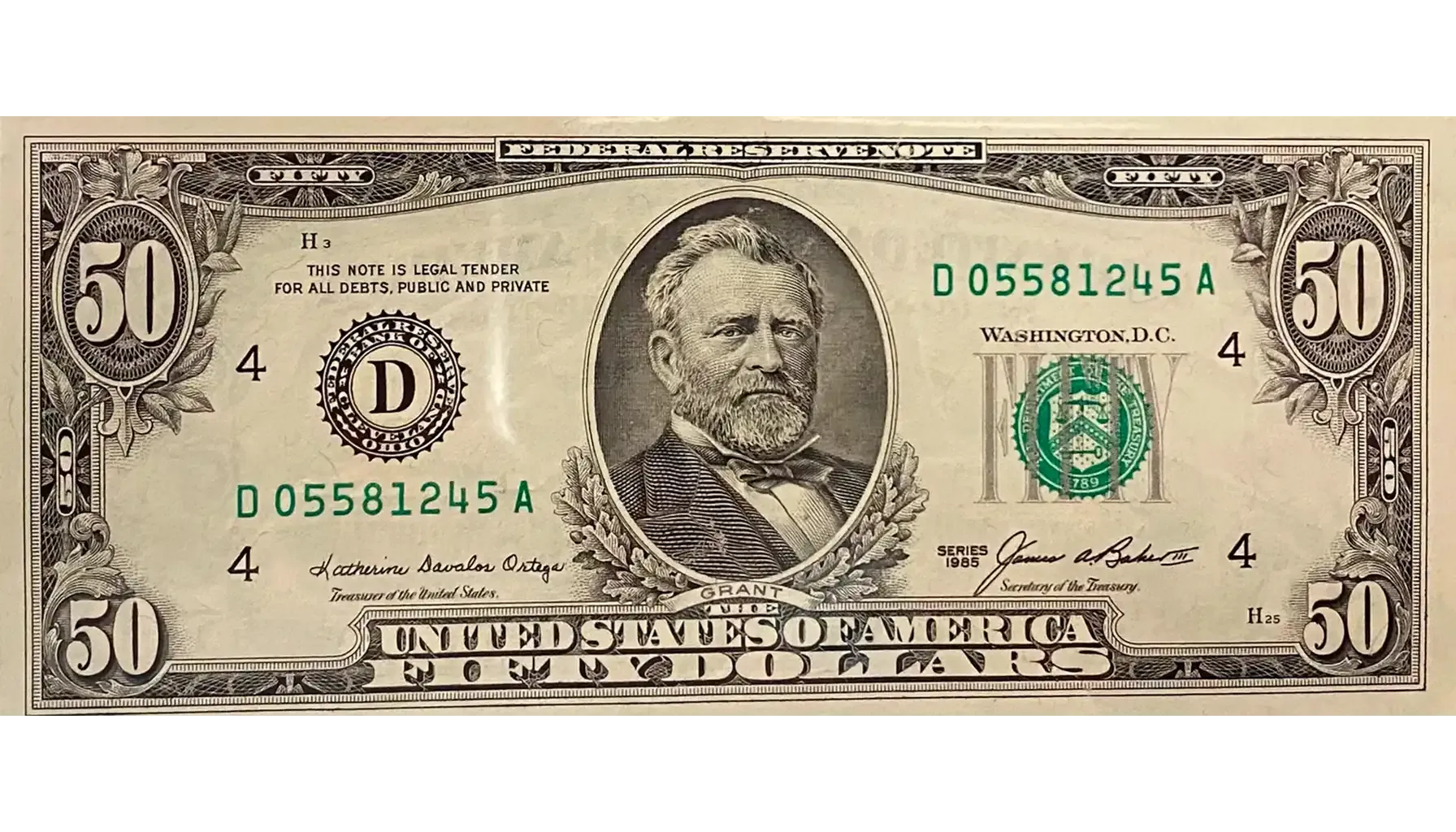
Obverse (front): Ulysses S. Grant in a borderless, off-center portrait. Behind him is a faint red-and-blue U.S. flag pattern. A small silver-blue star also sits to the lower right
Reverse (back): The U.S. Capitol, shown from the west front. Earlier notes depicted the east front
Inscriptions: “Federal Reserve Note,” “United States of America,” the motto In God We Trust, and the denomination
Watermark | A faint portrait of Grant, visible when held to the light |
Security Thread | Vertical plastic strip that glows yellow under UV light |
Color-Shifting Ink | The numeral “50” changes color (copper to green) when tilted |
Microprinting | Tiny words like “USA 50” embedded near Grant’s portrait and in borders |
EURion Constellation | Subtle dot pattern on the back |
Raised Printing | Textured feel of Grant’s coat and note lettering |
To spot a fake 50 dollar bill you should check for missing or poorly executed features, especially the watermark and color-shifting ink.
Value of Old $50 Bills
Series | Notes | Collector Value Range |
1934 | First post–gold standard issue. No longer redeemable in gold. Green seal | $75-$300 in circulated grades, higher in uncirculated |
1950s issues (1950–1950E) | Minor design tweaks. Still show Grant and the Capitol | $60-$150 depending on condition |
1969–1969C | New Treasury seal, smaller design elements | Around $60-$120 in average circulated grades |
1981 | Series issued with Buchanan as Treasurer and Regan as Secretary | Slight premium over face; $55-$125 depending on grade |
1985 | Ortega/Baker signature combo. Widely collected as “modern old notes” | $55-$130 |
1990 | First to add microprinting and a plastic security strip | Still modern, but early security features attract collectors; $55-$150 |
1996 | Major redesign: larger Grant portrait, watermark, and color-shifting ink | $60-$175. High-grade uncirculated notes are more rare |
What Affects Value?
Condition: uncirculated notes are worth far more than heavily folded bills
Star Notes: replacement notes (with a star at the end of the serial number) are scarcer
Low Serial Numbers: collectors pay more for bills with numbers like 00000042 or repeating patterns
Unique Errors: misprints, missing seals, or misaligned cuts can turn a $50 into a four-figure collectible
Collecting Guide for $50 Bills
Where to Buy and Sell
Coin & Currency Dealers: safe option, especially for higher-value notes
Online Auctions: eBay and Heritage Auctions list both common and rare $50 bills, but beware of fakes
Collector Shows & Clubs: a good way to learn the market and trade with others
Private Sales: always verify authenticity before exchanging money
Fake vs. Real $50 Bills
Always check for:
Watermark of Grant (visible in the light)
Security thread glowing yellow under UV
Color-shifting ink on the numeral 50
Microprinting near the portrait and borders
If any of these features are missing or look sloppy, you may be holding a fake 50 dollar bill.
Final Tip
For beginners, start with modern issues like the 1996 50 dollar bill or 2004 redesign. Advanced collectors often chase bills from the 1930s–1950s, or star notes and error notes with quirky misprints.
If you’re curious about who appears on other denominations and which older notes carry surprising collector value, see Who’s on the $10 Bill? Rare 10 Dollar Bills You Need to See.
$50 Bill Value by Series
Series | Notes / Features | Typical Collector Value Range |
1934 $50 bill | First post–gold standard notes. Green seal. | $75 -$300+ |
1950–1950E | Multiple small tweaks to design and seals. | $60 -$150 |
1969–1969C | New Treasury seal, smaller graphics. | $60 -$120 |
1974 | Morton/Simon signatures. | $65 -$130 |
1977–1981 | Still Grant/Capitol design, updated seals. | $55 -$125 |
1985 | Ortega/Baker signatures. | $55 -$130 |
1988 | Ortega/Brady. Transitional before new security. | $55 -$135 |
1990 | First with microprinting + security strip. | $55 -$150 |
1993 | Withrow/Bentsen. | $60 -$160 |
1996 | Big redesign: large off-center Grant, watermark. | $60 -$175+ |
2001 | Marin/O’Neill signatures. | $60 -$180 |
2004/2004A | Colorized flag background added. | $60 -$190 |
2009–2021 | Current designs. Face value in circulation, but $65 -$200 in high uncirculated. |
Spotting Fake $50 Bills -Quick Checklist
Watermark | Hold up to the light | A faint portrait of Ulysses S. Grant (matches main portrait) |
Security Thread | Shine UV light | Vertical strip glows yellow |
Color-Shifting Ink | Tilt the note | The big numeral “50” shifts from copper to green |
Microprinting | Use magnification | Tiny text like USA 50 around the portrait and borders |
Raised Printing | Feel with your fingers | Texture on Grant’s coat and lettering |
EURion Constellation | Look on the back | Pattern of small yellow-green dots to deter photocopying |
Serial Numbers | Inspect closely | Even spacing, no smudging, same color as Treasury seal |
If any of these features are missing, or poorly executed, it’s probably a fake dollar bill.
FAQ
Is there a $50 bill?
Yes. The $50 dollar bill has been printed since 1862 and remains in active circulation today, though it’s less common than $20s or $100s.
Who is on the 50 dollar bill?
If you’ve ever wondered who’s on the 50 dollar bill: Ulysses S. Grant, 18th U.S. president and Union general. He has been on the obverse since 1913-1914.
Which president is on the $50 bill?
Grant is the only president ever shown on the modern $50. Earlier large-size bills carried Hamilton, Franklin, and other figures.
What’s the difference between an old 50 dollar bill and a modern one?
Older notes (1934, 1950, 1969 series) have smaller portraits and no modern anti-counterfeiting features. Post-1990 bills added microprinting, security threads, watermarks, and later, colorized designs.
How much is a 1990 50 dollar bill value?
Most are only slightly above face unless uncirculated or a star note. Typical range: $55 -$150.
What about a 1985 50 dollar bill value?
Similar, about $55 -$130 depending on condition.
Can a fake 50 dollar bill be spotted easily?
Yes, by checking the watermark, color-shifting ink, security thread under UV light, and microprinting. Missing or poorly done features usually mean counterfeit.
What makes old 50 dollar bills valuable?
Condition, star notes, error notes, and rare serial numbers.
Who’s on the back of the 50 dollar bill?
The reverse depicts the U.S. Capitol, the east front on older notes, the west front on the 2004 redesign.

 Facebook
  X (Twitter)
  Pinterest
  LinkedIn