Contents:
The concept of coin sets is not really uncommon: since 1936, the US Mint, i.e., the one and only official source of American coinage, has been releasing carefully prepared, special sets, the aim of which was to demonstrate the prosperity of the monetary sector and promote collecting as a national pastime. Over time, these assemblages turned into more of a cultural tradition that wholeheartedly praises coins of different years, denominations, and designs.
The United States Mint proof set 1996, with all its iterations, is one of the most prominent representatives of its type. Nonetheless, its market performance was relatively modest when compared to other earlier or historically exceptional editions whatsoever. So, what is the 1996 mint proof set value? Which coins do its iterations include, and where to seek authentic pieces today?
Overview of the 1996 Proof Sets
The 1996 mint sets cannot be considered "just another annual release" but a numismatic creation of extreme importance. The legacy, which had started in 1936 and continued through the 1990 proof sets, finally reached a stage of technical perfection, where each iteration could be seen as a masterpiece to hold in collections for years.
The purpose of the 1996 US mint proof sets was quite obvious: to commemorate the prosperity of American coinage (for it neared the turn of a new millennium) and preserve the spirit of numismatic art. That year, the Mint launched a few versions of the mint coin sets for different target audiences and purposes, too. Let us review them one by one.
Type | Total Face Value | Mintage | Special Notes |
Standard Proof Set | $0.91 | 1,695,244 | Struck for collectors only; comes in Original Government Packaging (OGP). |
Silver Proof Set | $0.91 | 623,655 | Enhanced silver content for collectors. |
Prestige Proof Set | $2.41 | 55,000 | Key date for Prestige series. |
1996-W 4-Coin Gold Eagle Proof Set | $90 | 35,058 | Includes mint-issued box and COA. |
Coins Included & Special Features
Standard Proof Set
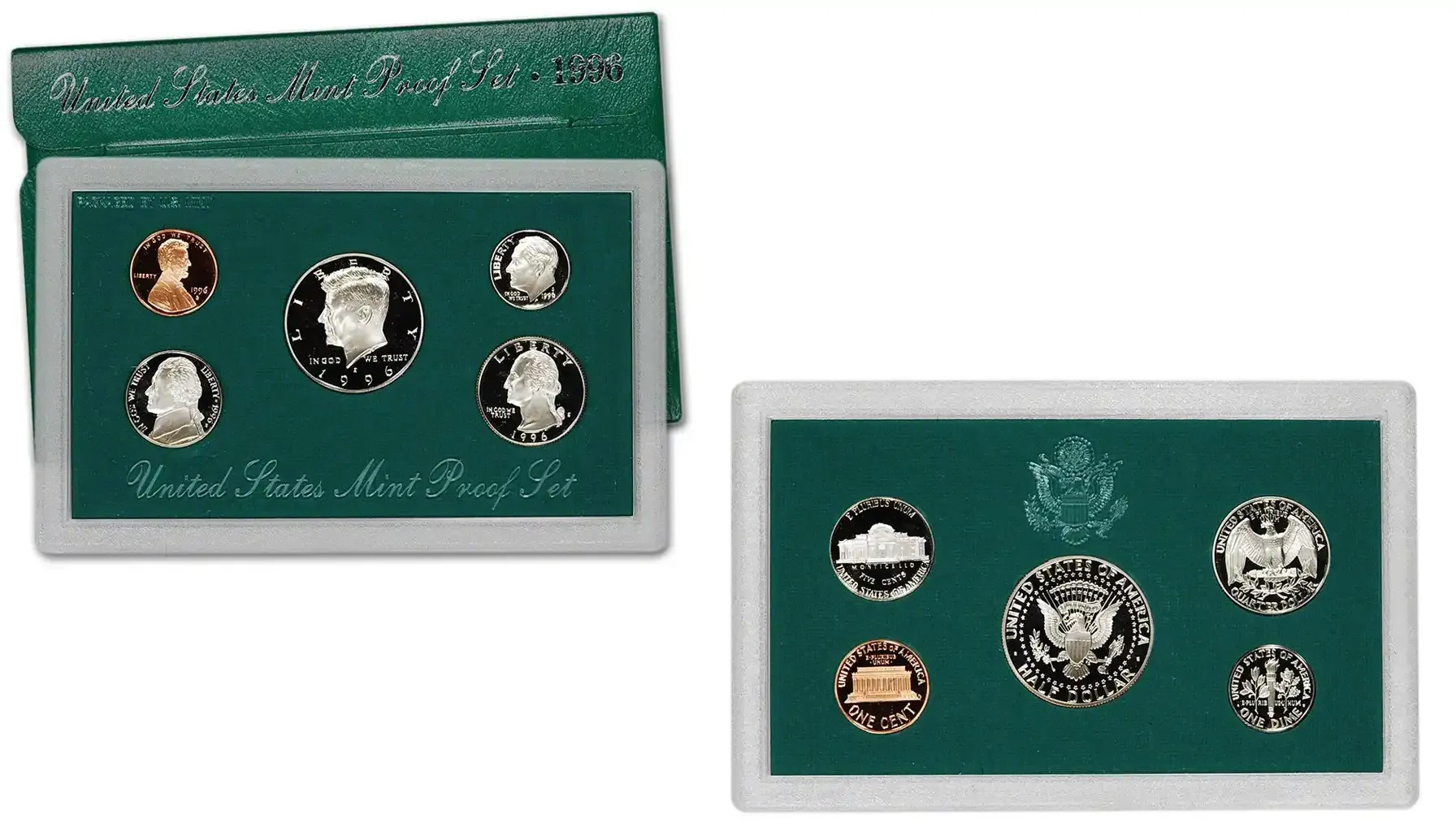
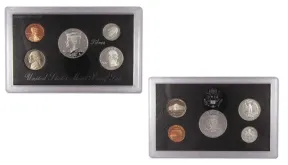
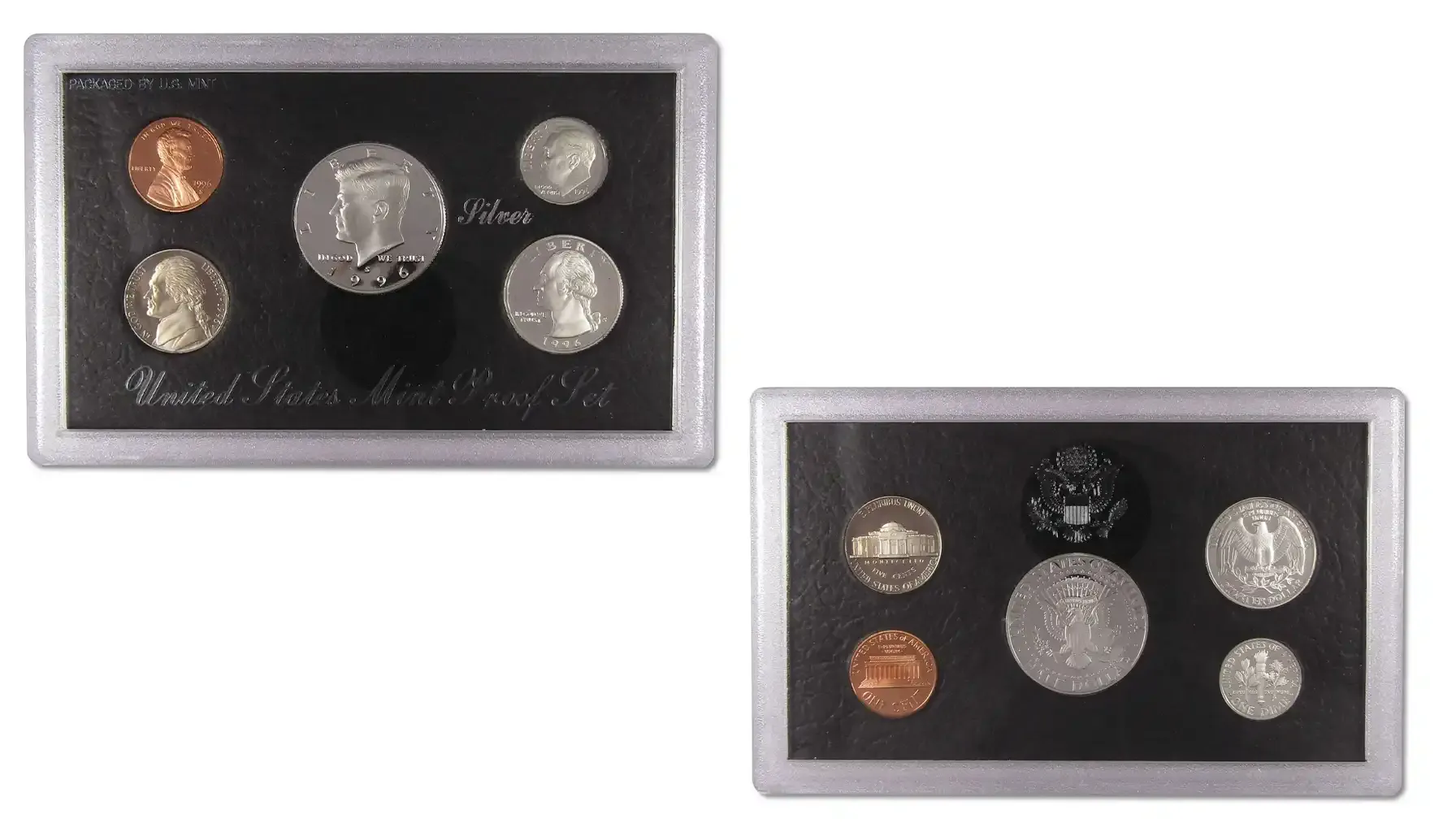
First comes the most widespread edition, i.e., the 1996 United States Mint proof set, which introduced five classic US denominations in pristine condition. These have been struck by the San Francisco Mint and could boast frosted design elements placed against a mirror-like field.
Coin | Type | Composition |
1¢ | Lincoln Cent | Copper-plated zinc (97.5% zinc, 2.5% copper) |
5¢ | Jefferson Nickel | 75% copper, 25% nickel |
10¢ | Roosevelt Dime | Clad (copper core, nickel outer layers) |
25¢ | Washington Quarter | Clad (copper core, nickel outer layers) |
50¢ | Kennedy Half Dollar | Clad (copper core, nickel outer layers) |
Silver Proof Set
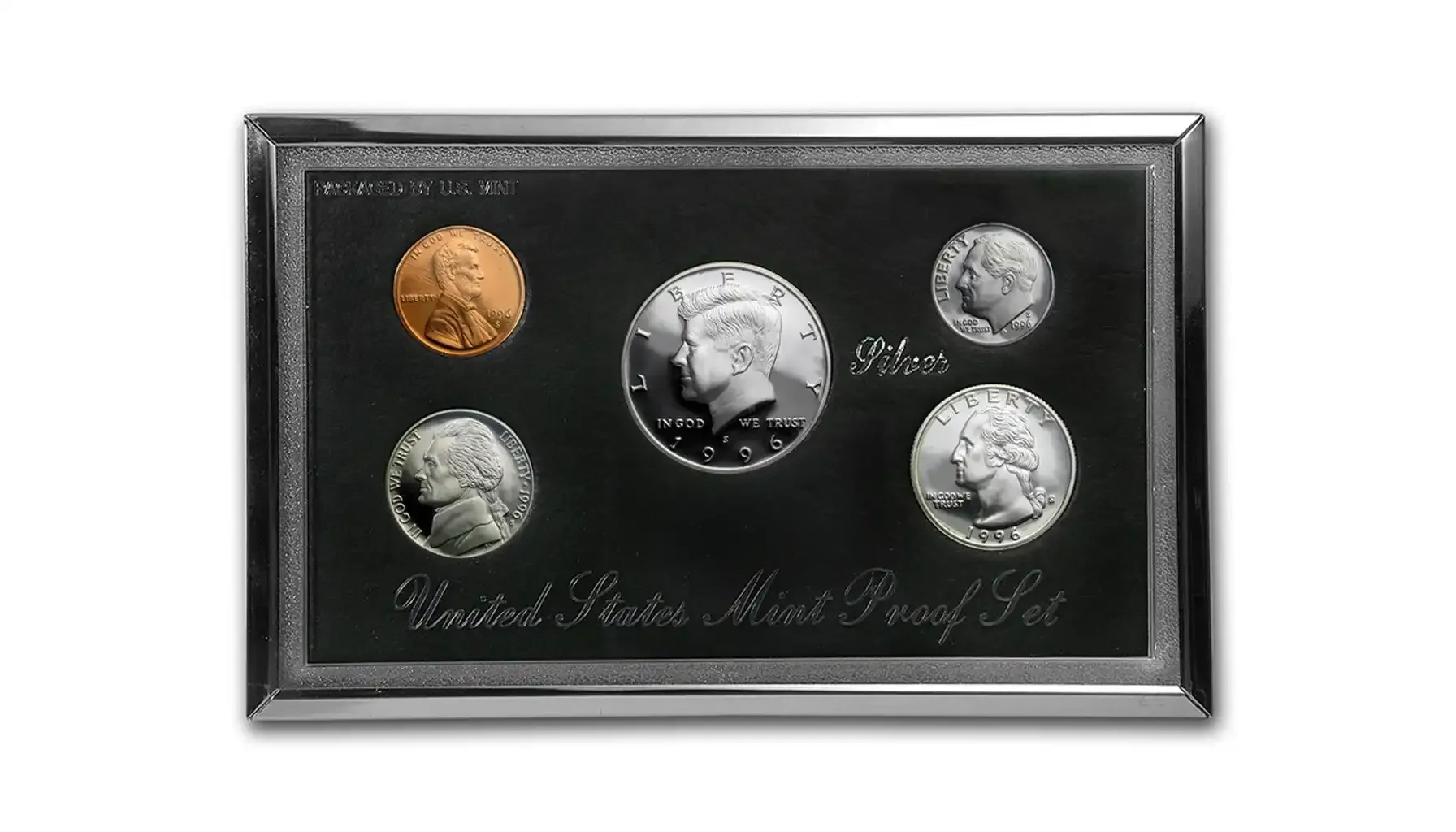
The coins of 1996 have also been minted in silver composition, i.e., a more refined representation of American coinage and the artistry of its creators. The same designs, the same denominations – this edition was quite the same when compared to its clad counterpart. The only difference is silver.
Coin | Type | Composition |
1¢ | Lincoln Cent | Copper-plated zinc |
5¢ | Jefferson Nickel | 75% copper, 25% nickel |
10¢ | Roosevelt Dime | 90% silver, 10% copper |
25¢ | Washington Quarter | 90% silver, 10% copper |
50¢ | Kennedy Half Dollar | 90% silver, 10% copper |
Prestige Proof Set
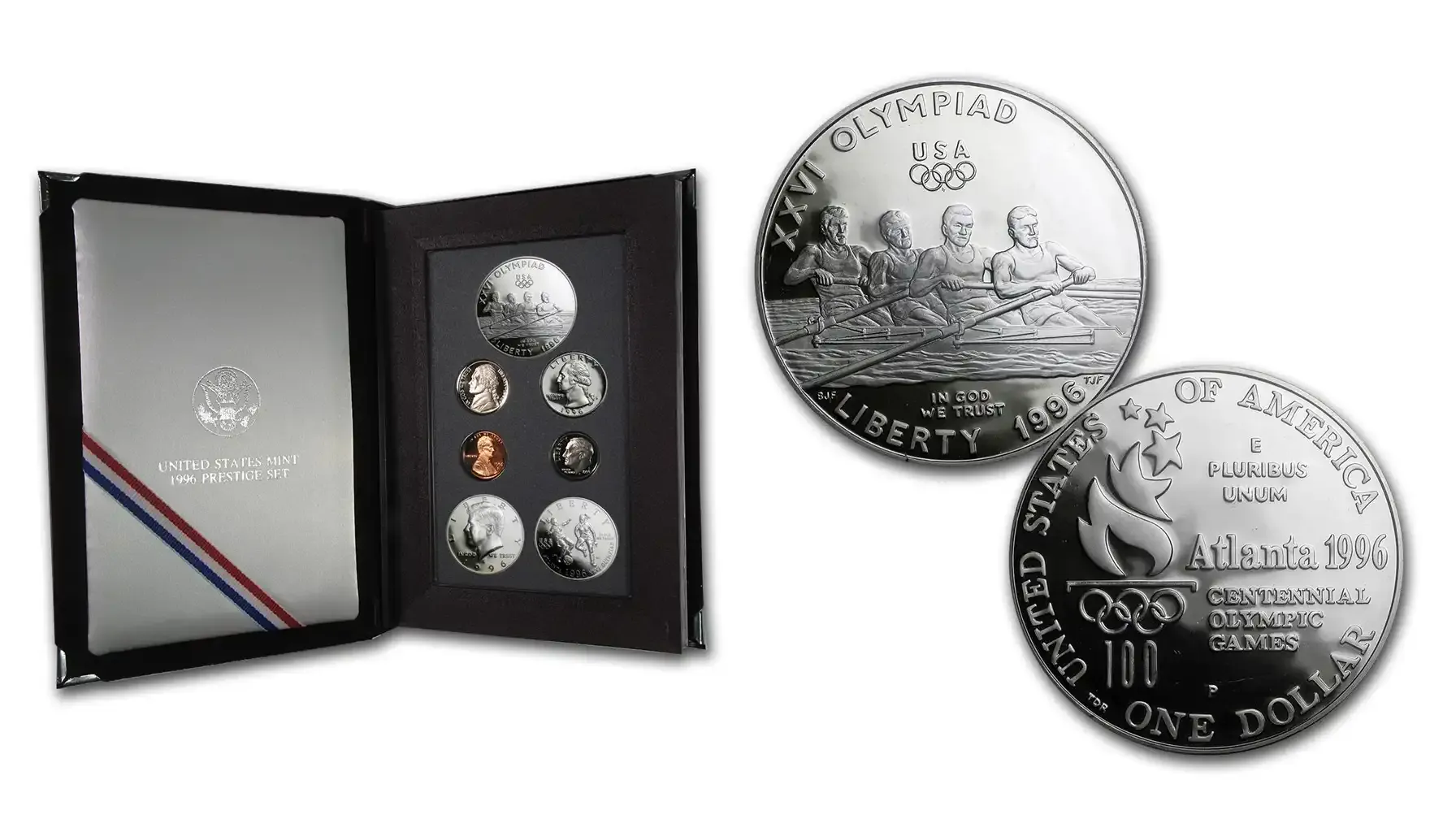
The 1996 proof set value demonstrates one more time how precious these creations are to the hearts and souls of the general public. This iteration, for instance, features all proof editions of the year, including the commemorative coins issued in honor of the Atlanta Centennial Olympic Games. As for their scarcity, the production was rather limited: only 55,000 left the minting sites, which turns them into a key date in turn.
Coin | Type | Composition |
1¢ | Lincoln Cent | Copper-plated zinc |
5¢ | Jefferson Nickel | 75% copper, 25% nickel |
10¢ | Roosevelt Dime | 90% silver, 10% copper |
25¢ | Washington Quarter | 90% silver, 10% copper |
50¢ | Kennedy Half Dollar | 90% silver, 10% copper |
50¢ | Olympic Soccer Half Dollar | Copper-nickel clad |
$1 | Olympic Rowing Silver Dollar | 90% silver, 10% copper (.7734 oz actual silver) |
1996-W 4-Coin Gold Eagle Proof Set
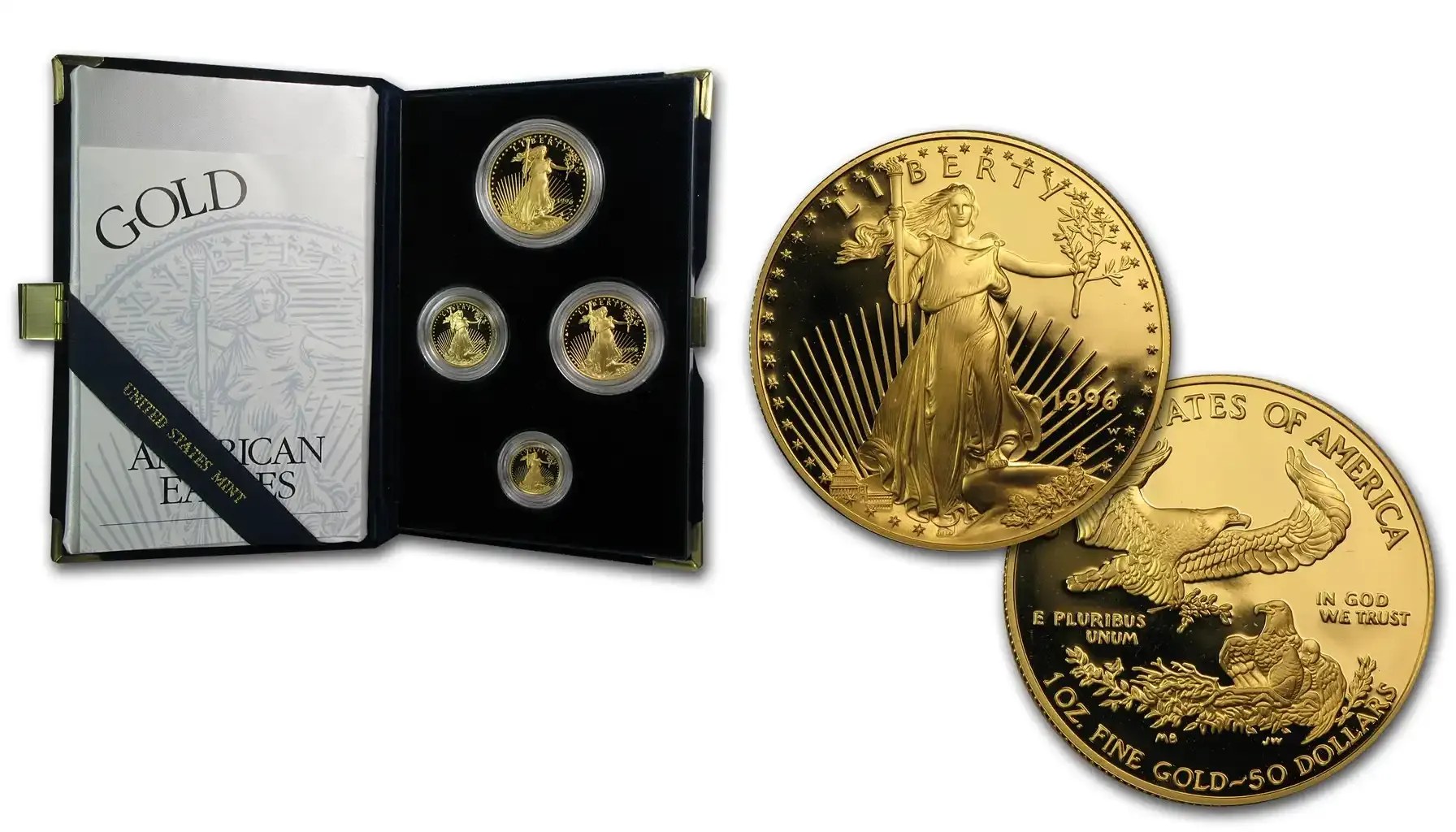
The American Eagle is probably the most widely recognized commemorative creation that could have demonstrated the true excellence in the sphere of gold coinage and numismatics as it is. Each coin, including the prominent 1996 W dime, was struck at the West Point Mint and featured the iconic Liberty design by Augustus Saint-Gaudens on the obverse side. As of today, it is still one of the most wanted gold issues of its era anyway.
Coin | Type | Composition |
$5 | Gold Eagle | 1/10 oz gold: 22-karat (91.67% gold, 3% silver, 5.33% copper) |
$10 | Gold Eagle | 1/4 oz gold (22-karat gold alloy) |
$25 | Gold Eagle | 1/2 oz gold (22-karat gold alloy) |
$50 | Gold Eagle | 1 oz gold (22-karat gold alloy) |
Packaging, Certification & Original Materials
Each assemblage of the coins was designed differently, so as to be displayed in collections (not hidden in the vaults):
Standard S.: Packaged in a clear hard plastic case with a dark insert, enclosed in an outer sleeve bearing the US Mint seal.
Silver S.: Presented in the Premier display-style case with a protective outer box (the Certificate of Authenticity, i.e., CoA, included).
Prestige S.: Encased in a deluxe display folder with satin-lined interior, accompanied by a CoA and outer sleeve.
1996-W Gold Eagle S.: Contained in a mint-issued velvet case with gold lettering, a protective outer box, and an official CoA.
1996 Mint Sets & U.S. Mint Proof Sets Compared
Apart from the proof sets, there were released ordinary collections which served different roles. While the first was aimed at collectors, who wished to cherish numismatic art, the latter offered uncirculated examples of the pieces used day by day.
Feature | Proof S. | Mint S. |
Purpose | Presentation-quality coins for collectors | Uncirculated circulation coins |
Finish | Mirrorlike, double-struck proof | Standard uncirculated, satin-like surface |
Mint Marks | San Francisco “S” | Philadelphia “P” and Denver “D” |
Coins | 5 coins (Cent to Half Dollar) | 10 coins (one from each mint) |
Packaging | Hard plastic display case | Two Mylar packs, red and blue |
How to Authenticate & Grade a 1996 Proof Set
First of all, it is vital not to fall into the trap of counterfeiting. To do so, one should be able to verify the origin, appearance, and condition of the coin on the spot. But how? Here are the main authentication and grading points to be aware of:
Check for the “S” mint mark on each coin (proof strikes only).
Confirm that these feature the mirrorlike fields and frosted design details.
Leave it in its original packaging without tampering.
Examine coins under magnification for scratches, haze, or spotting that may affect grade.
Submit to reputable grading services such as PCGS or NGC for certification.
Four iterations are always better than just one. Explore all the options and choose those that make your heart melt.
FAQs
What is the value of a 1996 Proof Set today?
The rates may vary, depending on the demand, but the average cost per set, according to the official resources, is $39.99 to $7,719.00.
What makes the 1996-W Roosevelt Dime special?
The 1996-W Roosevelt Dime can be found exclusively in the 1996 Gold Eagle set, and it was the first time that a dime bore the "W” mint mark of the West Point Mint.
How do I verify a genuine 1996 U.S. Mint Proof Set?
Authentic sets usually include proof coins with the “S” or "W" mint marks, a mirrorlike finish, Original Government Packaging (OGP), and a Certificate of Authenticity, i.e., CoA (not always, though).
Where is the safest place to buy or sell 1996 Proof or Mint Sets?
The best way to make such a meaningful purchase is to appeal to the official Mints, coin dealers, certified numismatic organizations (ANA members, or auction platforms such as Heritage Auctions or GreatCollection.

 Facebook
  X (Twitter)
  Pinterest
  LinkedIn