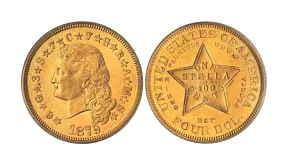
The Stella 4 dollar coin stands out for its rarity and its importance to the financial system and history of the United States.
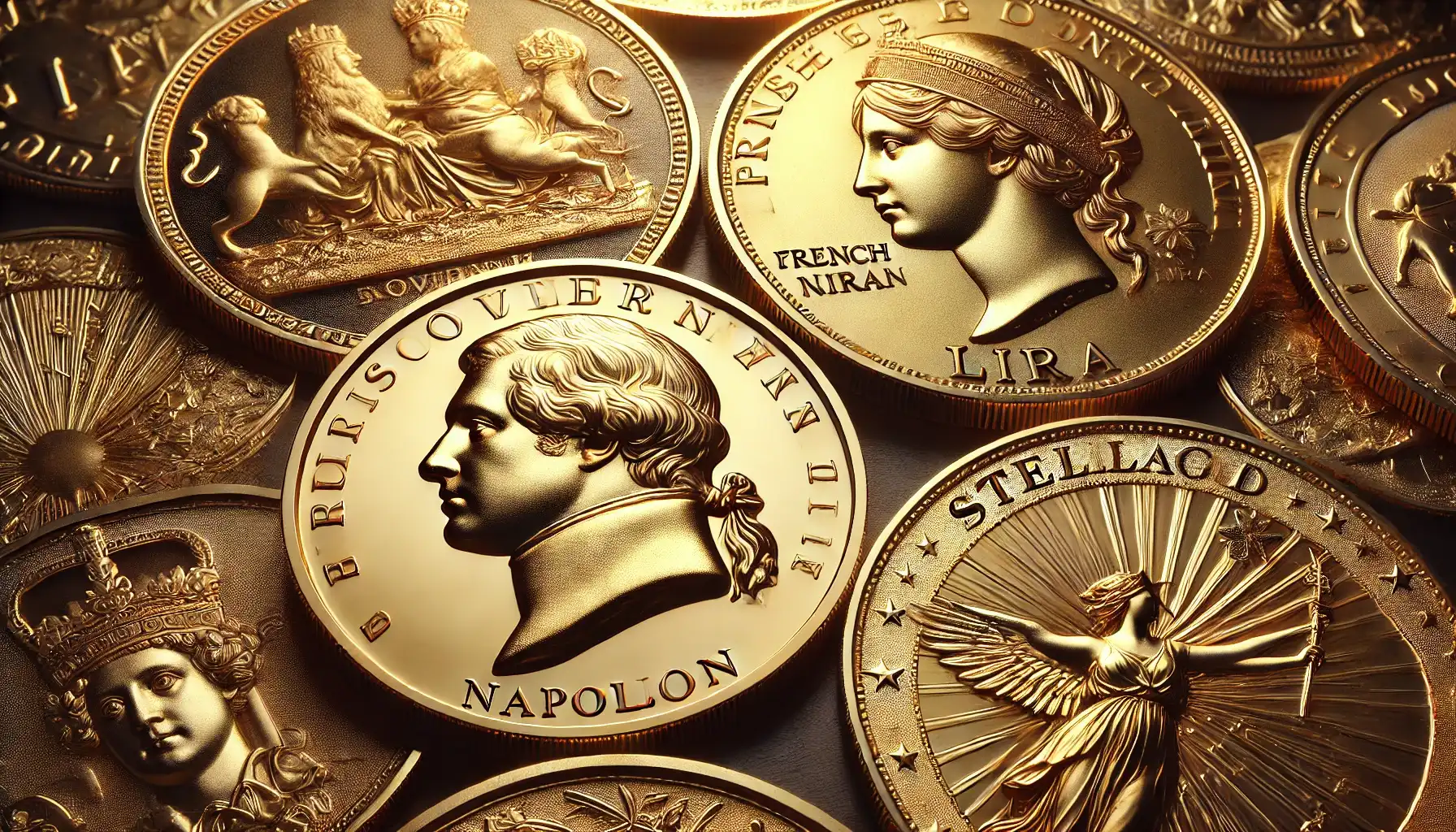
The issuance was intended to facilitate international trade, and it was expected that they would become a very important monetary unit and be treated similarly to the French napoleon, the Italian lira or British sovereign.
What Is a Stella Coin?
It was issued in the late 19th century. It is a very rare $4 gold coin ever minted.
Its name comes from the Latin “stella”, which means “star”. The name was not accidentally chosen - it symbolizes the reverse design and its exclusivity and rarity among other gold specimens of the time.
The purpose of its creation was the desire and need of the United States to create a universal currency for international trade and to strengthen trade relations with Europe. The idea for this ambitious project belonged to John Adams (U.S. Treasury), who sought to equalize the weight and face value of U.S. and European money.
Despite the far-reaching plans and the ambitiousness of the goal, the project was not adopted, and the four dollar coin pieces were not put into mass production.
In practice, it turned out that the 4 dollar denomination of this gold coin did not exactly meet the existing international standards: the difference in weight and gold content created inconveniences in exchange and settlements, and merchants were not interested in it.
The specimen with $4 denomination called Stella gold coin was minted at the United States Mint in Philadelphia. The best known version is from 1879, when several hundred pieces were issued. In 1880 a few more were issued, but this mintage was not intended for general circulation.
Read more about ancient Roman money here.

Moreover, the project was not seen in a rosy light by the Congress, so the project did not receive proper attention and funding, so only a small number of issued specimens (which were not very popular then but are producing a boom now) saw the light of day.
Interesting!
In the late 19th century, the U.S. Mint produced several experiments: the $4 Stella, the Amazonian Pattern Dollar and the Goloid Metric Dollar.
The Stella, with a denomination of 4 dollar, gold coin, produced in 1879 and 1880, was the Mint’s attempt to create a piece that could circulate internationally alongside the European gold standards of the time.
The Amazonian Pattern Dollar was designed in 1872 by William Barber. It was less about practicality and more about artistic ambition. Its version of Liberty broke from tradition: a strong, armored female figure with a sword and shield. It was struck in several metals: gold, silver, copper; it was conceived as an artistic exercise rather than a production coin.
The Goloid Metric Dollar was tested between 1878 and 1880. It came from an idea patented by William Wheeler Hubbell. It was meant to introduce a new alloy — a blend of gold, silver, and copper — that would simplify coinage and bring the United States closer to the metric system. The inscriptions precisely listed its weight and metallic formula. All together these features reflect the era’s science and precision engineering. However the alloy proved unreliable, and the project was abandoned.
Key Data
Characteristics | Value |
Denomination | 4 dollar |
Year of Issue | 1879–1880 |
Material | Gold (90%) |
Weight | About 7,0 grams |
Diameter | 22 mm |
Mintage | About 425 |
Two Types of $4 Gold Coin
Flowing Hair
The first one is called Flowing Hair Stella. It was designed by Charles Barber. The design of this version is considered more classic and easier recognizable.
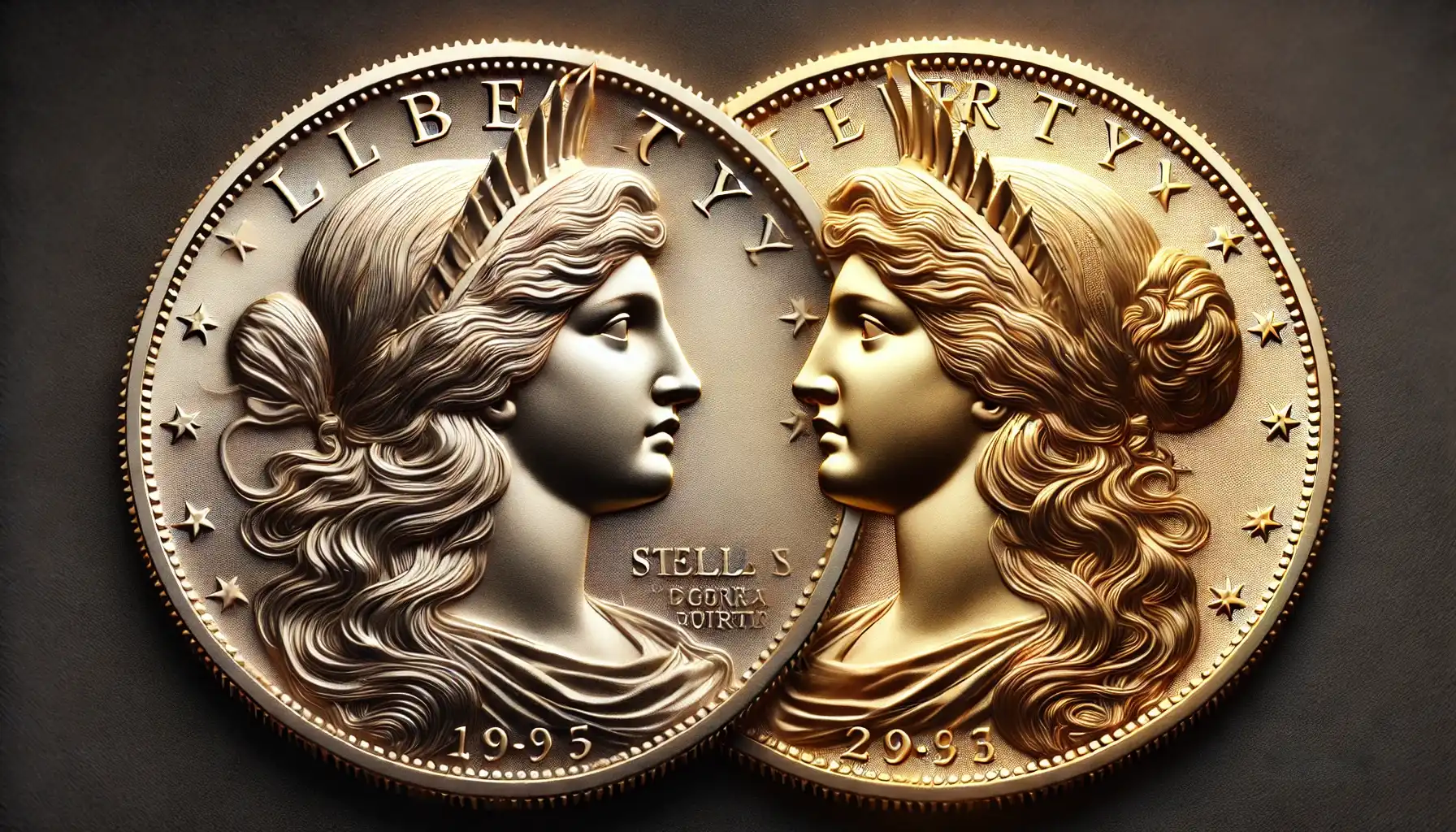
The obverse of these Stella coins shows the profile of Lady Liberty with her hair fluttering. Both she and her image (with the tiara on her head with the distinct inscription LIBERTY) emphasize the main thing - the freedom and independence of the States.
Around Liberty's head there are 13 five-pointed stars as symbols of the 13 original colonies that became the foundation of the United States. Below her profile is the year of issue.
Coiled Hair Liberty
The second type is the Coiled Hair Stella by George Morgan. This version is known for its more detailed depiction of Liberty. Here, Liberty looks more formal because of her hairstyle (hair pulled up and styled).
Liberty's facial features are more detailed, she seems to look more important and stern. On her head she also wears a detailed tiara with the inscription “LIBERTY” (the tiara is decorated and detailed). There are also 13 stars around Liberty, as well as the date is also at the bottom.
The reverse of both of these types is identical (but the second type is said to have slightly more details). It shows a star with the inscriptions “ONE STELLA” and “400 CENTS” reflected inside. The star is surrounded by the inscriptions “UNITED STATES OF AMERICA”, “E PLURIBUS UNUM” and the Latin phrase “DEO EST GLORIA”.
Characteristic | Flowing Hair Liberty | Coiled Hair Liberty |
Year of Issue | 1879-1880 | 1880 |
Metal | Gold (85.71%), copper (4%), silver (10%) | Gold (85.71%), copper (4%), silver (10%) |
Designer | Charles Barber | George T. Morgan |
Circulation | About 425 | About 10-15 |
Obverse Design | Flowing Hair Liberty | Coiled Hair Liberty |
Reverse Design | Five-pointed star with indication of weight and metal content | Five-pointed star with indication of weight and metal content |
Market Gold Stella Coin Price | $150,000 - $300,000 | $1,000,000 |
Rarity | Rare, but available to collectors | Extremely rare |
Stella Coin Value
It was never a circulation one but a U.S. Mint experiment from 1879–1880. Only a few hundred were struck—about 425 Flowing Hair pieces in 1879 and fewer than 20 of each Coiled Hair or 1880 issue. This supply places it in a row of the rarest American gold coins.
1879 Flowing Hair: $72,000 – $460,000
1879 Coiled Hair: $156,000 – $2.3 million+
1880 Flowing Hair: $400,000 – $1 million+
1880 Coiled Hair: $2 million+ (record sales exceed $2.3 million)
“Perhaps the most famous United States coins that never actually circulated… the 1879-1880 $4 gold Stellas.”
— CoinAppraiser summary
Sell Rare Coins
Here are documented auction results:
Date (Sale) | Stella Coin for Sale | Grade / Slab | Auction House | Price (USD) |
2025-Aug-26–31 | 1880 Coiled Hair | PR67 NGC CAC | Heritage | $2,280,000 |
2013-Sep-23 | 1880 Coiled Hair | PR67 Cameo NGC | Bonhams (Tacasyl) | $2,574,000 |
2013-Sep-23 | 1879 Coiled Hair | PR67 Cameo NGC | Bonhams (Tacasyl) | $1,041,300 |
2019-Jan (FUN) | 1879 Coiled Hair Stella gold coin | PF66 Cameo NGC | Heritage | $1,050,000 |
2015-Jun (Long Beach) | 1880 Coiled Hair | PR65 CAC | Heritage | $1,116,250 |
2022-Jan (FUN) | 1880 Coiled Hair | PR61 NGC | Heritage | $504,000 |
2018-Mar (Baltimore) | 1879 Flowing Hair | PR67 CAM PCGS | Stack’s Bowers | $384,000 |
2012-Jun (Baltimore) | 1879 Flowing Hair four dollar gold coin | PF68 Ultra Cameo NGC | Stack’s Bowers | $411,250 |
2021-Dec-16–19 | 1879 Flowing Hair | PR66 Ultra Cameo NGC | Heritage | $264,000 |
2019-Aug | 1879 Flowing Hair | PR64 PCGS CAC | Stack’s Bowers | $168,000 |
2024-Sep-12 | 1879 Flowing Hair | Proof-50 | Heritage | $120,000 |
2005-Jan | 1879 Coiled Hair | PR67 Cameo (same specimen later Tacasyl) | Heritage | $655,500 |
2012 | 1879 Coiled Hair | MS64+ PCGS | Heritage | $402,500 |
2018-Jan | 1880 Flowing Hair | PR67 Cameo NGC | Heritage | $750,000 |
2008-Mar | 1880 Flowing Hair | PR66 Cameo NGC | Heritage | $488,750 |
What influences the total price?
Coiled Hair issues are the most valuable.
Proof and Deep Cameo (PR/DCAM) grades bring exponential increases.
PCGS or NGC pedigree raises trust and resale value.
As a proposed international trade coin, it carries both aesthetic and narrative weight.
Because the 1879-1880 Stella made out of gold coin has the value which depends heavily on collector demand and provenance, liquidity is limited. Secure storage, insurance, and authentication are important. Investors should treat it as a long-term rarity asset rather than a quick-turn investment.
For portfolio inclusion you should choose top-graded, certified examples with documented auction history (avoid 1879-1880 Stella gold coin copy specimens that can have lower value); diversify within rare categories to balance risk; view it as a store of value and historical specimen.
A Star Among All
It's no false modesty to say this piece, just like other gold coins, e.g., with angel pictures, is one of the most important and valuable specimens in the world due to its significance and rarity (despite its modest size and mintage).
If you are interested in learning more about the current market value of a particular specimen, its authenticity, or more information about any other collectibles, or you want to identify the coins, you can use the Coin ID Scanner app. You will be able to easily identify rare pieces and track their market prices. Try to check the 1879-1880 Stella gold coin value first.

 Facebook
  X (Twitter)
  Pinterest
  LinkedIn