Contents:
The last of the large circulating dollars, struck 1971–1978, was designed by Frank Gasparro. Two families matter for price: standard copper-nickel clad pieces meant for circulation and the 40% silver issues sold to collectors out of San Francisco.
Eisenhower dollar coins value changes with composition, grade, strike, and a couple of famous varieties. To know exactly what you are holding, download the coin identifier app for free, and it will tell you right away the coin, its type, and it even guesses the price.
Quick ID — Silver vs. Clad, Mints, Dates
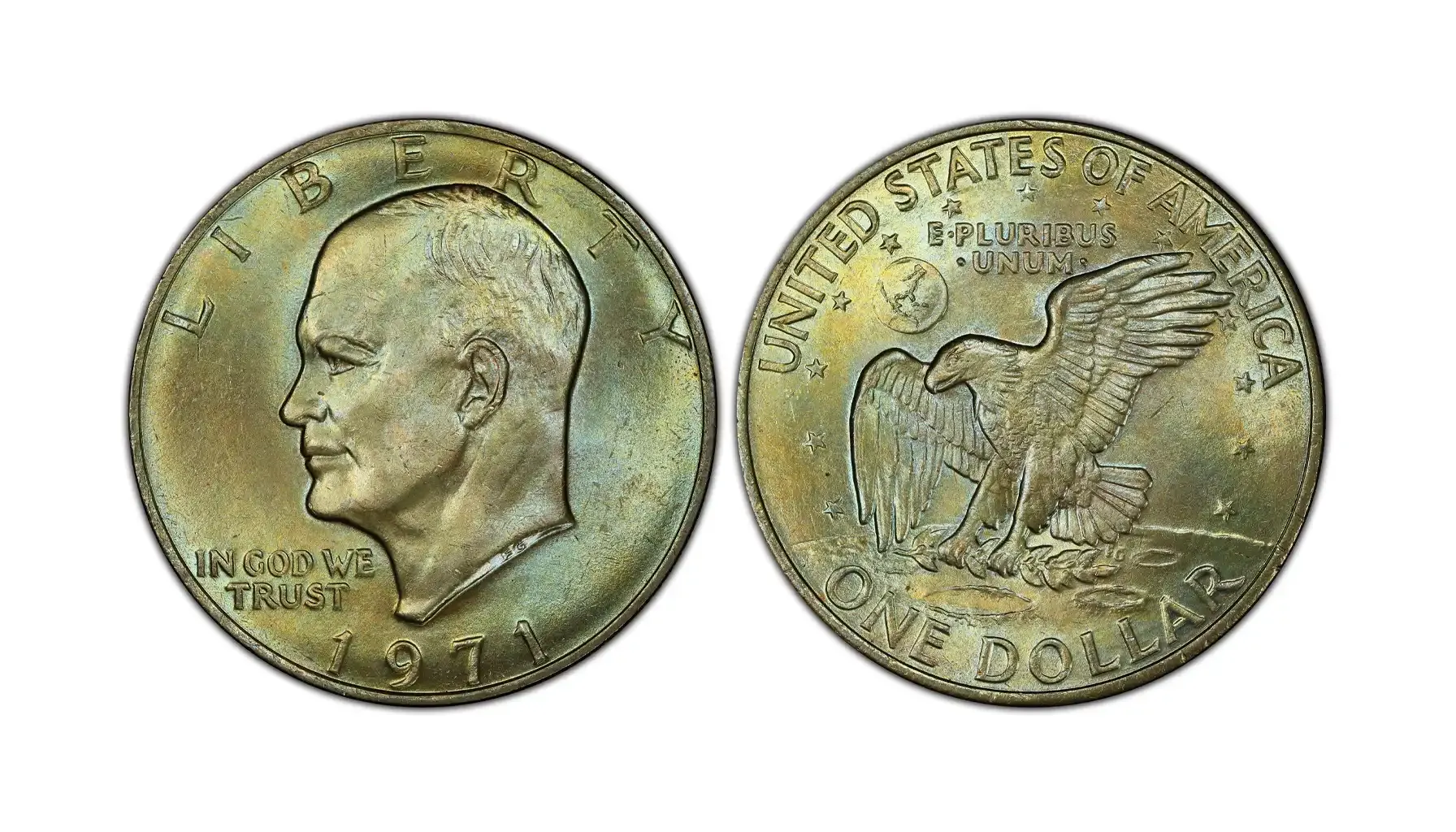
Eisenhower dollars came in two main compositions. The copper-nickel clad coins were struck for circulation between 1971 and 1978 at the Philadelphia (no mintmark) and Denver (D) Mints.
Collectors, however, could purchase special 40% silver issues minted only at San Francisco (S) from 1971 to 1974, and again for the 1976 Bicentennial. These were sold in two finishes: uncirculated coins packaged in blue envelopes (nicknamed “Blue Ikes”) and Proofs in brown boxes (“Brown Ikes”).
The mintmark appears just below Eisenhower’s neck on the front of the coin. Coins without a mark came from Philadelphia, while a D or S was struck in Denver and San Francisco.
You won’t find a 1975 dollar. During that time, the Mint prepared for the nation’s Bicentennial, so all coins from 1975–1976 carry the dual date 1776–1976.
If you’re checking composition, the weight and edge help. Regular clad coins weigh about 22.68 grams and show a distinct copper-colored stripe along the edge. The 40% silver versions are heavier at 24.59 grams and have a mostly grayish-silver edge without a bright copper band.
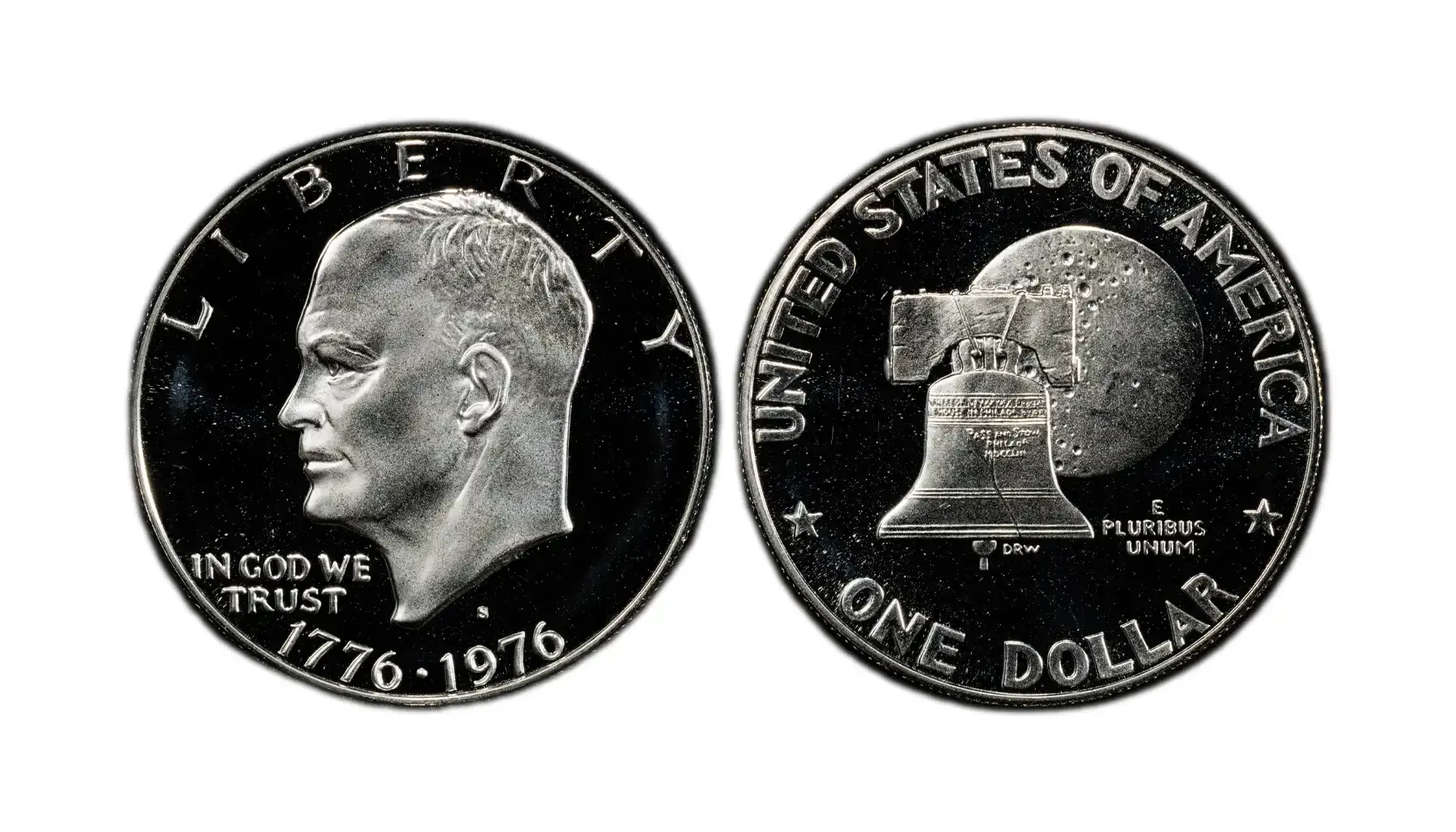
Standard issues have an eagle landing on the Moon; this coin was released in 1971, inspired by the Apollo 11 mission. Bicentennial dollars, struck for the nation’s 200th birthday, replace that with the Liberty Bell superimposed over the Moon, tying America’s independence to its space-age achievements.
Mini Specs Table
Item | Clad Ike | 40% Silver Ike |
Years | 1971–1978 (circulation) | 1971-S, 1972-S, 1973-S, 1974-S, 1976-S (collector) |
Composition | Cu-Ni over copper | 40% silver clad |
Weight | ~22.68 g | ~24.59 g |
Diameter | 38.1 mm | 38.1 mm |
Edge | Reeded | Reeded |
Mints | P, D, S (proofs at S) | S only (Unc + Proof) |
Complete Eisenhower Dollar Value Chart (1971–1978)
Year | Mint | Type / Notes | VG-8 | F-12 | VF-20 | EF-40 | U-50 | MS-60 | MS-63 | MS-64 | MS-65 | MS-66 |
1971 | (P) | Clad | $1 | $1 | $1 | $1 | $1 | $3.60 | $11.70 | $20.90 | $74 | $581 |
D | Clad | 1 | 1 | 1 | 1 | 1.30 | 4.20 | 13.90 | 17 | 27 | 63 | |
S | 40% Silver | 13 | 13 | 13 | 13 | 14 | 21.50 | 18.10 | 21.20 | 24.90 | 32 | |
(P) | Type 1 | 1 | 1 | 1 | 1 | 1 | 4 | 16 | 24.90 | 96 | 2,725 | |
D | Clad | 1 | 1 | 1 | 1 | 1 | 3.60 | 13.80 | 17.40 | 24.30 | 118 | |
S | 40% Silver | 13 | 13 | 13 | 13 | 14 | 19 | 18.10 | 20.20 | 25 | 29.70 | |
1973 | (P) | Clad | 1 | 1 | 1 | 1 | 1 | 5.20 | 12.20 | 22.90 | 45 | 472 |
D | Clad | 1 | 1 | 1 | 1 | 1 | 4.70 | 13.90 | 15.90 | 25.90 | 267 | |
S | 40% Silver | 13 | 13 | 13 | 13 | 14 | 20 | 17.70 | 19.70 | 23.20 | 29.10 | |
(P) | Clad | 1 | 1 | 1 | 1 | 1 | 3 | 11.70 | 21.90 | 37 | 204 | |
D | Clad | 1 | 1 | 1 | 1 | 1 | 4 | 11.70 | 16.40 | 25.90 | 86 | |
S | 40% Silver | 13 | 13 | 13 | 13 | 14 | 18.70 | 17.70 | 19.70 | 22.20 | 27 | |
(P) | Type 1 | 1 | 1 | 1 | 2 | 3 | 5.70 | 10.20 | 18.60 | 104 | 1,412 | |
(P) | Type 2 | 1 | 1 | 1 | 2 | 3 | 3.50 | 7.70 | 10.80 | 20.60 | 73 | |
D | Type 1 | 1 | 1 | 1 | 2 | 3 | 4 | 7.70 | 20.80 | 33 | 147 | |
D | Type 2 | 1 | 1 | 1 | 2 | 3 | 5.10 | 7.70 | 13 | 21.80 | 66 | |
S | 40% Silver | 13 | 13 | 13 | 13 | 14 | 22 | 17.60 | 19.80 | 23 | 29.40 | |
1977 | (P) | Clad | 1 | 1 | 1 | 1 | 1 | 5 | 11.70 | 20.30 | 25 | 64 |
D | Clad | 1 | 1 | 1 | 1 | 1 | 3.60 | 11.70 | 16.50 | 25.10 | 103 | |
1978 | (P) | Clad | 1 | 1 | 1 | 1 | 1 | 3.90 | 11.70 | 17.50 | 22.90 | 108 |
D | Clad | 1 | 1 | 1 | 1 | 1 | 5 | 11.70 | 17.50 | 29.20 | 163 |
Bicentennial Eisenhower Dollar Value (1776–1976)
Version | Metal | Mint(s) | Varieties | Typical Range |
Type 1 Clad | Cu–Ni | P, D | Bold lettering, blockier “E PLURIBUS UNUM” | $1 – $20 in circulated/BU, $30 + in MS-65 |
Type 2 Clad | Cu–Ni | P, D | Sharper, thinner letters (final hub) | $1 – $15 in BU, $60 + in MS-66 |
1976-S 40 % Silver Unc (“Blue Ike”) | Silver-clad | S | Single hub | ~$13 melt floor, $20 – $30 MS-65, $30 + MS-66 |
1976-S 40 % Silver Proof (“Brown Ike”) | Silver-clad | S | Cameo/Deep Cameo premiums | $13–$25 PR-65, $40 – $80 PR-69 DCAM |
1976-S No-S Proof | Silver-clad | S (absent) | Unique mistake, no mintmark | 1 known, ≈ $850,000 |
How to Tell Them Apart
The Type 1 and Type 2 Bicentennial reverses are the first giveaway: check the motto E PLURIBUS UNUM. On Type 1, the letters are thick and heavy; on Type 2, they’re thinner and sharply defined
Weight helps too. The 40% silver coins weigh around 24.59 grams, while the standard copper-nickel clad versions come in lighter at 22.68 grams. Flip the coin on its side: silver issues show a uniform gray edge, while clad coins reveal a clear copper stripe running through the rim
Most Bicentennial Ikes you’ll find in pocket change are clad and worth only face value. Uncirculated rolls carry a small premium, but high-end pieces are where real value appears. Certified MS-66 or higher Type 1Ы, and Deep Cameo proofs draw serious interest from collectors
At the top of the pyramid is the 1976 No-S Proof, a legendary rarity with just one known example. It’s far beyond everyday collecting.
Eisenhower Silver Dollar Value & Melt
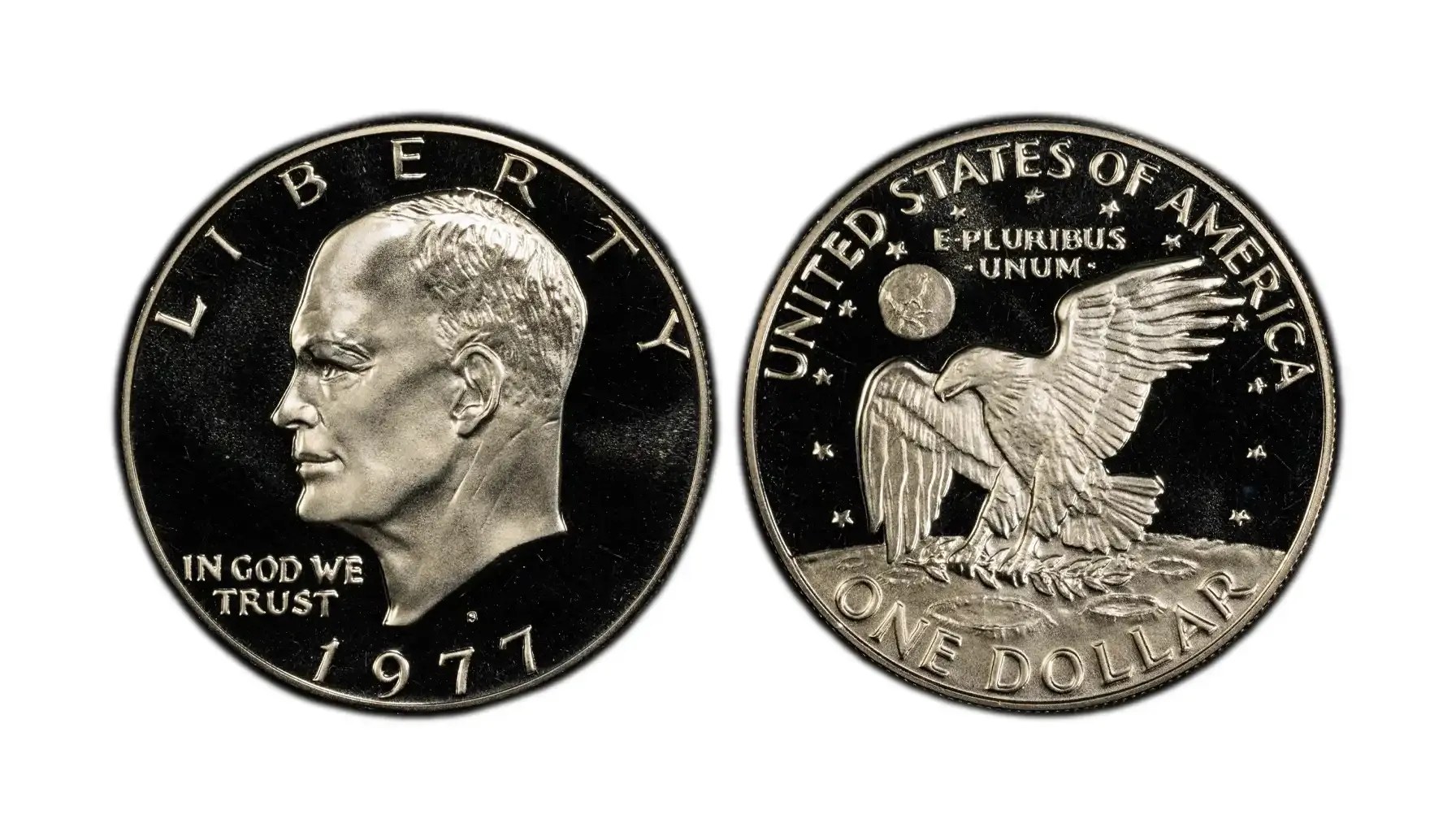
They feel heavier, denser, colder to the touch. Their value begins with the metal inside. Each 40% silver Ike: that’s 1971-S, 1972-S, 1973-S, 1974-S, and 1976-S, contains 0.3161 troy ounces of pure silver.
Do the math: if silver trades at $26 an ounce, the melt value sits around $8.22. If the spot price climbs to $30, the floor rises to roughly $9.48.
But collectors rarely stop at the metal Eisenhower one dollar coin value. Strike, finish, and packaging (“Blue” Uncirculated vs “Brown” Proof) decide the price:
Finish | Typical Range | Notes |
Uncirculated (Blue Ike) | ~$18–$30 | Nice satiny look; higher for MS-65+ |
Proof (Brown Ike) | ~$20–$50 | Cameo contrast boosts price |
Deep Cameo Proof | $40–$150+ | Black-mirror fields, frosty relief |
Top-pop slabs | Hundreds to thousands | Population scarcity drives it |
Key Varieties & What Moves Price
1972-P “Three Earths”
Philadelphia used three reverse hubs in 1972. They’re easiest to spot on the globe behind the eagle.
Type 1: Caribbean islands look mushy; most common
Type 2: Earth shows Florida clean and detached; scarce; strong premiums in MS grades (four figures at MS-66)
Type 3: Sharper islands; replaced Type 2 mid-year
Bicentennial Lettering (Type 1 vs Type 2)
Type 1: bold, blocky letters on E PLURIBUS UNUM; earlier strikes
Type 2: thin, refined letters; later production; usually better strikes
Both are collectible; high-grade Type 1s bring the bigger jump.
“Blue” & “Brown” Ikes
Blue Ike = 40 % silver uncirculated coin in blue U.S. Mint envelope
Brown Ike = 40 % silver proof coin in faux-wood box
Condition and cameo depth drive the value of Eisenhower dollar, not the packaging alone.
Errors & Oddities
Not common, but worth checking:
Off-center strikes (planchet not seated)
Missing clad layer (copper core showing)
Broadstrikes / partial collars
Doubled dies (look for doubled letters on LIBERTY)
Real premiums only with certified confirmation (PCGS/NGC). Cleaning kills Eisenhower centennial silver dollar value faster than any mint error adds to it.
Fast ID & Authentication
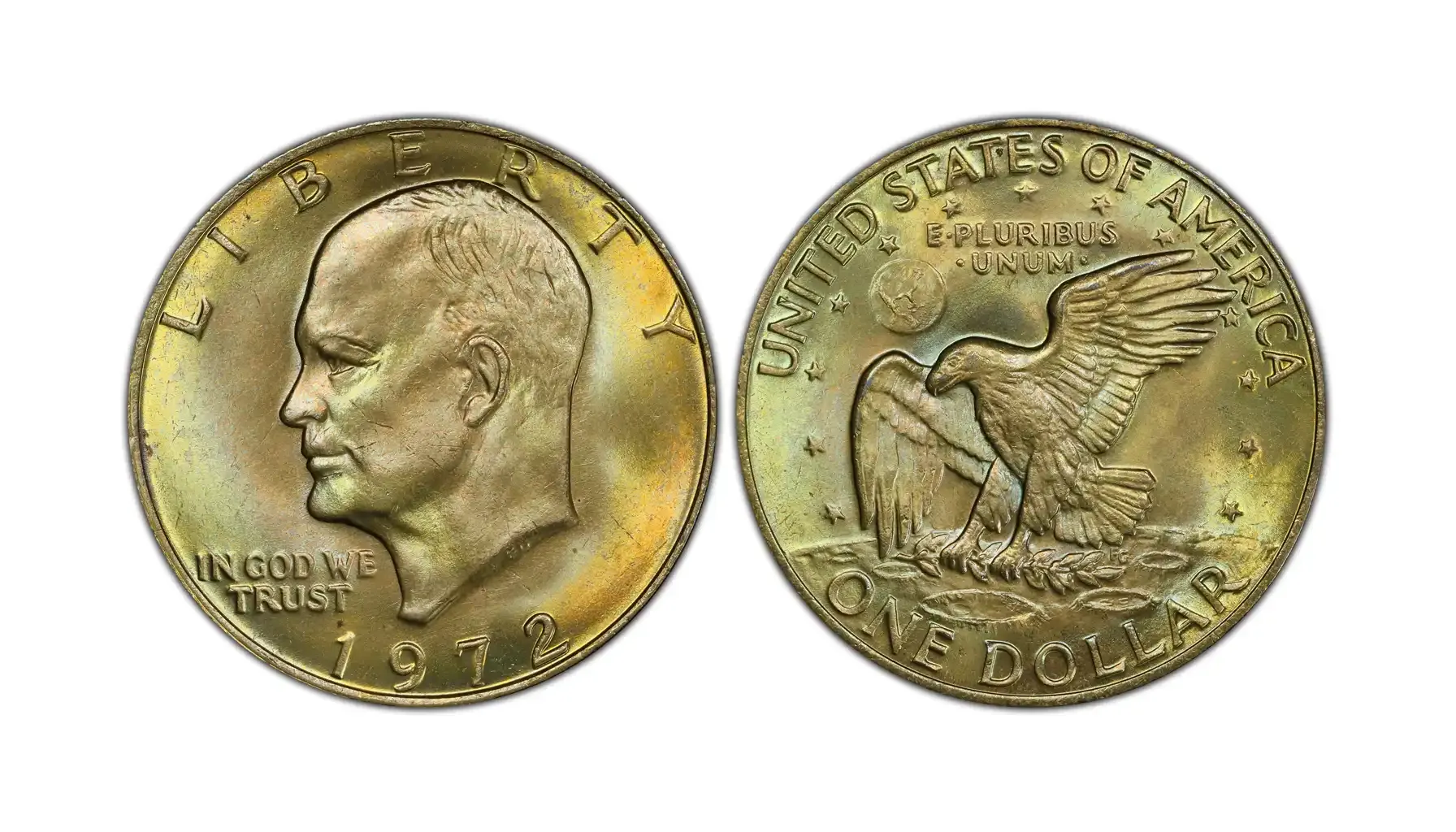
Obverse design:
Mintmark
No letter → Philadelphia (clad only)
D → Denver (clad)
S → San Francisco (silver Unc/Proof and clad proofs)
Weight test
Clad ≈ 22.68 g
40 % silver ≈ 24.59 g
Edge color
Clad shows a copper stripe
Silver reads solid gray with a faint layering
Reverse design:
Regular years (1971-74, 77-78): Apollo 11 eagle landing on the Moon
Bicentennial (1776-1976): Liberty Bell over the Moon
Anything else is a token, medal, or foreign copy
When in doubt, weigh it, read the edge, and check for an “S.” If Eisenhower half dollar value looks serious, send it to PCGS or NGC for grading and authentication.
Final Thoughts
Eisenhower dollars bridge two eras, old-school heft and modern mint tech. Most are affordable learning pieces; a few, like the 1972-P Type 2 or No-S Proof, headline auctions. Weigh yours, check the mintmark, match it to the chart, and if it looks exceptional, have it graded. Even a $2 Ike can teach you more than its price tag.
FAQs
What’s the value of an Eisenhower dollar?
Most clad circulation coins hover around $1–$3 in average condition, $10–$30 in bright uncirculated. Silver issues start near melt (about $8–$10 today) and climb sharply with higher grades or proof cameo contrast.
Which Ikes are silver, and what’s their melt value?
Only the 1971-S, 1972-S, 1973-S, 1974-S, and 1976-S coins are in Blue (Uncirculated) or Brown (Proof) packaging. Each holds 0.3161 oz of silver. Multiply that by the current spot price to find melt, roughly $8 - $10 lately.
What is the most valuable Eisenhower dollar?
The 1976-S No-S Proof Silver, a one-coin mistake, sits at around $850,000. Among regular issues, the 1972-P Type 2 can fetch thousands in MS-66.
How much is a Bicentennial Eisenhower dollar worth?
Clad coins are common: face value in circulation, $3–$10 uncirculated.
Silver 1976-S pieces bring $15–$30; proofs with deep cameo go higher.
Where is the mintmark on a 1776-1976 Ike?
Just below Eisenhower’s neck on the obverse.
- No mark = Philadelphia
- D = Denver
- S = San Francisco
Are there Eisenhower half dollars or centennial proofs?
No official half-dollar or “centennial” versions exist; those listings online are medals or private issues.
What’s the melt value vs. collector value?
Melt is the floor (silver only). Collector value depends on grade, strike, cameo depth, and rarity.

 Facebook
  X (Twitter)
  Pinterest
  LinkedIn