Contents:
The latest coins are usually the ones that are missed: they barely attract collectors and rarely represent the most exquisite numismatic creations in an instant. Nevertheless, certain examples should be taken as must-watch pieces, as they can unexpectedly appreciate in value or reveal peculiar errors that may make them expensive over time.
The 2025 Jefferson nickel may not be the most popular option to look for: its high mintage figures and consistent design do not overwhelm – they flourish. In this material, we are to cover the main details regarding nickels of 2025, check coin value, and finally define if it is worth collecting or not.
Mint Facts about the 2025 US Nickel
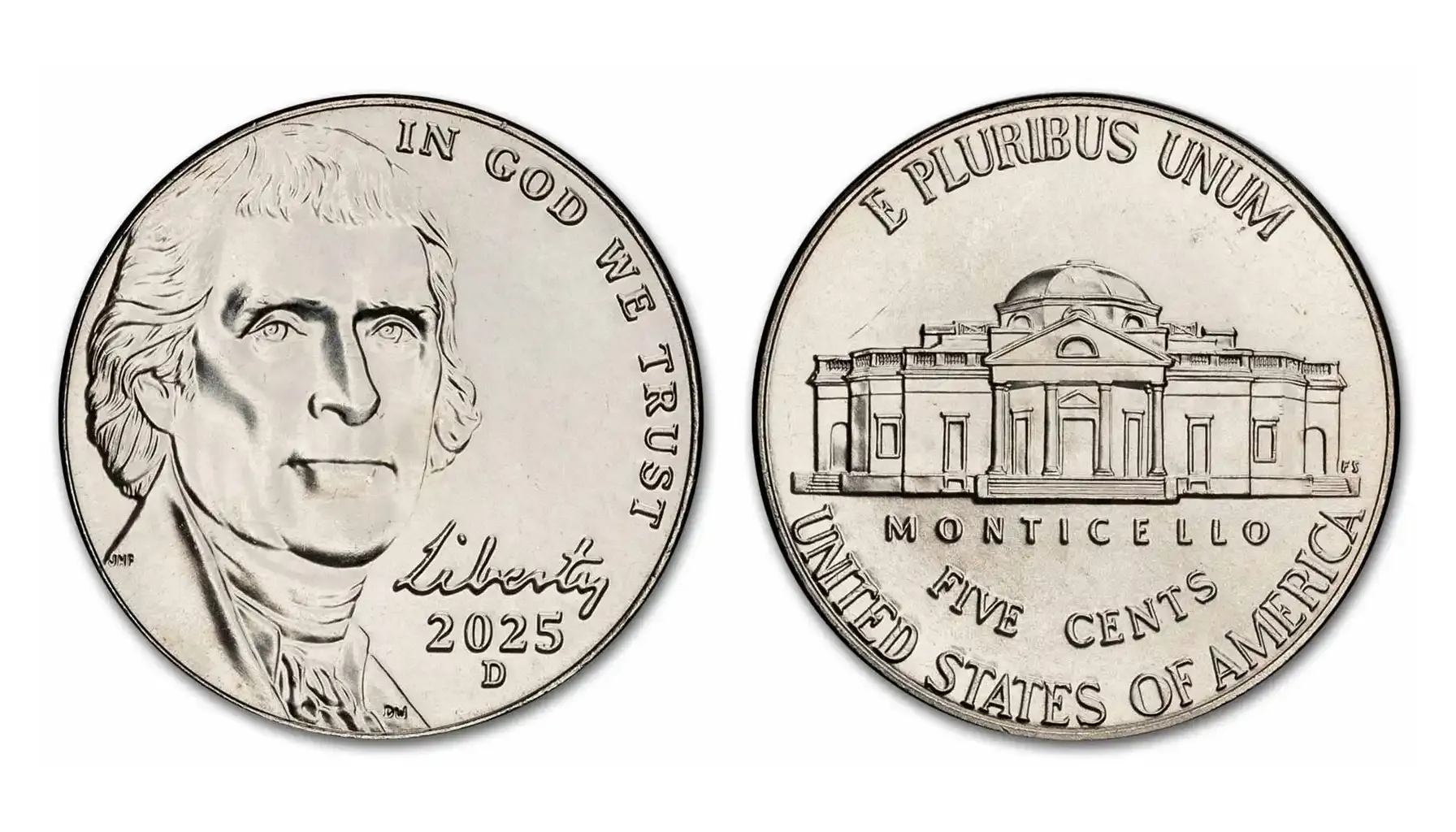
Obverse: Showcases a right-facing portrait of Thomas Jefferson, i.e., the third President of the United States (first introduced with the 1938 Jefferson nickel), along with the inscriptions “IN GOD WE TRUST” along the upper-right edge, “LIBERTY” to the right of the portrait, the year “2025” below the previous word, and a mint mark beneath.
Reverse: Introduces the Monticello estate, originally sculpted by Felix Schlag in 1938, as well as the inscriptions “E PLURIBUS UNUM” above Monticello, “MONTICELLO” below the estate, the denomination “FIVE CENTS” below, and “UNITED STATES OF AMERICA” along the bottom rim.
The Main Features | |
Composition | 75% copper, 25% nickel |
Weight | 5.000 grams |
Diameter | 21.21 mm |
Thickness | 1.95 mm |
Edge | Plain (smooth, without reeding) |
2025 Nickel Mintage | Philadelphia: 443,840,000 Denver: 322,320,000 San Francisco: N/A |
2025 Nickel Errors to Look For
Since the 2025 5C has been released only recently, potential errors have not yet been fully documented. Collectors and numismatists can only speculate at this stage, based on past patterns and common minting mistakes within the series.
Possible 2025 nickel errors may include:
Planchet errors, i.e., incorrect or flawed metal blanks.
DDO/DDR, i.e., Doubled Die Obverse or Reverse
Filled initials, i.e., mint mark or date, partially filled with metal
Struck-through errors, i.e., debris or foreign material struck into the coin
Triple stamping, i.e., a coin struck multiple times, causing ghost images
Die chips/cud errors, i.e., small metal protrusions from die damage

What Is the 2025 Nickel Value?
Although the coin has been recently launched, the market value is still unstable, especially since it is determined by its type, mint mark, and condition, let alone errors and deviations that are out of the norm. So, what is the 2025 D nickel value (other types included?
Type | P | D | S (Proof) |
Circulated (G-F) | $0.05 – $0.25 | $0.05 – $0.25 | N/A |
Uncirculated (MS60-MS65) | $0.50 – $2 | $0.50 – $2.50 | $5 – $10 |
Uncirculated (MS66-MS70) | $2 – $5 | $2.50 – $6 | $10 – $15 |
Proof (PF65-PF69) | $4 – $8 | $5 – $10 | $12 – $18 |
Proof (PF70) | $8 – $12 | $10 – $15 | $18 – $25+ |
Frequently Asked Questions
Will there be any special designs for 2025 nickels?
The 2025 iteration is no different from the rest of the coins within the series. Besides, no officially announced special designs have been released yet, though collectors should watch for commemorative or limited editions whatsoever.
What types of 2025 nickels will be available for collectors?
There are three main types: Philadelphia Mint (P), Denver (D), and San Francisco Proof (S) coins. The difference is in the quality of mintage and figures that impress.
How can I identify different mint marks on 2025 nickels?
The mint mark is usually located below the year on the obverse. Look for "P" for Philadelphia, "D" for Denver, and "S" for San Francisco Proof coins.
Are there any known errors to look for?
Since the 2025 variety has not been fully explored yet, errors can only be presumptive. Anyway, possible deviations may include planchet flaws, doubled dies (DDO/DDR), filled initials, struck-through debris, triple stamping, and die chips.
Should I collect both Philadelphia and Denver mint marks?
Yes, without a doubt! A collection may increase a collector's worth and let one compare potential differences in strike quality, finish, and minting characteristics.

 Facebook
  X (Twitter)
  Pinterest
  LinkedIn