Contents:
Out of all Beautiful Quarters, the 2017 quarter Effigy Mounds issue is, perhaps, the most abstract. What are the effigies this coin shows, and why were they represented in the first place? Let’s find out.
2017 Effigy Mounds Quarter Overview
America the Beautiful quarter series set out to represent the beauty of the U.S. sites. The 36th issue arrived in the program in 2017, and that was the Effigy Mounds 2017 quarter.
The coin celebrated the Effigy Mounds National Monument in Iowa, a place full of prehistoric sites. The mounds were once built by prehistoric cultures that lived in the Mississippi Valley. As for the use of these mounds, the researchers are pondering. Some say they were meant for tombs, and others say they were only decorative.
The coin’s design points out the same mounds that were once built by indigenous people.
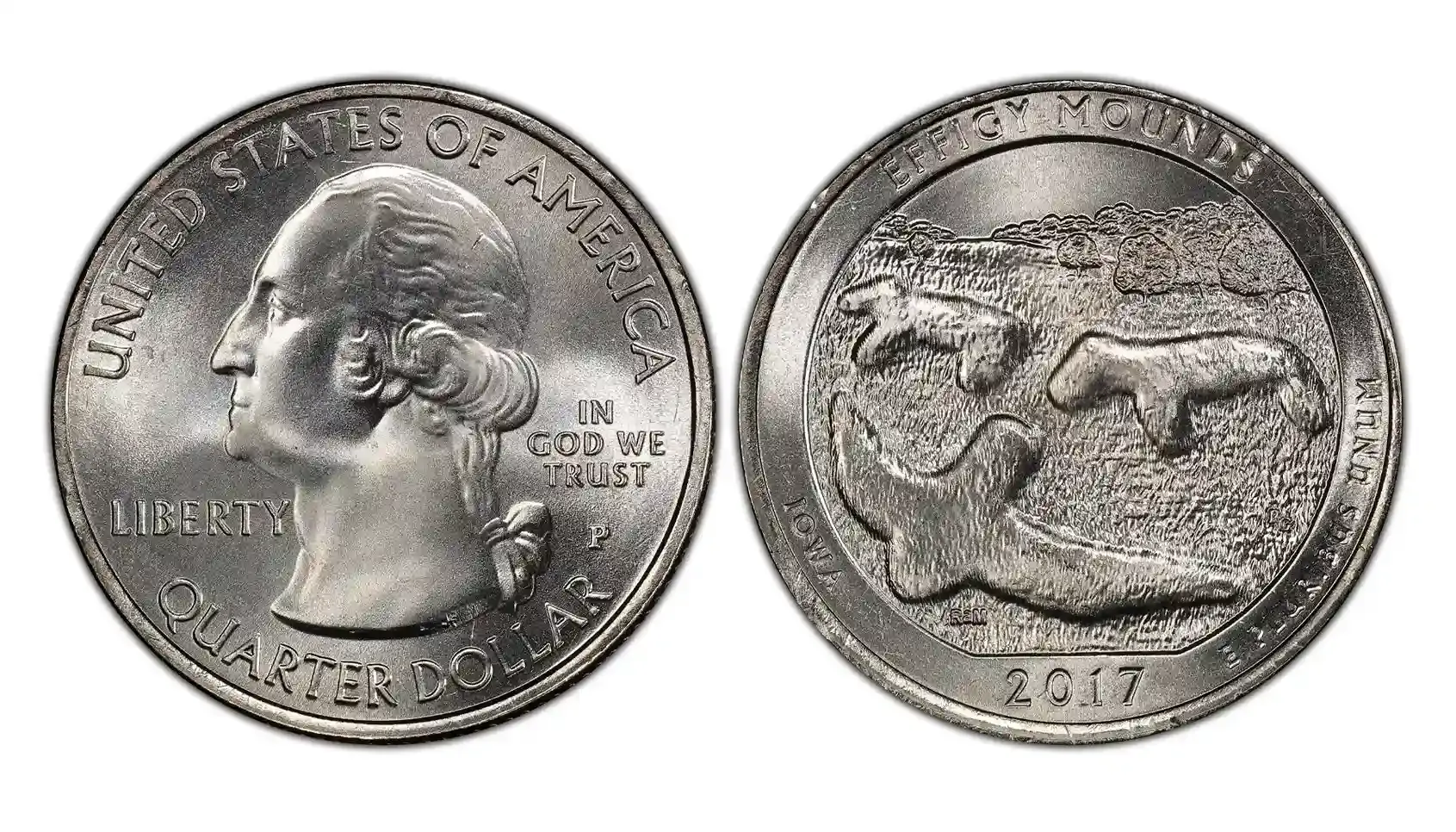
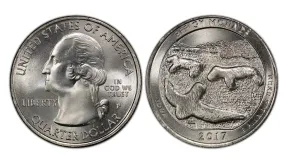
The obverse: A bust of George Washington, originally created for the 1932 Washington quarter. This side has inscriptions like “UNITED STATES OF AMERICA”, “LIBERTY”, “IN GOD WE TRUST”, and “QUARTER DOLLAR”.
The reverse: Three bird-shaped effigy mounds located in Effigy Mounds National Monument in Iowa. We see the mounds from the above perspective. You can also see some vegetation with trees in the background. There are inscriptions “EFFIGY MOUNDS”, “IOWA”, “E PLURIBUS UNUM”.
John Flanagan designed the classical obverse side, while Richard Masters designed the exclusive reverse.
As for the technical side of the coin, it is universal with other issues. For example, the next issue in the line, the 2017 Frederick Douglass quarter, had the same properties.
Property | Description |
Years of Minting | 2017 |
Type | Commemorative |
Shape | Round |
Edge | Reeded |
Metal Content (Clad) | 91.67% Copper, 8.33% Nickel |
Metal Content (Silver Proof) | 90% Silver, 10% Copper |
Total Weight (Clad) | 5.67 g |
Total Weight (Silver Proof) | 6.25 g |
Diameter | 24.26 mm |
Mintage | Philadelphia (P): 271,200,000 Denver (D): 210,800,000 San Francisco (S, Clad): 630,000 San Francisco (S, Silver): 466,700 |
2017 Effigy Mounds Quarter Value & Worth
The 2017 quarter value is relative to its face value in most cases. Only very high grades can go over the limits. This price range is not unique. Most Beautiful quarters have the same range, and an issue from the same year, the 2017 Ozark Riverways quarter, had similar values.
Coin Type | Grade | Estimated Value Range |
Philadelphia (P) Circulation Strike | Circulated (VG–XF) | $0.25 – $1.00 |
Uncirculated (MS60–MS65) | $1 – $6+ | |
Denver (D) Circulation Strike | Circulated (VG–XF) | $0.25 – $1.00 |
Uncirculated (MS60–MS65) | $1 – $6+ | |
San Francisco (S) Clad Proof | PR65–PR69 | ~$6 |
San Francisco (S) Silver Proof (90% Silver) | PR65–PR69 | ~$21 |
If you expected higher values, then we are sorry to disappoint. Don’t get your hopes down yet. Many commemorative quarters turn more valuable with time, and the program is just too new to be worth more than face value.
Plus, the beautiful quarters were always about, well, beauty, and the legacy they represented.
“The Effigy Mounds quarter design embodies the spirit of this sacred landscape… This new coin honors a special place where ancient people changed the landscape of their world in the most extraordinary way.”
— Marc Landry, Superintendent of the U.S. Mint at Philadelphia
United States Mint Official Website
2017 Effigy Mounds Quarter Error List & Most Valuable Varieties
Commonly, error varieties are the most valuable kinds of coins you can get, and this coin is no exception. While it doesn't have many known errors, the ones you encounter give it more value than even Silver Proofs.
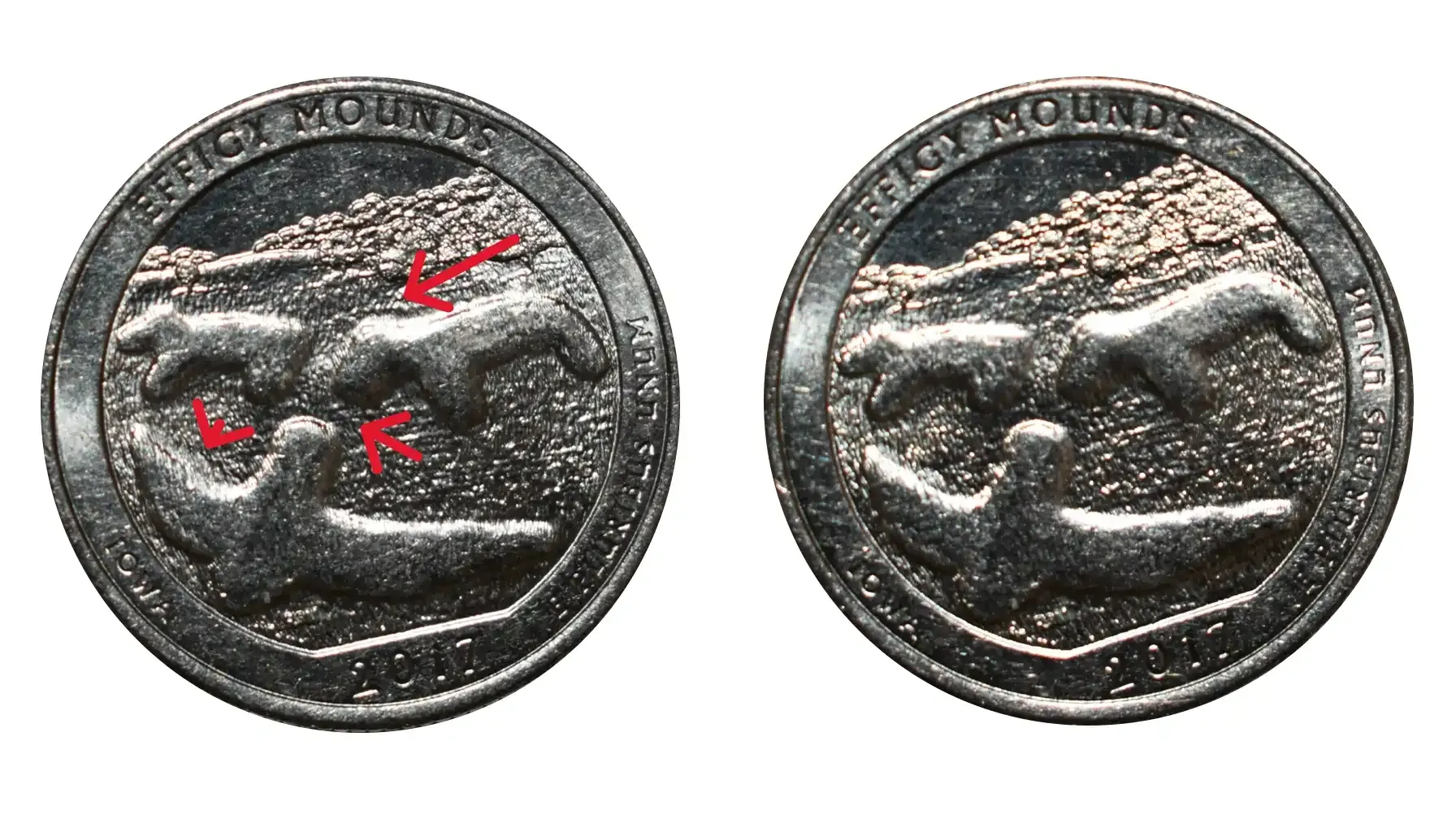
Here are some high-value errors you can see across the Beautiful program:
Missing clad-layer: This error is found only on clad issues. An outer cupronickel layer is missing, revealing the copper core. The coin that was supposed to be gray now appears orange or brown. Very dramatic. Genuine examples are rare and can be highly collectible. Often goes for $50+.
Major off-center strikes: The value depends on how much of the design is missing and whether the date/mintmark remains visible. Small off-centres are not worth much, but big shifts could be $25+.
Obverse or reverse doubled die: Some legends, dates, or design parts could be doubled. If the doubling looks clear, collectors are willing to pay big money for such a coin. Often, such examples go for $150+.
Other 2017 quarter errors are less valuable, but could make the coin worth a few dozen:
Strike through grease: Appears as blobs or traces of foreign materials struck within the coin's metal. Usually worth $5+, but could be more if the placement of the foreign material is in an intriguing manner (for example, Washington's nose).
Broadstrike: An error when the coin was struck without the retaining collar, making the bit broader and flatter. This error is very recognizable and often bought quickly, but not often for prices over $20.
Die cracks and die breaks (cuds): Various blobs and cracks that appeared on the coin during production. These are relatively common and not worth more than $15, unless cracks and blobs appear on design elements like the portrait.
Conclusion
In terms of circulation and value, the 2017 Effigy Mounds quarter is quite common. Typical examples are worth little more than face value unless they are high grade (clad proof/silver proof) or show significant errors.
Compared to most other bits from the Beautiful program, this issue stands out because:
It features earthworks, while most issues show either nature or artificial structures, not a blend.
It represents an ancient Native American cultural site, not a modern or colonial location.
The view from above is unusual for U.S. coinage. This perspective was needed, otherwise, we would not be able to see the mound shapes.

 Facebook
  X (Twitter)
  Pinterest
  LinkedIn