Contents:
The United States is… full of states. And every region deserves to be celebrated, for without them, there is no US. One particular quarter was made with this exact goal to celebrate Alaska.
We will learn about this quarter’s history, value, and various errors it may have.
Overview of the 2008 Alaska State Quarter
The Alaska quarter was released as part of the 50 State Quarters Program. This program ran from 1999 to 2008 to commemorate each U.S. state.
Alaska found itself closer to the end of the programs, as the 49th state issue in 2008. Mintage-wise, it was relatively common, not much bigger or smaller in mintage than its counterparts.
State Quarter (2008 Release) | “P” Variety (Philadelphia) | “D” Variety (Denver) | Total Circulating Mintage |
Alaska | 251,800,000 | 254,000,000 | 505,800,000 |
Oklahoma | 222,000,000 | 194,600,000 | 416,600,000 |
New Mexico | 244,200,000 | 244,400,000 | 488,600,000 |
Arizona | 244,600,000 | 265,000,000 | 509,600,000 |
Hawaii | 254,000,000 | 263,600,000 | 517,600,000 |
Despite their abundance, Alaska coins remain popular among collectors. Unique design plays a certain role here, and people who appreciate the state and its nature would take great interest in it.
“This groundbreaking initiative has been the most successful coin program in the Nation’s history. The 50 State Quarters Program has educated a generation of Americans about the history and geography of the States. It has also generated tremendous state pride...”
— Ed Moy, United States Mint Director
United States Mint Website
Design Details and Symbolism
Each coin from the State series was meant to show off, to reflect the best parts about their region.
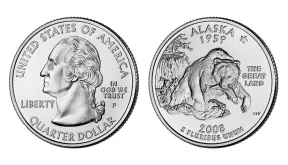
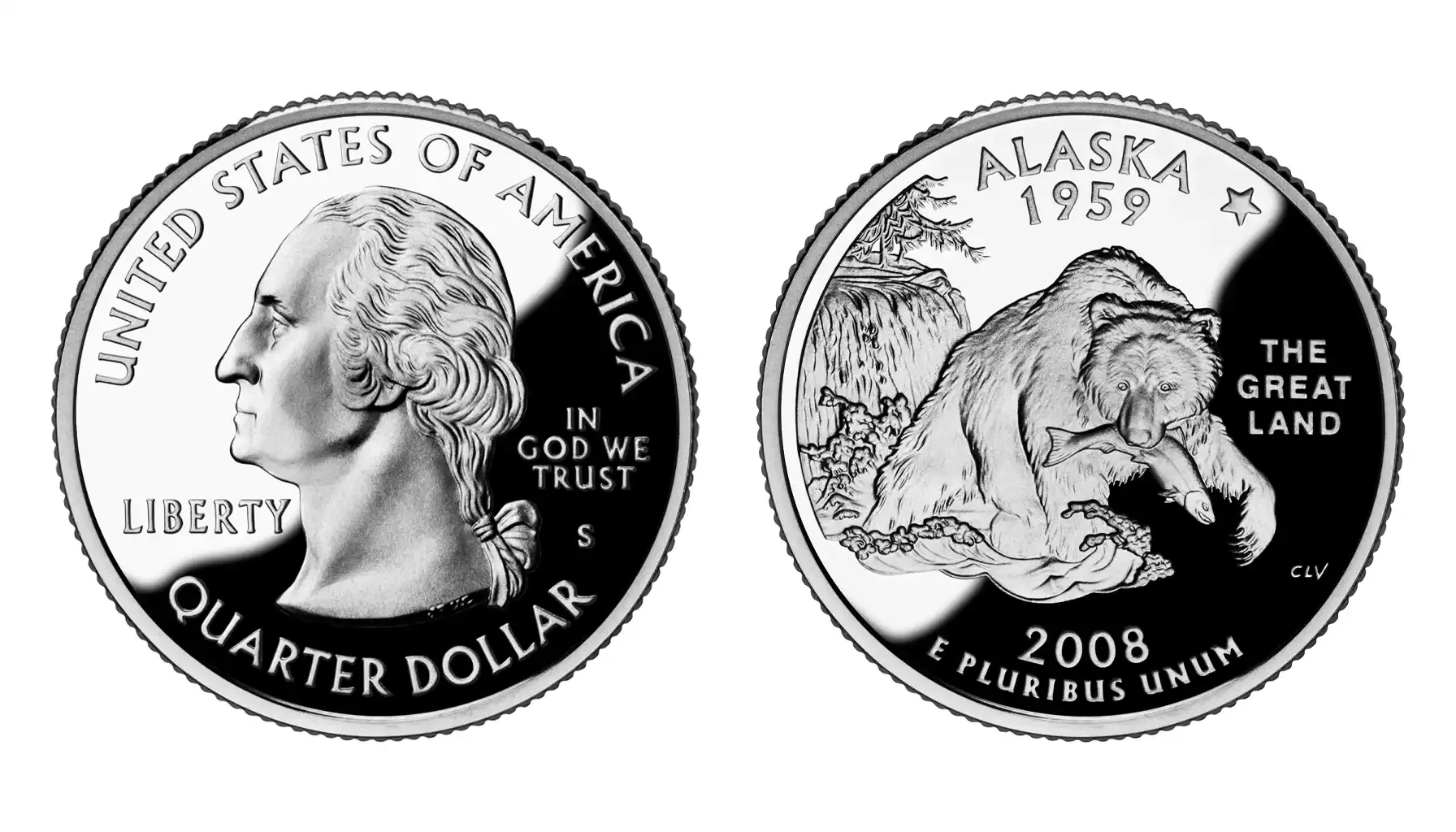
The obverse of the coin features a portrait of George Washington. The design includes the inscriptions: "UNITED STATES OF AMERICA," "LIBERTY," "IN GOD WE TRUST," the denomination "QUARTER DOLLAR," the mint mark, and the year "2008."
The reverse depicts a grizzly bear emerging from the waters. The bear has a salmon in its jaws. Above the bear is the North Star. The inscriptions show: “ALASKA,” “1959” (Alaska’s year of becoming a state), and “THE GREAT LAND,” Alaska’s nickname.
The obverse side is common for most Washington quarter mintages. This side was designed by John Flanagan. The reverse side is unique to the Alaska edition, and it was created by Charles Vickers.
Charles Vickers put a great deal of attention into the symbolism of the reverse side. Grizzly bears are a living symbol of the wilderness and wildlife of Alaska. The North Star symbolizes Alaska’s northern location and frontier identity.
Also read: Oklahoma Quarter.
2008 Alaska Quarter Specifications
Design is not always about how a coin looks. It is also about the way it is shaped. Every state quarter had to be perfect, precise, as many would collect them.
Attribute | Details |
Country | United States |
Years of Minting | 2008 |
Type | Circulating Commemorative Quarter (25¢) |
Shape | Round |
Edge | Reeded |
Metal Content | Clad: 75% copper, 25% nickel over copper core |
Total Weight | 5.67 grams |
Diameter | 24.30 mm |
Thickness | 1.75 mm |
As for minor properties, this coin is not magnetic (because copper, the main component, is not magnetic).
Alaska Quarter Error Varieties
Rare State quarters worth money often have one thing in common. Errors. Collectors often look for 2008 Alaska quarter errors. If you find a flaw, the collectible will be worth at least a few dozen dollars. With a high grading, you could expect a three-figure price, at the very least.
Some notable Alaska State quarter errors:
Extra Claw (Six Claw) Error: Some coins appear to show an extra toe or claw on the bear’s front paw. This may be caused by a die chip, though some coins may also show this feature due to damage.
Misaligned Dies / Obverse Rotation: Coins may appear with the obverse rotated relative to the reverse. Most cases are too small to acknowledge, but a 50+ degree rotation is rare and valuable.
Rim Cud Errors: A raised lump or irregularity on the coin’s edge caused by a broken die. Cuds that appear on the bear are more valuable.
Missing Clad Layer / Exposed Copper Core: Some coins may show missing or incomplete outer silver coloured layers, revealing the copper core.
Die Chips and Planchet Flaws: Small raised metal spots or anomalies in lettering, as well as minor planchet defects. Technically, the “Extra Claw” error is already a die chip, just so notorious that it got its own name.
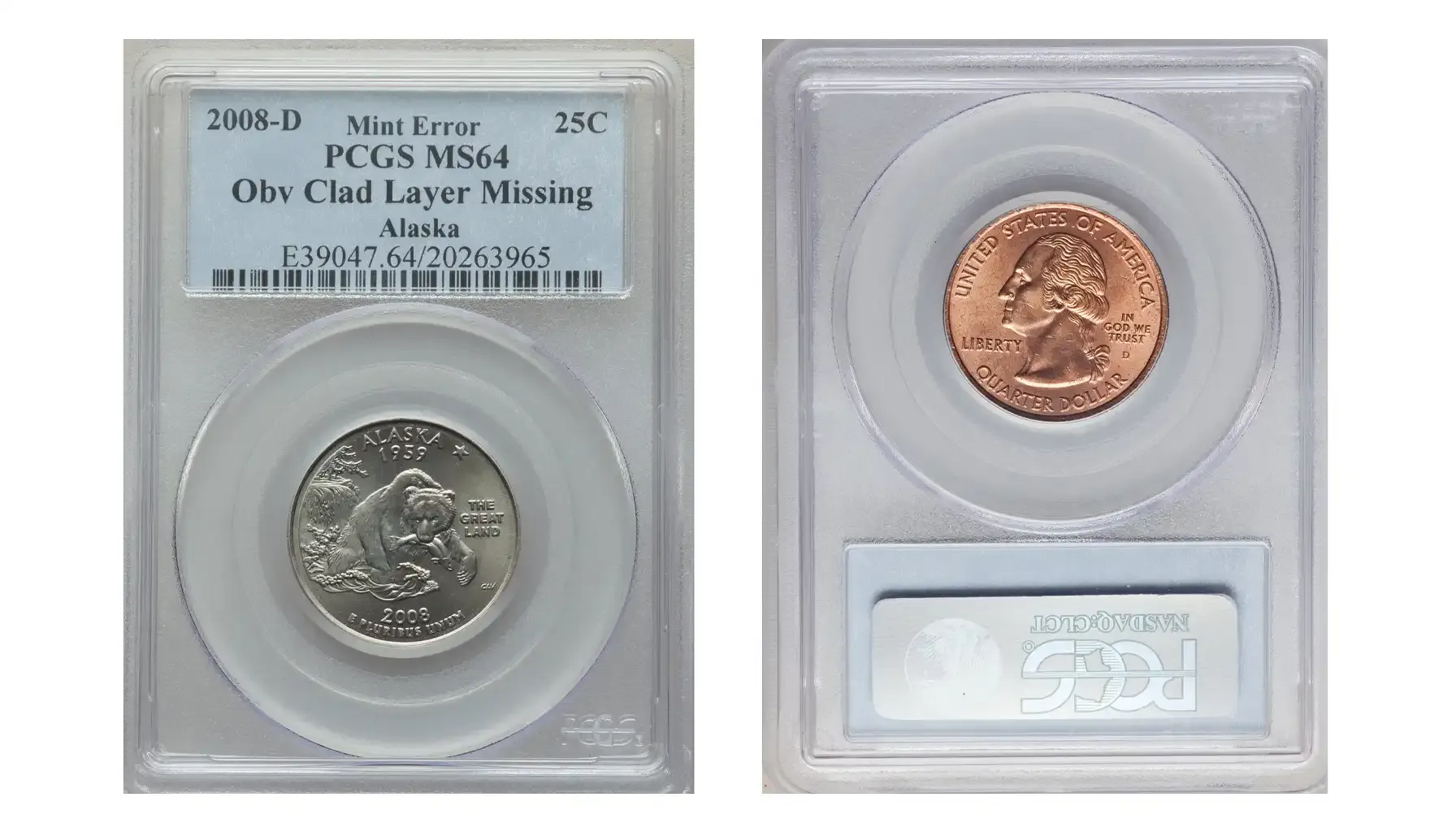
Out of all show errors, clad flaws are currently the price. One such coin with a missing clad layer was sold for over $200. That bit came from a Denver mint, but considering both facilities had a similar mintage, a 2008 P Alaska quarter error value with the same error would be similar.
Conclusion
The 2008 Alaska quarter is a visually striking and collectible coin, just like a New Mexico one.
Ordinary examples are abundant and modestly priced. Not just collectors, but enthusiasts too, would like to get one. Collectors specifically enjoy hunting for subtle varieties with errors.
Collectors appreciate this quarter not only for its monetary value but also for what it represents: pride in owning a piece of Alaska’s heritage.
Do you want to find out more about the world's coinage? Coin ID Scanner has a respectable database of over 150,00 pieces. The app has extensive blogs on numerous cons, with their value, history, and mintage details.

 Facebook
  X (Twitter)
  Pinterest
  LinkedIn