Contents:
Out of all State Quarters, the Illinois issue was, perhaps, the most direct in its presentation. Let’s see what was so interesting about its design, varieties, and value.
Illinois State Quarter Overview
In 2003, the 21st coin in the U.S. Mint’s 50 States Quarters Program was issued. The Illinois 2003 quarter. The first State quarter to appear in 2003, followed by the Alabama quarter.
What is special about the Illinois quarter? First of all, its design. While all State coins share the same obverse, their reverse is exclusive each time.
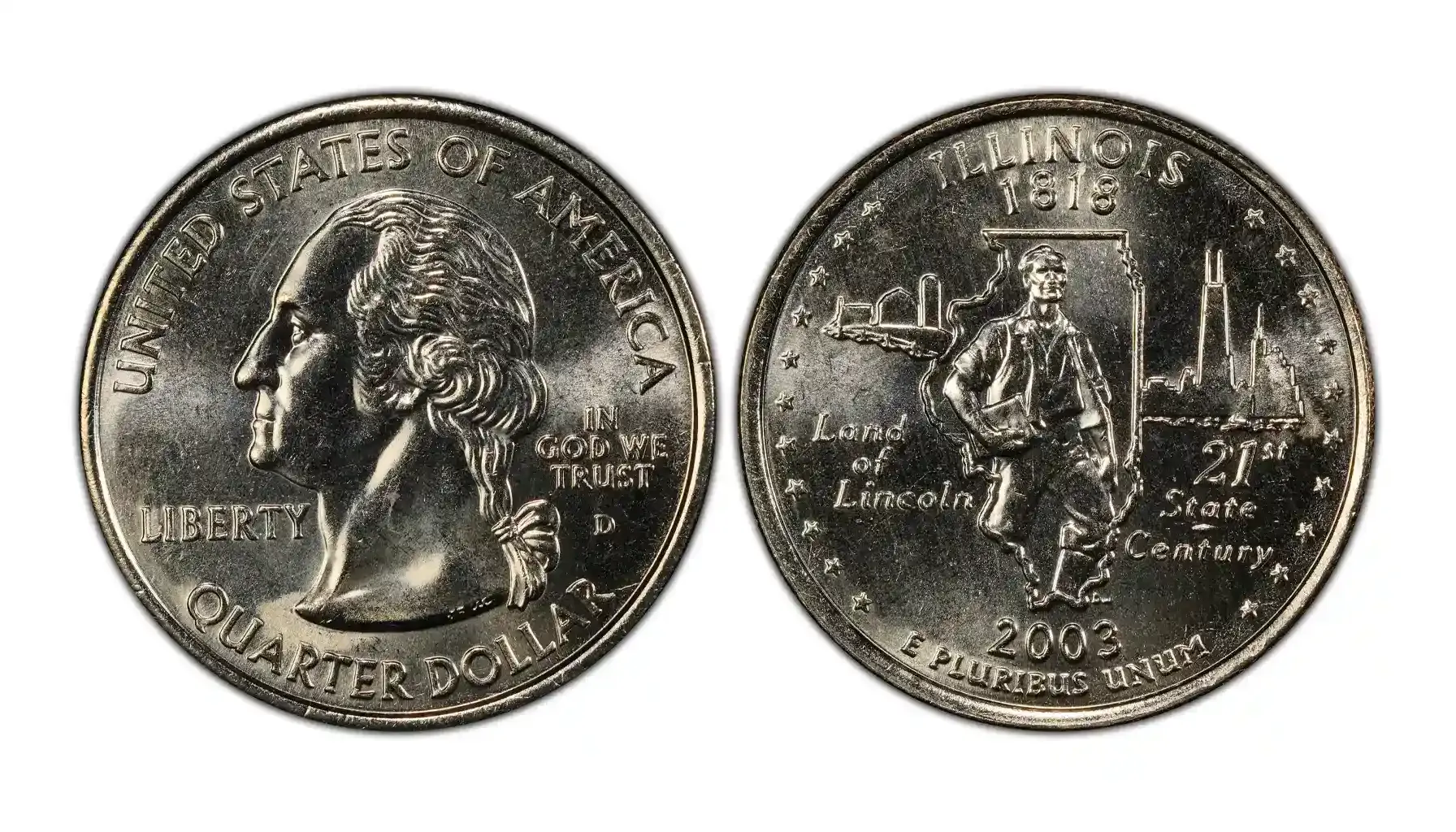
The obverse uses the standard portrait of George Washington, designed by John Flanagan.
The reverse design features a young Abraham Lincoln. He is standing inside an outline of Illinois state. On the left side of a coin stands a farm scene, and on the right, the Chicago skyline. The whole design is encircled by 21 stars. The side was designed by Beth Machon and sculpted by Donna Weave.
"This design is one of the most distinctive of the series. It is the first U.S. coin to feature a young Abraham Lincoln, and thus it is a numismatic first."
— Henrietta Holsman Fore
Illinois Quarter Launch
2003 Illinois Quarter Value and Errors Guide
We typically deal with “normal” coins and error variants. Most coins come out without errors, and those are valued according to their mint marks (P, D, or S) and their grade (condition). Most State Quarters, including other 2003 issues (like the Maine quarter), are worth face value.
Coin Type | Condition | Typical Value Range |
Business Strike – 2003-P (Philadelphia) | Circulated | $0.25 |
Uncirculated (MS60–MS63) | $0.50 – $2 | |
High Grade (MS65)+ | $3+ | |
Business Strike – 2003-D (Denver) | Circulated | $0.25 |
Uncirculated (MS60–MS63) | $0.50 – $2 | |
High Grade (MS65) | $3+ | |
Proof – 2003-S Clad | Proof | ∼$7 |
Proof – 2003-S Silver Proof | Proof | ∼$20 |
Overall, only the San Francisco variety is consistently above the face value. Silver proofs could be worth even more if the silver market is in good condition.
Error coins are a different kind of category. Their values are often too dramatic to comprehend in one table. While they also benefit from the good condition, often even a low-grade coin can be worth $20+ as long as it is a drastic error.
Some mint errors are well-documented for the State quarter, and other errors are still being discovered today:
Doubled Die (Obverse or Reverse)
Re-punched Mint Mark (RPM)
Off-Center Strikes
Die Chips and Die Cracks
Rare Illinois State Quarter Varieties
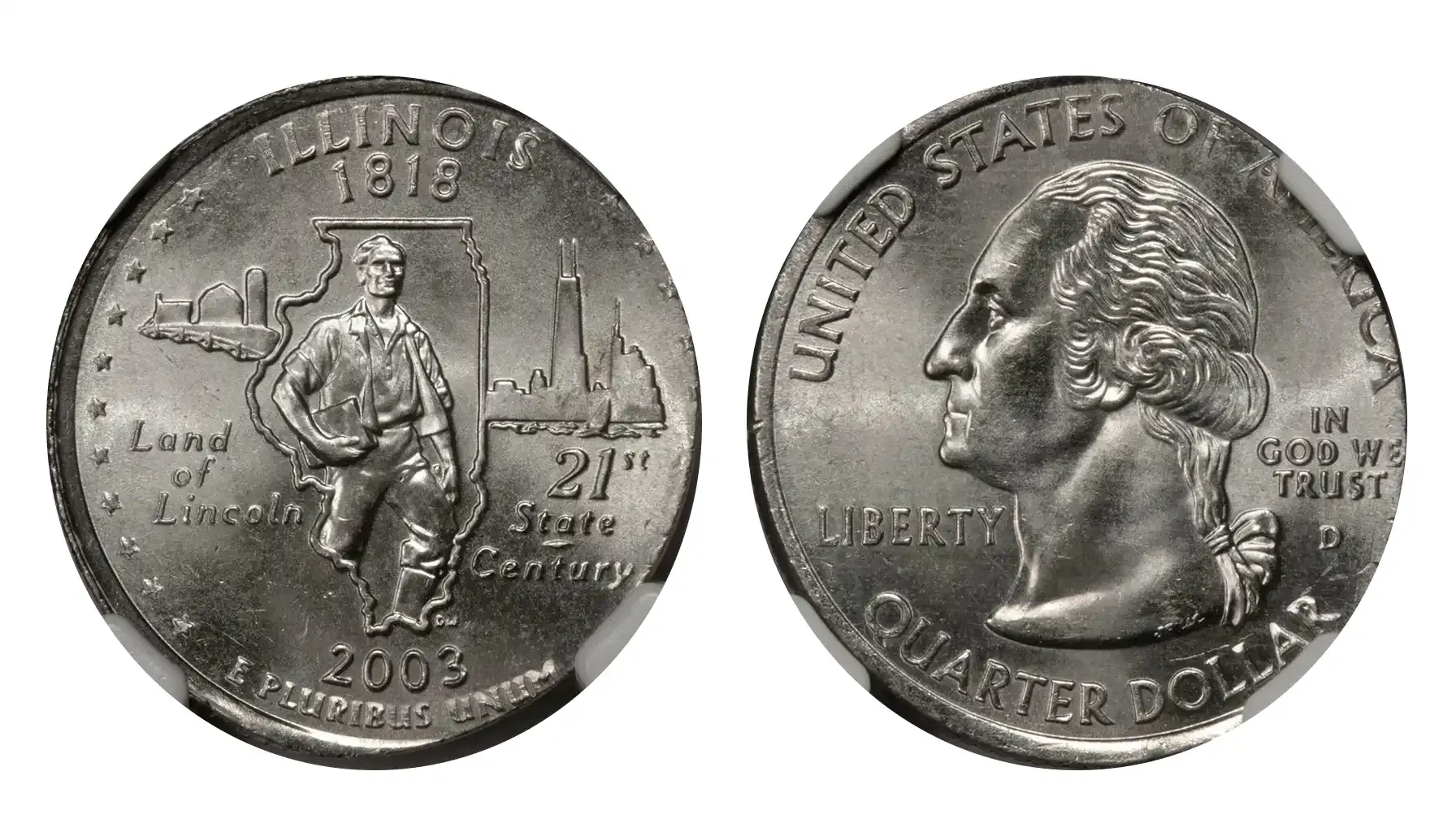
All error Illinois quarters are considered somewhat rare. We have already seen the list of errors. Now, let’s give each 2003 Illinois quarter error a little overview.
1. Doubled Die (Obverse or Reverse)
Doubling occurs when the die itself has been impressed twice in slightly different positions.
Doubling can be seen on date, inscriptions “LIBERTY,” “IN GOD WE TRUST,” and, in rare cases, reverse elements (Lincoln’s portrait, skyline lines)
This error is rarely documented.
2. Re-punched Mint Mark (RPM)
The mintmark could be struck more than once in different positions on the die. It leaves a small but visible “ghosted” mintmark.
Most RPMs were documented with the “D” (Denver) variety.
3. Off-Center Strike
The planchet was not fully centered when the coin was struck.
Small off-center strikes (a few percent) are of little value. Big shifts, though, are rare and valuable.
4. Die Chips and Die Cracks
Some coins come out with raised blobs (die chips) or extra lines (die cracks).
Chips and cracks are the most common errors for most State quarters.
If you can find such errors in a high-grade quarter, you can be sure: you own something exceptional, something rare. Something that truly reflects the importance of Illinois state itself.

 Facebook
  X (Twitter)
  Pinterest
  LinkedIn