Contents:
It’s often that the State Quarters depict something grand, monumental for their state. The Vermont state quarter, however, chose a more genial approach. Let us observe this coin's design and 2001 Vermont quarter errors.
2001 Vermont Quarter Overview
The Vermont quarter was released as part of the popular 50 State Quarters Program, which ran from 1999 through 2008. In 2001, a quarter was issued in dedication to Vermont's state.
Vermont was not the only state that appeared in the program in 2001. There was also a 2001 Kentucky quarter and a few other states. Unlike most other quarters, though, Vermont’s design is more down-to-earth and soft:
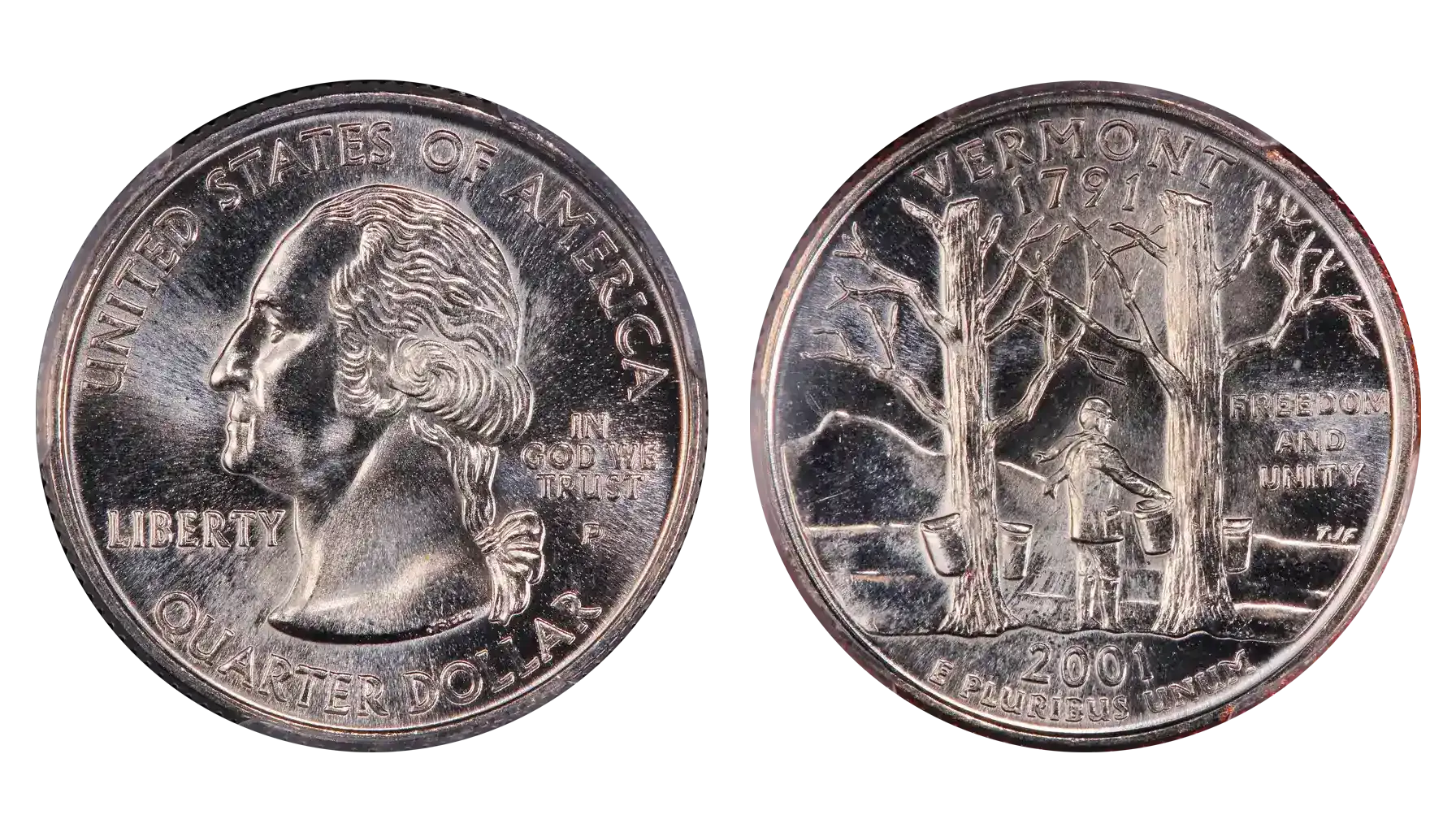
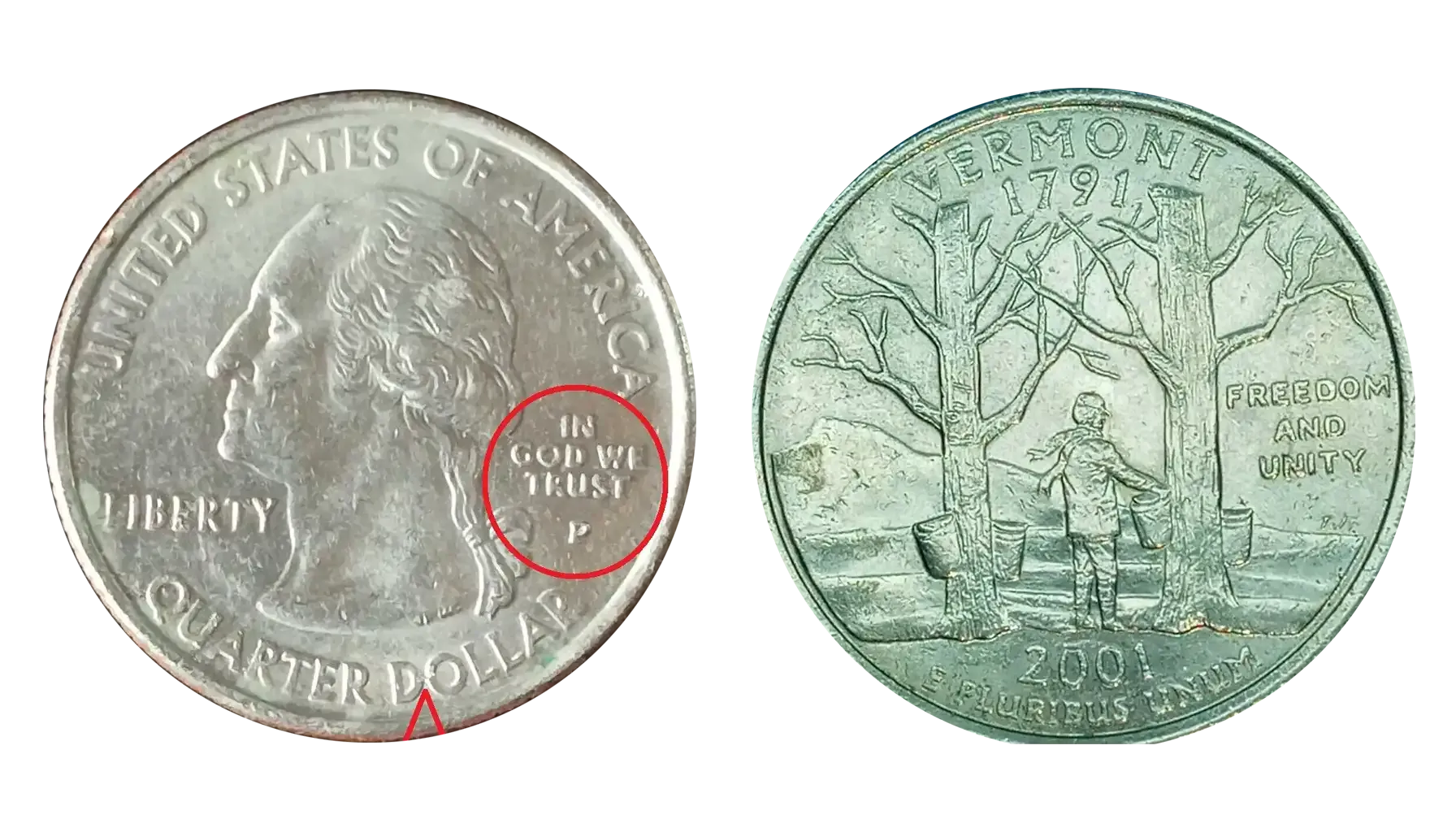
The obverse features a portrait of George Washington that appears on all State Quarters. This side was created by John Flanagan in 1932, but reportedly, the design was slightly refined for the State quarter release.
The reverse shows a pair of large maple trees with buckets attached to collect sap, a way to represent the state’s historic maple industry. A man in a jacket is collecting syrup. In the background, there is Camel's Hump Mountain, a popular site in Vermont.
"As the nation’s largest producer of maple syrup, it is fitting that the Vermont Quarter honors the people and the industry that have contributed so much to the state in its history."
— Holsman Fore
Vermont State House Gala Ceremony
Rare Vermont Quarter Varieties
The Vermont quarter is generally common. Compared to issues close to it on the timeline (like the 2002 Tennessee quarter), it has a very high mintage. With so many bits, few were designed to be made with errors, and collectors look for such coins.
Here is the 2001 Vermont quarter error list with pictures:
Off-Center Strikes: Most off-center quarters show only 5–15% design shift. Only moderately rare. However, over 40% shifts are rare and are often worth $50.
Broadstrikes: When the coin was not properly retained, it came out wider, flatter. Well-defined broadstrikes generally sell for $20–$75.
Die Cracks and Die Breaks (Cuds): Some quarters were struck with deteriorating dies. As a result, metal blobs appear on the design. This error is commonly worth about $20.
Double strikes: Coins struck twice (or more) are uncommon and visually interesting. A clear double strike can reach $150 or more.
How to Identify Vermont Quarter Errors and Value
Most Vermont quarters have similar values, but, like always, there is an exclusion. If you follow these steps, you can identify a bit pricier than most:
1. Examine the coin. Use a 5x–10x magnifier to check for:
Errors: extra metal blobs (cuds, die chips), lines or doubling on letters (possible die doubling), missing or distorted details, etc.
Mint Marks: “S” mint marks (located on the obverse, under the “IN GOD WE TRUST” motto) are rarer than “P” or “D”.
2. Weigh the coin.
A normal Vermont quarter should weigh 5.67 grams (clad).
However, if it weighs 6.25 grams, it's likely made of precious silver.
If there’s a different weight, perhaps you have a silver counterfeit or a unique error.
3. Get the coin graded.
If the piece seems promising (has errors or seemingly has excellent condition), consider grading the bit.
You can consult PCGS or NGC Grading Services.
As for the general values for this coin:
Coin Type | Grade | Typical Value |
2001-P (Philadelphia) | Circulated | $0.25 – $0.75 |
Uncirculated (MS60–MS64) | $0.75 – $1 | |
High grade (MS65)+ | $1 – $5 | |
2001-D (Denver) | Circulated | $0.25 – $0.75 |
Uncirculated (MS60–MS64) | $0.75 – $1 | |
High grade (MS65)+ | $1 – $5 | |
2001-S Proof (Clad) | Proof | ~$10 |
2001-S Silver Proof | Proof | ~$25 |
Overall, the Vermont quarter is an excellent modern coin to collect. It may be valuable only in the San Francisco variety, but its design and message are priceless.

 Facebook
  X (Twitter)
  Pinterest
  LinkedIn