Contents:
You can’t find a design more musical in the State Quarters program than the Tennessee quarter. Let’s appreciate its design in more detail and find out its value.
2002 Tennessee Quarter Overview
The U.S. Mint’s 50 State Quarters Program celebrated Tennessee in 2002. While there were other State Quarters issued during that year (e.g., the Ohio quarter), but were unlike Tennessee in terms of design:
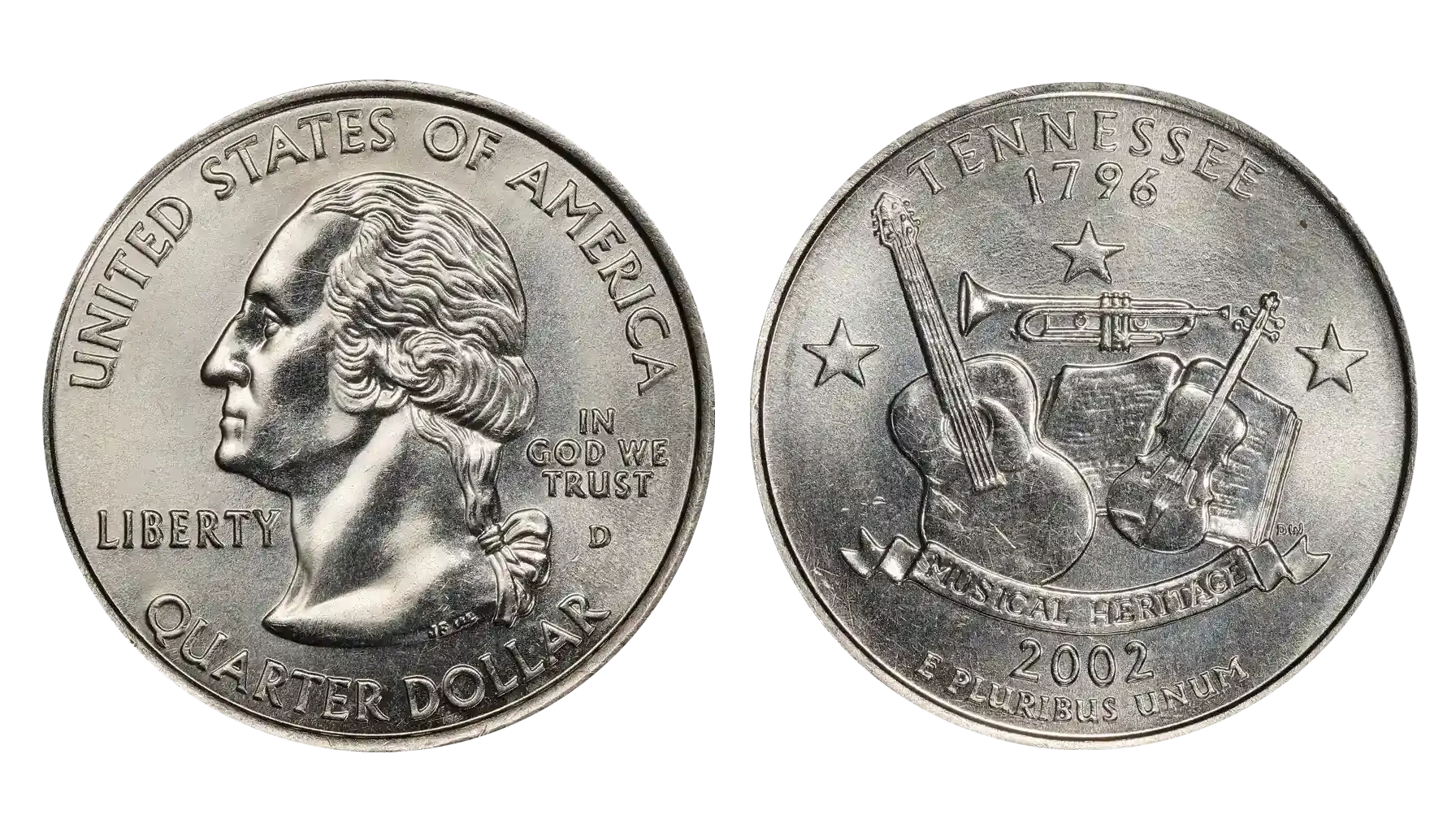
The obverse features the portrait of George Washington by John Flanagan. An unchanged design is also seen on other 2002 issues, such as the Louisiana quarter.
The Tennessee quarter back, created by Donna Weaver, celebrates Tennessee’s musical heritage. It shows a fiddle, a trumpet, and a guitar. These instruments show off music styles popular in the state and also represent groups of people who often used these instruments. A banner reading "Musical Heritage" ties the themes.
“Tennessee joined the Union on June 1, 1796 … Home to musical great Elvis Presley, the Grand Ole Opry and the Beale Street Historic District, Tennessee is rich in its musical contributions. In honor of this musical heritage, the new quarter’s design incorporates musical instruments and a musical score.”
— United States Mint
Official Website
Rare Tennessee Quarter Varieties
As the Tennessee quarter was heavily minted, a few examples came out wrong, with errors. If you're lucky enough to find them, many collectors would be happy to pay for the error quarters.
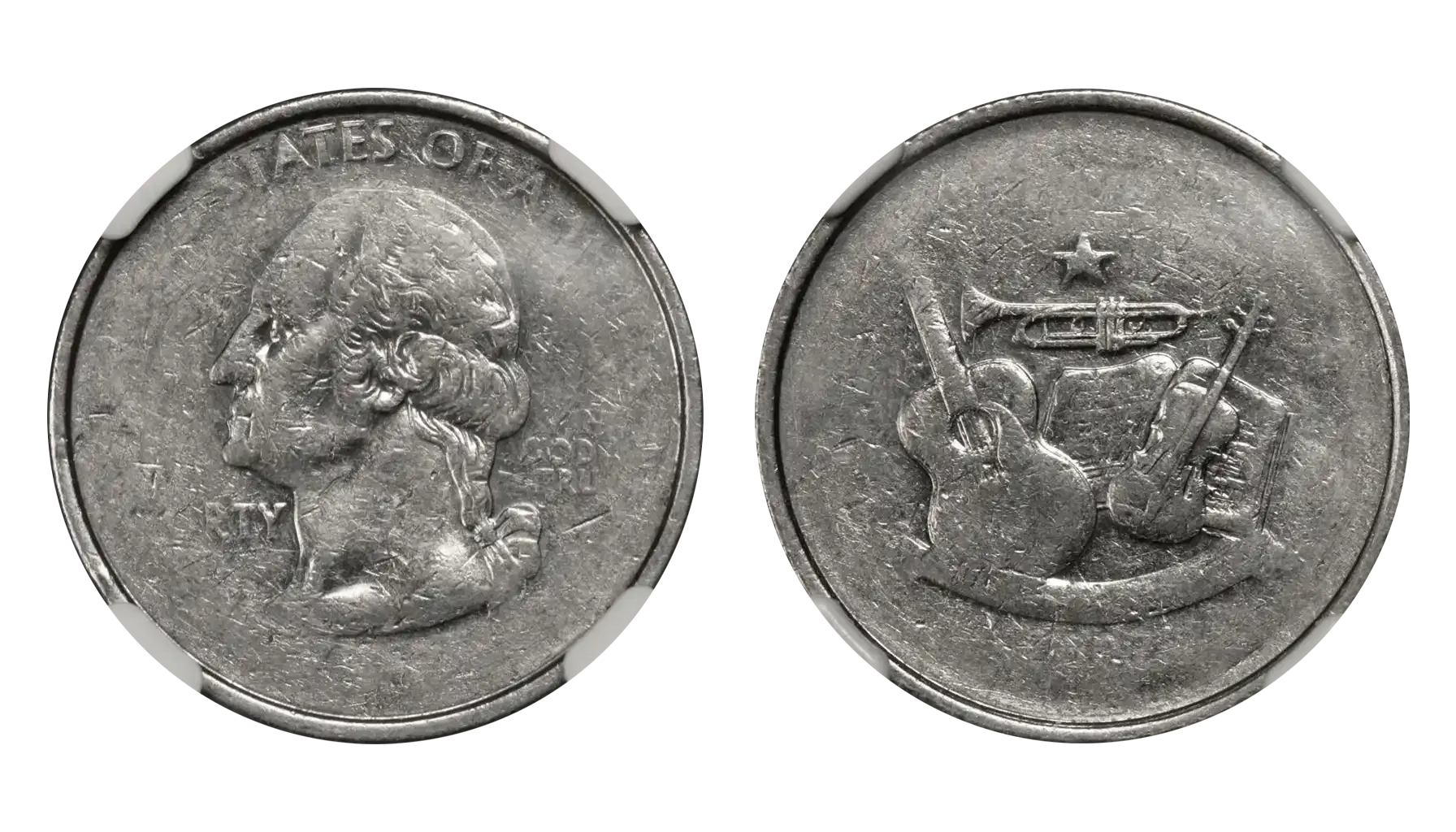
You can find the following 2002 Tennessee quarter errors:
Minor doubles on the musical instruments and lettering.
Repunched mintmarks (RPMs) on Denver (“D”) coins.
Small die cracks appearing near the trumpet, guitar strings, or stars.
Strikethrough designs, when elements from the obverse/reverse appear on the opposite side.
Many 2002 quarter Tennessee errors are usually subtle but can give you a coin worth over $20, even in mediocre condition.
How to Identify Tennessee Quarter Errors and Value
Some errors are easier to find, but the most valuable flaws could need a loupe to be found. Here is how you can find some of the errors we’ve covered:
Below are the most notable types of errors seen on 2002 Tennessee quarters:
Double Dies can appear on the obverse (DDO) or reverse (DDR). Doubling could appear on the letters in “Tennessee”, the instrument outlines, and the banner.
Repunched Mint Marks are easier to find. They look like a second outline on the Mint Mark. You will need a loupe and a reference picture with an authenticated “normal” coin.
Die Cracks look like raised lines or blobs of metal. You can turn the coin and look at it from the profile angle, where bumps are easier to see.
Strikethroughs appear as materials stuck under the metal: dust, grease. More often, you will see leftover traces. You will have to compare your coin's surface with the known “normal” variety.
Without the errors, a 2002 Tennessee quarter P, D, or S has these values:
Coin Variety | Condition | Estimated Value |
2001-P Business Strike | Circulated | ∼$0.25 |
Uncirculated (MS60–MS64) | ∼$0.75 | |
High Grade (MS65–MS66) | ∼$4 | |
2001-D Business Strike | Circulated | ∼$0.25 |
Uncirculated (MS60–MS64) | ∼$0.75 | |
High Grade (MS65–MS66) | ∼$4 | |
2001-S Clad Proof | Proof | ∼$7 |
2001-S Silver Proof (90% silver) | Proof | ∼$20 |
“S” quarters are the most desired in the line, coming from a small mitnage, and many have excellent eye appeal.
If you are a collector, a music lover, or a proud Tennessee citizen, maybe you should get this coin for yourself.

 Facebook
  X (Twitter)
  Pinterest
  LinkedIn