Contents:
A place named “The Ocean State” deserved a spot in the State Quarters program. Today, we will analyze the Rhode Island quarter: its varieties, errors, and values.
What Makes the 2001 Rhode Island Quarter Special
The Rhode Island quarter was the thirteenth release in the U.S. Mint’s 50 State Quarters Program, and it was issued in 2001. The year itself doesn't make the coin special, as there were other State releases in 2001 (for example, the 2001 Vermont quarter).
What is special about this coin is its mintage and design. The Rhode Island quarter was a high-mintage piece:
Philadelphia: 423,000,000.
Denver: 447,100,000.
San Francisco: 3,094,140 (clad proof), 889,697 (silver proof).
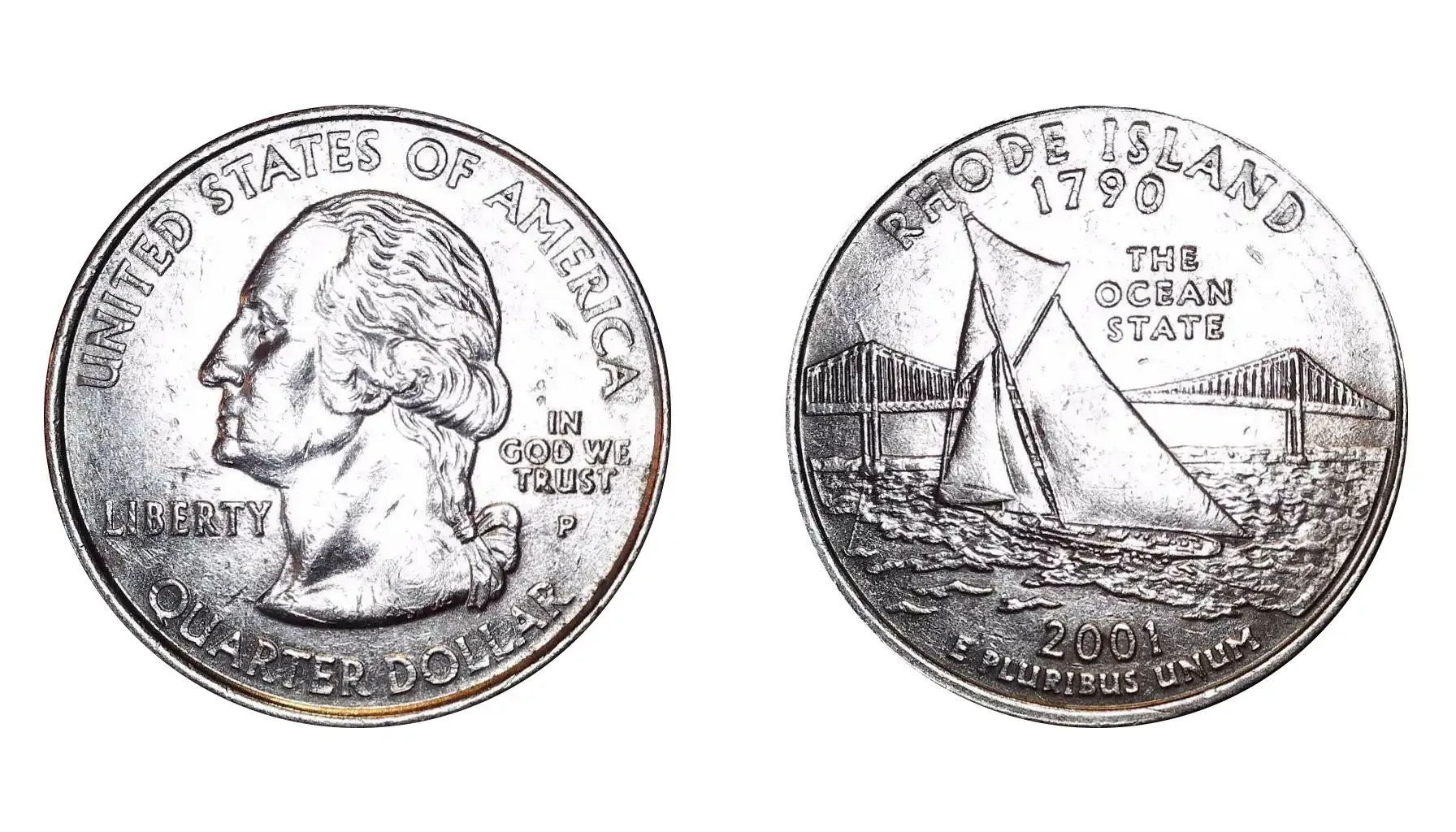
As for the design, the quarter focuses on the state’s coastal heritage.
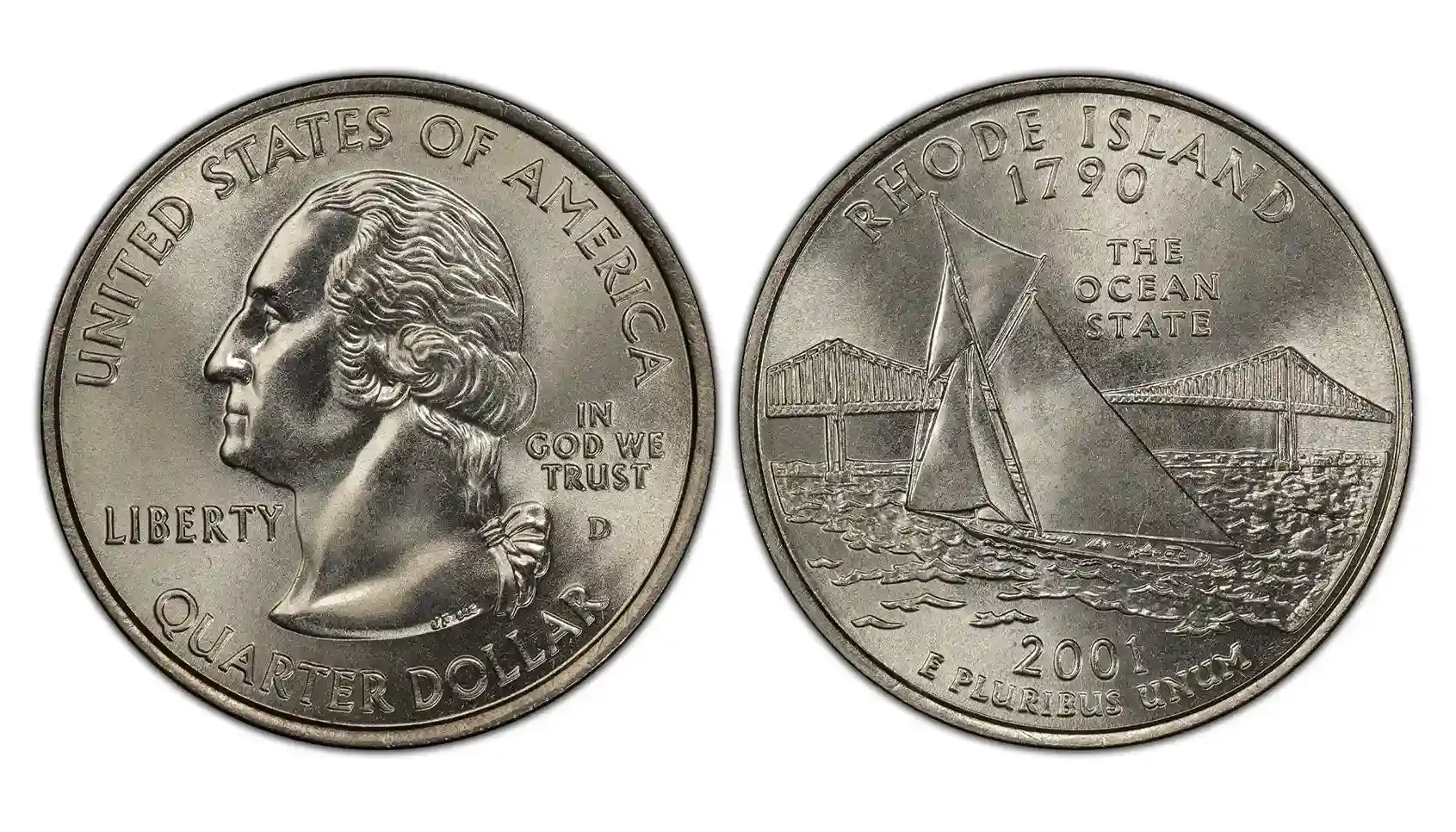
The front displays George Washington, created by artist John Flanagan. A generic design exhibited on all State Quarters (e.g., the Kentucky quarter from the same year).
The reverse has a sailboat sailing Narragansett Bay, with the Newport Bridge in the background (the bridge that connects Rhode Island with the mainland). This side was designed by Thomas D. Rogers Sr. The reverse also features a date, 2001.
"The postmark of May 21, 2001, Providence, Rhode Island marks the day that the Rhode Island quarters were first released to the Federal Reserve Bank and the public — certifying this limited edition and honoring America's Ocean State..."
— United States Mint
Official Website
2001 Rhode Island Quarter Error Types to Look For
As a high-mintage bit, this quarter is common. Gladly, errors are always a rare sight, so a coin with errors is often very valuable.
Here is a list of some possible Rhode Island 2001 quarter errors:
Off-Center Strikes: These errors occur when the coin is not properly aligned between the dies. A design portion is shifted to the side. Most off-center errors are only slight (10%–15%).
Die Cracks: An error when the coin has blobs (extra metal). Die cracks appear most often on the sailboat and the bridge.
Struck-Through Errors: The error happens when foreign material (grease, metal shavings) gets in the metal during striking. A minor error.
Double Die Errors (DDR/DDO): Some people report minor doubling cases. Lettering and bridge elements are doubled most often. This error is highly valuable.
Missing Clad Layer: In rare cases, the nickel coating can be missing on one or both sides, exposing the copper core. A very scarce and visually striking error.
How the 2001 Rhode Island Quarter Value Is Determined
For almost any coin, these factors determine its value:
Grade (Condition): Usually, coins can be circulated and uncirculated. Uncirculated bits, especially in high grades, are always more valuable.
Mintmark: San Francisco (“S”) coins are the most valuable, coming from a small mintage.
Error Presence: The more visible the errors, the more valuable the bit is.
Eye Appeal: Sharp coins with luster are in favor.
Market Demand: Commemorative coins are in demand every few years during anniversaries of the state they praise.
Coin Variety | Condition | Estimated Value Range |
2001-P Business Strike | Circulated | Face value ($0.25) |
Uncirculated (MS60–MS64) | $0.75 | |
High Grade (MS65–MS66) | ∼$5 | |
2001-D Business Strike | Circulated | Face value ($0.25) |
Uncirculated (MS60–MS64) | $0.75 | |
High Grade (MS65–MS66) | ∼$5 | |
2001-S Clad Proof | Proof | ∼$10 |
2001-S Silver Proof (90% silver) | Proof | ∼$25 |
Overall, the 2001 P quarter value is usually less than $1. The same goes for the 2001 D quarter value. In contrast, San Francisco coins are worth a lot of money too, primarily the silver versions.
In summary, the Rhode Island coin is an appropriate depiction of the state and what it's known for: the water, boats, and heritage.

 Facebook
  X (Twitter)
  Pinterest
  LinkedIn