Contents:
New Jersey. The third state to join the USA in 1787. One of the centers of the pharmaceutical industry. This beautiful state was also included in the State Quarters program. So, what do you know about the features of this coin?
1999 New Jersey Quarter Design Overview
Designers | John Flanagan, William Cousins and Alfred Maletsky | |
Weight | 5.67g (for regular strike) | |
6.30g (for silver version) | ||
Diameter | 24.30mm | |
Metal Content | 75% Copper, 25% Nickel (for regular strike) | |
90% Silver, 10% Copper (for silver version) | ||
Mints | Philadelphia | 363,200,000 |
Denver | 299,028,000 | |
San Francisco (proof) | 3,713,359 | |
San Francisco (silver) | 804,565 | |
The mintage for this specimen was quite large. The largest was from Philadelphia. However, this does not mean that these coins will be the cheapest.
Proof and Silver versions are also present. These were created specifically for collectors and were not part of general circulation. The same, by the way, can be observed with the 2000 Massachusetts Quarter.
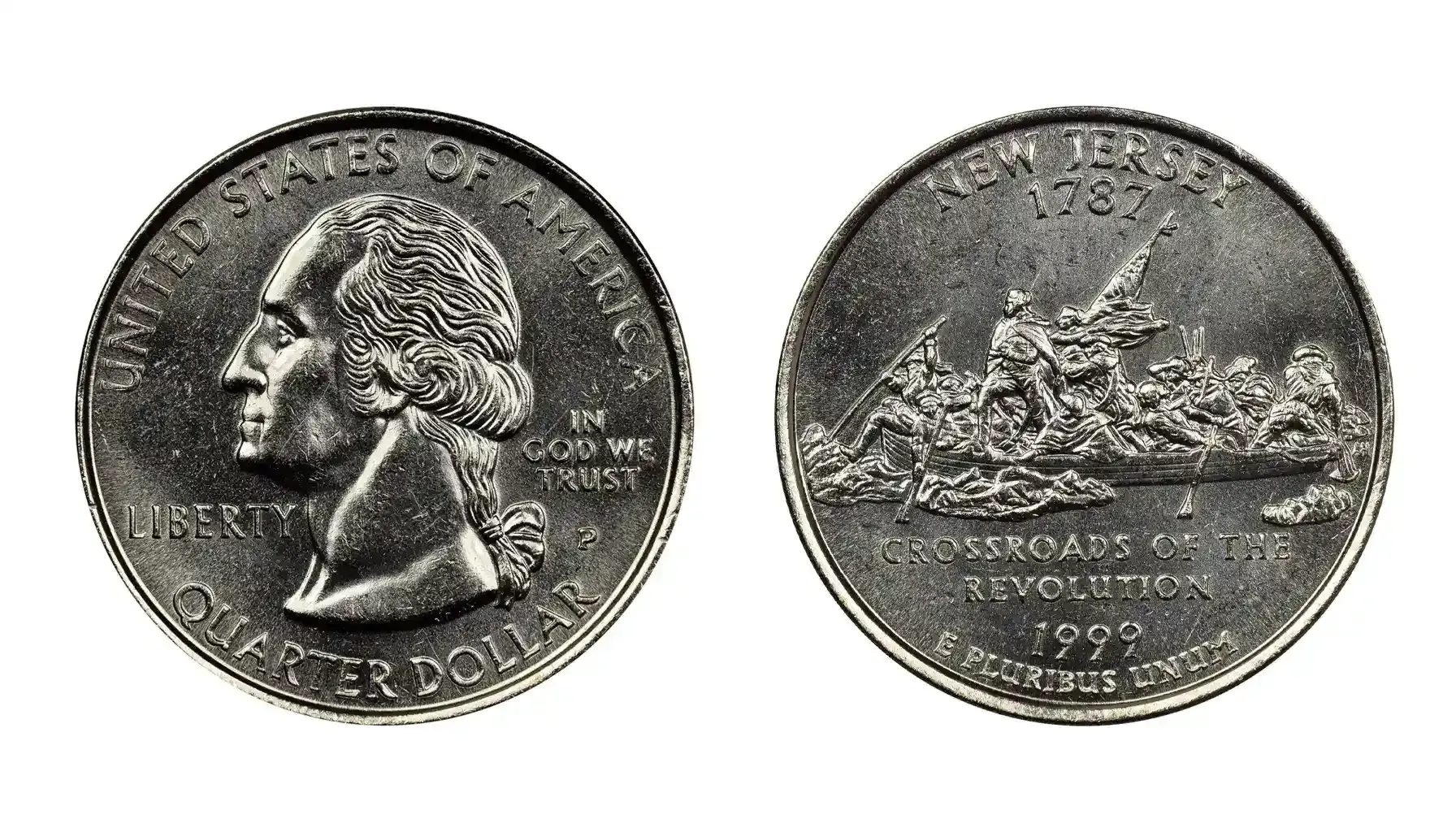
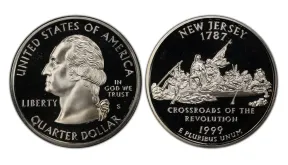
The obverse traditionally features George Washington, the first US president. The reverse of the New Jersey 1999 quarter depicts his troops crossing the Delaware River. This is depicted because the troops' crossing occurred in Trenton, New Jersey, on December 25, 1776.
Below the image are engraved the words Crossroads of the Revolution. The inscription is related to the fact that the state of New Jersey changed hands several times between warring nations during the War of Independence, which is why it earned this name.
1999 New Jersey Quarter Error List Highlights
Error Type | Price (from eBay) |
DDO/DDR | $1,000.00 |
Brockage and broadstruck | $1,749.97 |
Die Crack Error | $200 |
Multiple Errors | $1,000.00 |
Double Clip 7% | $93.99 |
Double Struck Both Off Center | $2,499.97 |
Heavy Grease Strike | $16.99 |
Double Die
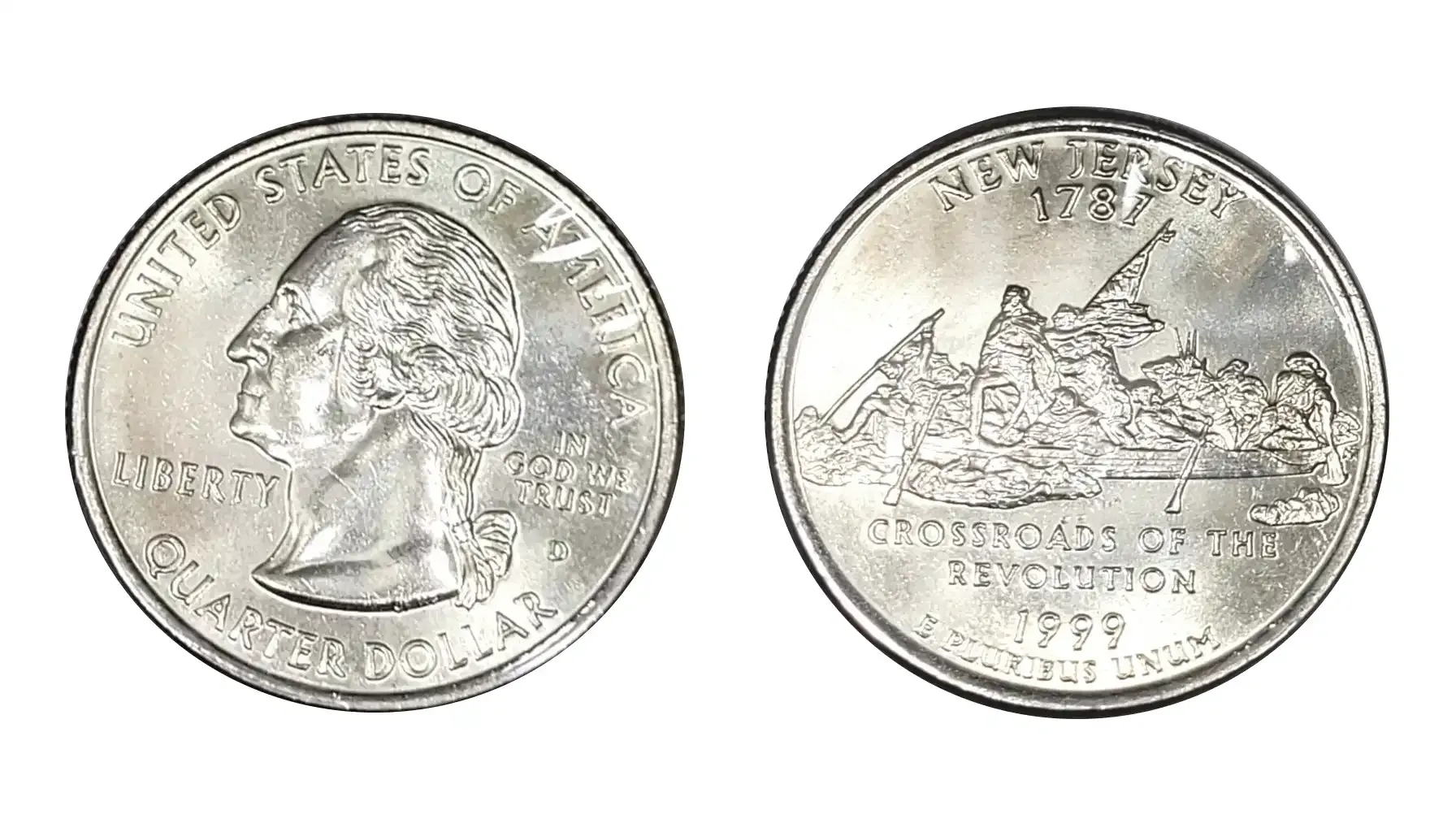
It's abbreviated to DDO or DDR
During manufacturing, the die experienced a shift or repeated manifestation of details. Therefore, on the coin, one part is depicted as doubled. Most often, these are letters, numbers, or portrait details, as in our case, the portrait of George Washington.
It's quite easy to distinguish. The doubling looks like clear, parallel lines, definitely not smeared. It differs from Mechanical Doubling, which is usually flat and has a rigid projection, not a distinct mirror.
Brockage
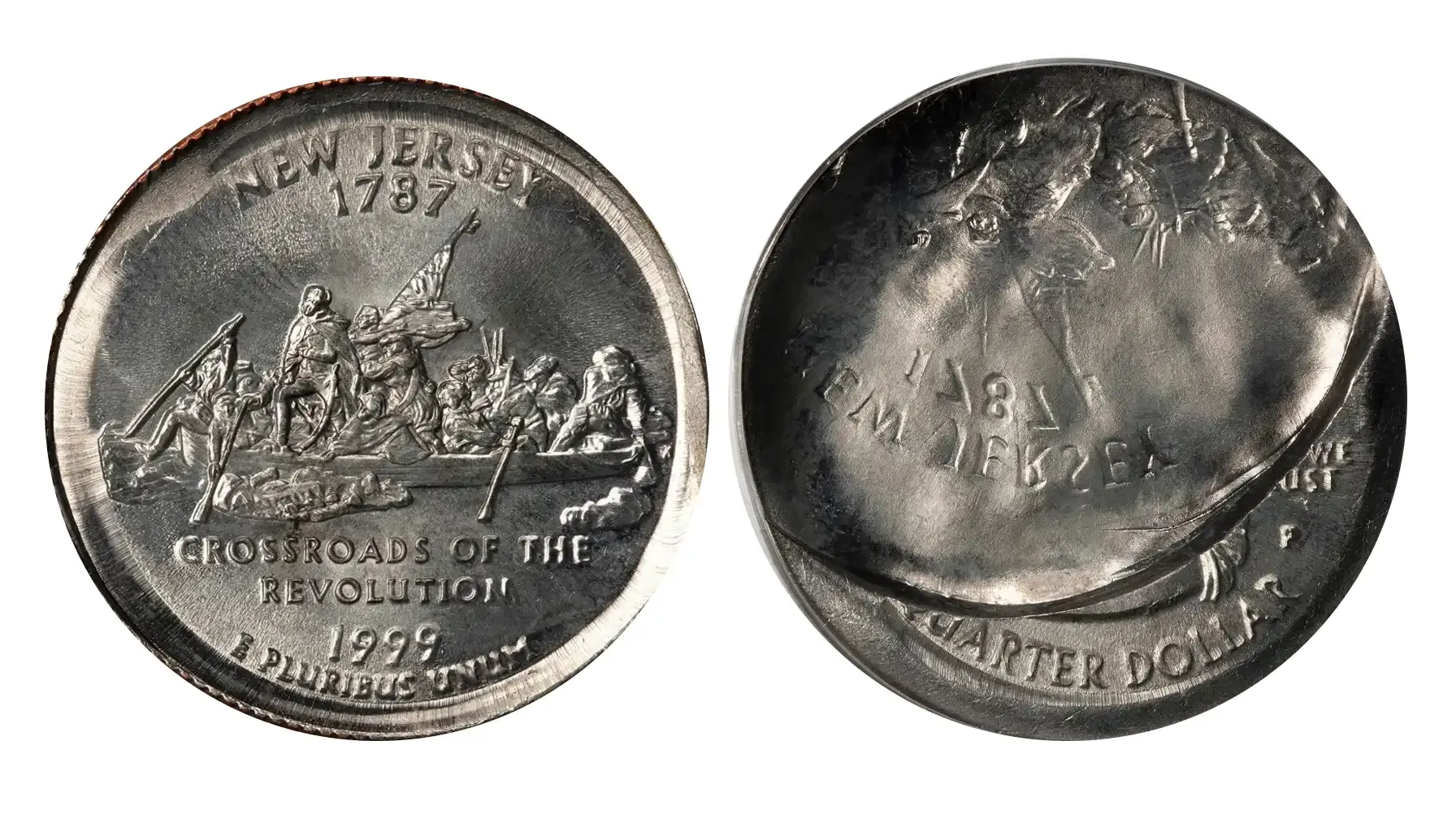
A broadstrike coin was struck without the retaining collar. As a result, the planchet stretched in diameter and became wider and thinner. Thus, such a coin has an enlarged diameter and may have indistinct edges and a stretched design.
Die Crack Error
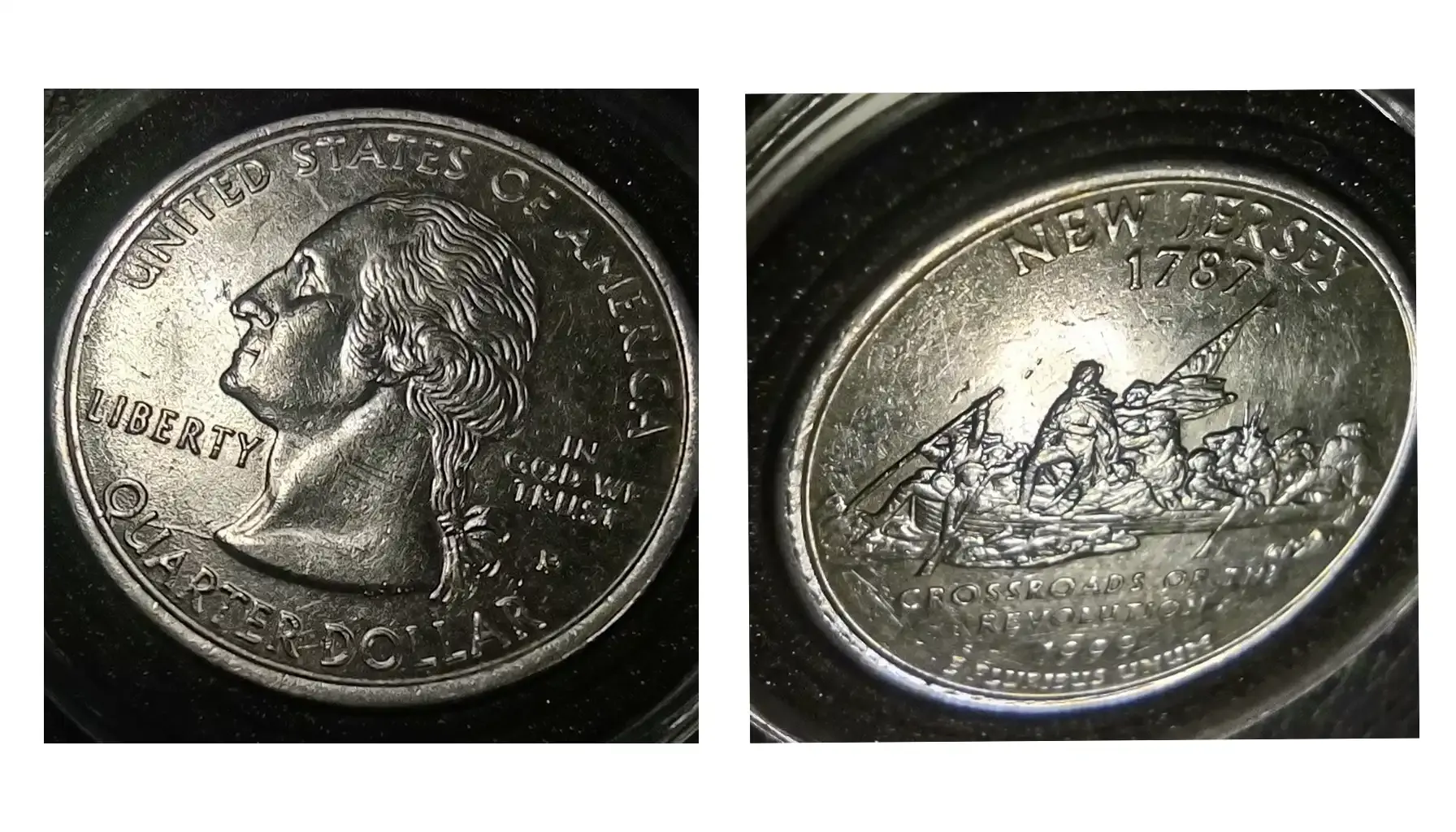
A die crack appears on the die, and during subsequent minting, it leaves a raised line on the coins, which is called a die crack line. This looks like a thin or thick raised line, often running across the portrait, fields, or inscriptions.
Multiple Errors
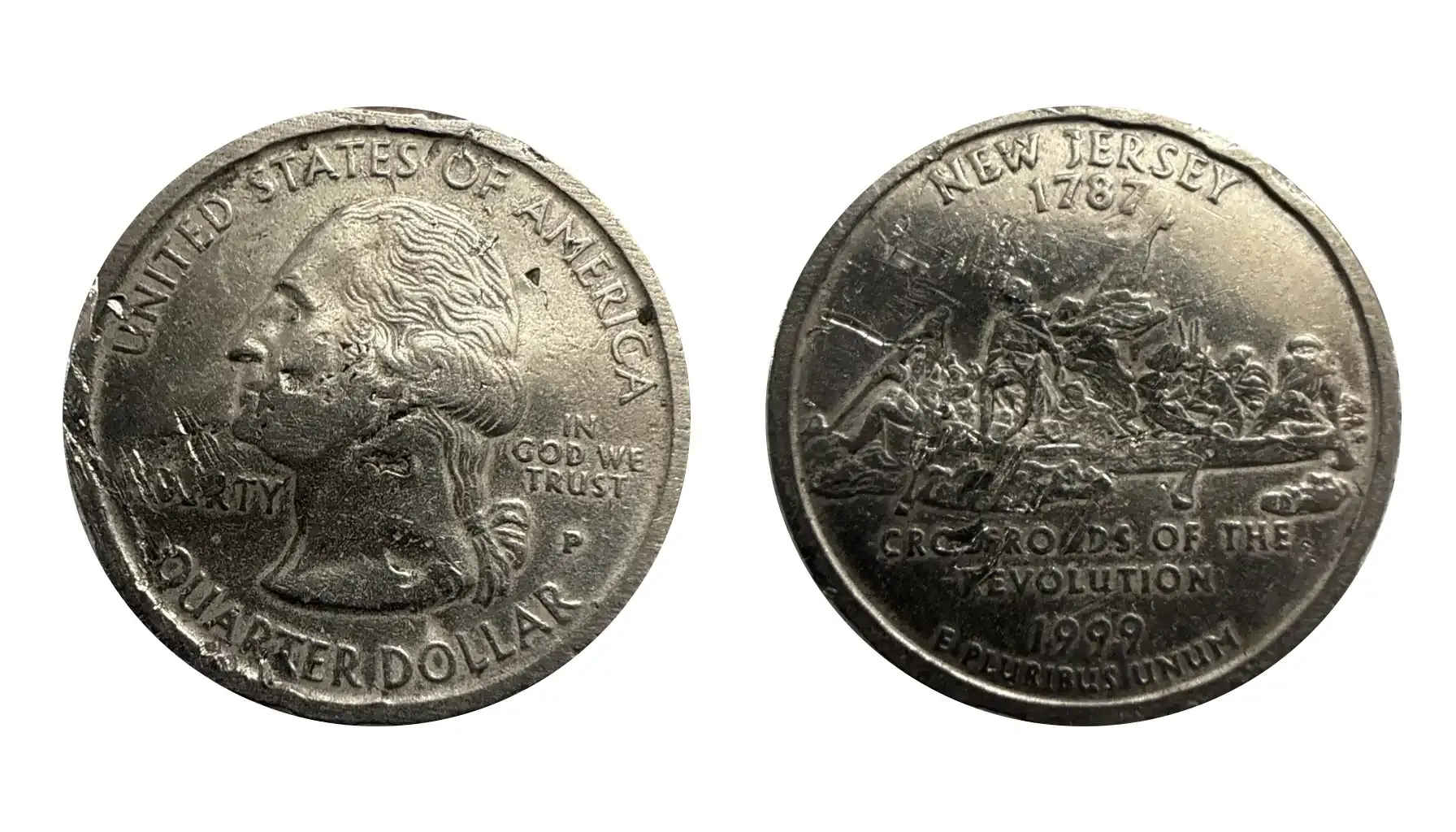
This is a combination of two or more errors, such as a double die and an off-center strike. Combinations of defects can increase value, and this is indeed a rarer variant. If you find such a specimen in the 1999 Connecticut State Quarter, you will likely gain significant value.
Double Clip
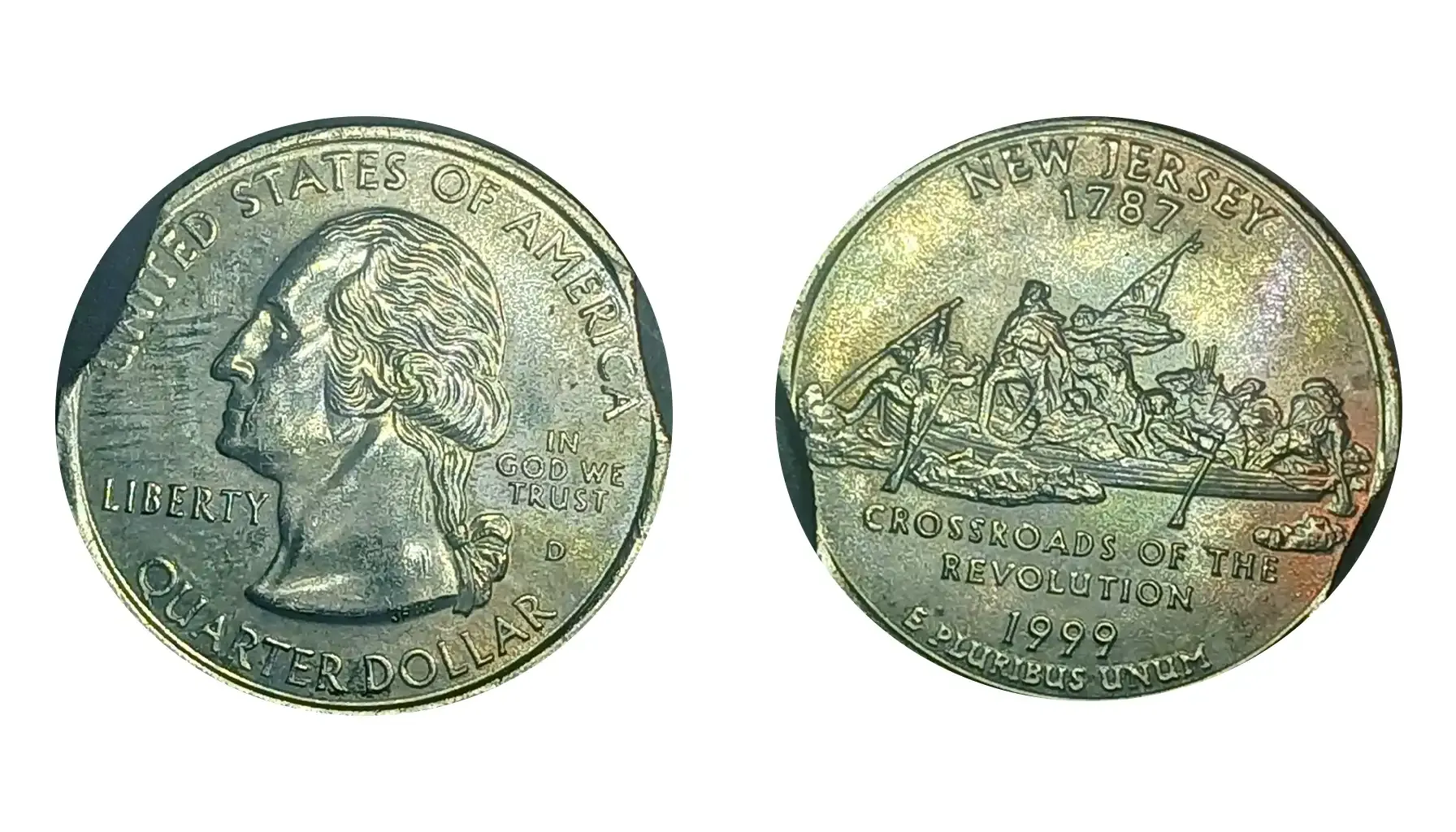
In the case of the State Quarter New Jersey, there is a 7% Double Clip. During planchet preparation, it might have been cut incorrectly or a part was missing, resulting in two skips.
This results in several clipped areas, sometimes symmetrical or varying in location. The percentage indicates how much is lost from the original reference coin.
Double Struck Both Off Center
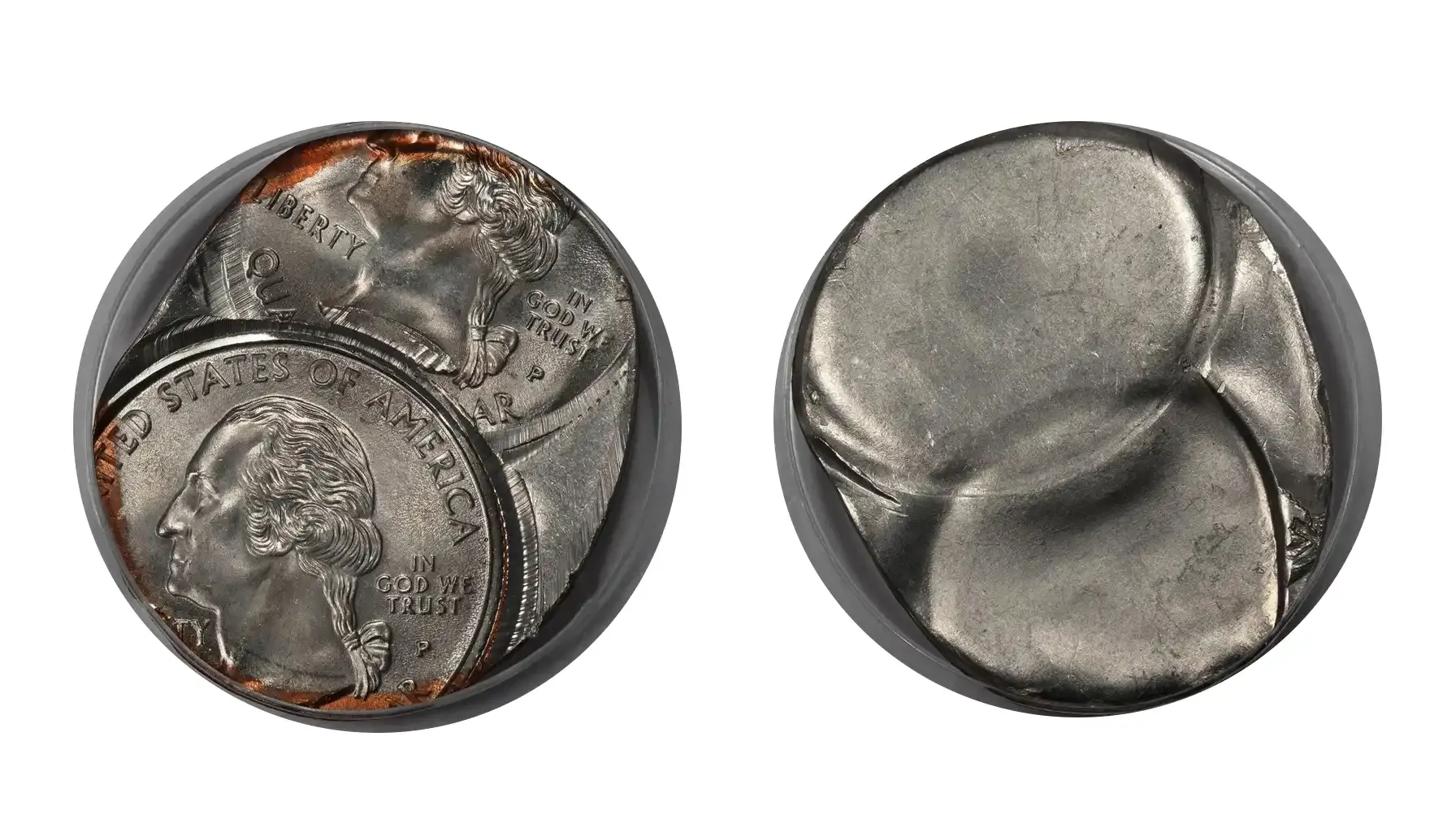
A planchet received two consecutive strikes from the coin press. In both instances, the center of the strike did not coincide with the center of the coin itself. This looks like two superimposed images, but with different offsets.
Both images are partially visible, contour duplications appear, but it's clear that something is amiss. This is also measured in percentages. The higher the percentage, the higher the value.
Heavy Grease Strike
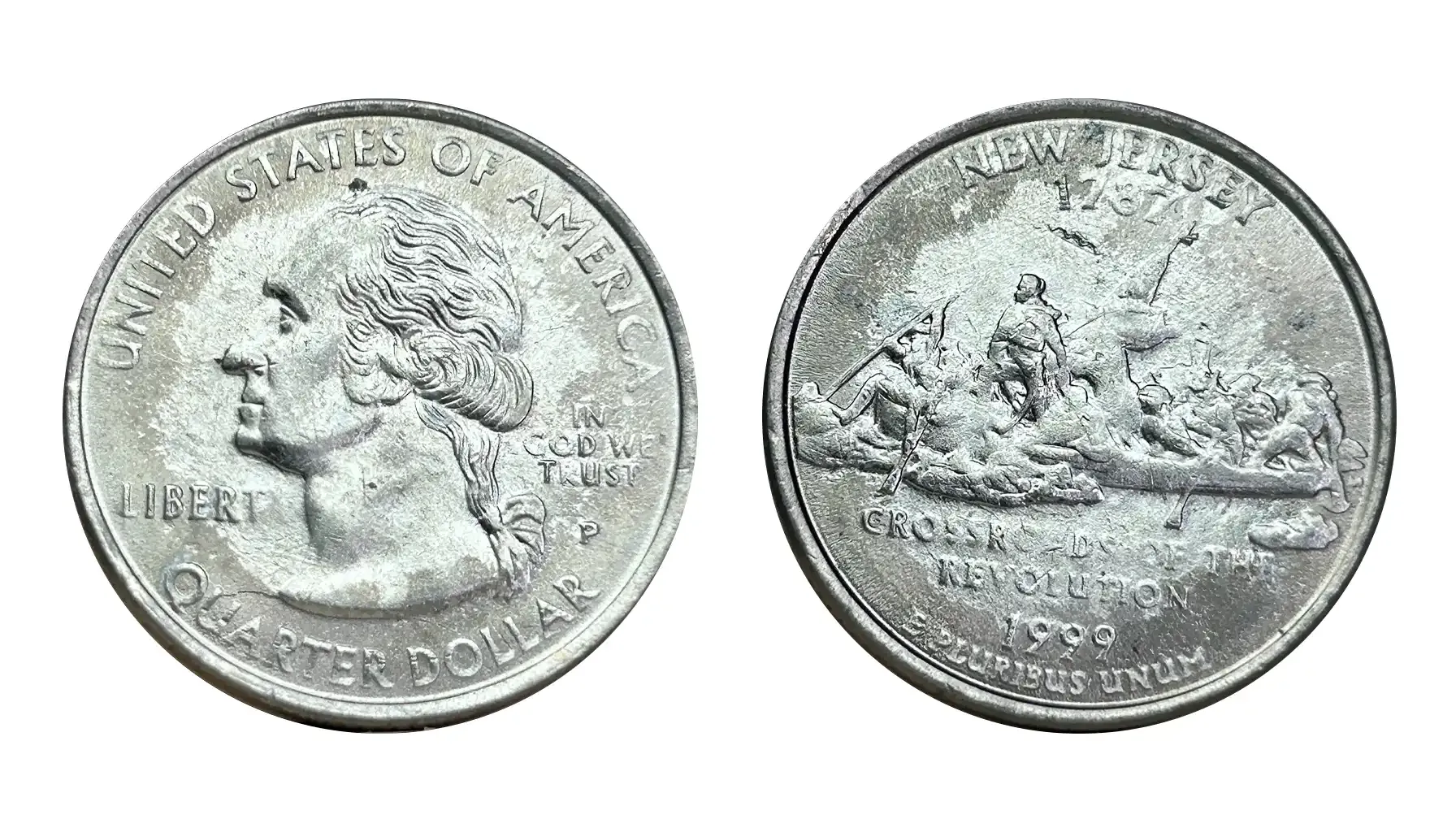
The die during the minting process was partially clogged with grease, dirt, or anything else. Because of this, the metal of the planchet did not capture the impression of the die, resulting in blurry or weak details. That is, it looks slightly dirty or does not entirely clear design elements.
Well, the most valuable New Jersey State Quarter Errors turned out to be Double Struck Both Off Center, and Brockage and broadstruck.
These are truly valuable specimens, and we would recommend purchasing them if you are considering interesting error varieties. DDO and Multiply Errors are also quite valuable.
1999 New Jersey Quarter Value Guide
Grade | P Regular Strike | D Regular Strike | S Proof |
60 | $0,50 | $0,50 | $5 |
62 | $1 | $1 | $6 |
63 | $2.5 | $2.5 | $7 |
64 | $5 | $5 | $8 |
65 | $7.5 | $7.5 | $8 |
66 | $12.5 | $12.5 | $8 |
67 | $45 | $70 | $8 |
68 | $315 | $685 | $8 |
69 | - | - | $11 |
70 | - | - | $30 |
Thus, from the regular strike, specimens from Denver turned out to be the most valuable. And we recommend them if you want to acquire something from the regular strike. Pay attention to grades 67 and 68 from Denver, as well as grade 68 from the Philadelphia Mint.
Also, consider the Proof issue in MS-70 grade. In any case, it is still benchmark quality. And if you want something more unusual and valuable, pay attention to the 1999 New Jersey quarter error list with pictures.

 Facebook
  X (Twitter)
  Pinterest
  LinkedIn