Contents:
- How Much Is a 1994 Quarter Worth Today?
- 1994 Quarter Value Chart
- Is a 1994 Quarter Worth Anything in Circulation?
- Rare 1994 Quarter Errors List
- How to Identify a 1994 Quarter Error
- What Makes a 1994 Quarter Valuable?
- 1994 Quarter No Mint Mark: Does It Exist?
- Where to Buy or Sell 1994 Washington Quarters
- FAQs About 1994 Quarter Value
To be honest, most 1994 specimens in daily circulation have a $0,25 value. But who knows how lucky you are.
So, how much is a 1994 P quarter worth? And, moreover, how to identify these coins?
Spoiler: Professional grading services identify exceptional pieces reaching values hundreds of times higher than their face amount.
Parameter | Value |
Metal Content | 75% Copper, 25% Nickel |
Mass | 5.67 grams |
Diameter | 24.26 mm |
Designer | John Flanagan |
Edge | Reeded |
How Much Is a 1994 Quarter Worth Today?
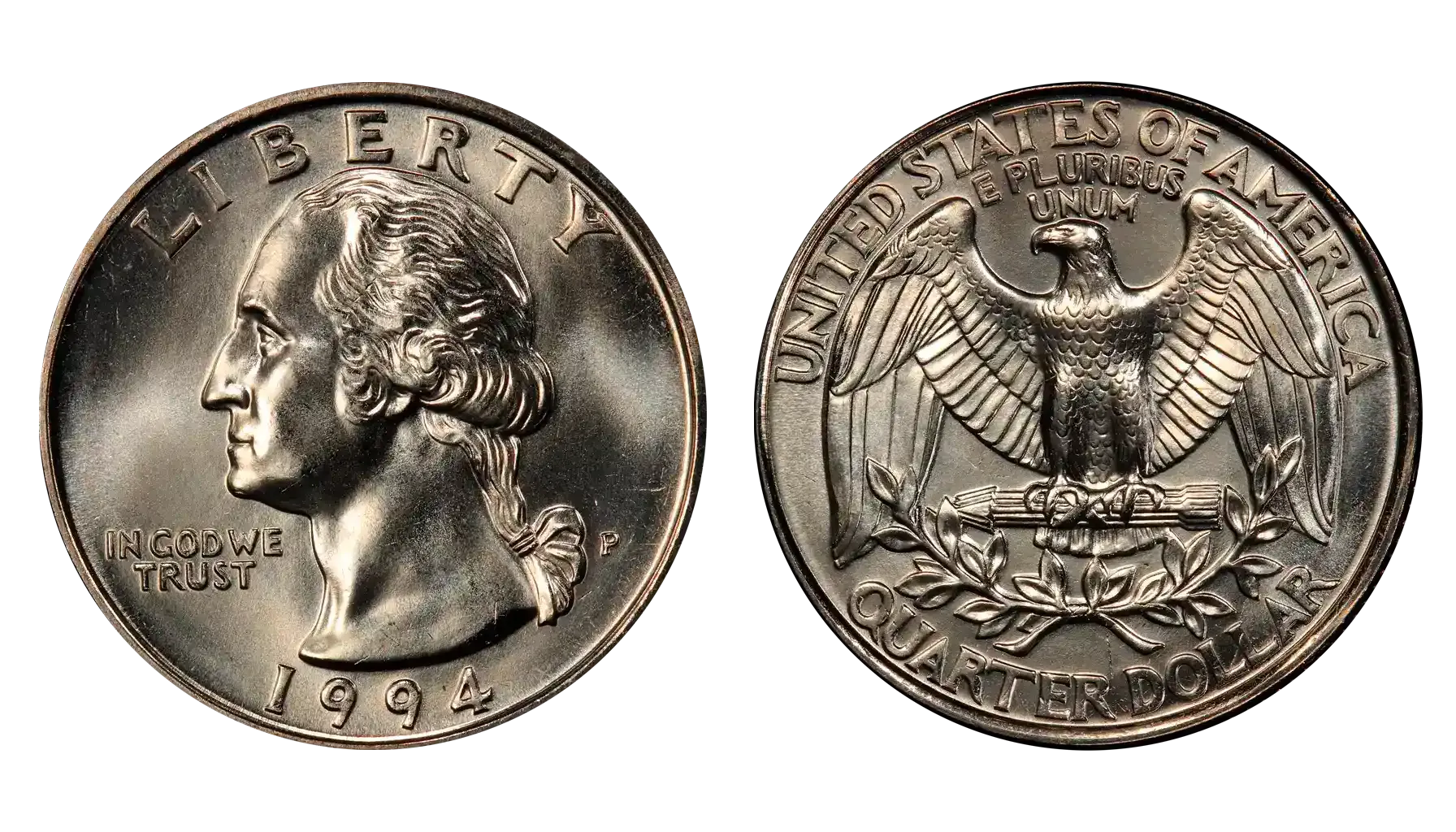
Market pricing for any 1994 coin depends heavily on its numerical grade according to the Sheldon scale.
Standard coins from the Philadelphia P and Denver D mints in MS63 condition generally sell for $1.00.
Reaching a higher MS65 grade pushes, for example, the 1994 P quarter value, toward a range of $5.00 to $10.00.
Specimens kept in exceptional MS67 condition appear rarely and command prices starting from $50.00.
Auction records from early 2026 show that coins in MS68 condition frequently exceed $550.00. Annual price growth for top-tier 1994 quarters consistently averages between 3% and 5%.
San Francisco S mint coins were created exclusively for collector sets and never entered general circulation. Base metal Proof quarters from this year typically trade for $4.00 to $7.00.
Silver Proof versions from 1994 S currently hold a value between $20.00 and $35.00 depending on mirror clarity, yes, a bit more than the 1994 quarter value P.
1994 Quarter Value Chart
Coin Condition | 1994 P | 1994 D | 1994 S Proof | 1994 S Silver Proof |
MS63 / PR63 | $0.25 | $0.25 | $4.00 | $20.00 |
MS65 / PR65 | $5.00 | $5.50 | $7.00 | $25.00 |
MS67 / PR67 | $55.00 | $50.00 | $15.00 | $45.00 |
MS68 / PR69 | $600.00 | $475.00 | $30.00 | $75.00 |
MS69 / PR70 | — | — | $165.00 | $385.00 |
Prices represent coins certified by professional grading companies like PCGS or NGC.
Is a 1994 Quarter Worth Anything in Circulation?
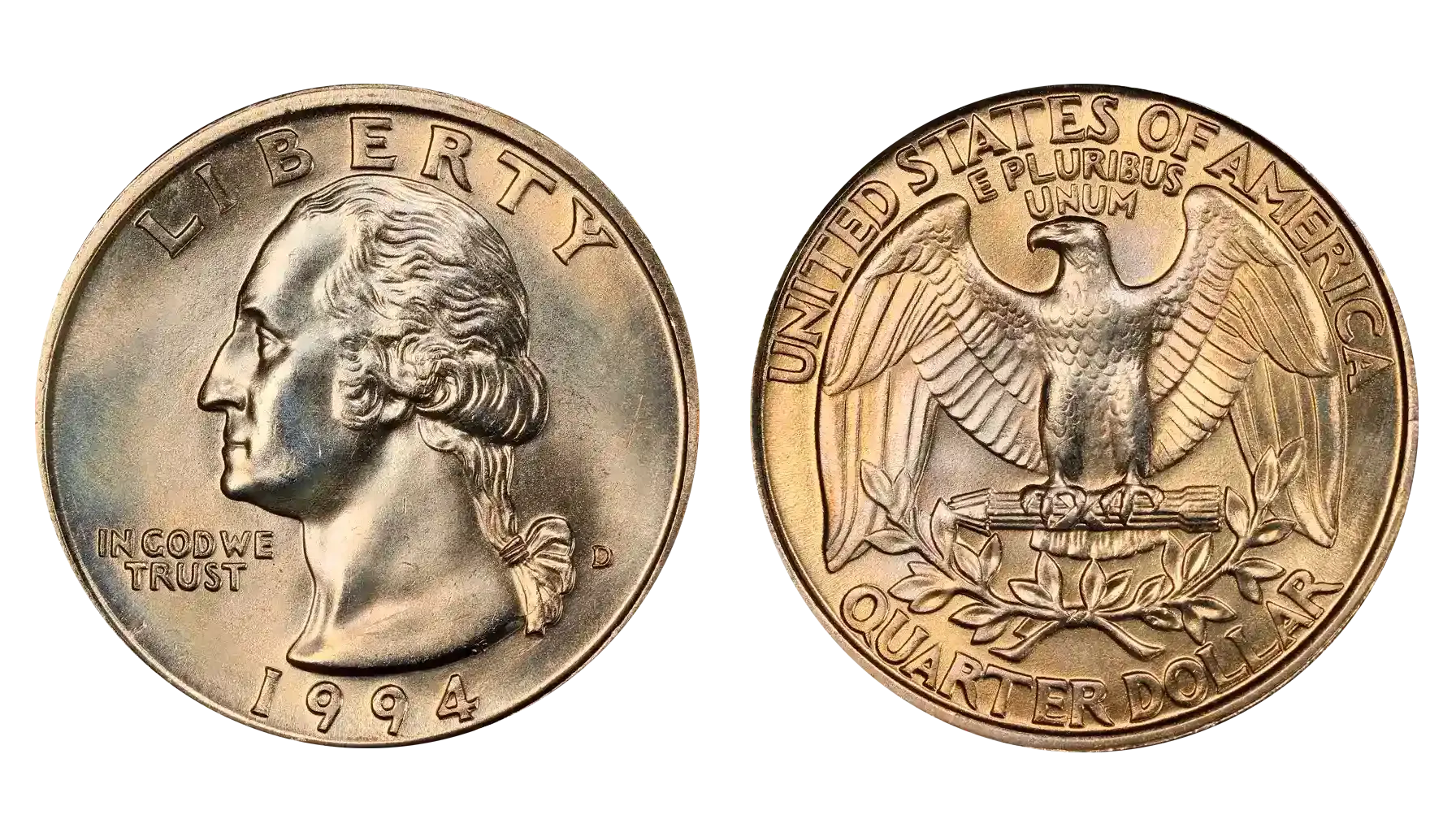
Such physical damage reduces their numismatic appeal to zero for serious investors.
Visible flattening of the relief → valuation at face value.
Total loss of original mint luster → lack of interest from professional coin dealers.
“... if you look at 1998 prices for many Washington quarters they were in the case of dates like the 1985-D, 1994-P and a host of others in the $1-$2 range, yet these dates and many others are now at least $15 in MS-65.”
— Paul M. Green, writer, the winner of numerous Numismatic Literary Guild awards
Numismatic News
Ordinary 1994 P Washington quarter pieces without errors remain worth exactly 25 cents in any retail transaction.
Rare 1994 Quarter Errors List
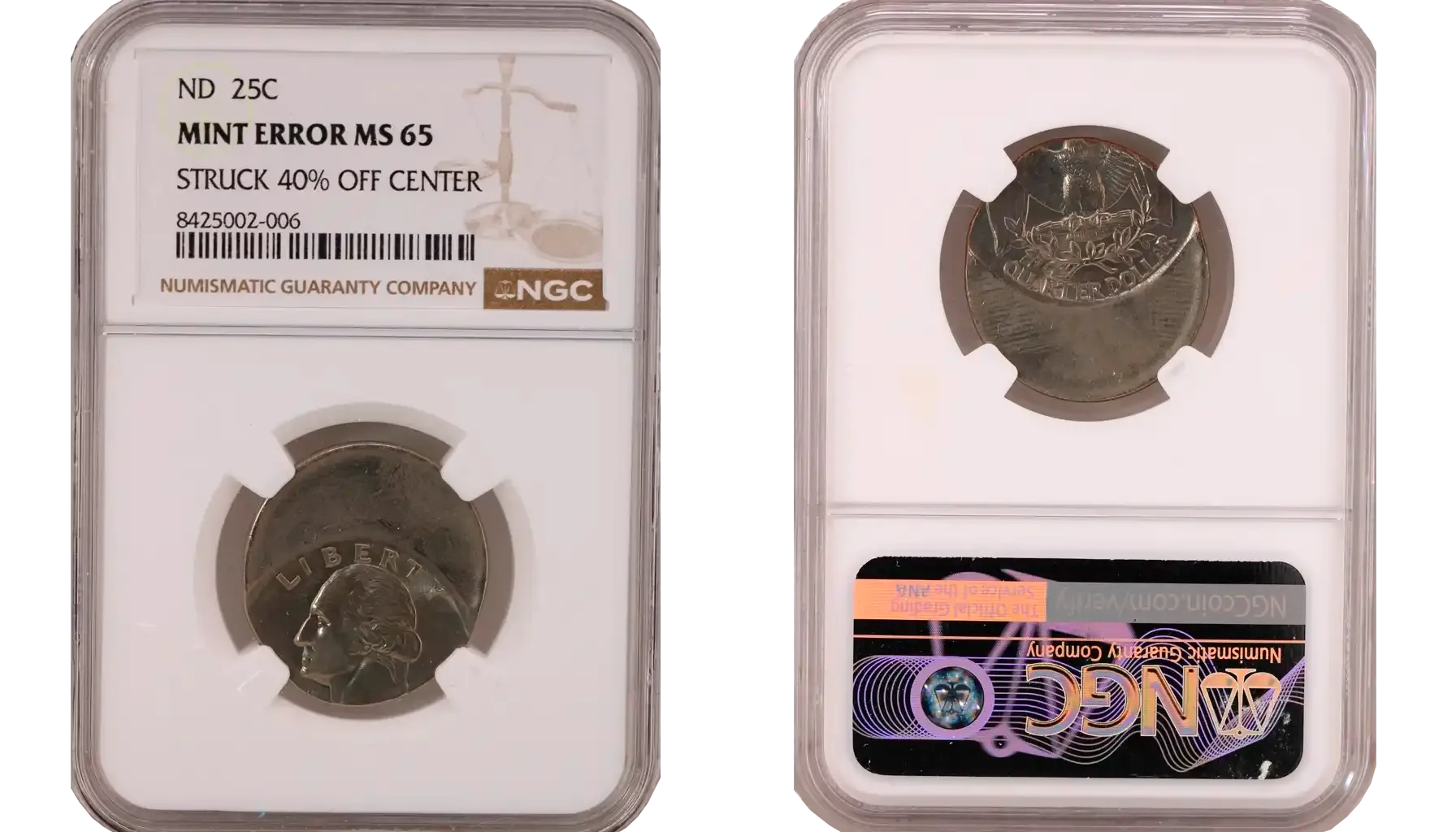
Production 1994 P quarter errors occur infrequently, making them highly sought after.
Confirmed 1994 quarter error list includes the following specific categories:
Off-Center Strike: The image appears shifted away from the center, leaving part of the copper-nickel planchet blank.
5-10% shift → price $15.00-$30.00
50% shift with a visible date → price $150.00-$300.00
Broadstruck: The machine strikes the coin without the restraining collar, resulting in a wider and thinner diameter.
Average prices for these pieces range from $35.00 to $75.00
Double Die: A rare hubbing error creating slight doubling on letters or digits.
1994 examples show very faint doubling, keeping prices around $25.00
Die Cracks: Raised lines appearing on the surface caused by a fractured steel die.
Small cracks add roughly $5.00 to $15.00 to the total 1994 D quarter value, for instance.
Clipped Planchet: The coin features a concave missing section shaped like a crescent moon.
Value fluctuates based on the clip size, usually between $35.00 and $85.00
How to Identify a 1994 Quarter Error
To identify a genuine error, you need a focused inspection using a high-powered magnifying glass. The first essential step is checking the weight on a precise digital scale.
A weight significantly lower than 5.67 grams often suggests a thin planchet or clip error. You can reveal plating issues or mechanical tampering by examining the edge of the coin.
Missing ridges on the reeded edge might indicate a broadstruck error or post-mint damage from a grinder. A magnet test proves useful since authentic quarters should never stick.
Extra thickness in the words LIBERTY and IN GOD WE TRUST helps spot Double Die varieties.
Comparing a suspect coin against a high-quality Proof sample helps reveal subtle relief anomalies.
What Makes a 1994 Quarter Valuable?
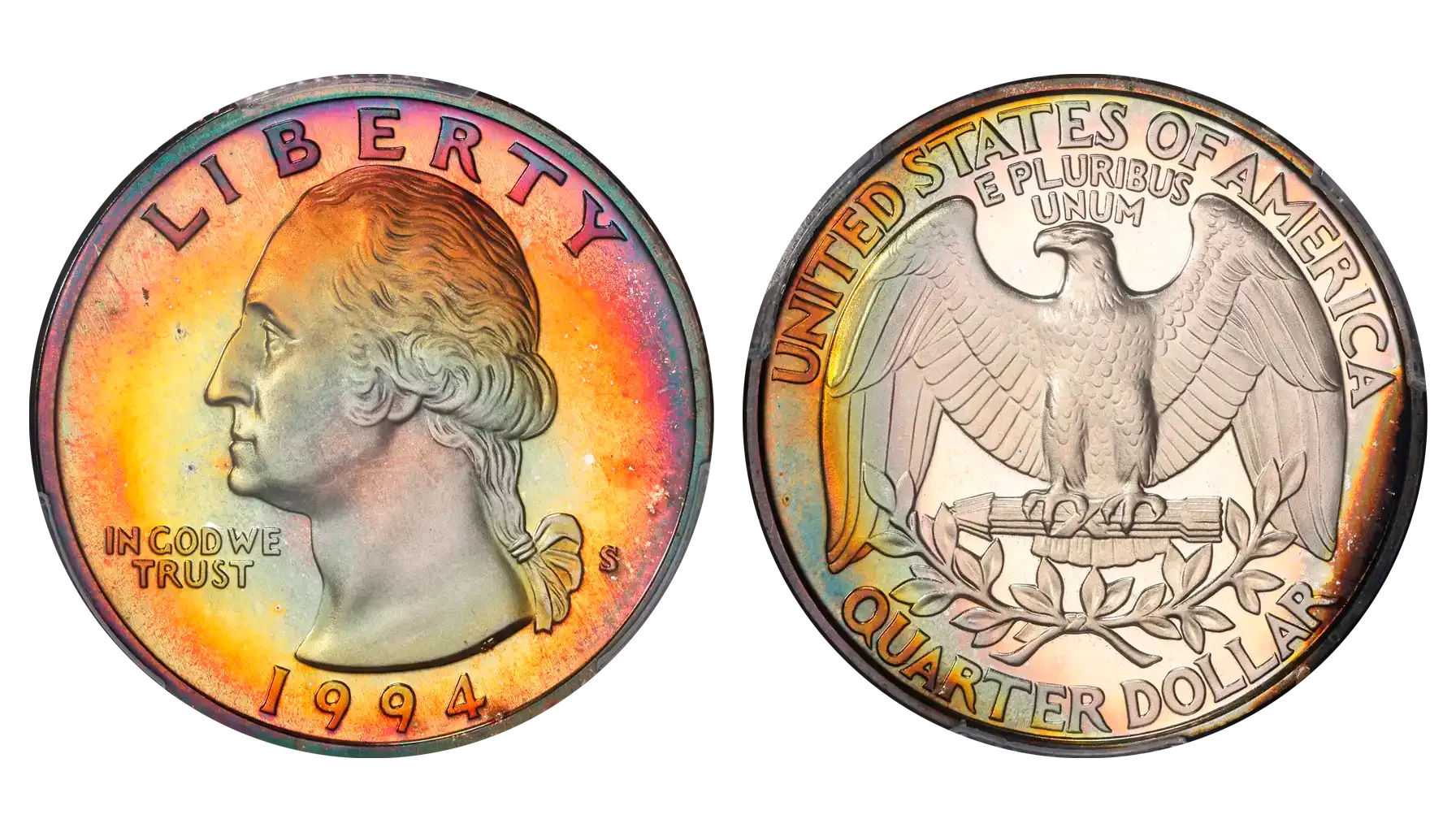
Surface quality defined as Gem Uncirculated remains the primary driver of high market prices.
Finding a perfect coin field free from microscopic marks is extremely difficult for 1994 production runs.
Key pricing factors:
Presence of vibrant mint luster
Absence of contact marks from coins hitting each other in shipping bags
Sharpness of detail in Washington’s hair and the eagle’s feathers
Rarity of a specific documented striking error
A record price for a 1994 quarter P specimen occurred in a recent high-profile auction. A coin graded as MS67+ sold for a sum exceeding $650.00.
Statistics indicate that the population of 1994 quarters in MS68 grade remains in the single digits for each mint.
1994 Quarter No Mint Mark: Does It Exist?
Many people encounter 1994 quarters lacking a visible letter on the front side.
Missing mint marks on coins from this specific year do not count as intentional varieties. Philadelphia used no marks before 1980, but every 1994 coin from that facility should have a P.
Lacking a mark usually results from one of these three factors:
A die filled with industrial grease preventing the letter from being pressed into the metal.
Severe circulation wear that erased the small letter over thirty years.
Intentional mechanical removal by a person trying to create a fake rarity.
A 1994 P quarter with a missing mark due to a grease-filled die typically sells for $5.00 to $12.00.
Common technological glitches like this do not make the coin a unique national treasure.
Standard issues for this year must display either a P or a D to be considered normal, but if you want to make money — just check the 1994 D quarter error list with pictures to know what to look for.
Where to Buy or Sell 1994 Washington Quarters
Selecting the right platform for trading coins significantly impacts the final financial return. Selling circulated 1994 quarters through major auction houses is illogical due to high listing fees.
Recommended channels for transactions:
Heritage Auctions: Ideal for coins holding a grade of MS67 or higher and major 1994 Quarter Errors with pictures.
eBay: Best for trading slabbed coins and mid-tier striking defects. You can see many actual specimens in the 1994 P Quarter Error List With Pictures.
Local Coin Shops: Suitable for quick sales at prices slightly below the wholesale market.
- Numismatic Forums: Trading directly with other hobbyists avoids expensive third-party commissions.
Prioritizing coins certified by NGC or PCGS protects buyers from losing money.
Remember: Buying uncertified coins carries the risk of encountering cleaned surfaces or hidden damage.
Verifying the certification number on the official grading service website is a mandatory step before payment.
FAQs About 1994 Quarter Value
Are there any 1994 quarters worth money?
Yes, coins in MS67 condition or higher and 1994 S Silver Proof versions carry significant market premiums. Specimens featuring verified major striking errors also trade for amounts far above their face value.
What's special about a 1994 quarter?
This year represents the final era of the classic eagle reverse design before the 50 States program began.
What is the error on a 1994 D quarter?
The most frequently documented error for the 1994 Denver mint is the Broadstruck strike. Collectors also find coins with die cracks on the back near the eagle's wing tips.
Is a 1994 quarter silver?
Standard 1994 P and 1994 D quarters contain only copper and nickel. Only special 1994 S Silver Proof coins found in annual prestige sets consist of 90% silver metal. Checking the edge for a solid silver color without a copper stripe confirms the silver content.
How many 1994 quarters were made?
The total mintage exceeded 1.7 billion coins: 825,000,000 from Philadelphia, 880,034,958 from Denver, and about 3.3 million from San Francisco + Proofs.
What are the errors on a 1994 quarter?
Major errors include off-center strikes, clipped planchets, and detached plating layers. Rare examples showing double strikes or coins struck on the wrong metal blanks also exist.
What's special about a 1994 quarter?
The 1994 series stands out for having consistently high strike quality at the Denver facility.
What is a 1994 quarter worth?
Values range from $0.25 for a basic coin to $650.00 and up for museum-quality specimens.

 Facebook
  X (Twitter)
  Pinterest
  LinkedIn