Contents:
1991 is a remarkable year for the JFK series. Compared to other issues, this one had a slightly lower overall mintage, and currently it is relatively scarcer than other years. If you are completing the whole JFK set, you should identify rare coins of this kind quite well and understand the general price range for them. Let’s start learning nuances!
1991 Kennedy Half Dollar: Specifications and Mint Marks
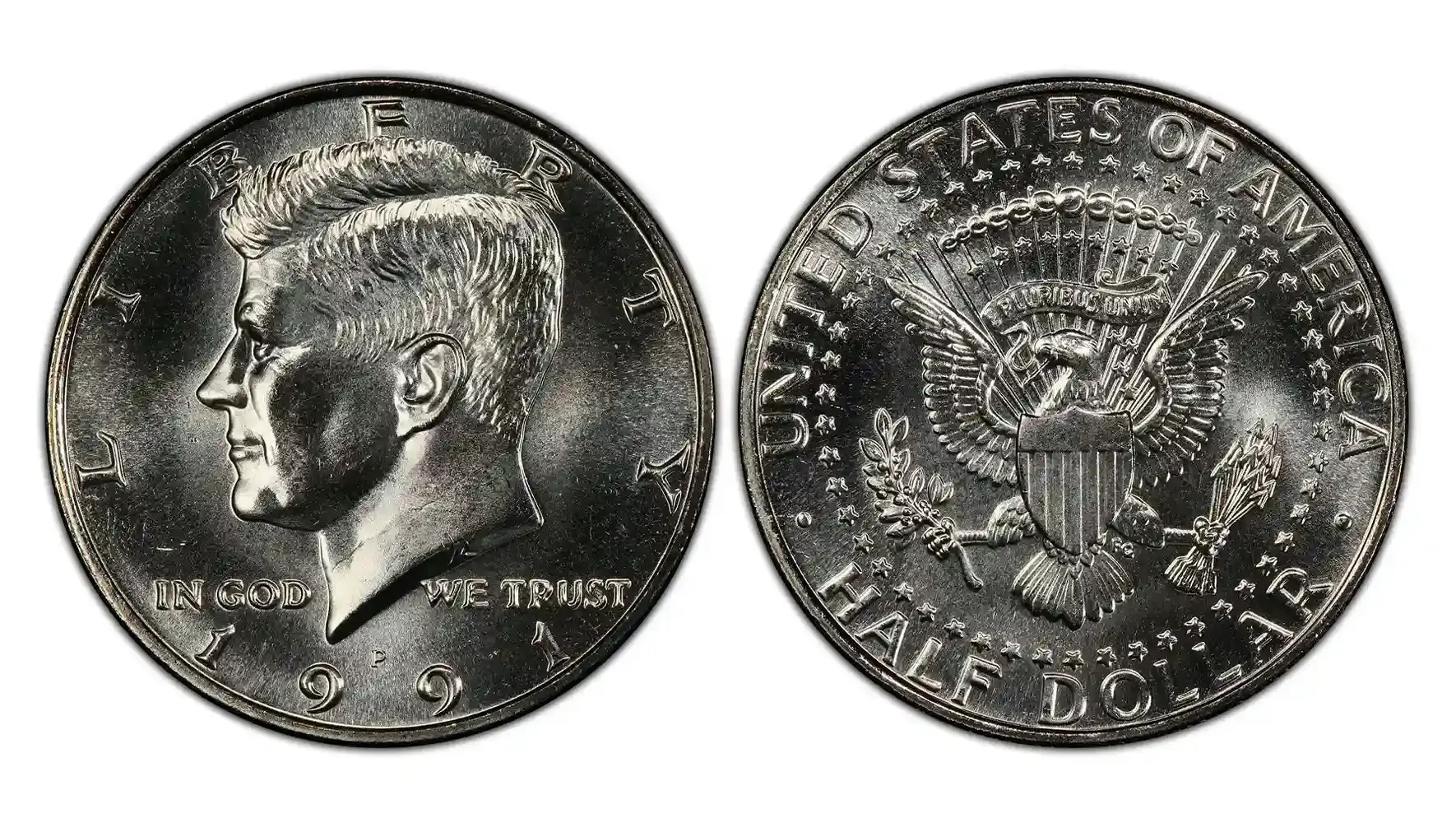
To avoid counterfeits and overpriced examples, train your eye and remember key characteristics of a coin we are studying today. While the JFK coin is not as old as the Barber half dollar and other issues, it still can be faked, so educating yourself is crucial.
Technical Specifications of the 1991 Half Dollar Coin
Diameter: 30.61 mm
Weight: 11.34 grams
Composition: Copper-nickel clad (outer layers 75% copper, 25% nickel bonded to a pure copper core)
Edge: Reeded, 150 ridges
Metal content: 91.67% copper, 8.33% nickel
Designers: Gilroy Roberts (obverse) and Frank Gasparro (reverse)
Face value: 50 cents (USD)
Understanding 1991 Half Dollar P and D Mint Marks
The 1991 Kennedy Half Dollar was struck at two major facilities:
Philadelphia (no mint mark): The most common issue, responsible for nearly half of the year’s total mintage.
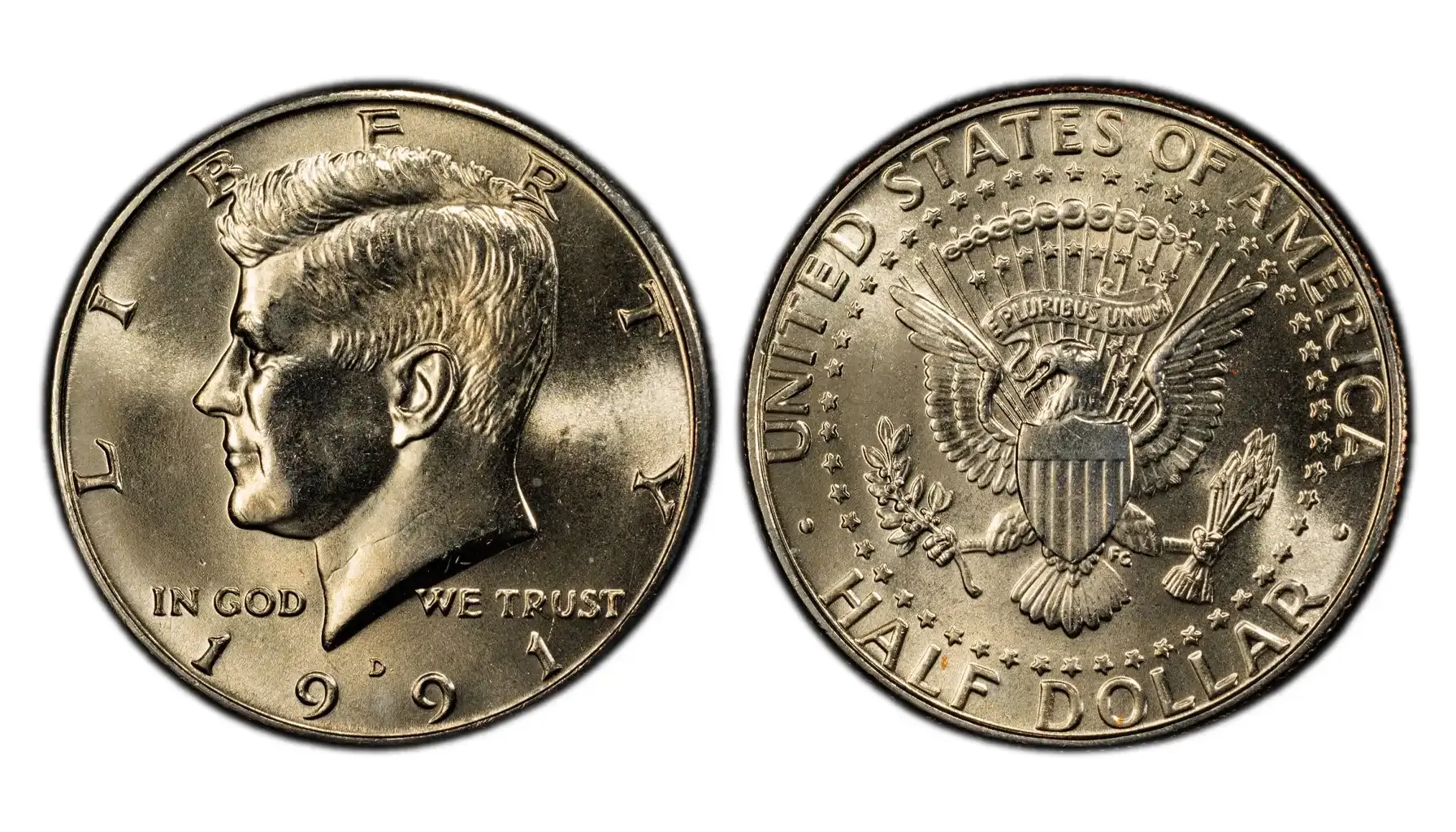
Denver (“D” mint mark): Found beneath Kennedy’s neck on the obverse side. Slightly scarcer in high mint-state condition but widely available.
No special mintmark placement changes occurred that year, but collectors prize clearly struck mintmarks on uncirculated specimens.
Silver Content and Composition
Unlike its 1964 counterpart and some other half dollar varieties, the 1991 half dollar contains no silver. It is fully copper-nickel clad, making its intrinsic metal value minimal. Its appeal lies in design precision, condition rarity, and proof aesthetics rather than bullion worth.
Notable 1991 Kennedy Half Dollar Varieties
While all circulation coins are common, this year has some proof and error varieties that attract collectors. Proofs from San Francisco were minted with specially polished dies, creating reflective fields and frosted portraits. Error coins such as double-die or misaligned strikes are visually attractive and unusual, which makes them highly-interesting even for non-professionals.
“The 1991-P Kennedy Half Dollar has one of the lower mintages in the Kennedy Half Dollar series, with the exception of several coins struck after 1998 as mintages were significantly lower for some issues after this year.”
— Jamie Hernandez, a numismatist
For the PCGS Overview of the 1991 JFK Half Dollar
The year produced three principal types:
Philadelphia circulation strike (no mint mark)
Denver circulation strike (“D” mint mark)
San Francisco proof coin (“S” mint mark, mirror-like finish)
How Much Is a 1991 Half Dollar Worth: 1991 Half Dollar Value
The 1991 Kennedy Half Dollar is not valuable because of its metal content. Only condition, mintmark, and strike quality can make the price premium-level. Most examples remain quite affordable for regular collectors, as the mintage is recent and large. Anyway, there are high-grade coins and proofs popular among experienced collectors. Prices for them can go up to hundreds of dollars.
Circulated coins: Most pieces found in circulation are worth about $0.50 to $1, but not much higher than face value.
Uncirculated examples: A Mint State example usually ranges in value from $4.50 to $20 depending upon the grade and luster.
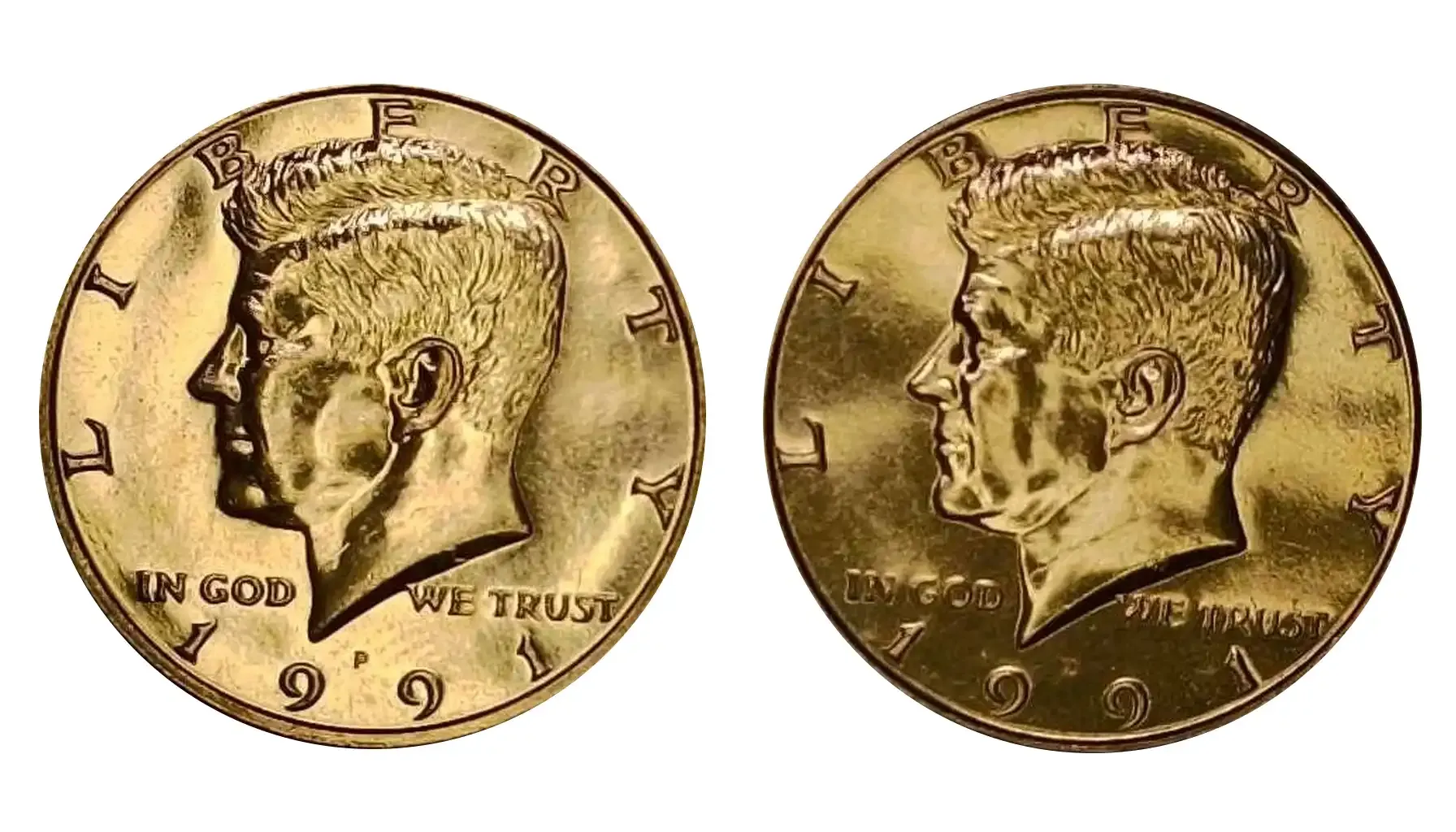
Proof coins: The 1991-S proof half dollar is minted in San Francisco and usually sells for $18 to $35; high-grade certified examples sell for $50 or more.
Although these values seem modest, the 1991 issue nonetheless stands as a fundamental representative of late 20th-century U.S. coinage — a time in which production quality was high but public circulation was minimal.
1991 P Half Dollar Value
The Philadelphia Mint struck about 14.87 million coins, making this the most common of the year. Circulated specimens have minimal premiums while uncirculated examples graded MS65 or above are worth a range from $10 to $100+, depending on strike sharpness and luster preservation. Coins with full details on Kennedy’s hair and strong reverse clarity often achieve top-tier pricing in certified auctions.
1991 Half Dollar D Value
The Denver Mint created approximately 15 million coins. While similar in availability to the Philadelphia issue, Denver strikes can sometimes look a little sharper. Circulated examples remain worth about $0.50 to $1, and high-end uncirculated (MS66+) examples can reach $60 to $150. Some collectors like the “D” mintmark coins for set completion or as examples of mid-series die quality consistency.
Factors Affecting 1991 Kennedy Half Dollar Value
Four main criteria determine the value of a 1991 Kennedy Half Dollar:
Condition and Grade: The prices are significantly higher for Higher Mint State and Proof grades.
Certification: Coins graded by professional services, such as PCGS or NGC, generally have stronger market credibility and usually sell for premium prices.
Mint Mark: The values of the 1991-P and 1991-D coins are similar, but “S” mint proofs command significantly higher premiums.
Errors and Varieties: The rare minting anomalies, like double-die obverses, misaligned strikes, or clipped planchets, sometimes raise the value for collectors by orders of magnitude.
Identifying and Grading Your 1991 Kennedy Half Dollar
You’ve got your hands on a 1991 JFK 50 cents. Now, wear your cotton gloves, grab a magnifying glass, and start spotting little details, step-by-step understanding the value of your example.
How to Spot Mint Marks on a 1991 Half Dollar
P (Philadelphia): No visible mintmark beneath Kennedy’s neck.
D (Denver): Small “D” mintmark under Kennedy’s neckline on the obverse.
S (San Francisco): Appears on proofs, typically with sharp cameo contrast and polished surfaces.
Circulated vs Uncirculated vs Proof Coins
Circulated: Show flattened details, reduced luster, and minor surface wear from use.
Uncirculated (MS): Retain full mint luster and crisp edges but may display minor contact marks from storage.
Proof (PR): Produced using special dies with mirrored fields and frosted devices; far superior in detail and surface finish.
Tips for Estimating 1991 Half Dollar Coin Value
Compare current market pricing using online coin value checkers or apps like Coin ID Scanner.
Check the surface quality for scratches, hairlines, or dullness that can lower the grade.
Have potentially valuable coins professionally graded to confirm authenticity and maximize resale potential.
Check for unique errors or variations in mintmark placement; these are often the hidden gems that bring the highest returns.
Extra Tip: If you’ve got a couple of 1991 JFK half dollars, check all of them via coin ID Scanner to pick the most unusual-looking ones for further professional grading. It will save you time and money, as numismatist’s services are quite expensive.
Collecting 1991 Kennedy Half Dollar Coins
In the very beginning of your journey, it is crucial to draw the roadmap. Therefore, we should learn more about tricky spots and nuances in collecting 1991 half dollars. It will allow you to save money and make your collection structured and organized right from the start.
“The 1991-P Kennedy Half Dollars were struck decently and examples up to about MS65 can be found easily. In MS66 they are much more difficult but they are somewhat common that they can be purchased inexpensively either certified or raw. In MS67 condition they are very difficult to find and worth a significant premium. Anything grading higher than MS67 is a very rare coin, as few examples if any are known in this condition.”
— Jamie Hernandez, a numismatist
From the PCGS Overview of the 1991 JFK Half Dollar
How to Start a 1991 Half Dollar Collection
Even in a small range of just one year, there are many varieties that allow building a set. To create a balanced collection of 1991:
Include both P and D mint issues — Philadelphia and Denver coins provide a complete representation of circulation strikes.
Include a San Francisco proof — it shows the best strike quality and craftsmanship of the year.
Look for error coins, such as double-die or off-center examples, for uniqueness and added value.
Choose certified specimens: Graded coins, either MS or PR, by PCGS or NGC, assure authenticity and attract serious buyers.
Combining these varieties creates a complete perspective on the minting variability of the coin and its design in varying finishes.
Choosing Between 1991 P and D Half Dollars
While both are readily available, 1991-D coins occasionally show sharper details and are thus slightly more attractive to specialists. Philadelphia strikes are more common and are thus often chosen for bulk or starter sets. High-grade specimens from either mint are affordable and enhance any Kennedy series collection.
Safe Storage and Handling of 1991 Half Dollars
Proper preservation is important to maintain grade and appearance. The following practices are recommended:
Store coins in airtight capsules or Mylar flips to prevent oxidation.
Keep them in a cool, low-humidity environment, away from sunlight or temperature shifts.
Always handle the coins by the edges only, using cotton gloves to prevent fingerprints.
When possible, save original Mint packaging for proof coins.
These precautions prevent toning, surface damage, and the small abrasions that can dramatically reduce collector value over time.
FAQ — Common Questions About the 1991 Half Dollar Value
How much is a 1991 half dollar worth?
Most circulated coins are worth $0.50-$1 and uncirculated pieces bring in a value of $4-$20. Proofs will sell from $20-$70, depending on grade and certification.
What is the 1991 P half dollar value?
The 1991-P Philadelphia coin is common, though sharp uncirculated examples will fetch between $10–$100+, particularly in grades of MS65–MS67, if certified.
Where is the mint mark on a 1991 Kennedy half dollar?
Below Kennedy’s neck on the obverse — “D” for Denver, “S” for San Francisco proofs, and no mark for Philadelphia.
Are there any rare varieties of the 1991 half dollar?
No major varieties exist, though double-die obverse and off-center strike errors are known and can bring multiples of face value.
What factors affect the 1991 50 cent coin value?
The major factors affecting its market price include condition, mint mark, professional certification, and unique minting errors.
Can I grade a 1991 half dollar at home?
You can approximate conditions using light and magnification or use Coin ID Scanner as the first layer of check-up, but only PCGS or NGC grading confirms the true market grade and authenticity of a coin.

 Facebook
  X (Twitter)
  Pinterest
  LinkedIn