Contents:
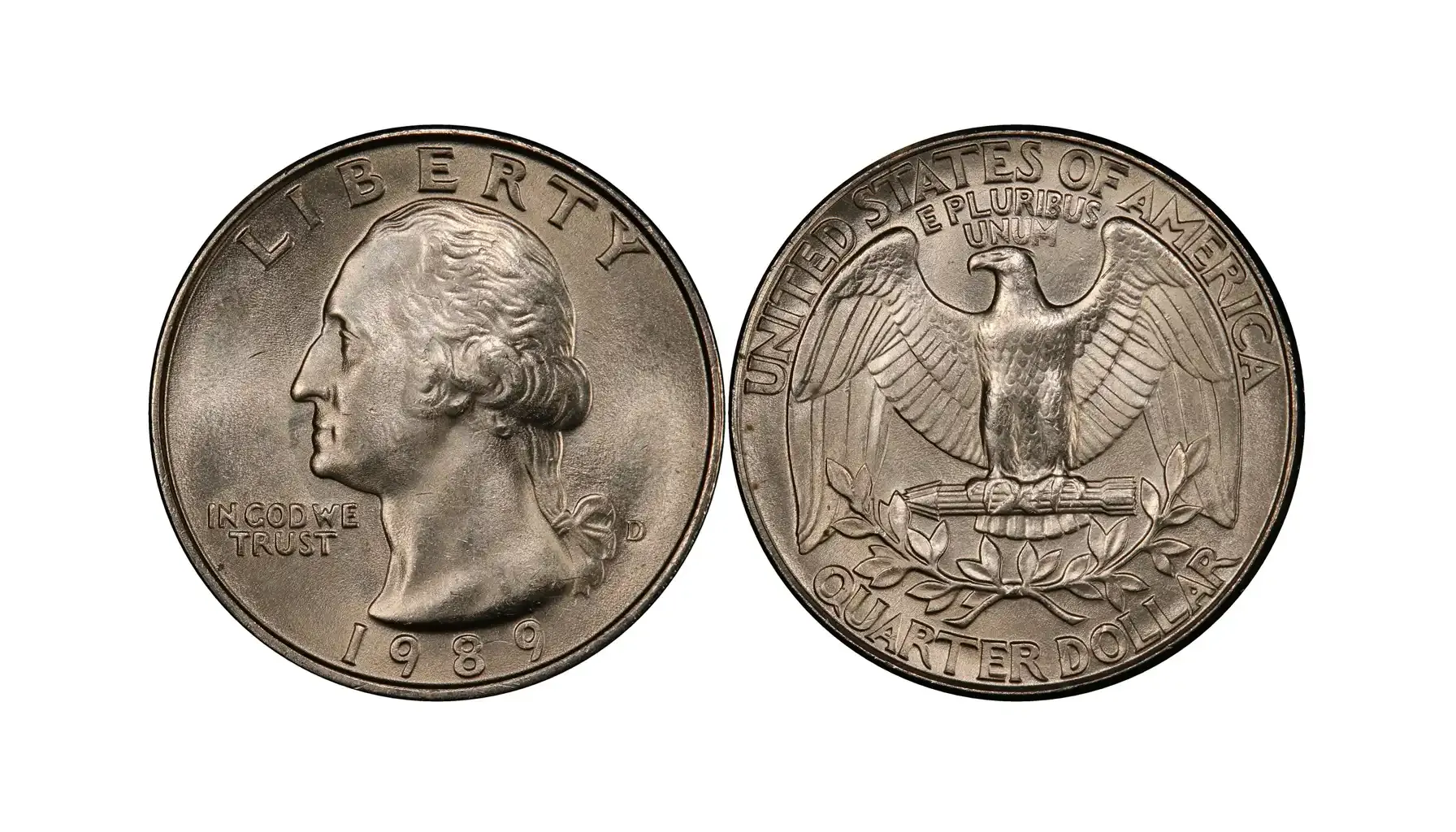
A 1989 quarter is a United States Washington quarter struck from copper-nickel clad over a pure copper core. It is part of the long-running Washington quarter series that began in 1932 to honor the bicentennial of George Washington’s birth.
How much is a 1989 quarter worth? It depends.
Is there any rare 1989 D quarter with error? Maybe.
What is the best app to check coin value? Coin ID Scanner!
… here’s everything you need to know:
Specification | Details |
Denomination | 25 Cents |
Year | 1989 |
Metal Composition | Outer layers: 75% Copper, 25% Nickel; Core: 100% Copper |
Weight | 5.67 g |
Diameter | 24.26 mm |
Thickness | 1.75 mm |
Edge | Reeded (119 reeds) |
Designer (Obverse) | John Flanagan |
Designer (Reverse) | John Flanagan |
Mint Marks | P (Philadelphia), D (Denver), S (San Francisco – proof only) |
Mintage | Over 1.7 billion across all mints |
Historical Reference
The 1989 Washington quarter belongs to the long-running Washington quarter series, which debuted in 1932 to mark the 200th anniversary of George Washington’s birth. The original design by sculptor John Flanagan was chosen over several other proposals and became one of the most popular motifs in U.S. coinage.
By 1989, the design had been in continuous use for more than half a century with only minor adjustments, e.g., the addition of the “P” mint mark for Philadelphia. Some of them you can even find in a 1989 P quarter error list with pictures.
Unlike earlier quarters minted from 90% silver and 10% copper (1932–1964), the 1989 issue was made from copper-nickel clad over a pure copper core.
Billions were struck at the Philadelphia (1989 quarter P mint mark) and Denver mints, while the San Francisco Mint produced proof versions for collectors. This year’s issue holds no major design changes, but examples in pristine condition or with striking errors are of interest to numismatists.
Mint Marks
On the 1989 Washington quarter, the mint mark is a small letter that means where the coin was struck. It appears on the obverse (front) of the coin, just to the right of George Washington’s ponytail ribbon, above the “9” in the date.
First appeared on quarters in 1980 (except for 1982 no-mint-mark variety in other denominations).
1989 P Washington quarter coins are common in circulation.
D – Denver Mint
Large production runs. 1989 quarter D coins are also common in circulation.
S – San Francisco Mint (Proof coins only)
S quarter 1989 specimens were made for collector sets, featuring sharper strikes and mirror-like fields.
Not intended for circulation, though some have entered it accidentally.
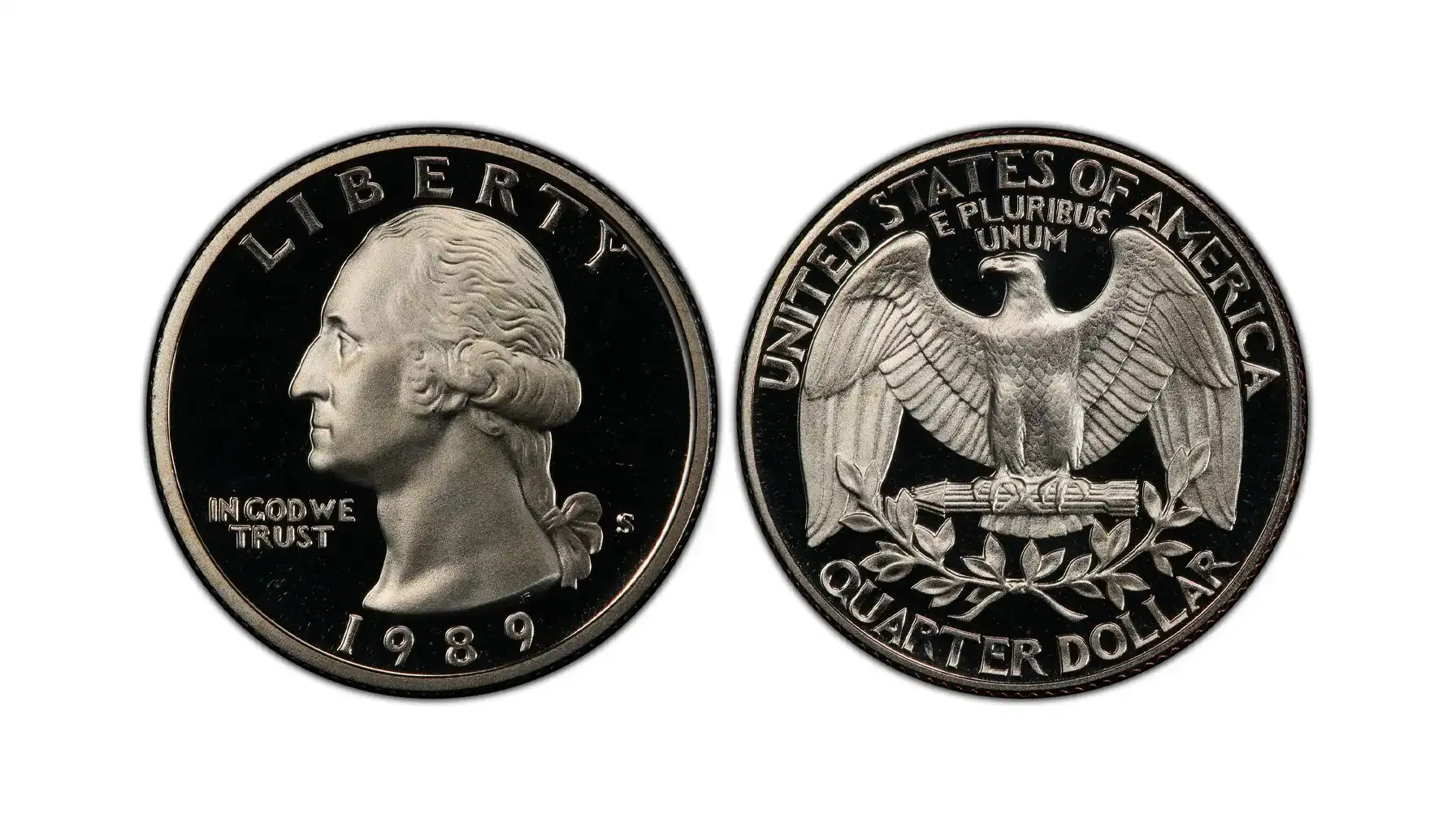
What Is a 1989 Quarter Worth?
Grade / Type | Value |
Philadelphia - 1989 P quarter value | |
Circulated (G4–AU58) | $0.25–$0.35 |
MS60 | $1–$2 |
MS63 | $4–$6 |
MS65 | $12–$18 |
MS66 | $45–$70 |
MS67 | $150–$350+ |
Denver - 1989 D quarter value | |
Circulated (G4–AU58) | $0.25–$0.35 |
MS60 | $1–$2 |
MS63 | $3–$5 |
$10–$16 | |
MS66 | $40–$65 |
MS67 | $120–$300+ |
San Francisco - 1989 S quarter value | |
PR65–PR68 | $4–$12 |
PR69 DCAM | $18–$40+ |
PR70 DCAM | $120+ |
1989 quarter value error varieties | |
Off-Center Strike (5–10%) | $15–$30 |
Off-Center Strike (15–50%) | $35–$120+ (with full date visible) |
Broadstrike (no rim, expanded flan) | $20–$50 |
Clipped Planchet (small, curved) | $15–$35 |
Clipped Planchet (large or multiple) | $40–$80+ |
Die Crack / Cud (minor) | $5–$15 |
Die Crack / Cud (major, bold) | $25–$60+ |
Struck Through Grease (minor detail loss) | $5–$12 |
Struck Through Grease (major design loss) | $20–$50 |
Double Die Obverse (DDO, minor) | $15–$30 |
Double Die Obverse (DDO, strong spread) | $80–$200+ |
Double Die Reverse (DDR, minor) | $10–$25 |
Double Die Reverse (DDR, strong spread) | $75–$150+ |
Missing Clad Layer (partial) | $50–$150 |
Missing Clad Layer (full side) | $200–$400+ |
Mint Error Combination (e.g., broadstrike + off-center) | $150–$500+ |
1989 Quarter Errors
Off-Center Strike
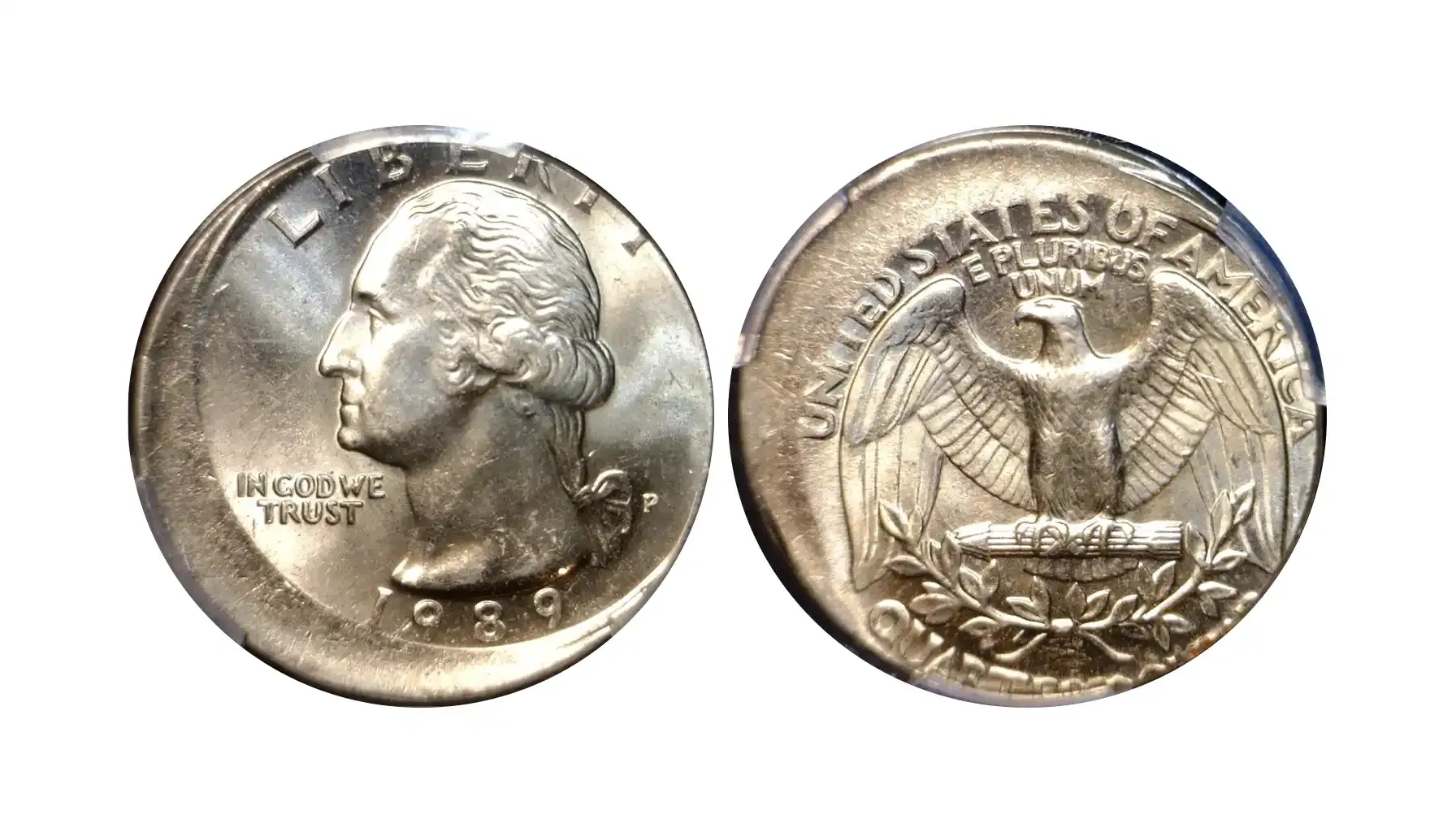
What it is: Die strikes the planchet away from center, leaving a crescent of blank metal. It may be one of the 1989 D quarter errors, as well as S and P.
How to confirm:
Rim is complete on one side and missing on the opposite crescent.
Reeding will “fade out” toward the blank area.
Design elements near the crescent should end abruptly, not smeared.
1989 hotspots: Date/mintmark zone—if the “1989” still shows, value improves.
Common confusion: Vise-squash or clamp damage creates flattened zones, not a true unstruck crescent with proper metal flow.
Broadstrike
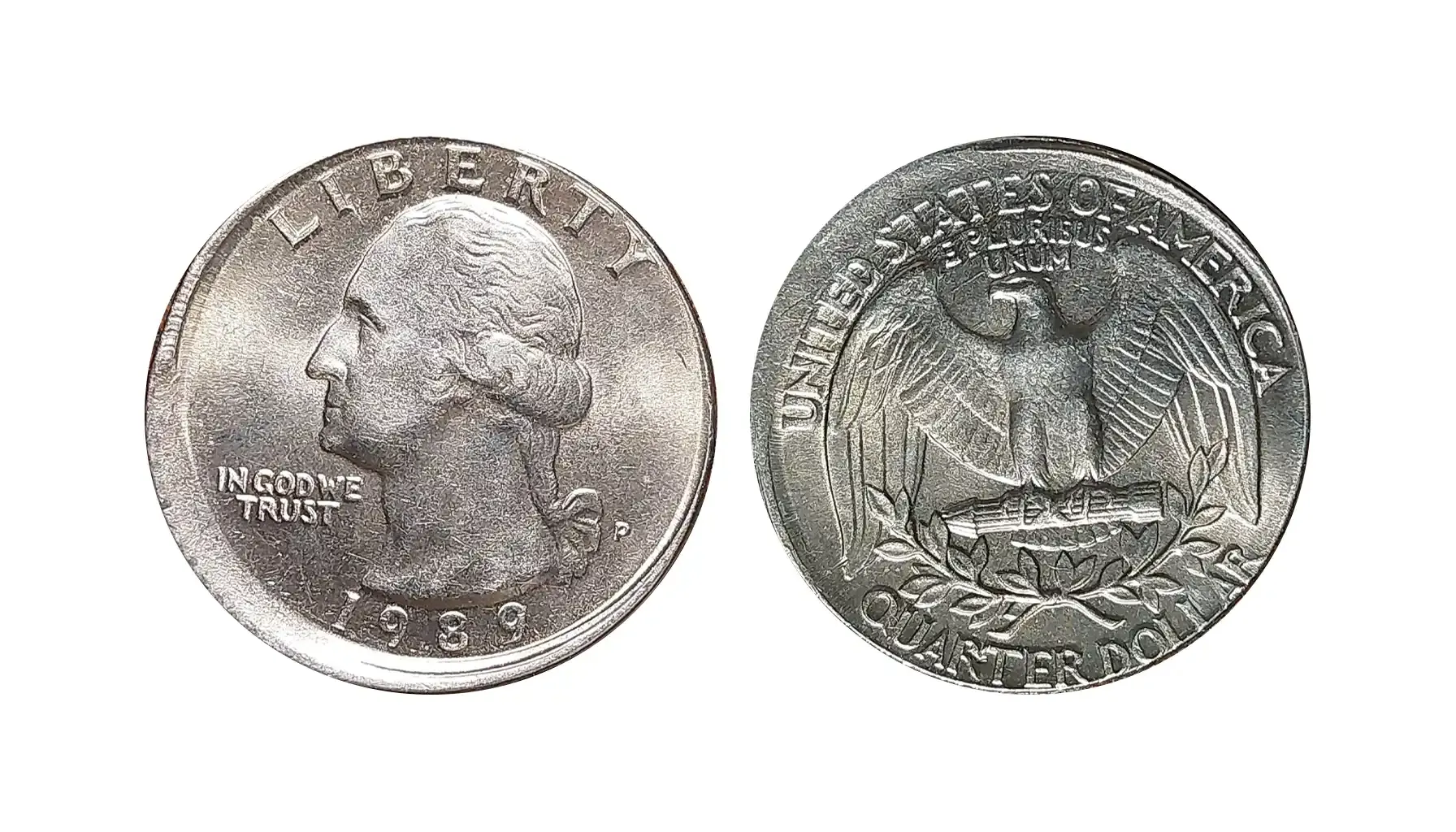
What it is: Collar die failed; coin spreads wider, loses the sharp rim.
How to confirm:
No reeding (or reeding severely deformed) all the way around.
Diameter slightly larger than ~24.26 mm; rim looks “pancaked.”
Legends near rim can look stretched but not sliced.
1989 tells: Plenty of mass-production; genuine broadstrikes exist, but check the edge closely.
Common confusion: Hammered edges or spooning; these show peened, work-hardened metal and often uneven thickness.
Clipped Planchet
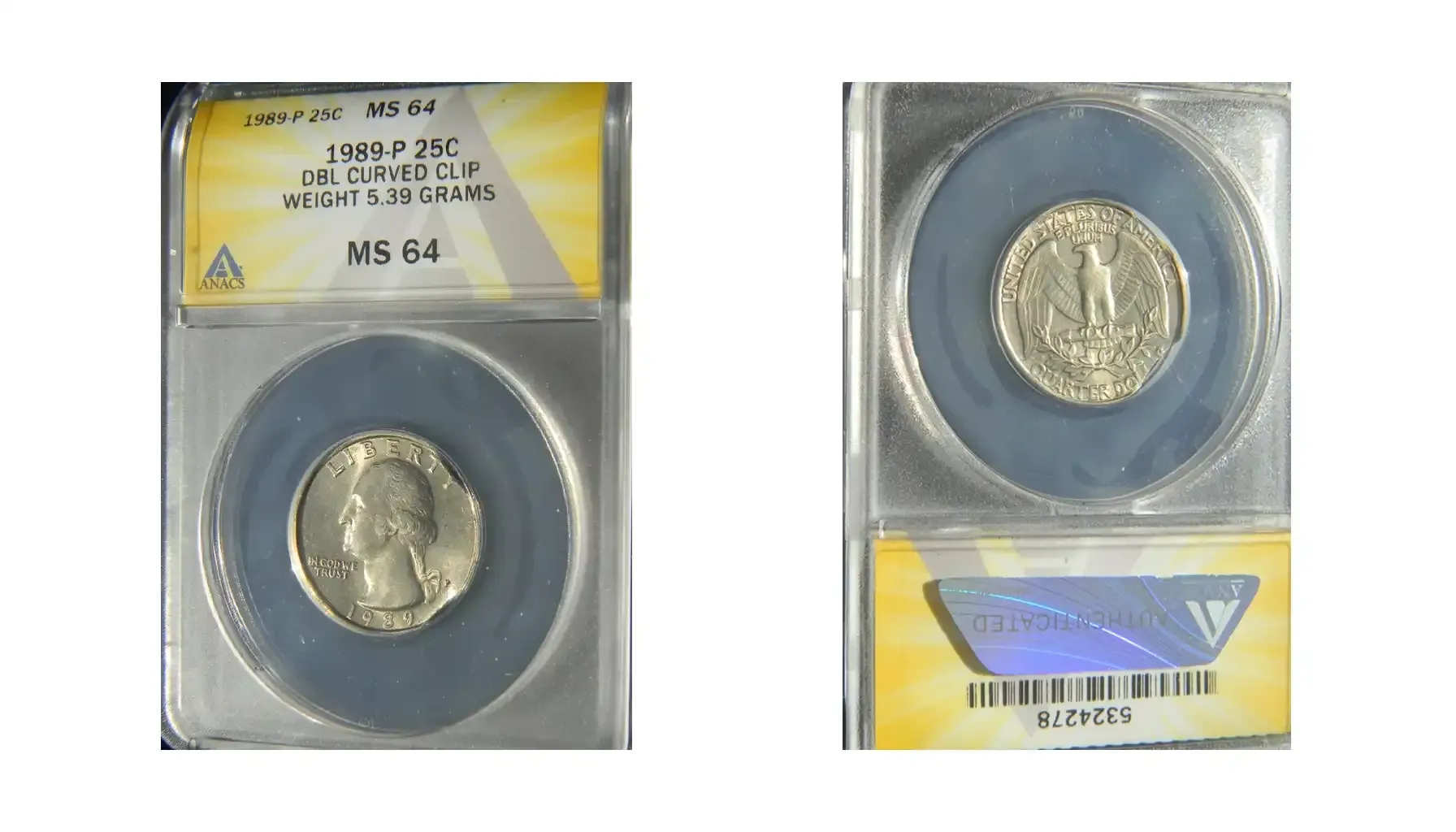
What it is: Blank was punched where sheet overlapped a previous punch; bite-shaped missing piece.
How to confirm:
Blakesley effect: Opposite the clip, the rim is weak/flat due to metal flow physics—key diagnostic.
Clip arc is smooth and matches the coin’s curvature.
1989 tells: Small 3–7% clips are most encountered.
Common confusion: Nicks/bites after minting—these won’t show Blakesley and usually have torn metal.
Die Crack / Cud
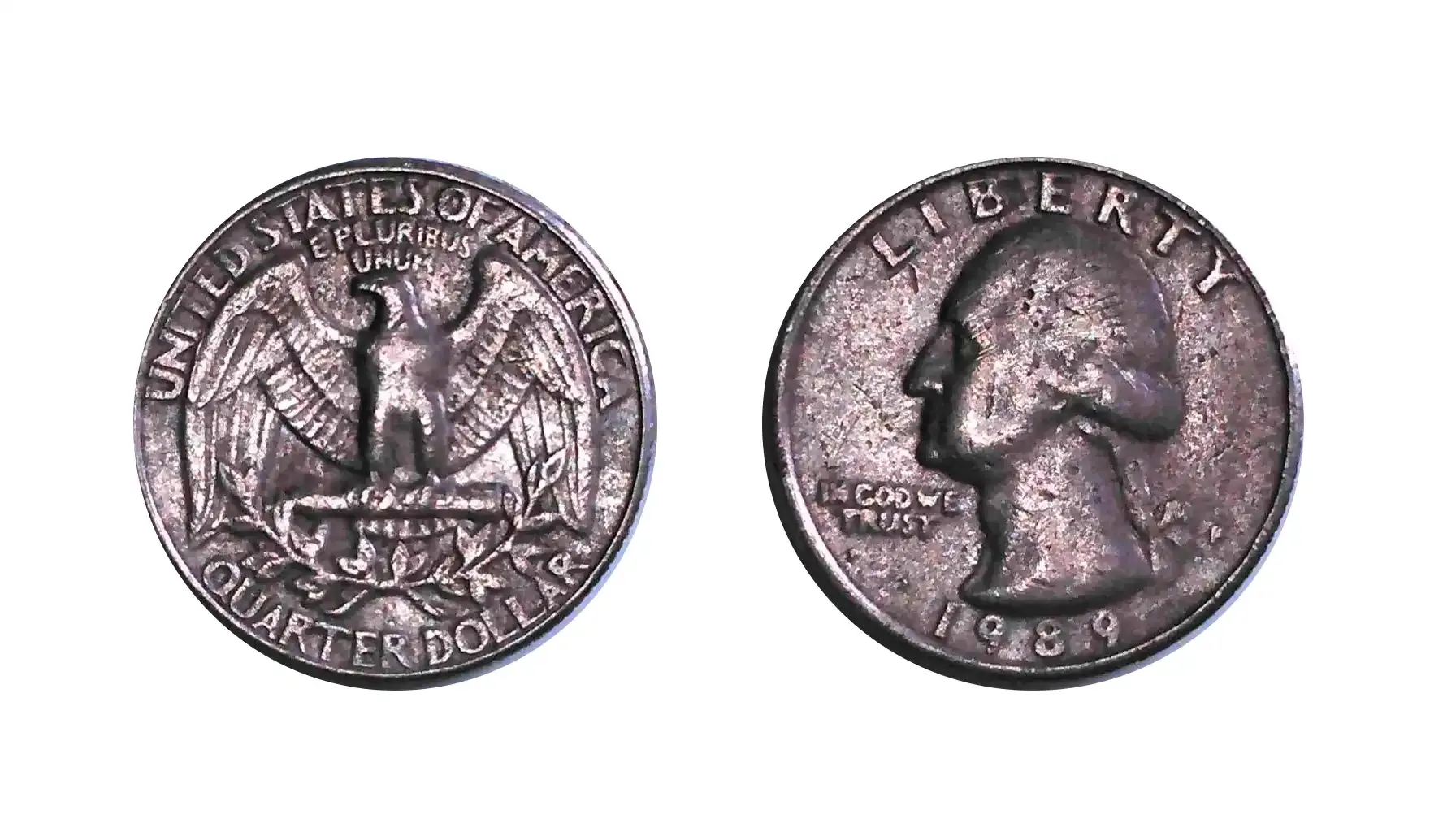
What it is: A crack in the die transfers as a raised line on the coin.
How to confirm:
Lines are raised, continuous, and often cross fields into devices.
Luster flows over the line; no raw metal shine.
Is a 1989 quarter worth anything in this case? Small cracks = small prices, and vice versa.
Common confusion: Scratches are incuse and cut the luster.
Struck Through Grease (minor detail loss)
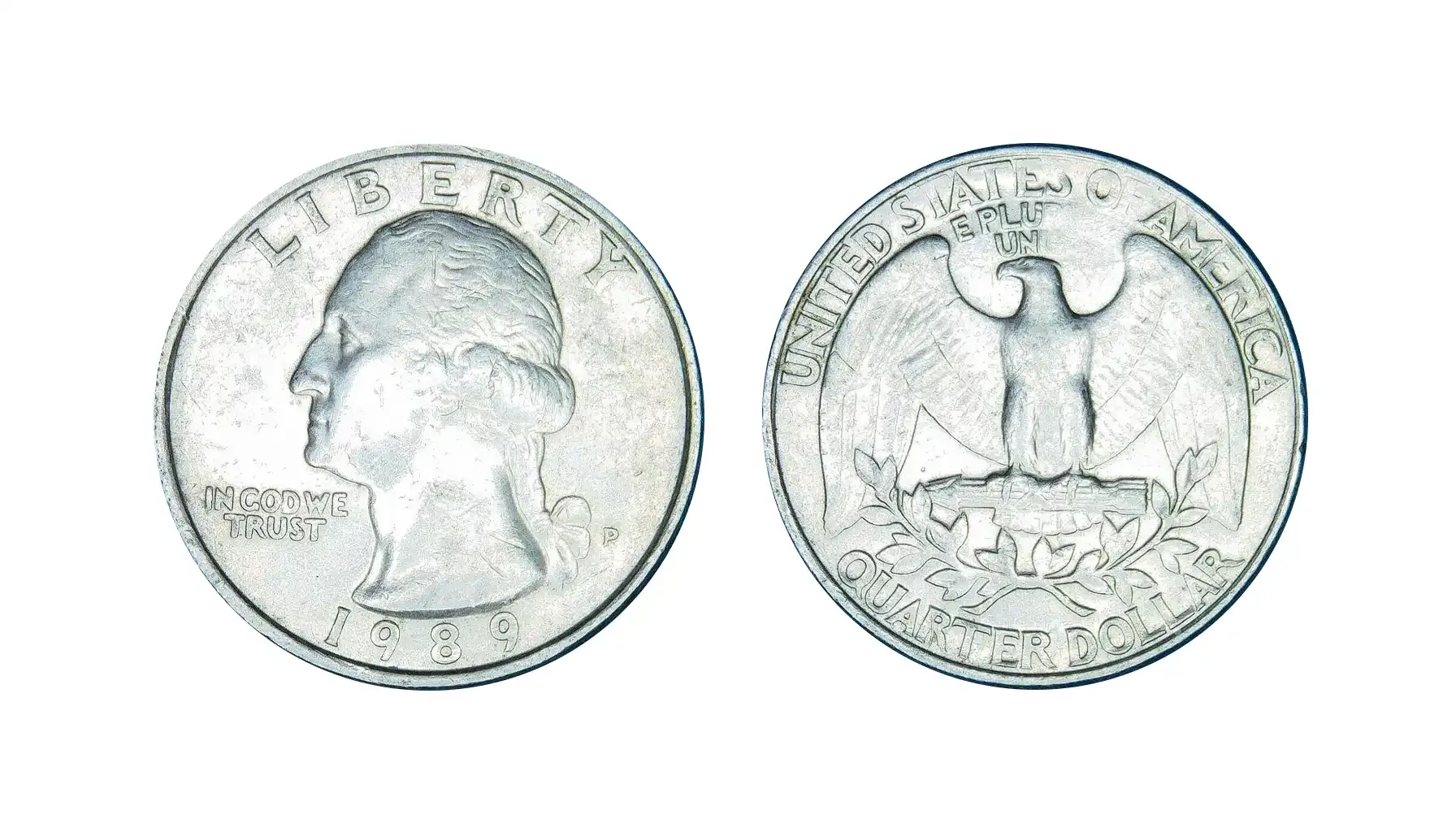
What it is: Grease/debris fills die recesses; design doesn’t fully strike up.
How to confirm:
Soft, rounded detail loss with undisturbed luster across the flat area.
No displaced metal, no scratches leading into the fade.
1989 hotspots: “IN GOD WE TRUST,” eagle feathers.
Common confusion: Wear. Grease strikes keep mint luster; wear kills it.
Doubled Die Obverse (DDO)
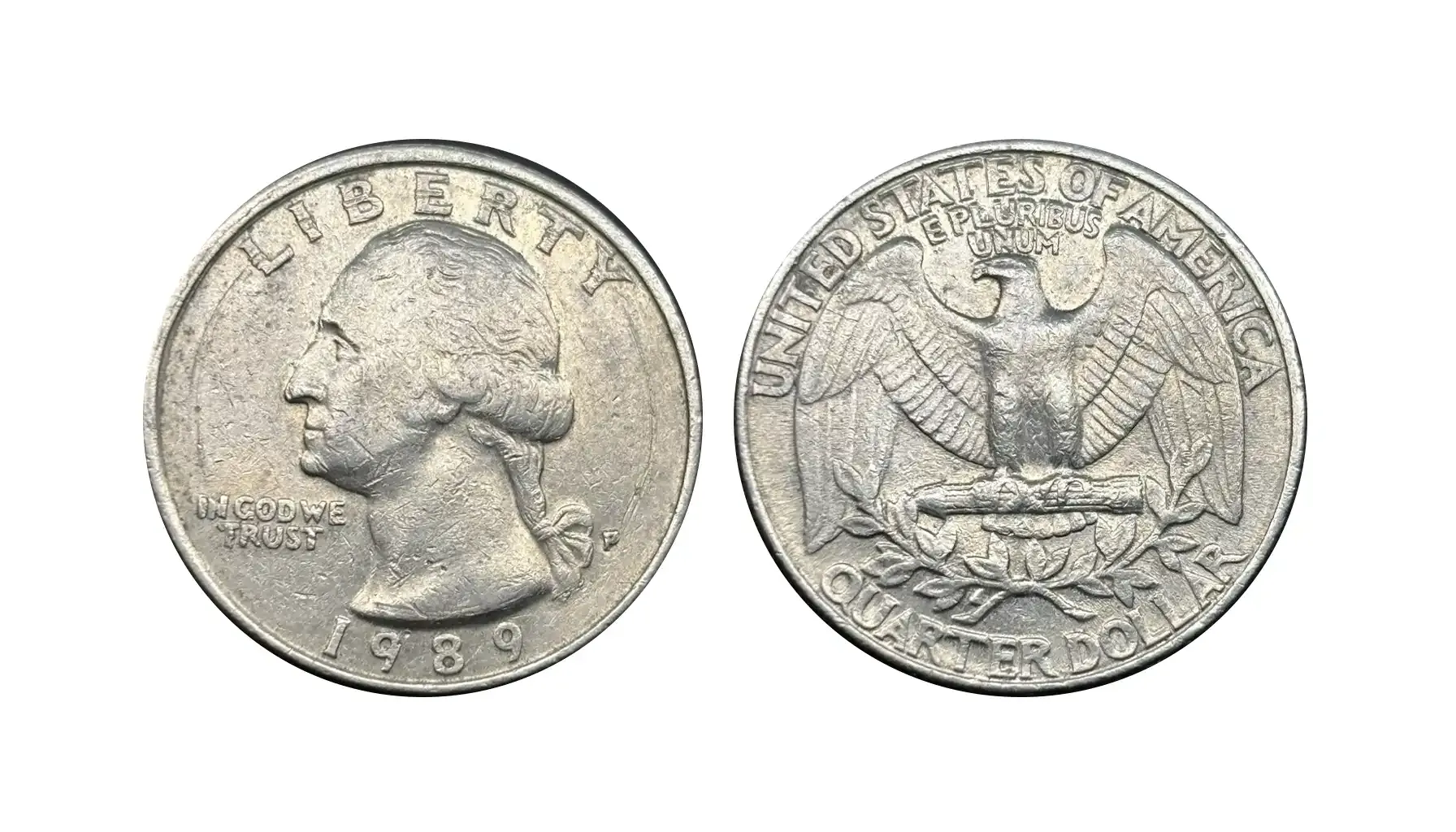
What it is: Hub doubling—design doubled on the die itself.
How to confirm:
Look for separated serifs/notches on “LIBERTY,” date, and “IN GOD WE TRUST.”
Doubling is raised and matches design shape—not flat.
Tools: 10× loupe; tilt under single-source light.
Common confusion: Machine/strike doubling is flat, shelf-like, and often toward rim.
Doubled Die Reverse (DDR)
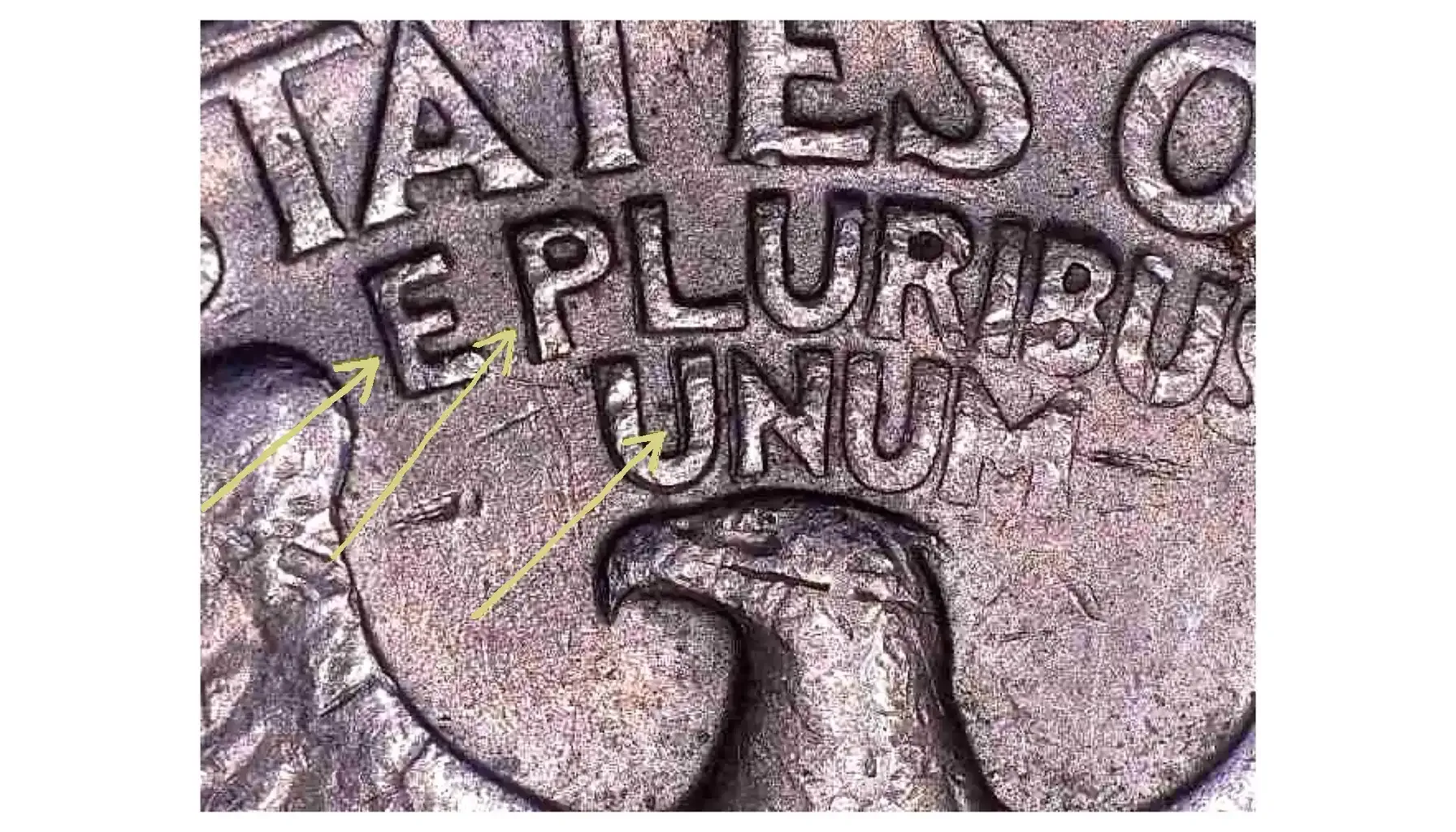
What it is: Hub doubling on reverse—eagle, arrows, OLIVE branches, legends.
How to confirm:
Check “UNITED STATES OF AMERICA,” “E PLURIBUS UNUM,” feather tips.
Look for tiny notches/splits, not flat shelves.
Common confusion: Bounce/strike doubling—flat and directionally smeared.
Missing Clad Layer (partial)
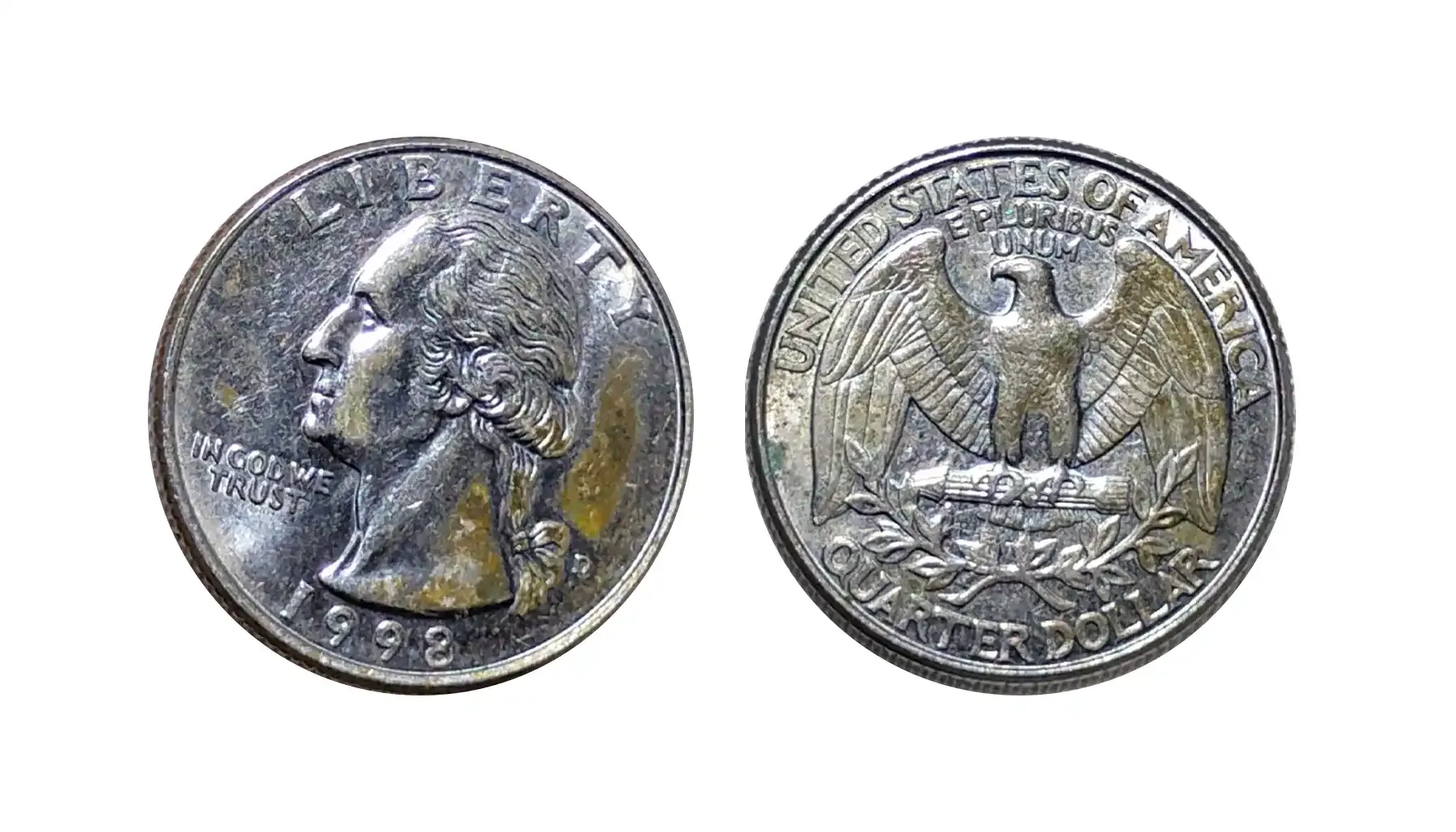
What it is: Part of the outer cu-ni layer didn’t bond/was absent; copper core peeks through.
How to confirm:
Two-tone areas with a clean step between grey (clad) and reddish (core).
Edge will show a “gap” in the grey band where missing.
Weight often a bit low (e.g., ~5.3–5.5 g depending on loss).
Common confusion: Abrasion revealing copper—those have scratch marks and irregular edges.
Fast Checks
Normal 1989 quarter = 5.67 g. Low weight flags missing-clad; very low (~3.11 g) suggests wrong planchet (like a cent)—a different error altogether.
Reeded vs. missing/warped reeding helps confirm broadstrike vs. damage.
Real die cracks/cuds are raised; scratches/gouges are incuse.
Struck-through grease keeps luster smooth over the weak area. Wear/tooling breaks it.
Lighting: Use a single lamp and tilt slowly; notches of true doubling “pop” at certain angles.
Magnification: A clean 10× loupe is enough for most diagnostics.
Certification: For strong DDO/DDR, full missing-clad, large off-centers, big cuds—consider PCGS/NGC/ANACS for market confidence.
Apps: Use Coin ID Scanner to identify your coin and its 1989 quarter value D, S, P.

5-Year Price Predictions (2025–2030)
Every rare 1989 quarter is a common modern clad coin in circulation. With most of the mintage still in circulation and mint sets aging, pristine examples—especially MS67 or better—are expected to become modestly scarcer over the next five years.
Proofs from San Francisco remain affordable due to large surviving quantities, but perfect-grade PR70 DCAM coins will continue to attract competitive bids.
Error coins (like those from the 1989 D quarter error list with pictures), especially full missing clad layers, large off-center strikes and strong doubled dies, have proven to hold and even increase in value as collectors focus more on modern varieties.
Type / Grade | 2025 Value | 2030 Predicted Value | Trend |
P Mint MS65 | $12–$18 | $18–$25 | ▲ Moderate |
P Mint MS67 | $150–$350+ | $200–$450+ | ▲ Moderate-Strong |
D Mint MS65 | $10–$16 | $15–$22 | ▲ Moderate |
D Mint MS67 | $120–$300+ | $160–$400+ | ▲ Moderate-Strong |
S Mint Proof PR69 DCAM | $18–$40 | $20–$45 | ► Stable |
S Mint Proof PR70 DCAM | $120+ | $150–$200+ | ▲ Mild |
This will be interesting for you if you’re here: Top Coins to Invest in 2025.
Disclaimer: All 1989 copper quarter prices listed in this article are average at the time of writing. This means that they may change over time due to various numismatic market trends, such as demand, metal price changes, and others. Always check current prices to be sure.

 Facebook
  X (Twitter)
  Pinterest
  LinkedIn