Contents:
Decency or mediocrity? Current value or its potential? Coin hunts have always been equivocal, for they may offer either a pocket change specialty or a genuine numismatic relic with the possibility of great collectible worth. Sometimes, this gets imperceptible, for even the least noticeable units of currency turn into valuable assets over the course of time.
So as to get started, it is always important to collect what is said to be decent yet not overly fancy. One such instance that is worth collecting but can be overshadowed by its silver-bearing counterparts is the 1983 half dollar coin. Although this does not carry intrinsic bullion value, its power is hidden in the condition, mint mark, and minting deviations of peculiar forms. So, how much is a 1983 half dollar worth, and which features identify this coin as unique?
1983 Kennedy Half Dollar Overview
The path of the Kennedy half dollar commenced with a tragic loss: in 1963, the country was suffering from the untimely passing of their beloved leader, President John F. Kennedy. So as to pay tribute to his immense contributions, each governmental institution strived to honor his memory in a lasting way, and the US Mint found its own.
Within weeks of his assassination in November 1963, Congress approved the redesign of the 50C as a replacement for the Franklin half dollar, and, hence, released a new Kennedy half dollar in 1964. By 1983, this unit of currency had become an integral (=legendary) part of the American monetary system, incorporating several compositional modifications from 90% silver to 40% silver to a copper-nickel clad.
The Main Features of the Half Dollar Coin 1983
The Main Features of the Kennedy Half Dollar 1983 | |
Composition | 75% copper, 25% nickel over a pure copper core (copper-nickel clad) |
Weight | 11.34 grams |
Diameter | 30.6 mm |
Thickness | 2.15 mm |
Edge | Reeded |
Mint Marks | “P” for Philadelphia “D” for Denver “S” for San Francisco (proof) |
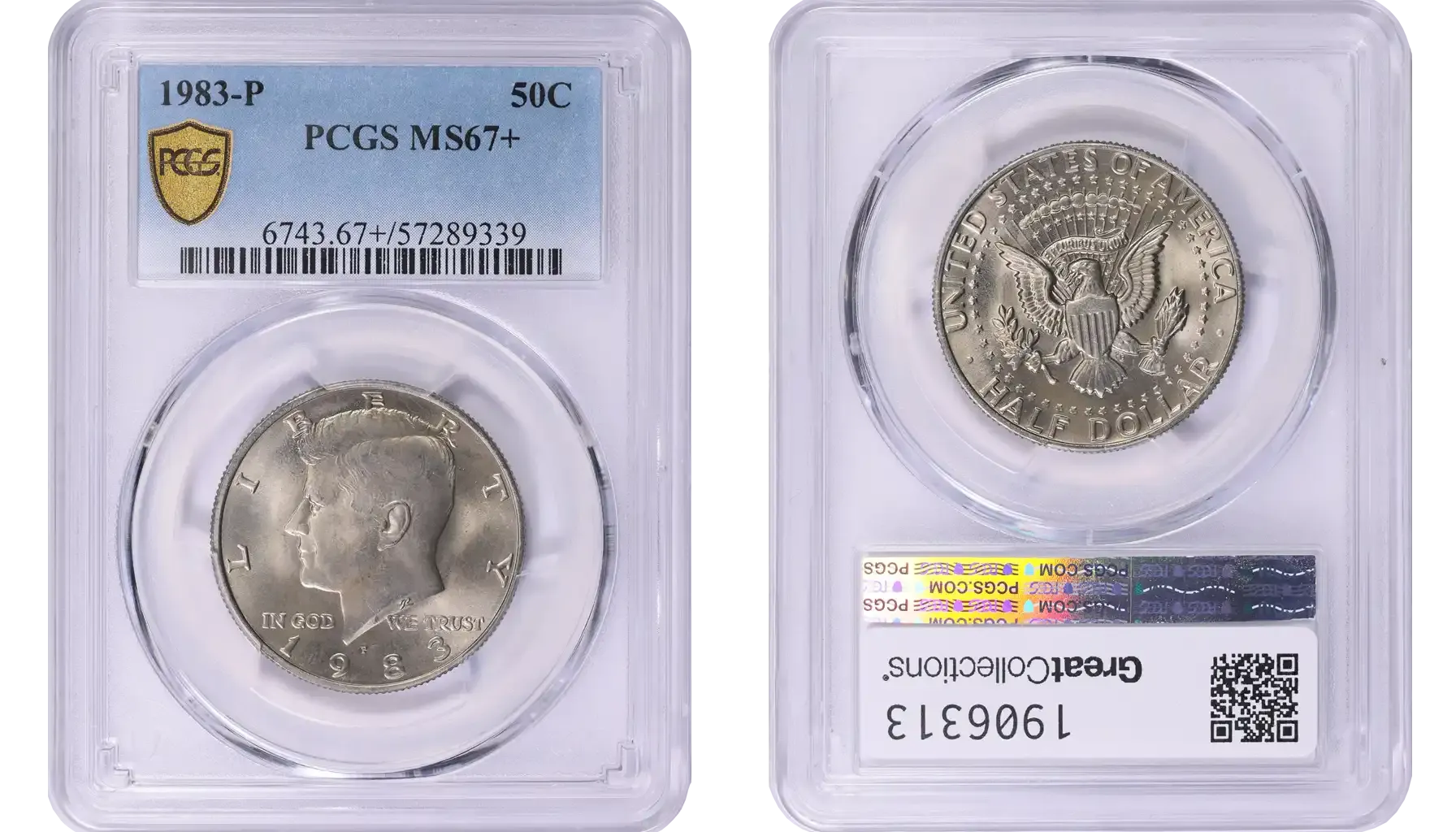
Obverse: Displays the bust of President John F. Kennedy, as well as the inscription “LIBERTY”, “IN GOD WE TRUST” on either side of the bust, the date “1983” near the bottom rim, and a mint mark right above the year.
Reverse: Demonstrates the Presidential Seal of the United States (a heraldic eagle, with a bundle of arrows in its left talon and an olive branch in its right), surrounded by the circle of 50 stars, the inscription “UNITED STATES OF AMERICA” around the upper rim, “E PLURIBUS UNUM” on the scroll held in the eagle’s beak, and the denomination “HALF DOLLAR” at the bottom.
1983 Kennedy Half Dollar Value, Market Trends & Collectibility
Type | Scarcity | Typical Market Price | Collector Interest | Notes |
1983-P Business MS66 | Moderate | $50 – $120 | High | Fewer Mint Set survivors; desirable gem condition |
1983-D Business MS67 | Rare | $350 – $700 | Very High | Top-grade coins command strong premiums at auction |
1983-D Business MS68 | Extremely Rare | $2,000 – $4,000+ | Very High | Record-setting examples are extremely scarce |
1983-S Proof PR68 | Common | $8 – $15 | Moderate | Standard proof quality; Deep Cameo enhances appeal |
1983-S Proof PR69 DCAM | Uncommon | $10 – $20 | High | Mirror-like surfaces and cameo contrast attract collectors |
1983-S Proof PR70 DCAM | Rare | $40 – $90 | Very High | Perfect examples are prized in registry sets |
Error Coins | Rare | $575 – $1,800+ | High | Value depends on severity and eye appeal |
The 1983 half dollar coin values are approximate and may fluctuate over time.
Half Dollar 1983 Types by Mint and Strike
1983-P 50C (Regular Strike)
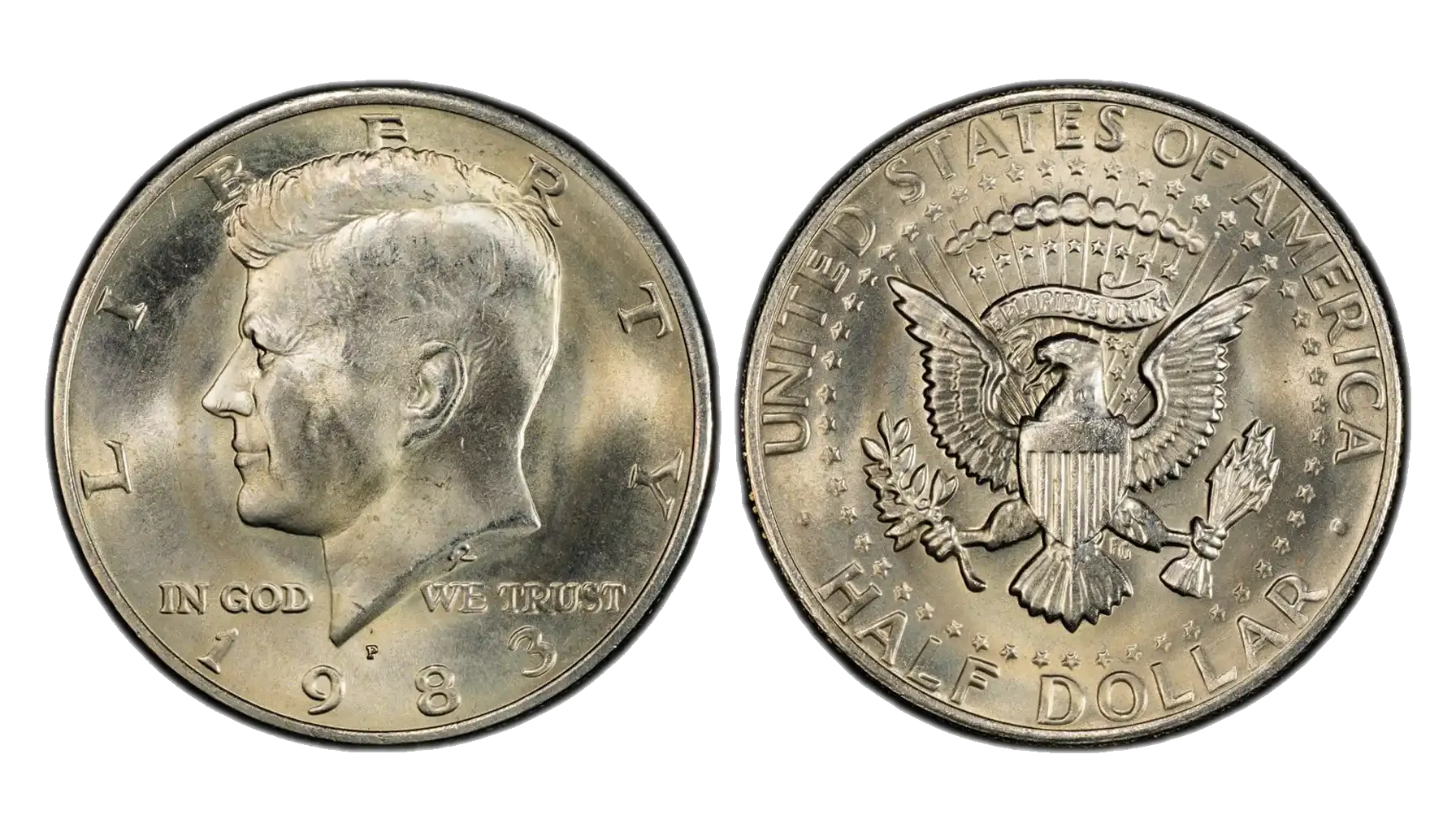
Produced by: Philadelphia Mint
Mintage: 34,139,000
Auction Record: $805 for MS66
In 1983, both the Denver and Philadelphia Mints were equally productive in terms of mintage figures of 50-cent coins. As such, the 1983 half dollar P was quite a common unit of currency, for the main part of the batch entered circulation immediately. As a result, high-grade survivors with exceptional levels of quality and strong luster are genuinely hard to find, though AU and lower grades represent the upper end of availability.
1983-D 50C (Regular Strike)
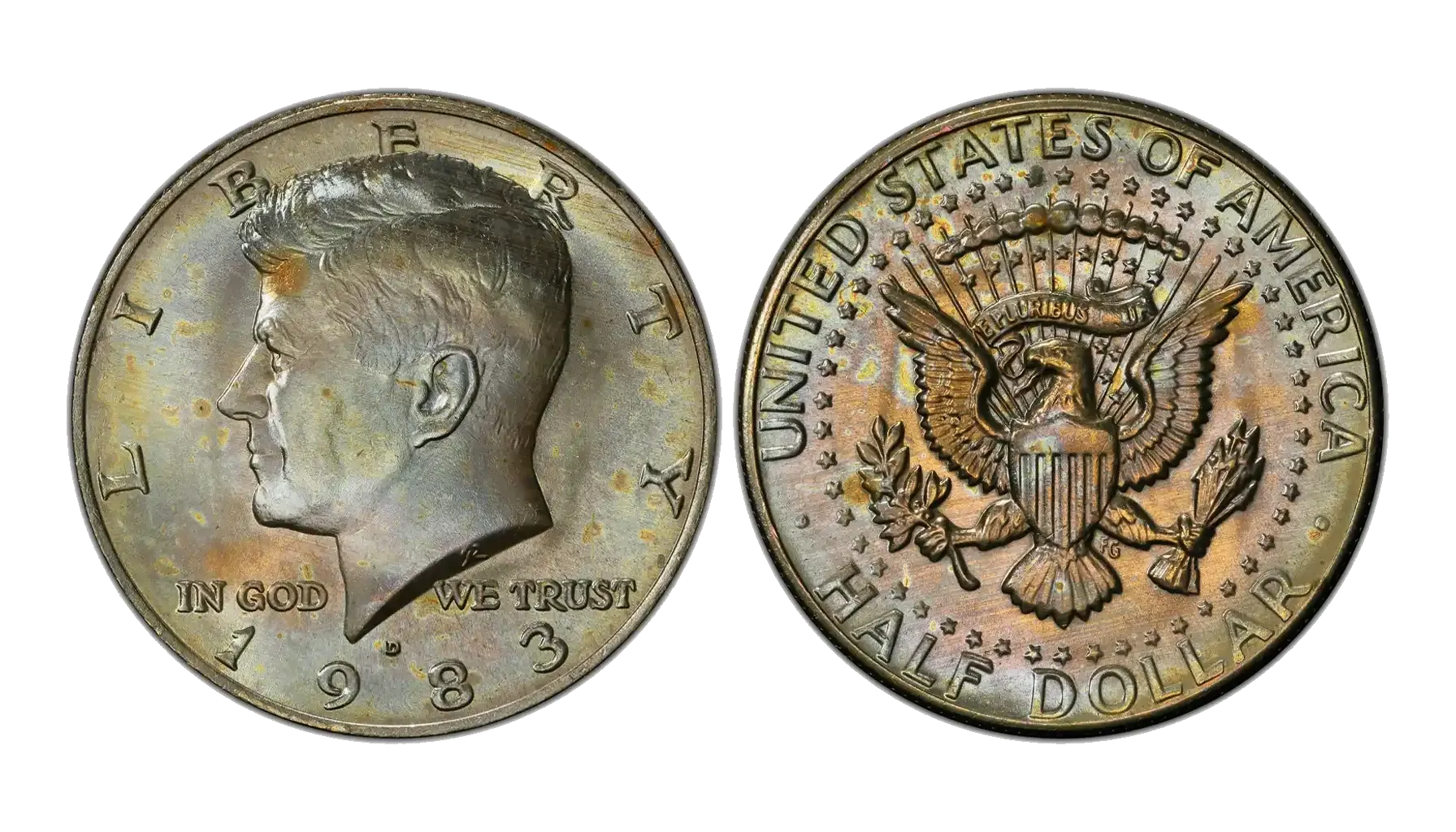
Produced by: Denver Mint
Mintage: 32,472,244
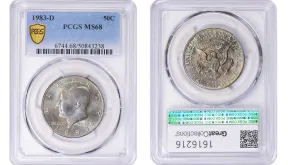
Auction Record: $4,230 for MS68
When compared to the previous mint, Denver was responsible for slightly fewer halves, yet the overall story is the same: most were released into circulation, with only a few untouched 1983 half dollar D varieties having been kept in collections from the very beginning. As a rule, Denver issues often show stronger strikes, yet marks and abrasions from handling may make it less available in MS67+.
1983-S 50C (Proof)
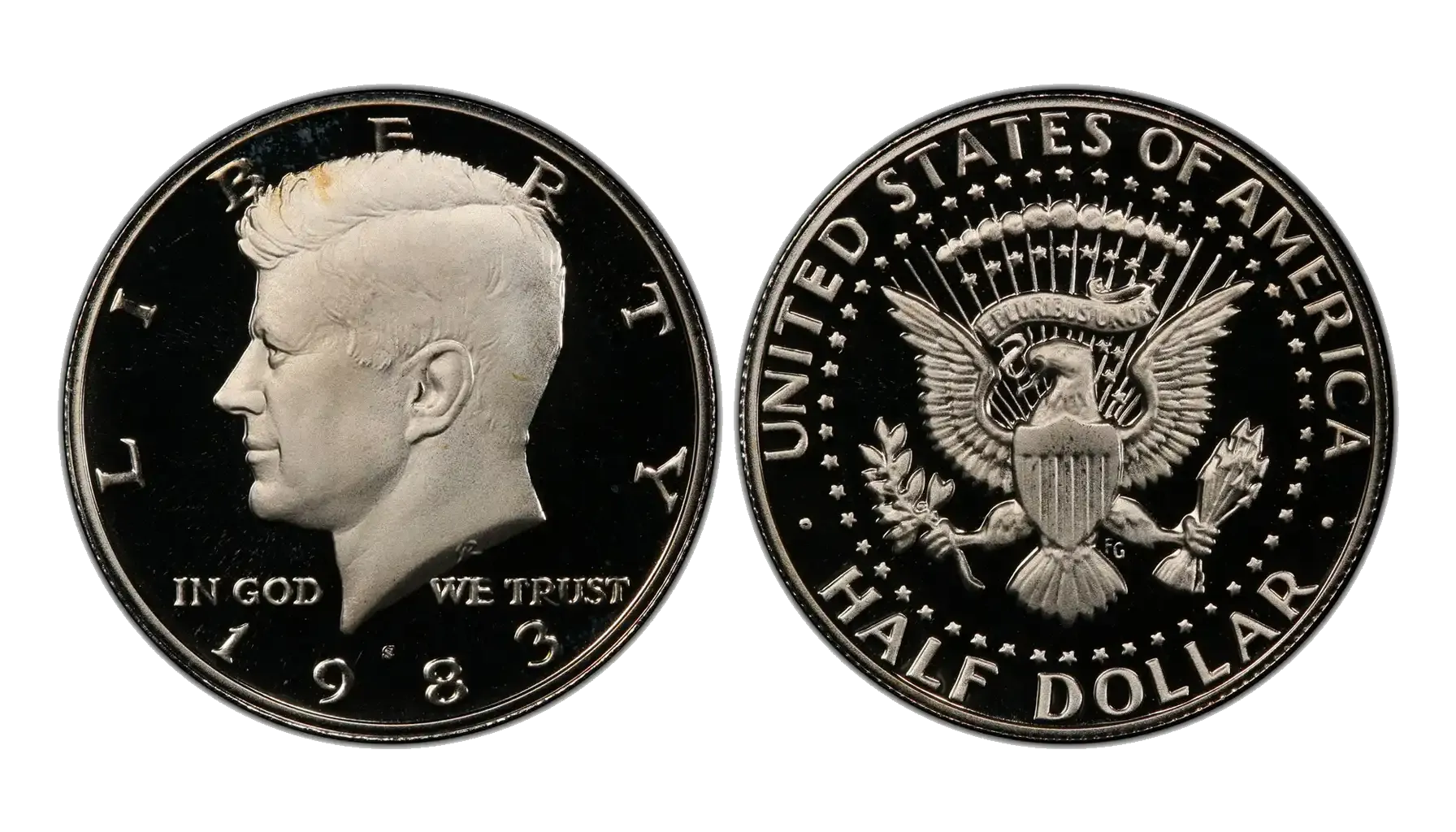
Produced by: San Francisco Mint
Mintage: 3,279,126
Auction Record: $546 for PR70
When it comes to the proof editions, this year was also quite productive, which generally makes these instances decently priced. As required by the mint, proofs should display (deep) cameo contrast, with frosted devices set against highly reflective fields. Yet, having such a sample may be a fine addition to the collection, however common this coin may be.
“Most 1983-S Proof Kennedy Half Dollars were struck in great quality. Finding examples in PR68-PR69 Deep Cameo should be the norm. Perfect PR70 Deep examples are scarcer, but with enough searching, one can be found with minimal effort.”
— Jaime Hernandez, renowned numismatist, PCGS price guide editor
PCGS CoinFacts
1983 Half Dollar Errors & Varieties
80% Off-Center
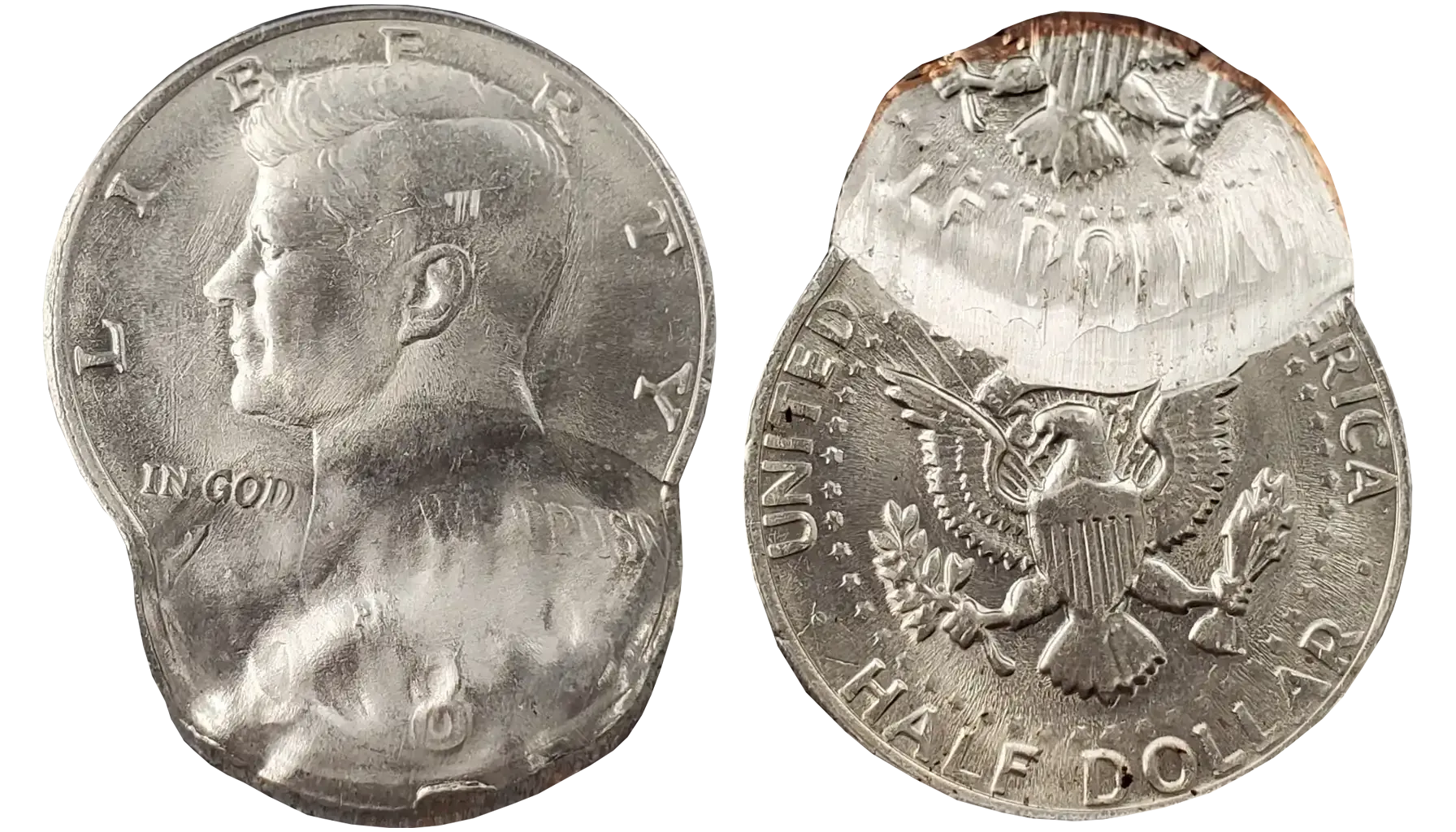
Estimated Value: $1,795
Coins with deviated designs are the treasures found on the market. They generally turn into something more valuable than just a common representative of the series.
An 80% off-center strike, one of the most precious 1983 P Kennedy half dollar errors these days, usually occurs when the planchet (blank coin) is improperly aligned in the press. This means that the striking misses the central design and makes it appear shifted. As for the worth, the rules are simple: the higher the percentage of the shift, the better it is for collectors.
Struck Thru
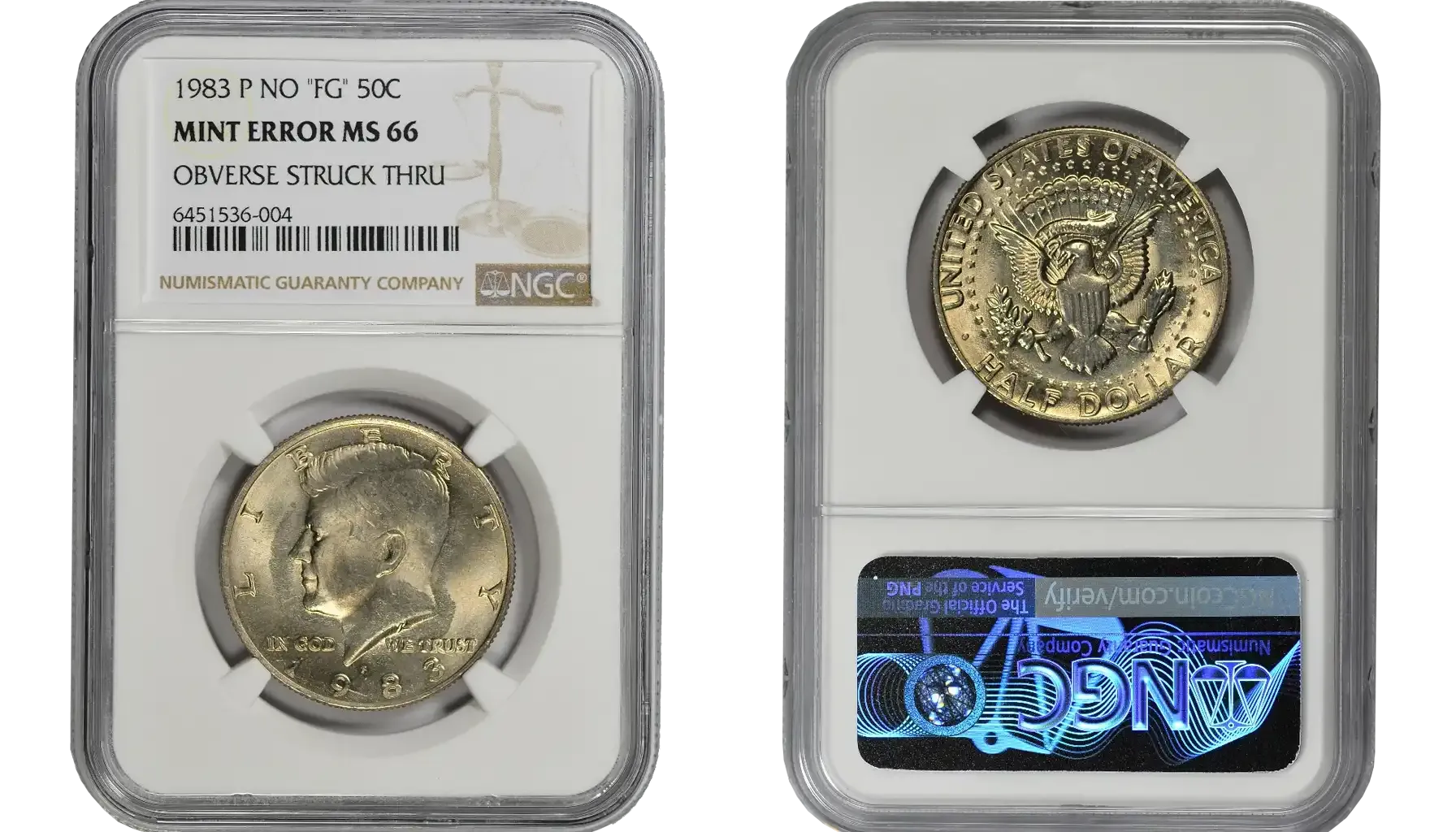
Estimated Value: $1,000
Sometimes, numismatic creations may bear “additional” features which do not belong to the original coin design – these are generally referred to as struck-thru errors. These typically come from foreign material (e.g., grease, debris, or paper fragments) having been lodged on the planchet during the minting process.
The result is the partial or distorted images with small blank patches or uneven surfaces. Coins in this category are valued based on the size and prominence of the error, as well as their overall appeal.
Die Clash
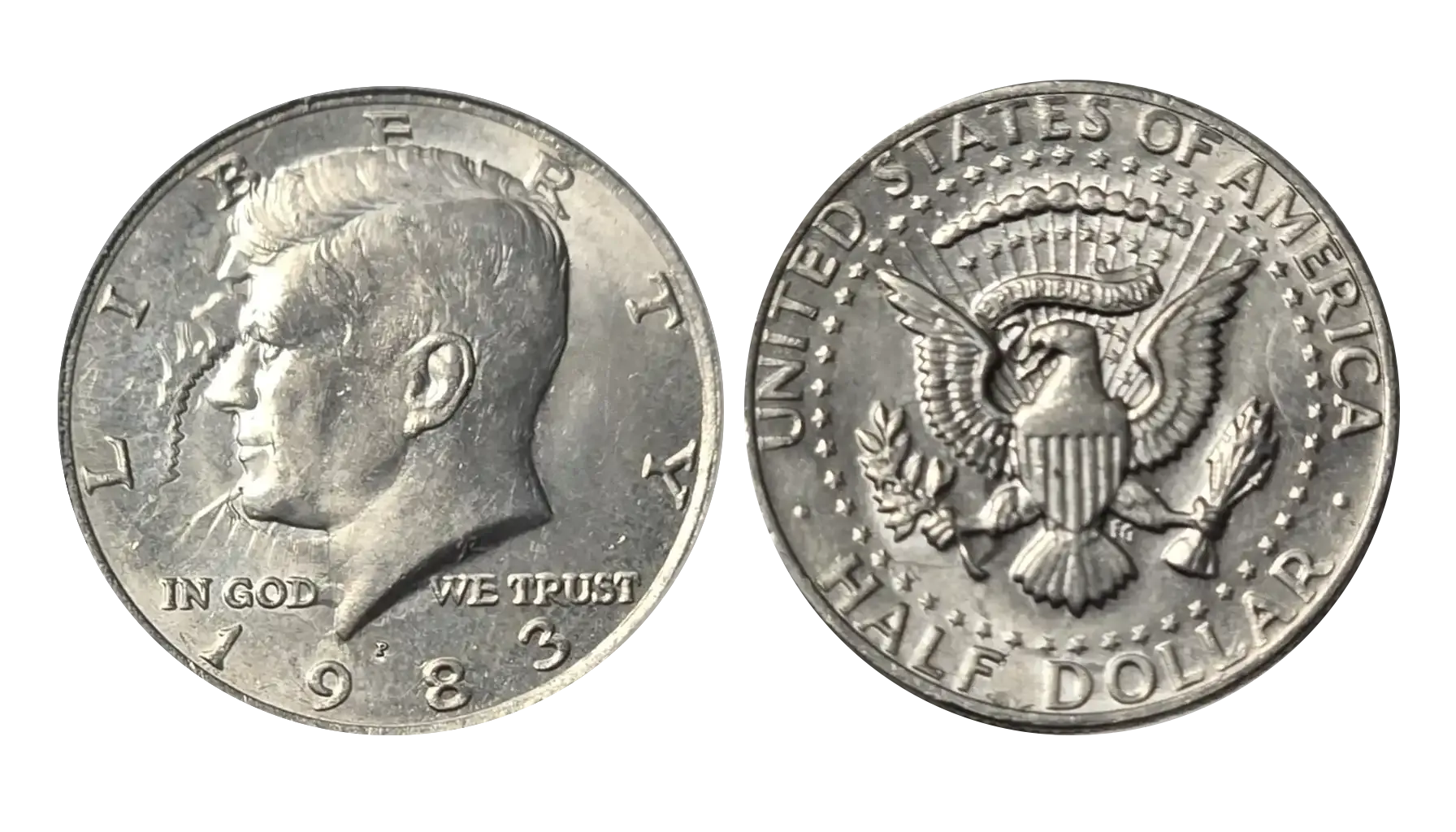
Estimated Value: $900
On the same level of curiosity, one may examine the die clash deviations, i.e., errors characterized by ghost-like impressions of the opposite side’s design. When looking at the 1983 50C, there appear faint outlines of the eagle on the obverse or Kennedy’s profile on the reverse. Nonetheless, it is vital not to underestimate this deviation: die clash coins are relatively uncommon and highly collectible because each clash is unique and may grant an exceptional experience for those collecting.
Broadstruck
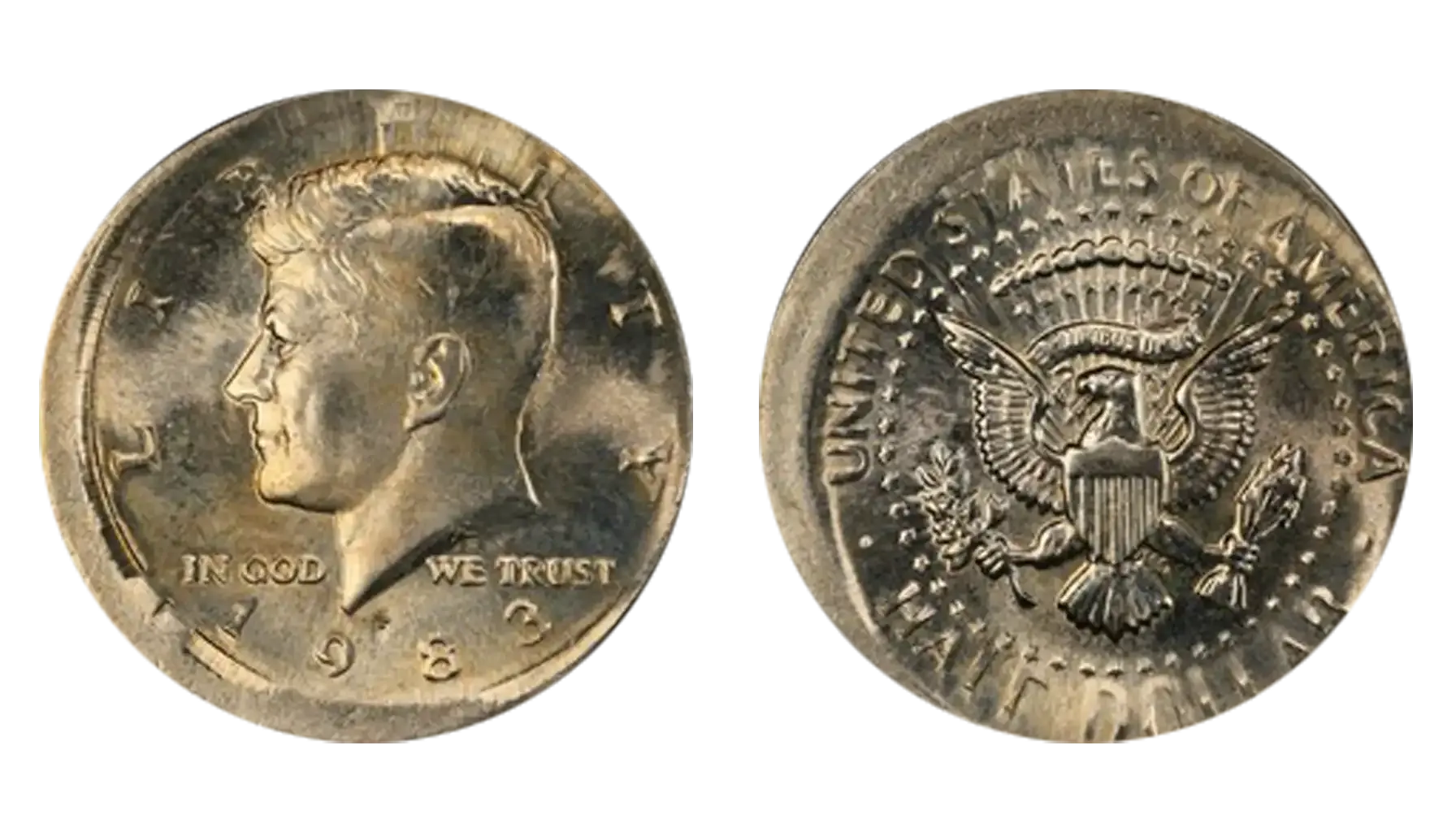
Estimated Value: $575
A broadstruck Kennedy Half Dollar is a relatively casual deviation that occurs when the retaining collar fails during striking. Hence, the planchet expands outward beyond its normal diameter. As a result, the Mint gets a larger, flatter coin with details stretched toward the edge, often with a flattened or distorted rim.
A Quick Note for Those Who Need Help
Keeping up with the trends can be difficult at first. But fear not: the market is full of digital opportunities designed to make your numismatic journey easier, smarter, and far more rewarding. Enter Coin ID Scanner, an innovative tool to identify coins, detect errors, manage collections, and simply explore the numismatic world with an appropriate level of expertise.
Collecting is about being satisfied, not overwhelmed, in the end.

 Facebook
  X (Twitter)
 ) Pinterest
Pinterest  LinkedIn