Contents:
Years may be lost in the context of history and sheer numbers minted, but their voices are heard in what we treasure. Coins are among the most powerful but tranquil artifacts that reveal cultural peculiarities and historical moments of the past. Yet, some of them remain unnoticed until they pop up on the coin auction platforms or blogs that discuss collectibles numismatists might be looking for.
The 1979 half dollar coin may not be the most notable instance within the series, but it is indeed worth considering as a reflection of the shift away from silver coinage and the evolution of US currency in general. So, which features may identify this coin as a compelling piece to collect? What do they look like, and is a 1979 half dollar worth anything after all?
1979 in Context: The Legacy of the Kennedy Half Dollar Coins
Tragic events cannot help but affect all spheres of life, especially when they are nationwide and engraved into the collective memory of generations. In fact, the XX century was full of devastating circumstances, some of which changed the monetary sector forever – this is indeed the case of the untimely demise of John F. Kennedy, the 35th president of the United States, in 1963.
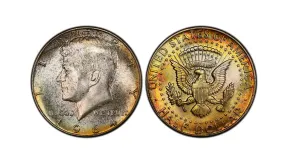
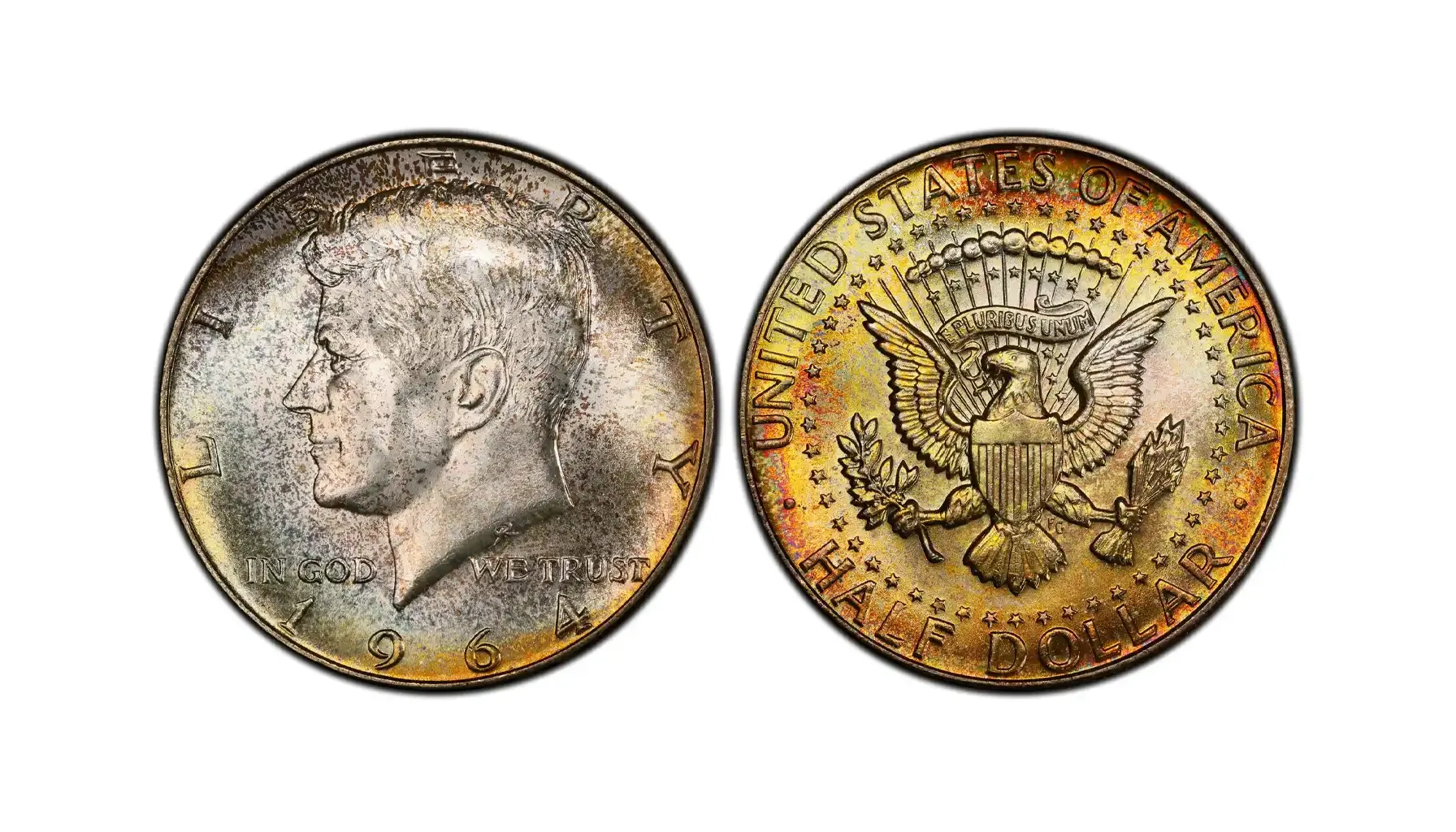
The US Mint was quick to react to the event of the tragedy and, so as to perpetuate his ultimate legacy, it quickly launched a new coin program meant to replace the older one, i.e., the Franklin half dollars. As a result, there was released a 1964 Kennedy half dollar, which marked the beginning of a long-standing series that continues to be produced to this day.
By 1979, the series had already gone through significant changes. The original 90% silver composition of 1964 lasted only a single year, replaced by a 40% silver alloy from 1965 to 1970, and then fully transitioned to copper-nickel clad for circulation starting from 1971. Hence, the half dollar 1979 was no longer a circulating powerhouse but a workhorse widely used in daily trade. However, even these common issues may boast peculiar samples of immense worth and cultural beauty.
Related article: Silver Price Predictions 2030: How High Could It Go?
Design Features and the Main Characteristics
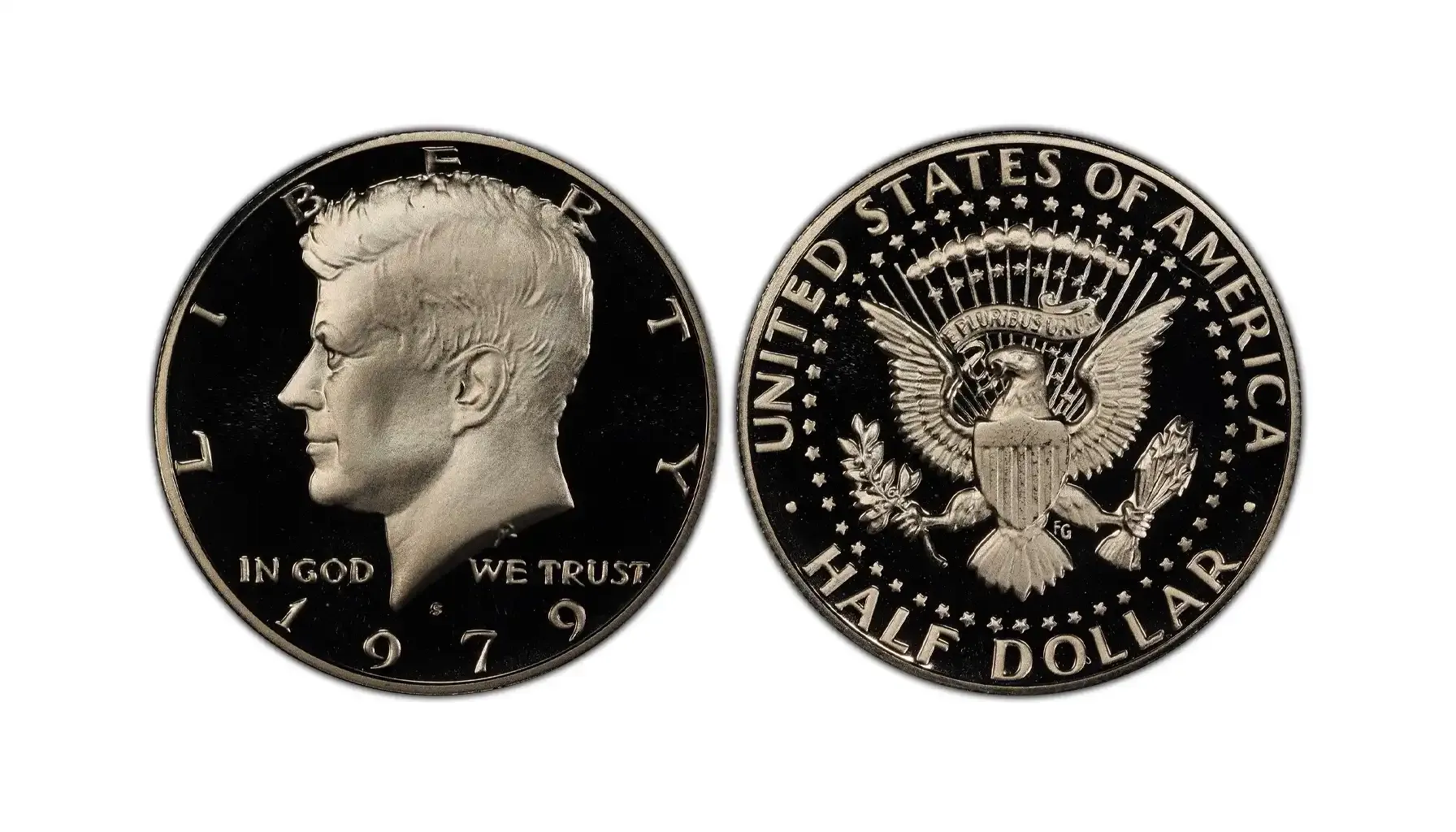
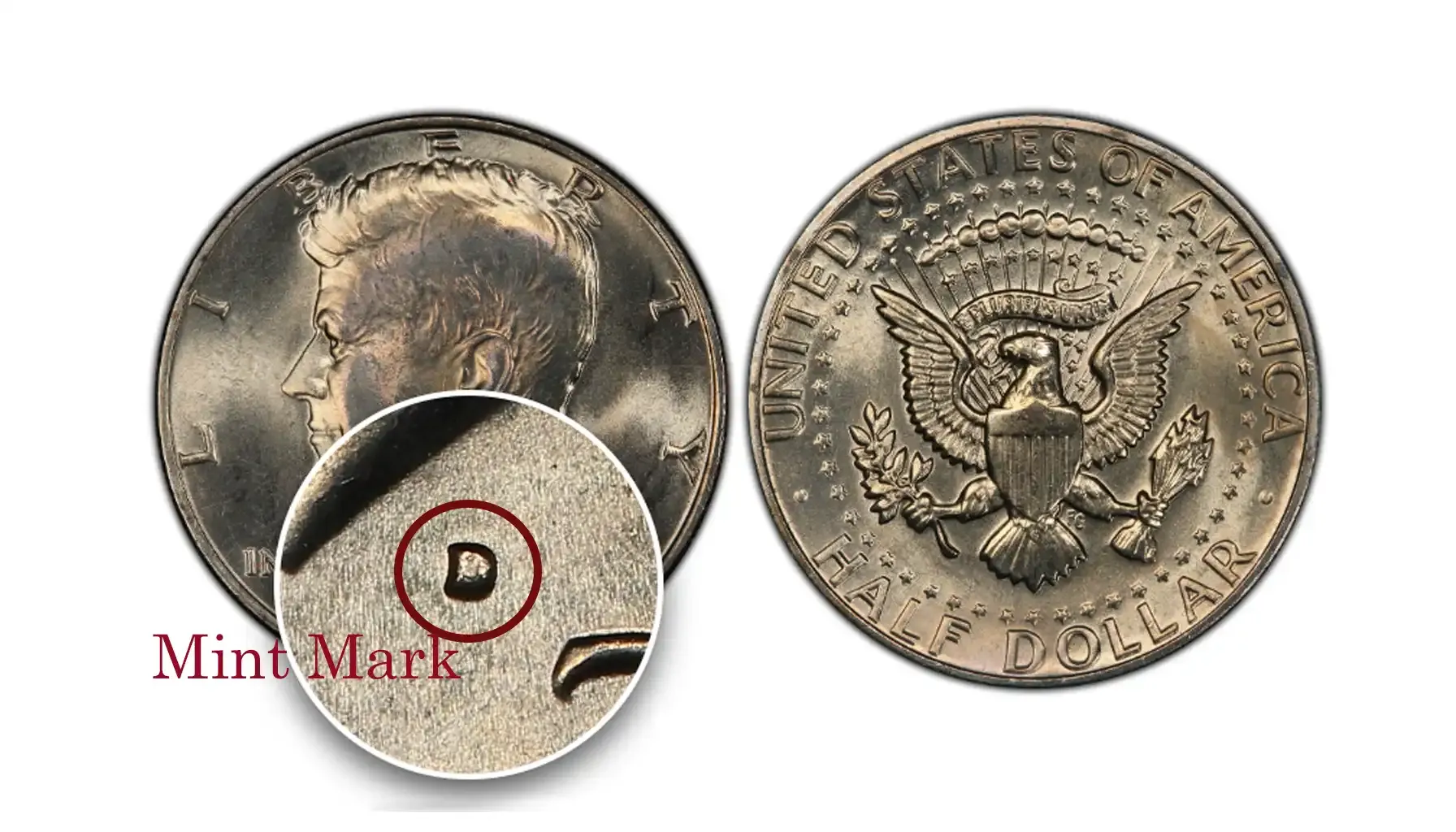
Obverse: The obverse side, the most prominent (=recognizable) part of the coin, features a left-facing portrait of President John F. Kennedy, designed by Gilroy Roberts, along with the inscriptions “LIBERTY” spaced evenly around the upper rim, “IN GOD WE TRUST” separated into two parts by the portrait, a mint mark below the bust, and the year of issue “1979” beneath.
Reverse: The reverse side, designed by Frank Gasparro, on its part, introduces the Presidential Seal, which includes an eagle with outstretched wings, holding a bundle of arrows in its left talon and an olive branch in its right, as well as a circle of stars around (each representing a state).
As for the inscriptions, the reverse displays “UNITED STATES OF AMERICA” around the upper edge, the denomination “HALF DOLLAR” along the lower rim, and the motto “E PLURIBUS UNUM” (“Out of many, one”), written on a flowing banner.
The Main Features of the Kennedy Half Dollar 1979 | |
Composition | 75% copper, 25% nickel over a pure copper core |
Weight | 11.34 grams |
Diameter | 30.61 mm (1.205 inches) |
Thickness | 2.15 mm |
Edge | Reeded (150 reeds) |
Designer (Obverse) | Gilroy Roberts |
Designer (Reverse) | Frank Gasparro |
Mint Marks | None for Philadelphia “D” for Denver “S” for San Francisco (proofs) |
Half Dollar Coin 1979 Types by Mint
1979 50C (Regular Strike)
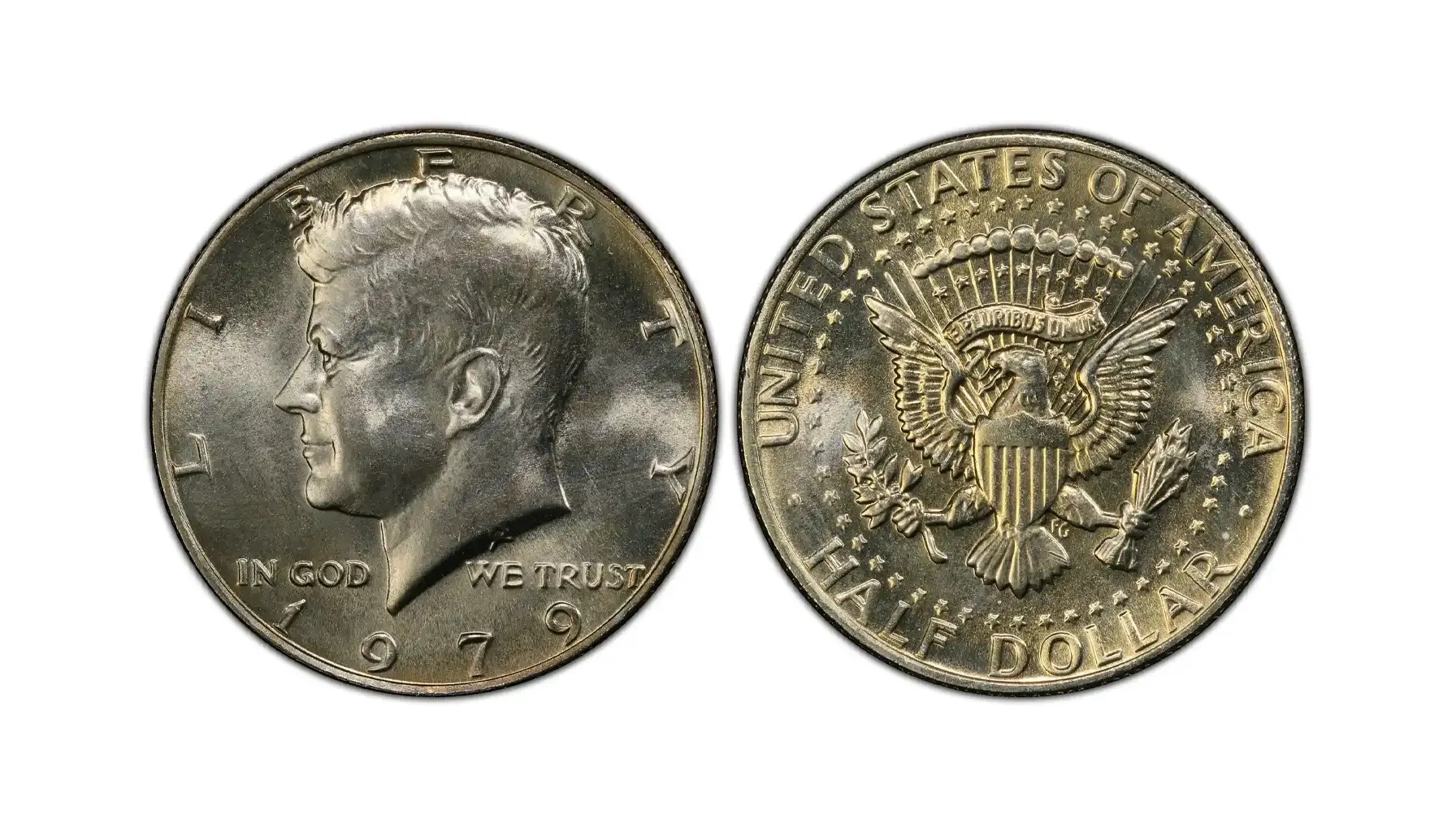
Produced by: Philadelphia Mint
Mintage: 68,312,000
Auction Record: $4,113 for MS64
In 1979, the Philadelphia Mint was the most productive minting facility, which released more than 69 million coins for general circulation. Although these might easily be found in circulated conditions, Mint State examples are decent enough to be sought after by collectors, thanks to their sharp detail and well-preserved surfaces.
1979-D 50C (Regular Strike)
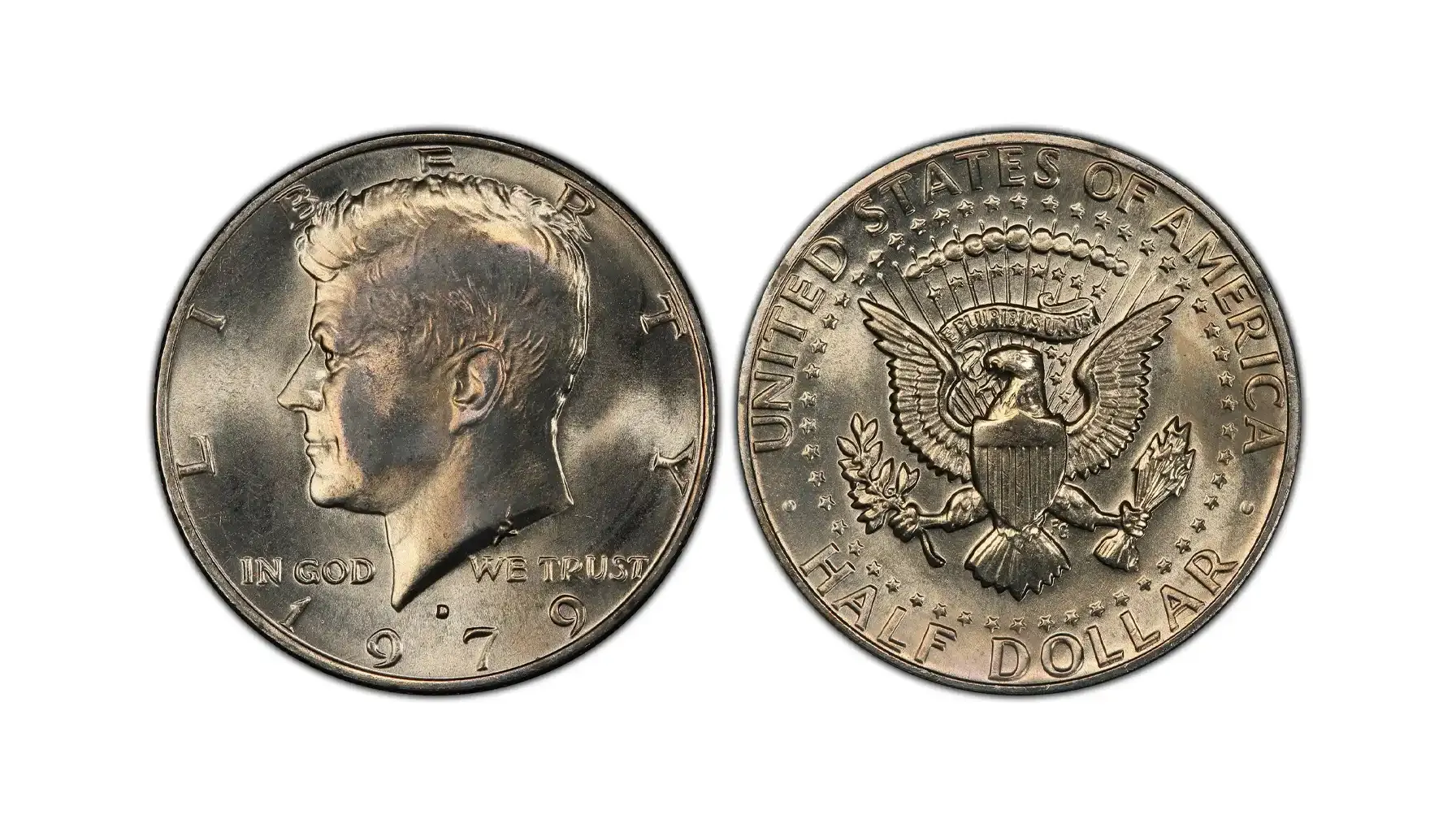
Produced by: Denver Mint
Mintage: 15,815,422
Auction Record: $5,750 for MS68
When compared to the precious type, the Denver-minted variety may boast limited production quantities, which are far scarcer in higher grades. In this case, the 1979 JFK half dollar value may exceed a few thousand because of clean strikes, well-defined relief, and limited availability.
1979-S 50C Type 1 and Type 2 (Proof)
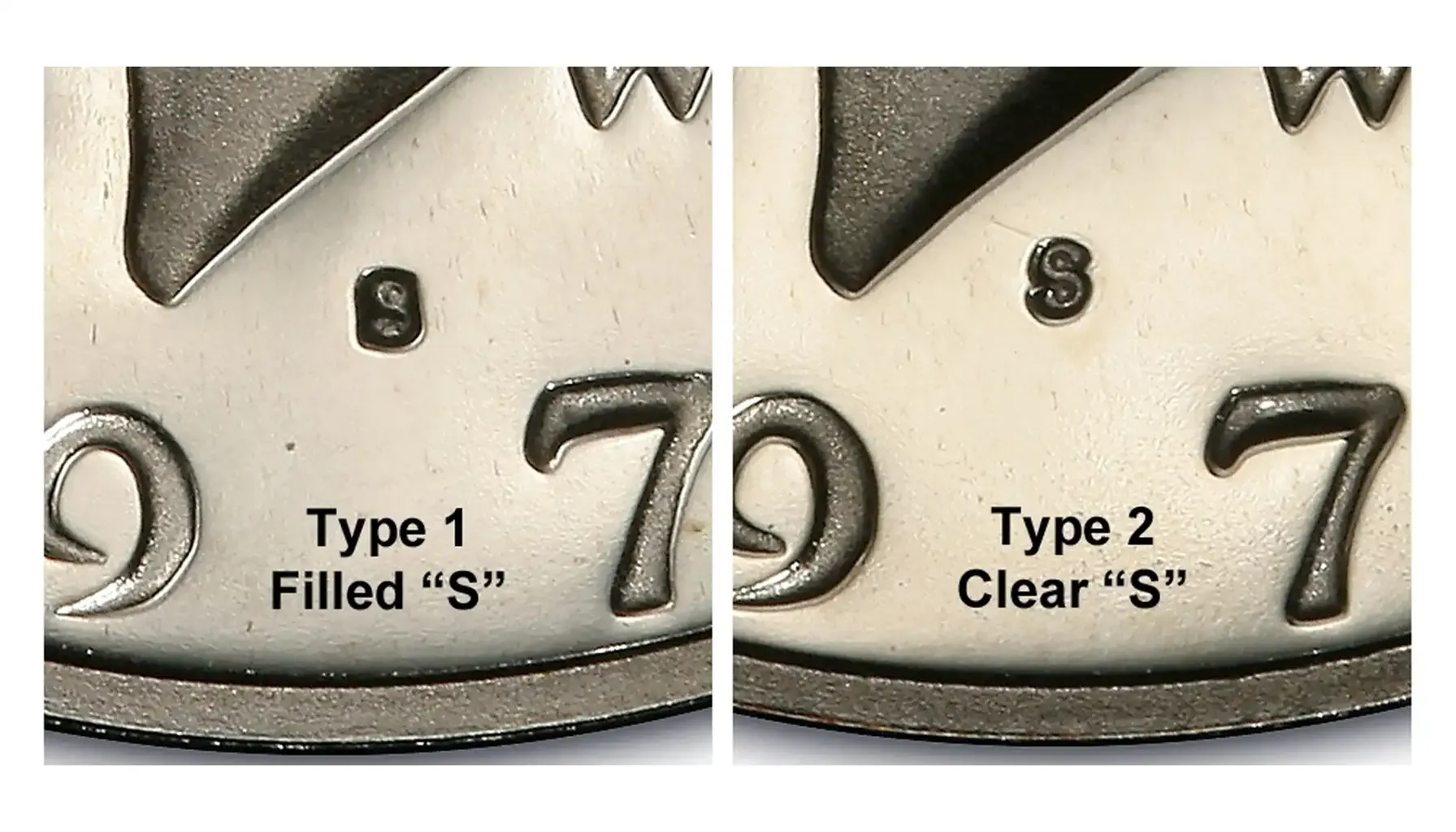
Produced by: San Francisco Mint
Mintage: 3,677,175
Auction Record: $1,208 for PR70
Proof coins are always the most peculiar, but the 1979 issue was even more special. As such, there were two major types of proof coins, with Type 1 bearing the filled "S" mint mark on the obverse side and Type 2 featuring a clear "S". When found in uncirculated (approved) grades, these numismatic creations may be quite valuable, though their original purpose and initial preservation make them decently priced.
How Much Is a 1979 Half Dollar Worth?
Money has its own price, too. The 1979 half dollar coin value, for instance, is a complicated variable that relies on several factors (these will be discussed further). According to statistics, collectors are ready to pay a lot for uncirculated or proof coins, but circulated options may also contribute to the worth of your collection anyway.
Grade | 1979 50C | 1979-D 50C | 1979-S Type 1 Proof | 1979-S Type 2 Proof |
Circulated (VG–F) | $0.50 – $1 | $0.50 – $1.50 | N/A | N/A |
About Uncirculated (AU50–AU58) | $2 – $4 | $3 – $6 | N/A | N/A |
Mint State (MS60–MS63) | $5 – $10 | $10 – $20 | $30 – $60 | $50 – $120 |
High Mint State (MS64–MS65) | $15 – $25 | $25 – $50 | $70 – $120 | $150 – $300 |
Top Proof / PR70 | N/A | N/A | $150 – $1,208 | $500 – $3,738 |
Note: Values listed are general ranges for 2025 and can vary (especially during bidding wars). Rare finds, well-preserved coins, and trending collector interest can cause significant swings in price after all.
The Main Elements Behind the 1979 Half Dollar Value
Now that one is well aware of the main half dollar coin 1979 value ranges, it is reasonable to understand what defines it and which factors may contribute to the end price. Let us see.
Condition & Grade
The first and foremost factor in determining the market value is the condition of a coin. In particular, they are usually graded on a scale from Good (G) to Mint State (MS70), with higher numbers indicating more well-preserved pieces.
Coin grading scale: Good (G) → About Uncirculated (AU) → Mint State (MS60–MS70)
Circulated coins: May be sold for the face value or a bit higher, depending on wear
Uncirculated coins (MS60–MS65): Are not confined to the melt value or what is stated on the face.
Proof coins: Mirror-like fields and flawless details, especially Type 2 proofs, can command hundreds or even thousands of dollars
Mint Marks $ Mintage
The place of origin and mintage figures (i.e., how many were produced) are also vital. As mentioned above, the 1979 issues were produced by three major facilities, located in Philadelphia, Denver, and San Francisco. Coins with lower mintage generally have higher collector value, yet it is not a golden rule.
Philadelphia (no mint mark) – 68,312,000 minted; common in circulation
Denver (D) – 15,815,422 minted; scarcer, higher premiums in MS grades
San Francisco (S, proof coins) – 3,677,175 each for Type 1 & Type 2; most collectible
1979 Half Dollar Errors & Varieties
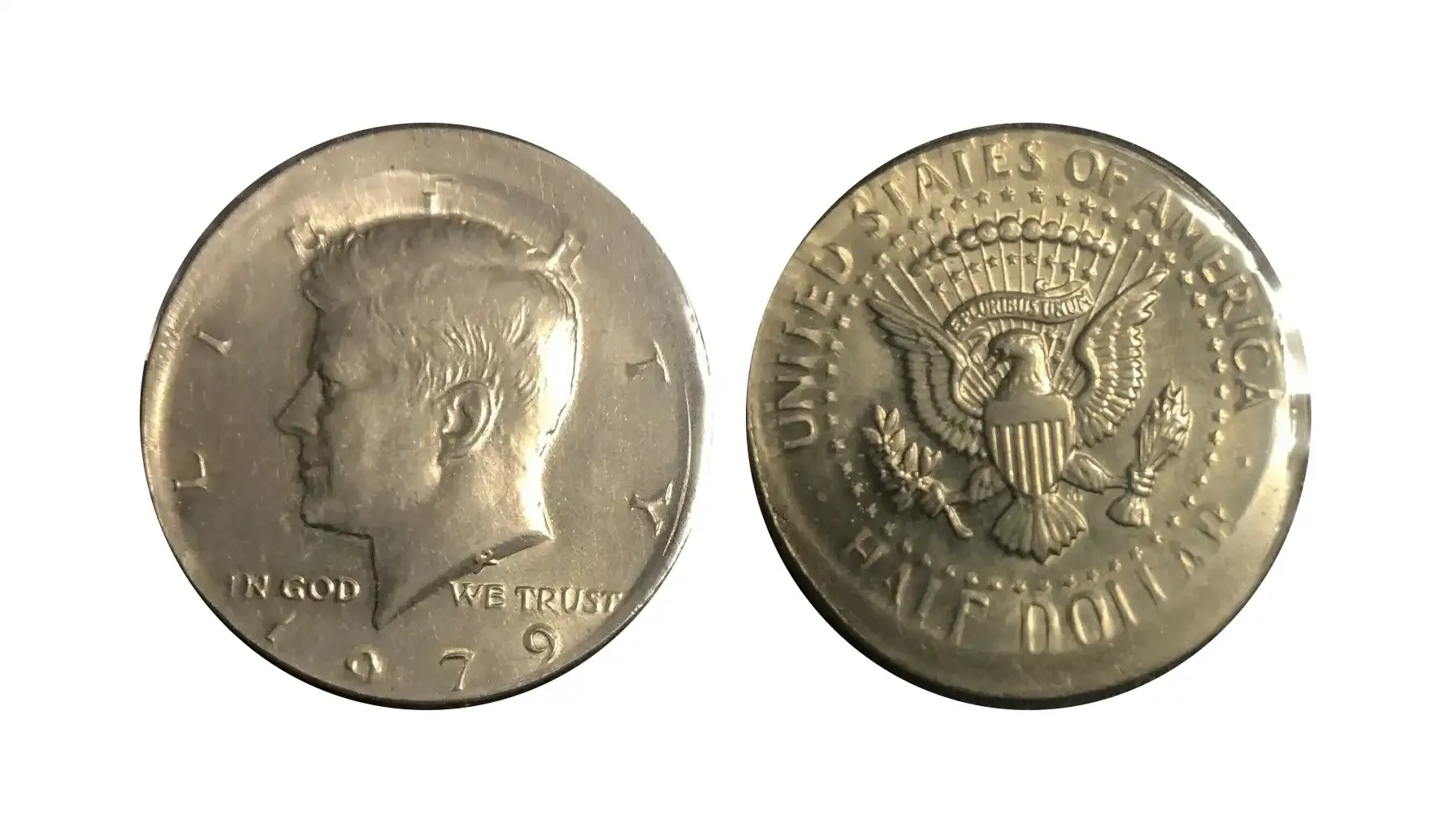
Sometimes, coins may bear imperfections, but these boost the half dollar 1979 value even more. This means that any minting deviation may turn a relatively common piece into an exclusive creation that cannot be repeated anyhow. As for particular instances, these include:
Off-Center Strikes: Misalignment of the design.
Broadstrikes: Enlarged, thinner pieces struck outside the restraining collar
Clipped Planchets: Instances with curved or straight-edge gaps from improperly cut blanks
Die Cracks: Raised lines formed by fractures in the die
Cuds: Blobby, raised areas where part of the die has broken away
DDO (Doubled Die Obverse): Visible doubling of letters, numbers, or design features on the obverse side
DDR (Doubled Die Reverse): Visible doubling of inscriptions or design features on the reverse side
Struck Thrus: Indentations or distortions caused by debris or objects between die and planchet
In this case, errors may be far more valuable than the instances of general circulation. Exclusiveness is the key.
Metal Content
Finally, it is time to turn to the metal content, i.e., the factor that involves the initial, metal-focused worth. Throughout the years of production, some proofs have been minted in silver, while many “normal” pieces were struck in copper-nickel clad. The latter are, by logic, a bit more expensive due to the precious metals that even beat the public demand.
Values May Grow but Only If You Spot Them
The 1979 Kennedy half dollar worth is not based on its age or metal. Instead, it is a combination of aspects, which should be analyzed all at once. Nonetheless, we know how difficult and flabbergasting it may be to inspect numismatic creations on your own. But fear not: there are numerous digital opportunities to identify coins and make their processing easier and less stressful – Coin ID Scanner.
What Is Coin ID Scanner?
Coin ID Scanner is an innovative application that helps you identify coins and reveal everything you need to know: years of minting, country of origin, type, edge, composition, weight, diameter, and even current price ranges per grade. But what is more, it helps you grow as a collector!
Feature | What It Brings |
Photo Identification | Snap or upload a coin photo to unlock a full profile with price info |
Digital Collection | Build and manage your personal collection in one secure place |
Global Database | Access 187,000+ coins from all over the world |
Smart Filters (Pro) | Refine searches by country, period, material, or mint |
AI Coin Helper | Get instant tips and numismatic insights to your needs |
Even a common half dollar can be collectible. Explore what you hold, and let the collection expand!

 Facebook
  X (Twitter)
  Pinterest
  LinkedIn