Contents:
There are different series of coins that last for centuries, but the economy does not stand still, so a token with the same image may cost differently in different years due to composition and circulation.
Therefore, before you decide to identify coins and its value yourself, study the history and what generally affects the price.
What Lies Behind The 1968 Jefferson Nickel
Composition and Design
The Design:
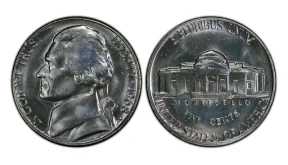
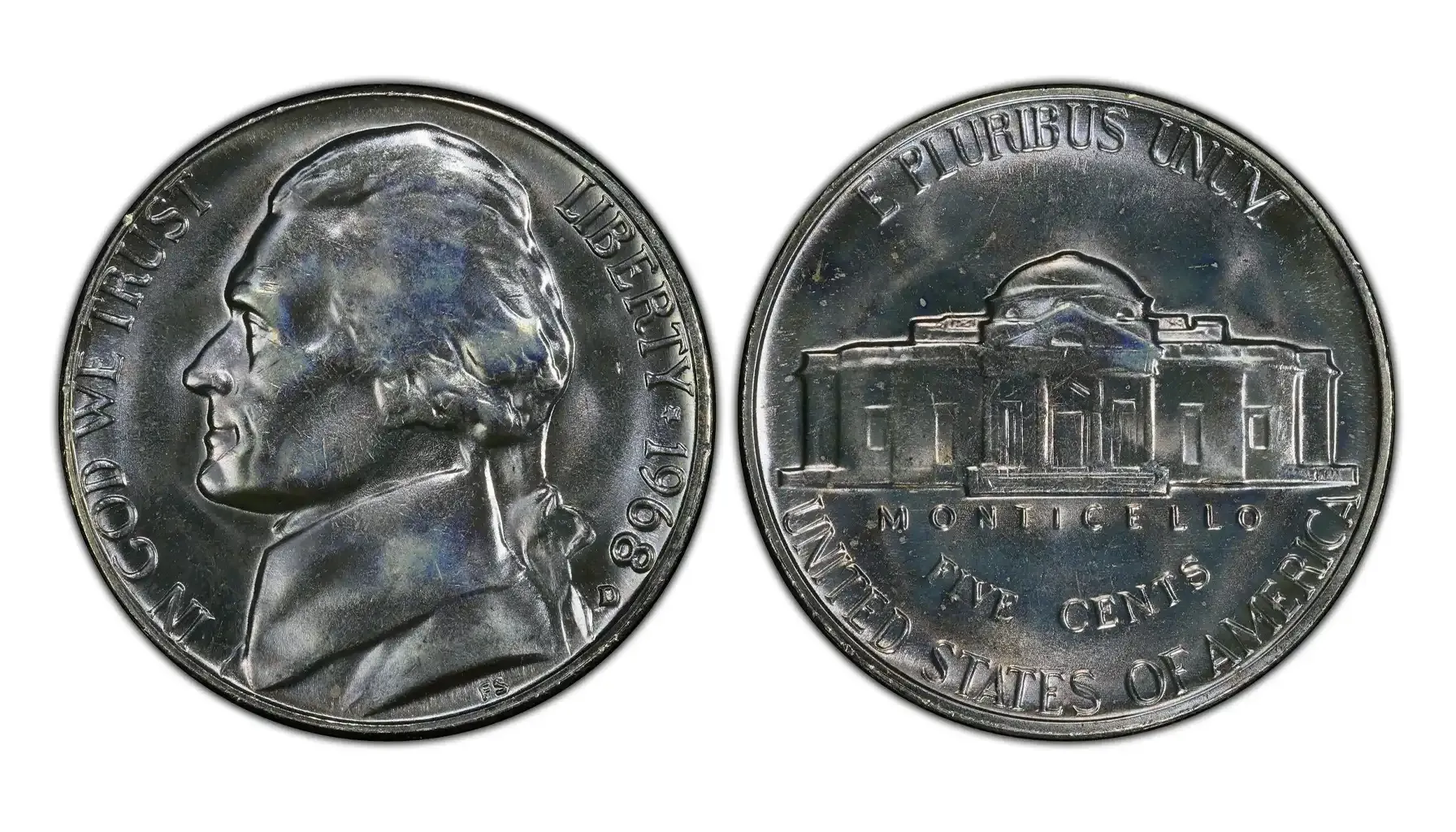
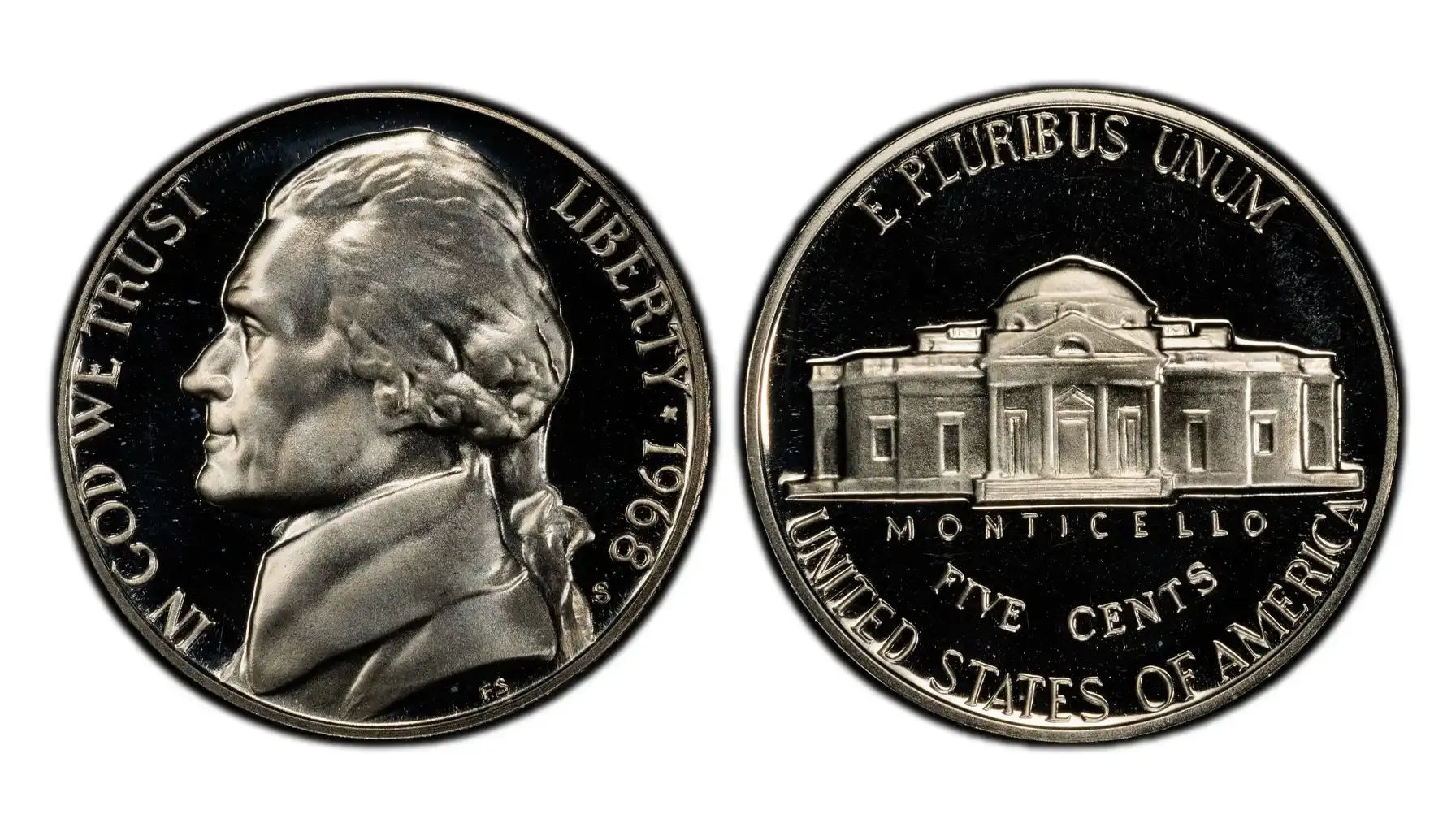
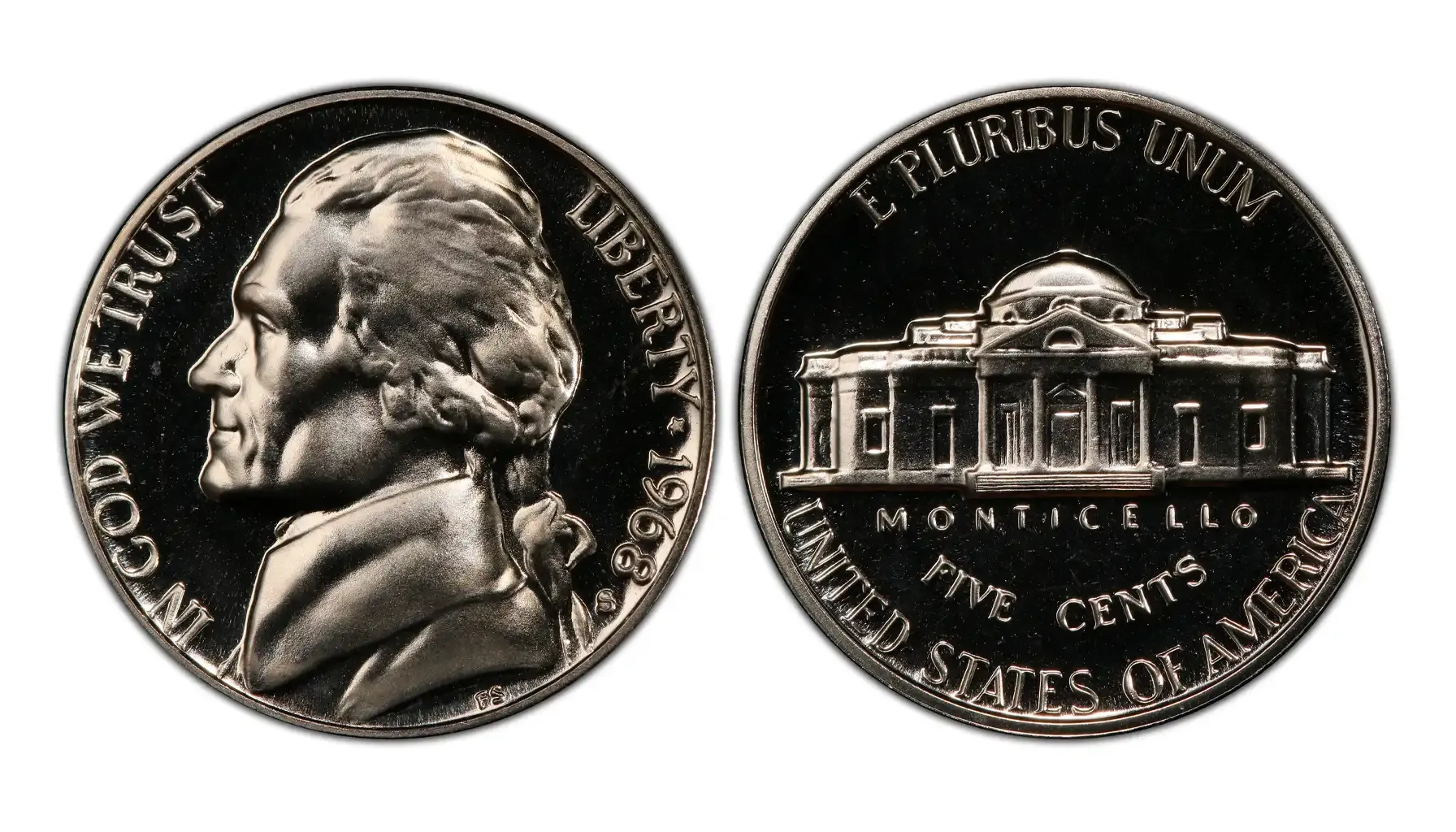
Obverse: Thomas Jefferson, the third president of the United States, looks to the left, and to the left of his face is the inscription "IN GOD WE TRUST" is on the left of his face, "LIBERTY" and the year are on the right.
Reverse: The coin depicts Jefferson's large house in Monticello, with "MONTICELLO" written above the house, below it is "FIVE CENTS", and around the edge of the coin is "UNITED STATES OF AMERICA" and "E PLURIBUS UNUM".
The Composition:
1942–1945: "War Nickels" were made from a composition with 35% silver content.
From 1946 until 1968: 75% copper and 25% nickel
Why the Mint Mark Matters
Mint Place | Mint Mark | Mintage |
Denver | D | 91,227,880 |
San Francisco | S | 3,041,506 |
The Main Idea:
San Francisco and Denver made a very large number of coins, and they are very easy to find, so most of them may be inexpensive, but if they are in perfect condition, the price tag may well be high.
San Francisco additionally made Proof coins for collectors.
That year, Philadelphia used its production facilities to mint other denominations of cents, dimes, and quarters, so all tokens this year are mint-marked.
“Although Mint Director Eva Adams blamed collectors, and just about everyone else except herself, for the coin shortage of the 1960s, it was essentially over by late in 1967. Coinages then returned to more reasonable levels.
Beginning in 1968 Director Adams ordered that the mintmark be changed to the obverse of all coins. She also arranged for all proof coins to be struck at the re-opened San Francisco mint, taking this task away from Philadelphia.”
— R.W. Julian, American numismatist, writer and researcher
Numismatic News
How to Identify Your 1968 Nickel
Finding the Mint Mark
The Mark's Location:
On the reverse of the coin, to the right of the image of the Monticello house, there is a mint sign.
Letter "D": The coin was made in Denver
Letter "S": The coin was made in San Francisco
Varieties and Errors
Full Step (FS)
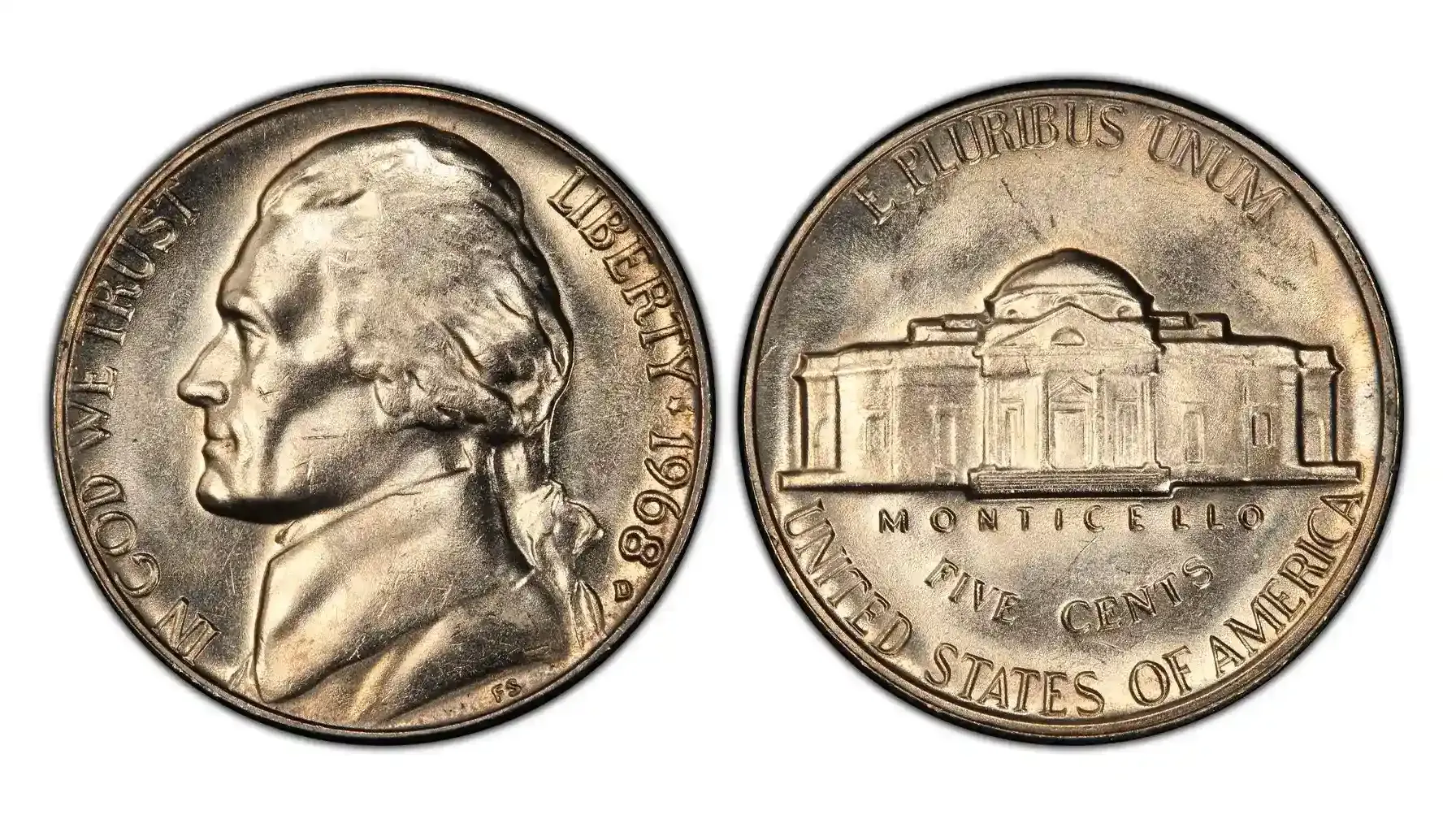
This is not a mistake, but an important detail, because "Full Step" means that five or six steps of a house are clear, solid and in no way broken.
When making coins, the central parts are often not processed strongly enough or the tools are old, so the steps are weak.
Rare and cost much more than regular MS-65 coins.
Doubled Die
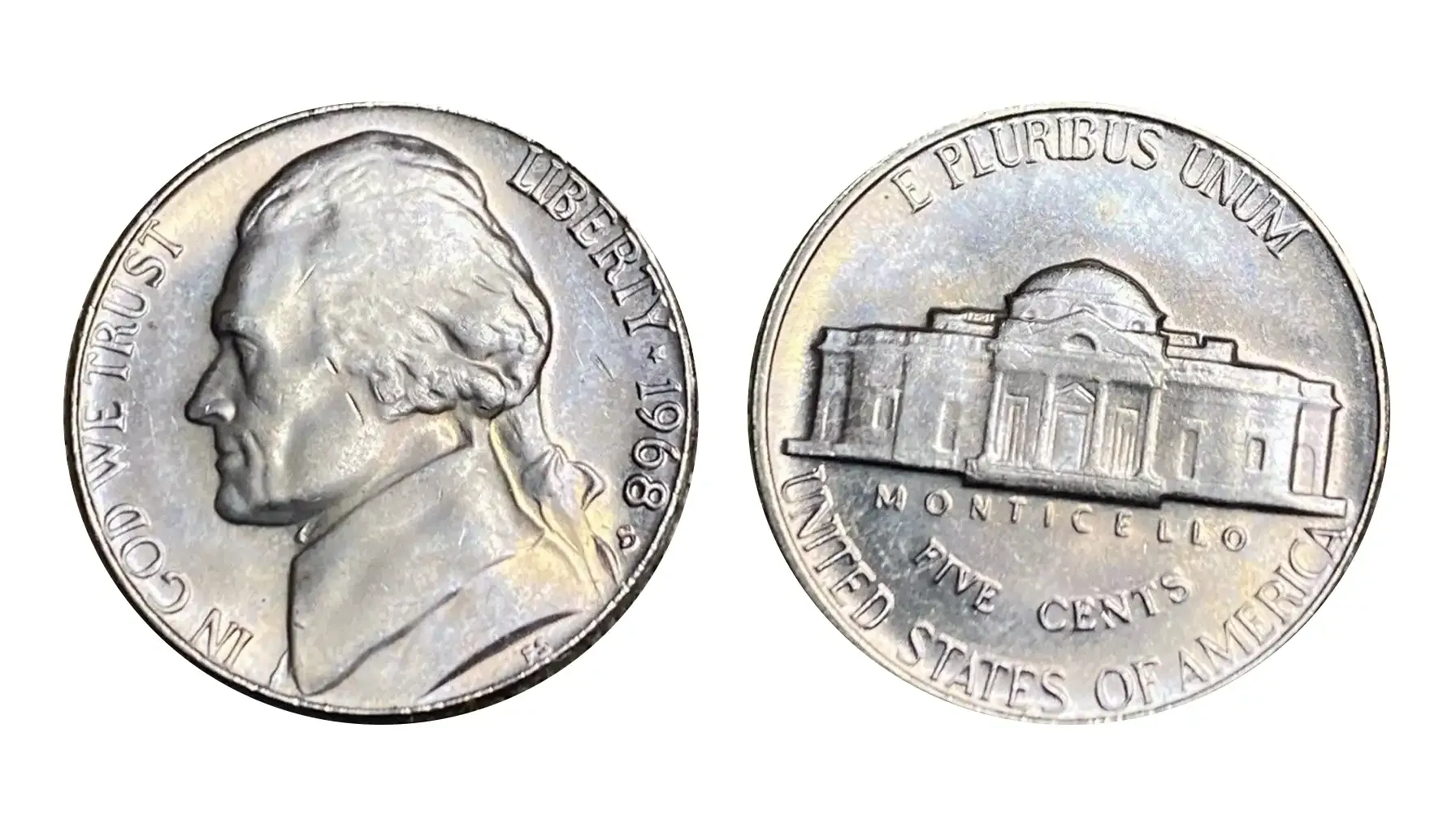
Doubled Die Obverse: doubling of the letters in "LIBERTY" and "IN GOD WE TRUST", and also in the date "1968".
Doubled Die Reverse: doubling of the writing "MONTICELLO", "FIVE CENTS" or "E PLURIBUS UNUM".
Repunched Mint Mark
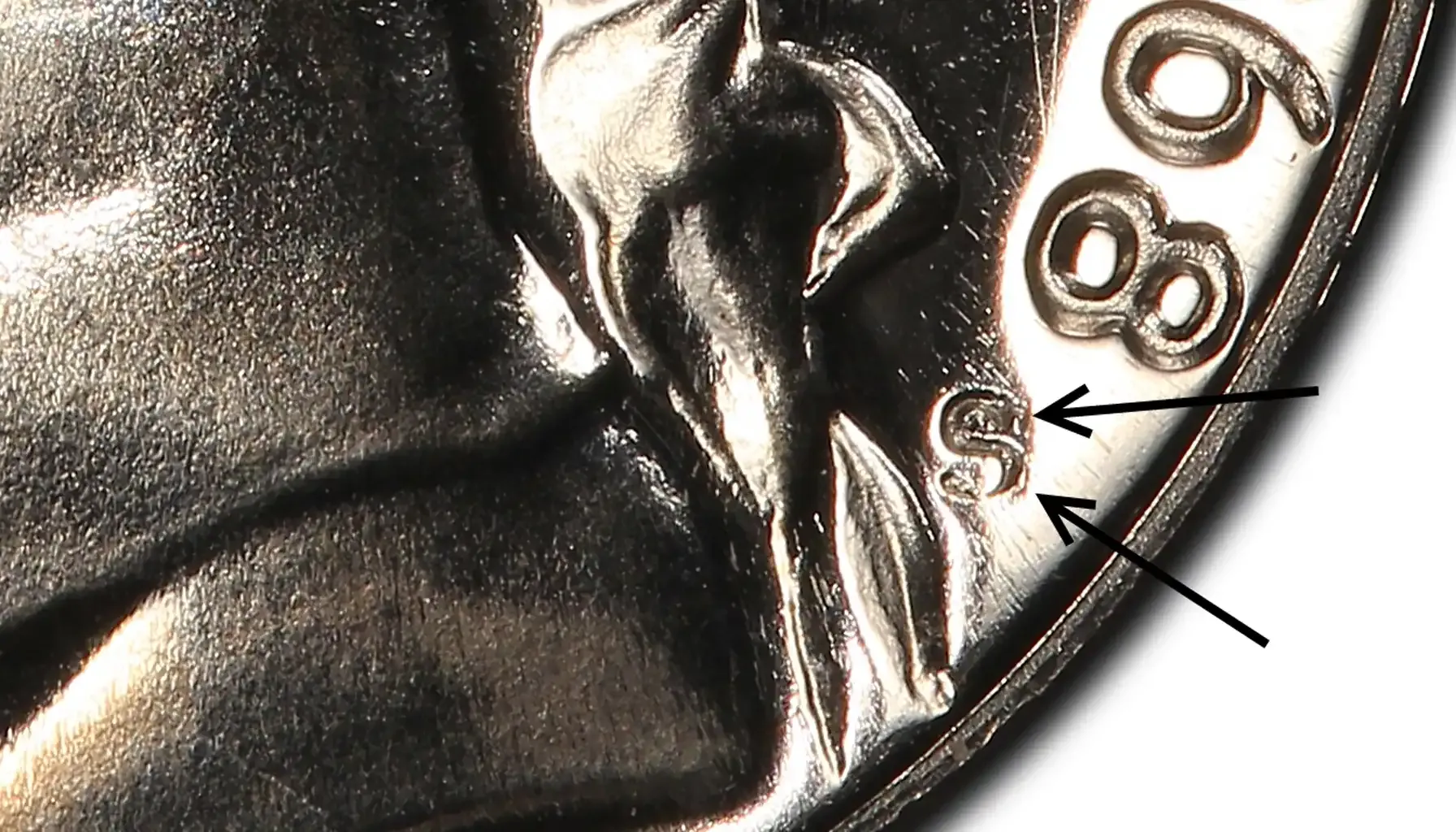
The mint mark was put onto the working tool by hand.
Look for signs of a previous, moved, or turned hit of the letter "D" or "S" next to the final mark.
Off-Center Strike
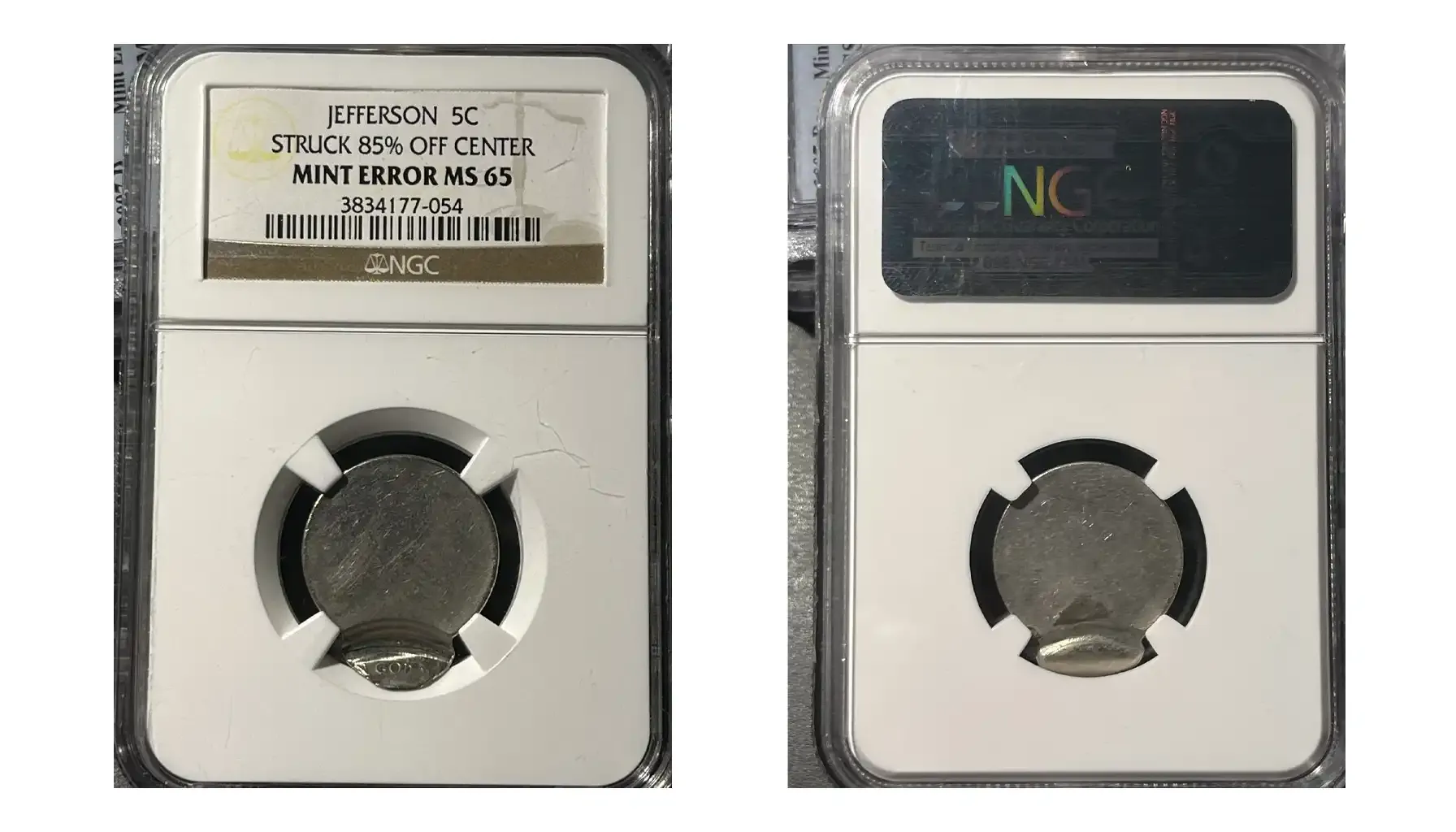
The image appears to be shifted, meaning there may be no pattern, and an empty space may be visible on the coin, and the more the coin has moved as a percentage, the higher the error value.
How Much Is a 1968 Nickel Worth Today?
The Grading System
Grade | Description |
G-4 | The basic shapes of Jefferson and Monticello can be seen, and the writings and date may be rubbed off |
VF-20 | There are signs of use on all the high parts of the coin, and on Jefferson's face, you can only see the general shape of his hair, but the writings are easy to read |
AU-58 | There are only very small signs of use on the highest parts |
MS-60 | Wasn’t used as money, but it may have small marks from being stored not really properly |
MS-65 | With a strong shine and only a few small marks on the surface |
You should never clean an old coin, even if it seems dirty and old.
The dirt and color on the coin, called patina, shows its age and history, and if you try to clean the coin with strong water or soap — you will change the appearance of the surface and damage its original condition, and a professional collector will immediately realize that the coin has been cleaned, and it will greatly reduce its price.
Current Value Chart
Coin | Mark | G-4 | MS-60 | MS-65 | MS-65 FS |
Regular | No Mint Mark | $0.05 | $0.50 - $1.00 | $3.00 - $8.00 | $75 - $125 |
Regular | D | $0.05 | $0.50 - $1.00 | $3.00 - $8.00 | $85 - $150 |
Proof | S | - | $4.00 - $6.00 | $15 - $35 | $50 - $100 |
The 1968 S nickel value can change based on market demand, condition, grading, and the specific characteristics of individual coins.
All Information In a Moment
It can be difficult for a beginner to immediately and quickly assess the 1968 coin value, so there are some life hacks that will help you 100%.
Study Through Coin ID Scanner
Main Helpfulness:
Quick Identification: By using the image recognition technology, you can just take a photo of your 1968 nickel, and the Coin ID Scanner will quickly find the year, the mint place, and sometimes even possible mistakes.
Current Value: It gives you the most correct market price based on the coin grade you put in.
Organizing Your Collection: It lets you keep all the information about every coin: photos, the date you got it, the price, the current grade, and the estimated, for example, 1968 D nickel value.
How to Grade
After you know the mint place and the likely grade, for example, MS-65, you may ask the community for their opinion on 1968 nickels worth money.
Because the coin collecting market always changes, the value of your collection will be updated quickly in the app, and this lets you know when the price for your 1968-D FS nickel is at its highest point.
Conclusion
It is worth considering the history of each token, but not so much out of a great love for history, as to understand and analyze how many copies could approximately remain and, most importantly, how the composition has changed. Therefore, if they say 1968 five cents with an admixture of silver at the auction, run away from it.
FAQ
How much is a 1968 nickel worth?
The value of the 1968 nickel goes from 5 cents to $150 and more.
Where is the mint mark on a 1968 nickel?
The mint mark is located on the reverse, between the building and the edge of the coin, just above the writing "MONTICELLO" like on the 1968 S Jefferson Nickel.
Is a 1968 nickel silver?
No, the 1968 nickel is not silver. It is made from 75% copper and 25% nickel.
What makes a 1968 Nickel D rare?
It is rare in very high uncirculated conditions (MS-65 or better), if it has Full Steps on Monticello, or has a rare production mistake.
How can I tell if my 1968 nickel is uncirculated?
Uncirculated coins keep their first minted look, so if the coin is dull or the surface looks smoothly rubbed, it is used.

 Facebook
  X (Twitter)
  Pinterest
  LinkedIn