Contents:
The 1966 Washington quarter is a part of transitional minting. The change in metal composition made this issue an important subject of study. Everyone has heard of this quarter. But only a few know it can be valuable.
How much is a 1966 quarter worth? Use a free coin identifying app on your smartphone to easily recognize the basic characteristics of the specimen you found. An accurate assessment of minting details helps to judge the real value of a 1966 quarter.
Why the 1966 Quarter is Unique
The 1966 quarter marks a radical change in U.S. coinage. After silver prices spiked, the government switched to base metals to prevent a total coin shortage. This year remains a primary example of how American currency transitioned from precious metal to modern clad composition.
Main factors to note:
Composition: First full production year using copper-nickel instead of 90% silver.
Volume: Massive mintages created by 24/7 production to replace hoarded silver coins.
Anonymity: Intentional removal of mint marks to discourage coin collecting and hoarding.
While common today, the 1966 quarter is a historical witness to the "Silver Crisis" that changed the manufacturing of U.S. money.
The 1964 Coin Impact on 1966 Mint Marks
The cash crisis of the mid-1960s led to a rapid increase in the price of silver on world markets. Until 1964, all Washington quarters contained 90% pure precious metal.
The intrinsic value of the metal in old coins exceeded their face value of 25 cents. This led to the mass melting down of cash by the population for profit.
The main reasons for the radical changes of 1966 were:
Completely running out of government silver reserves
Mass hoarding of 1964 silver coins
Forced transition to a cheap copper-nickel alloy
A three-year government ban on mint marks
Dealing with numismatists speculating on rare series
The Coinage Act of 1965 effectively erased the visual differences between issues from different mints, thus all of them produced 1966 no mint mark quarters.
Here is another coin you may be interested in: 1964 Silver Quarter.
High Mintage and Survival in Circulation
The US mints switched to round-the-clock operation in order to stop the economic paralysis. The total circulation of the 1966 quarter became one of the largest in the history of the Washington series.
A comparison of circulation figures is shown in the table below.
Year of Issue | Mintage numbers | Composition |
1964 | 1 264 526 000 | 90% Silver |
1965 | 1 819 717 540 | 75% copper, 25% nickel over a pure copper center |
1966 | 821 101 500 | 75% copper, 25% nickel over a pure copper center |
Decades of active circulation have caused several characteristic signs of wear on any coin:
Complete loss of the original shine
Strong blurring of the fine details of the relief on Washington's head
The appearance of deep dents and numerous scratches
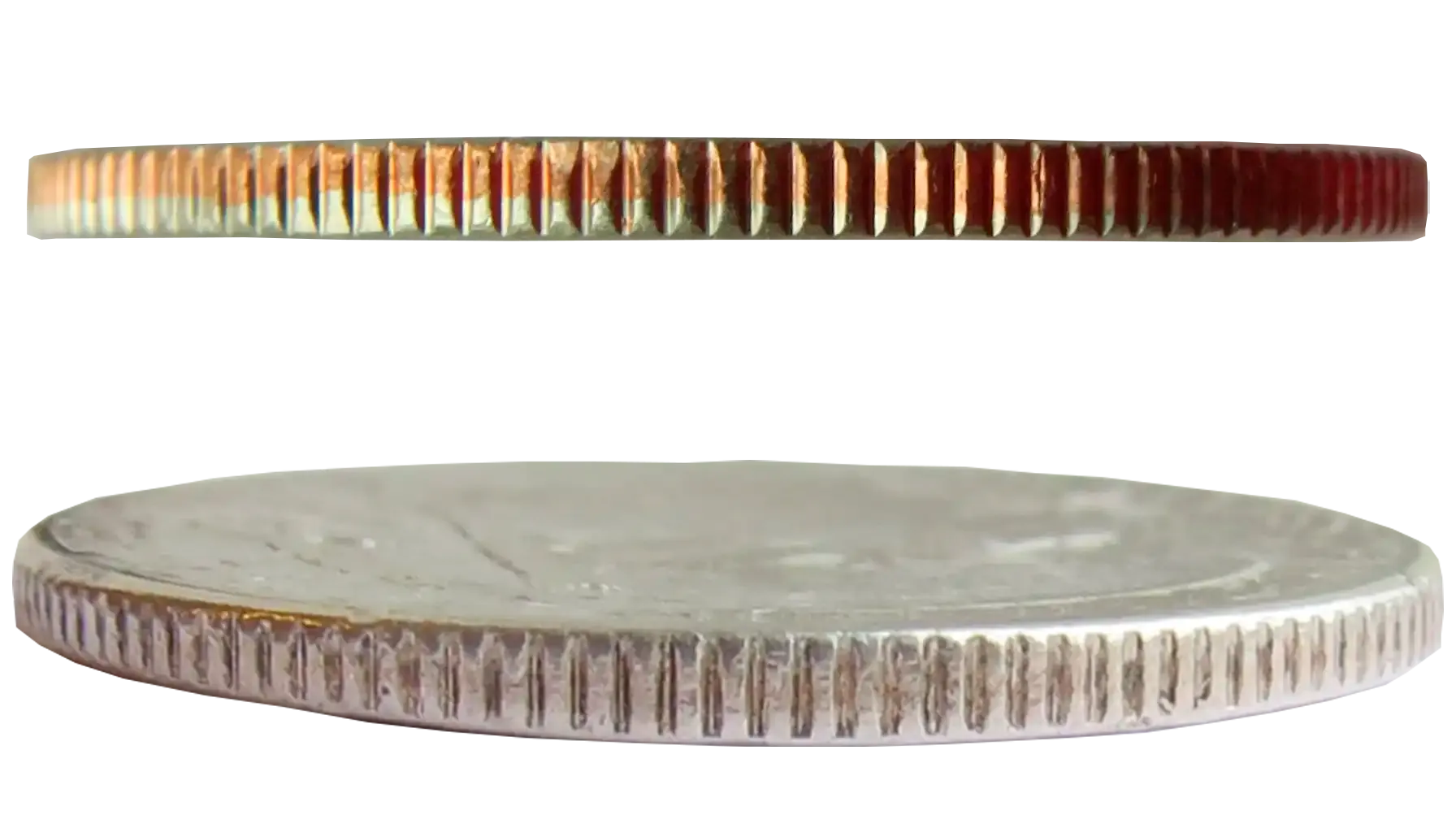
Darkening of the copper core is visible on the edge of the coin
Absence of well-preserved specimens in circulation
Today, it is uncommon to find a 1966 coin without signs of wear in a wallet.
Almost all perfect specimens have long been in private albums or special plastic cases.
Design and Specifications of the 1966 Quarter
The visual design of the coin has preserved the traditional features established in 1932.
The changes only affected the metal's structure to ensure the coin's durability.
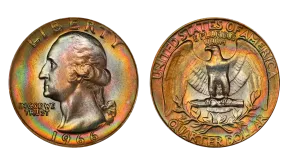
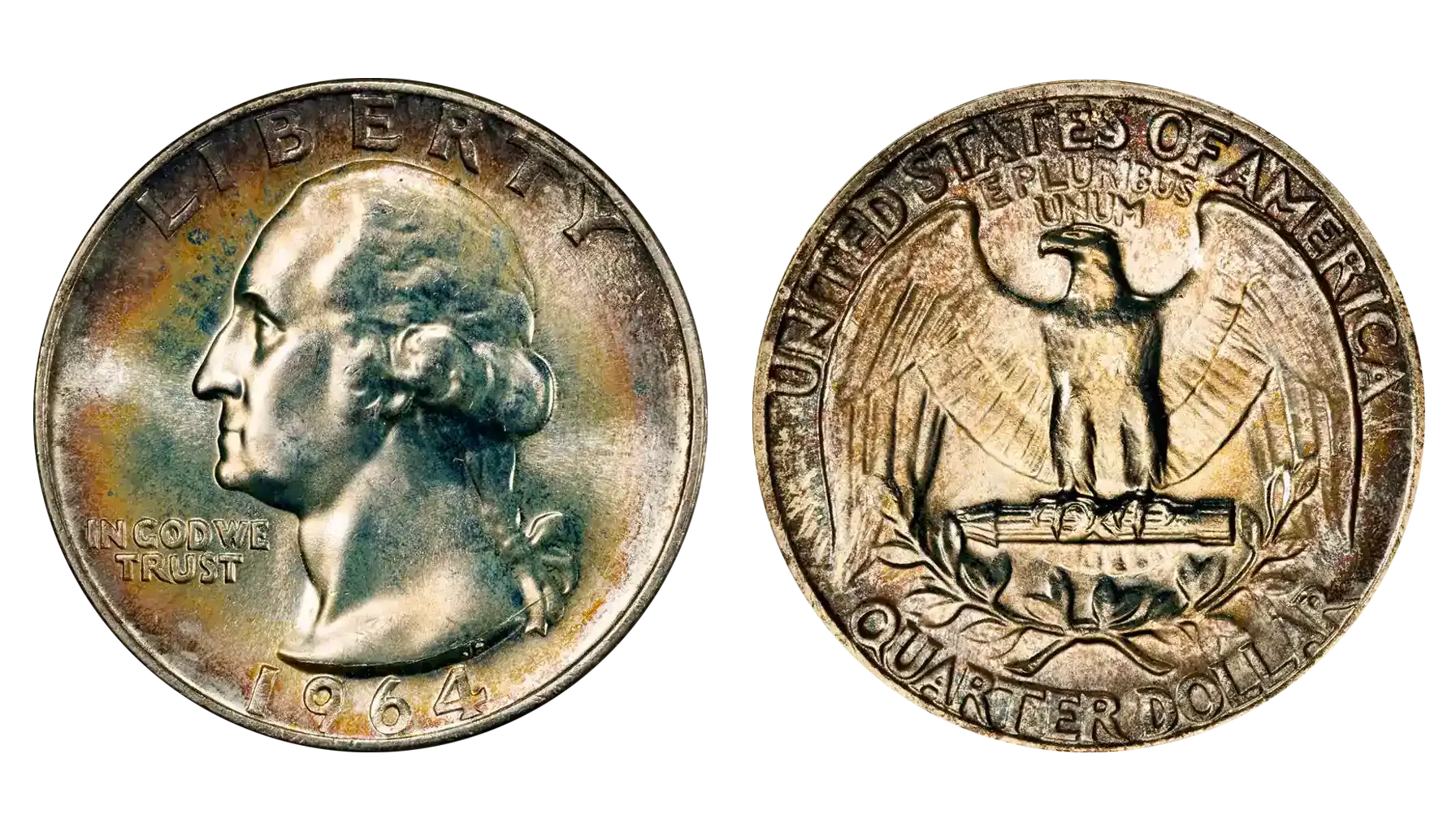
Obverse (Heads): The Washington Portrait
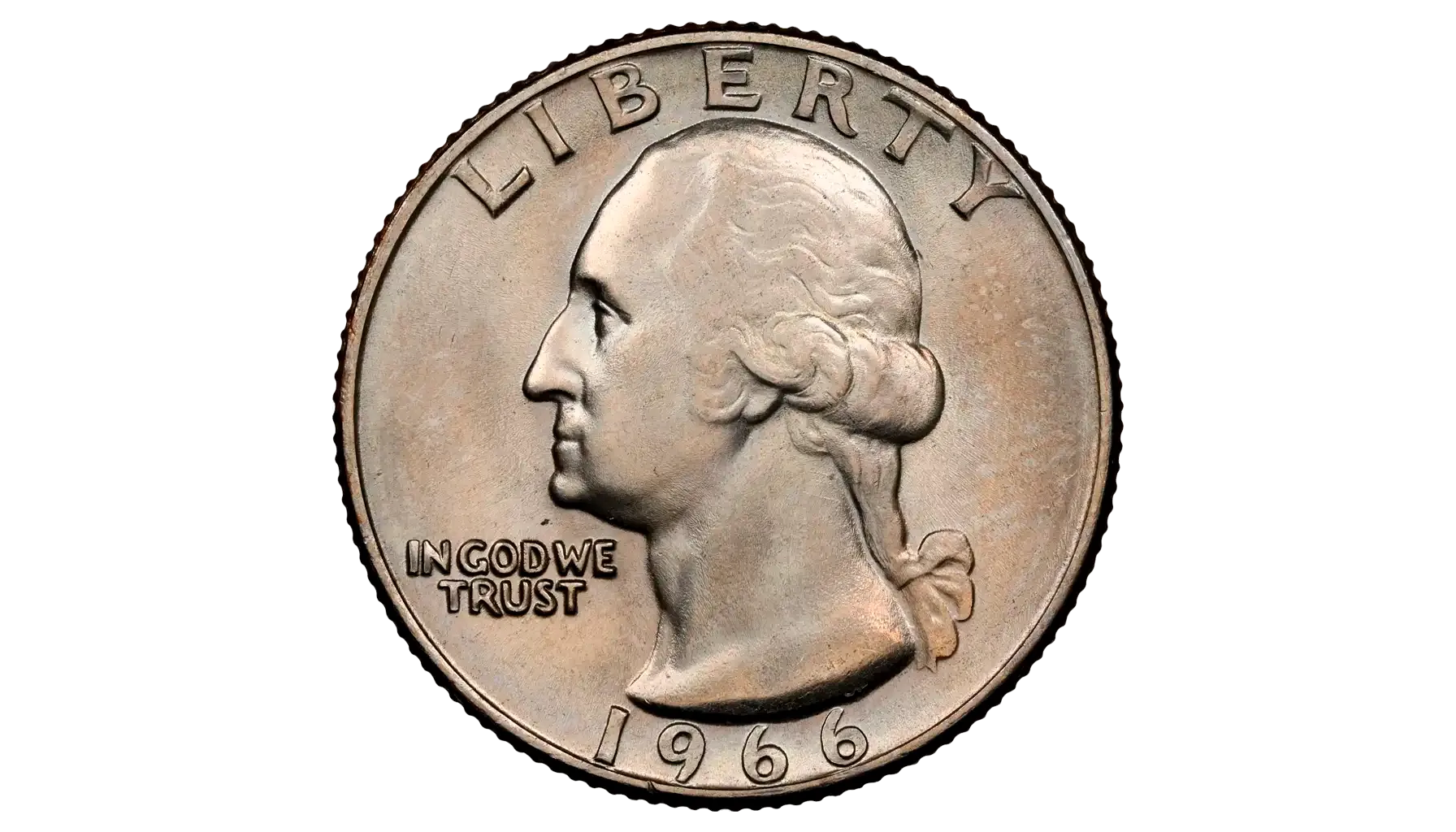
The obverse shows George Washington's profile facing left. Sculptor John Flanagan based this design on a bust by Jean-Antoine Houdon.
Above the president's head is the inscription "LIBERTY." To the left of his neck is the motto IN GOD WE TRUST, which has become a mandatory element of American currency.
The year of issue, 1966, is minted at the bottom of the field below the portrait.
Reverse (Tails): The Heraldic Eagle Design
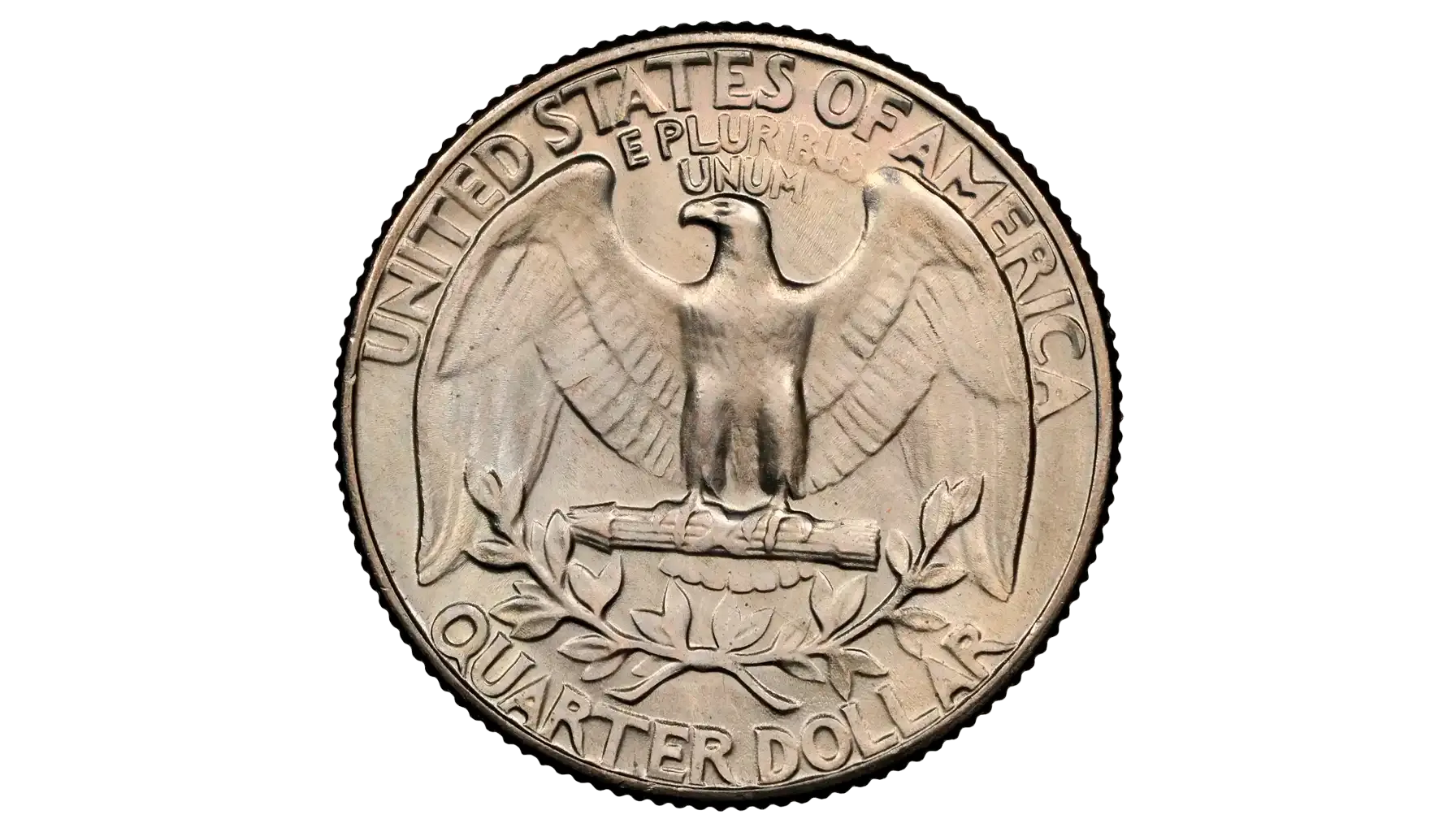
The reverse displays a bald eagle standing with spread wings. It grips thirteen arrows bundled together over two crossed olive branches.
Specific inscriptions found on the reverse:
UNITED STATES OF AMERICA, following the top curve
E PLURIBUS UNUM struck above the eagle
QUARTER DOLLAR located at the base
Clad Copper-Nickel vs. Silver Predecessors
By 1966, the Mint changed the metal mix. Every 1966 quarter is made of a copper-nickel clad. It has a solid copper core with an outer layer of 75% copper and 25% nickel.
Main characteristics for the 1966 quarters:
Weight: 5.67 g
Diameter: 24.30 mm
Edge: 119 reeds
Because of this change, the silver content of the 1966 quarter is zero. Since there is no precious metal, the value of a 1966 quarter is usually just 25 cents.
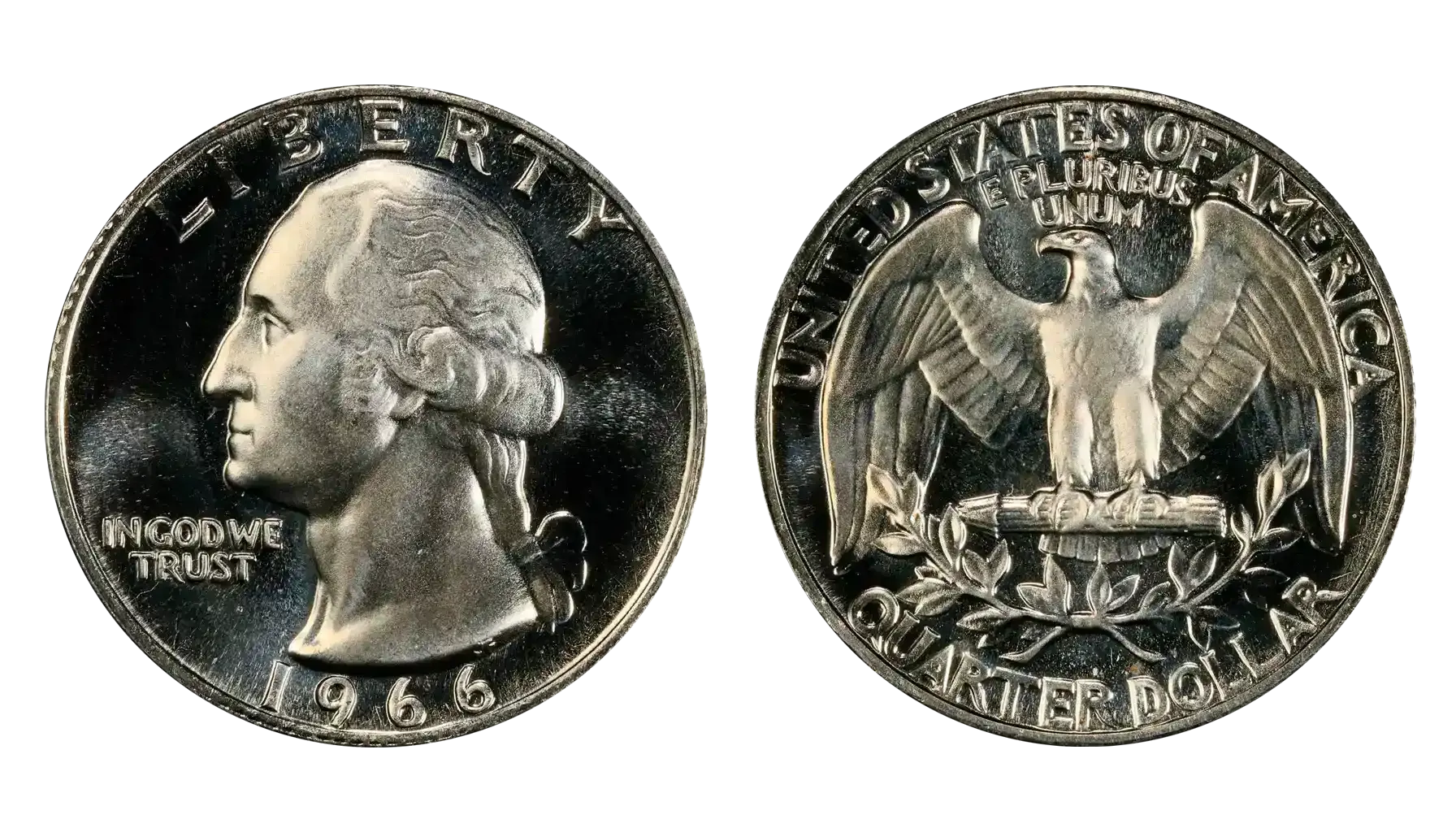
Some 1966 coins were issued in Special Mint Sets (SMS). These have a satin finish and a sharper strike than normal coins. While they look better, the metal is exactly the same as coins used in stores.
If you are interested in collecting sets, please check other US Coin Sets.
The Significance of the "No Mint Mark" on 1966 Quarters
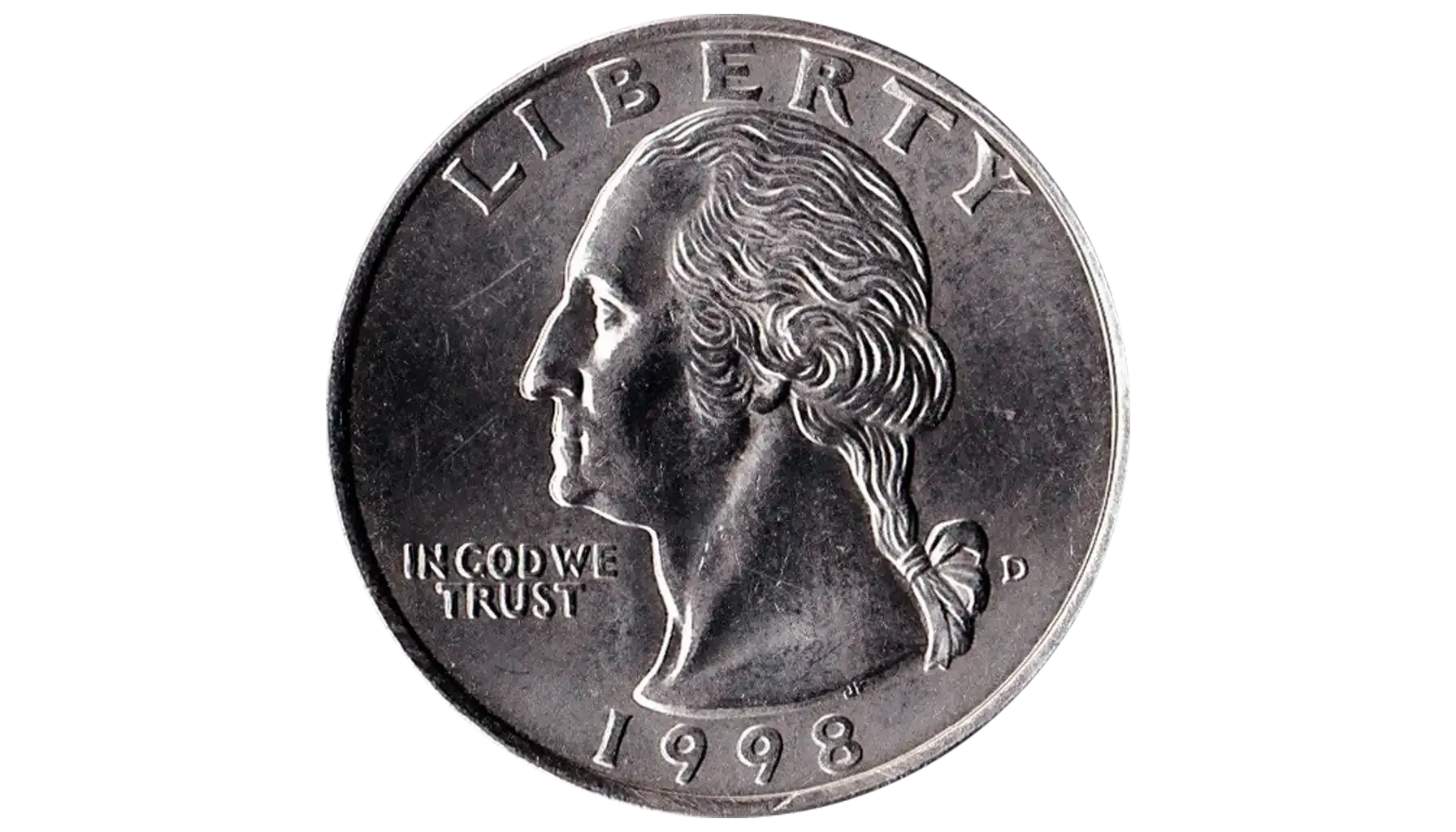
The absence of a mint mark is not a mistake, but a conscious step taken by the government. In the mid-1960s, numismatists and speculators actively withdrew coins from specific mints from circulation. The result was an artificial shortage.
Why No "D" or "S" Mint Mark? A Temporary Policy Explained
Where is the mint mark on a 1966 quarter? The thing is that all the mint marks are missing. The 1966 issue is notable for the complete absence of mint marks on all coins minted.
The US Treasury Department introduced this temporary measure to combat an acute shortage of small change.
The government's strategy was to create the most uniform means of payment possible, devoid of any collectible appeal. Therefore, collectors cannot see the familiar P, D, or S quarter varieties.
The authorities expected the 1966 quarter with no mint mark to be actively used for its intended purpose without its removal to private collections.
Identifying a Genuine 1966 Quarter: What to Look For
To distinguish a standard copper-nickel 1966 quarter from older silver issues, check these technical characteristics:
Feature | Silver Quarter (Pre-1965) | 1966 Quarter (Clad) |
Composition | 90% Silver, 10% Copper | Copper-Nickel "Sandwich" |
Weight | 6.25 g | 5.67 g |
Edge View | Solid silver-white | Two-toned (copper stripe visible) |
Drop Sound | High-pitched "ring" | Dull metallic thud |
Main things to check first of all
Edge Color: Look at the coin's side. A genuine 1966 quarter shows a distinct orange/brown copper core between nickel layers. Silver coins have a solid white edge.
Weight: Use a digital scale. A 0.58-gram difference immediately separates silver blanks from clad production.
Visual Luster: Silver has a soft, warm glow. The 1966 copper-nickel alloy appears colder, greyish, and more clinical.
How Much Is a 1966 Quarter Worth?
Market price depends entirely on the coin's physical state and surface preservation. While billions were made, most have spent decades in circulation, losing their detail and luster. Are 1966 quarters worth anything? The answer varies from a few cents to thousands of dollars based on the grading scale.
Is a Worn 1966 Quarter Worth Anything?
Coins found in daily change are "circulated", i.e., they show visible wear on Washington’s hair and the eagle’s feathers. Because these are not silver, their metal value is low.
Grade | Condition | Market Value |
G-4 | Heavily Worn | $0.25 |
F-12 | Moderate Wear | $0.25 |
EF-40 | Light Wear | $0.25 - $0.50 |
AU-58 | Nearly New | $1.00 - $2.00 |
Prices are average and may vary based on different reasons.
In most cases, the 1966 quarter no mint mark value is simply its face value or a bit higher. Unless the coin is in flawless condition or has a mint error, it is generally considered a "spender."
Uncirculated Condition Value
A 1966 quarter becomes valuable when it has never been used in trade. These coins must retain their original "mint frost" and show no signs of friction on high points.
Grade | Market Value |
MS-63 | $3 - $5 |
MS-65 | $10 - $20 |
MS-66 | $30 - $50 |
MS-67 | $150 - $400 |
MS-68 | $8,000 - $20,000+ Auction record: MS68+ exemplar was sold for $21,000 at Heritage Auctions |
High-grade values are based on PCGS and NGC auction records. But still check the market levels before any deal.
Quarters in MS-67 condition or higher are very hard to find. A rare MS-68 example is a major discovery and can sell for over $10,000 at a large auction. All because very few coins survived the high-speed minting process without scratches.
The 1966 Special Mint Set Quarters
Are 1966 quarters worth anything if it comes about a special strike? Yes, these coins were part of a hybrid set produced for collectors. They are sharper than business strikes but not quite as mirrored as Proofs.
SMS Grade | Market Value |
SP-65 | $5 - $10 |
SP-67 | $15 - $30 |
SP-68 | $50 - $100 |
SP-68 CAM | $500 - $1,000 |
These Special Mint Set (SMS) coins have a smooth, satin-like finish. Those with a "Cameo" (CAM) effect, where the portrait is frosted and the background is reflective, reach the highest premiums.
“The 1966 and especially the 1967 coins much more closely resemble proof coins, with much more deeply reflective fields and the raised features of early strikes often showcasing rich, frosted surfaces.”
— Joshua McMorrow-Hernandez, Author
PCGS
1966 Quarter's Value: Grade, Luster, Strike
Several technical factors determine the 1966 quarter value no mint mark. A collector evaluates the coin using three main pillars:
Grade: The numerical rating from 1 to 70. Small scratches (bag marks) significantly drop the price.
Luster: The way light dances off the surface. A "dead" or cleaned surface has no value.
Strike: How hard the die hit the coin. Weak strikes lack detail in the eagle's chest feathers and Washington’s ear.
Rare Varieties and Error Coins: 1966 Quarter Value Error
A minting error turns an ordinary coin into a worthy collectible. Please check the 1966 quarter error list to see which valuable varieties are found. The value of an error depends on its rarity and the condition of the coin itself.
Doubled Die Varieties
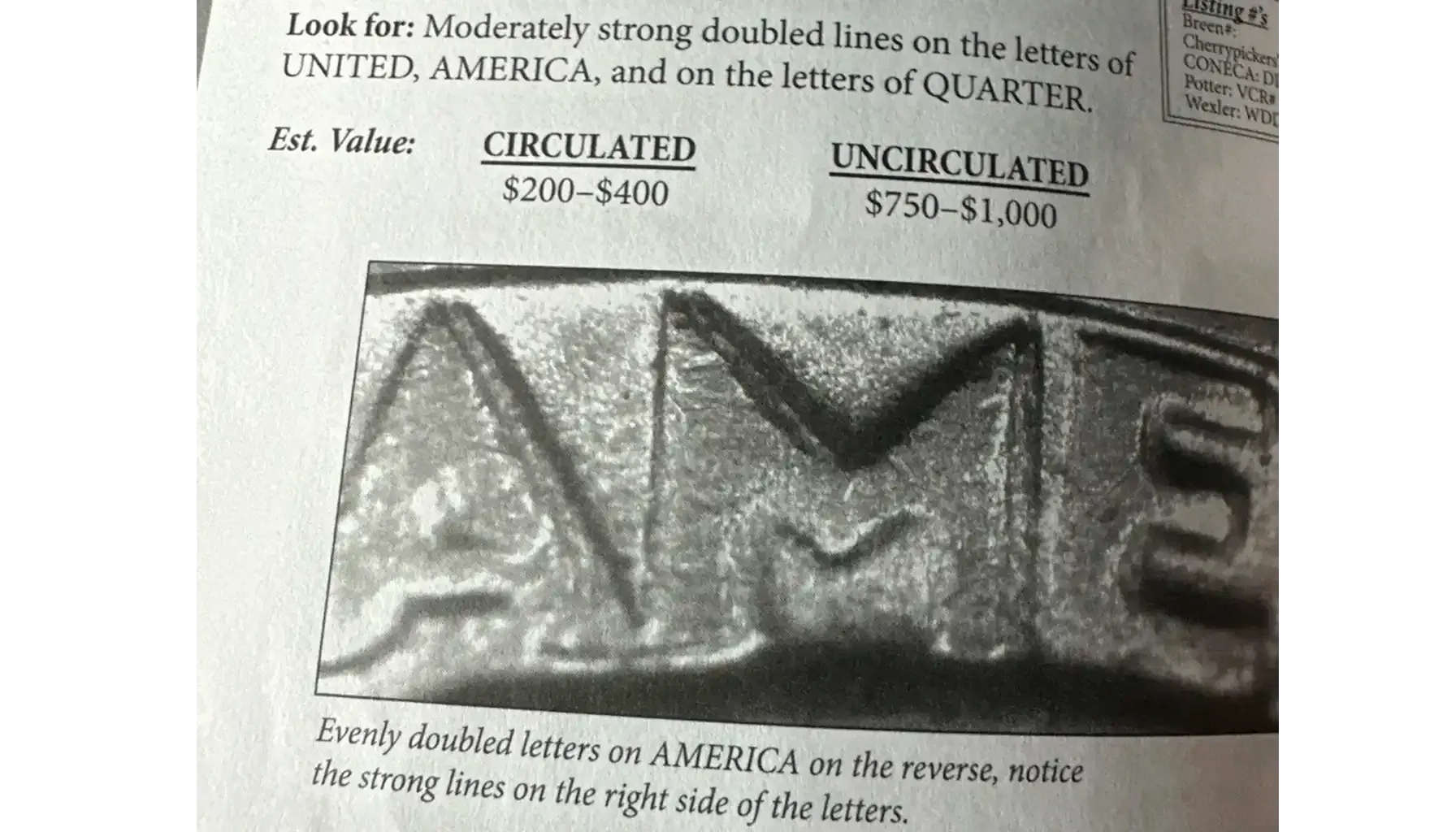
Doubling occurs when the die strikes the planchet twice. Look for split contours on the letters in the "IN GOD WE TRUST" motto and other inscriptions like “AMERICA” on the obverse or reverse.
Use a 10x magnifier to find thin, doubled lines.
Strong doubling on the inscriptions attracts the most demand.
Auction prices for these typically range from $200 to $600.
Off-Metal Strikes: Dime Planchet
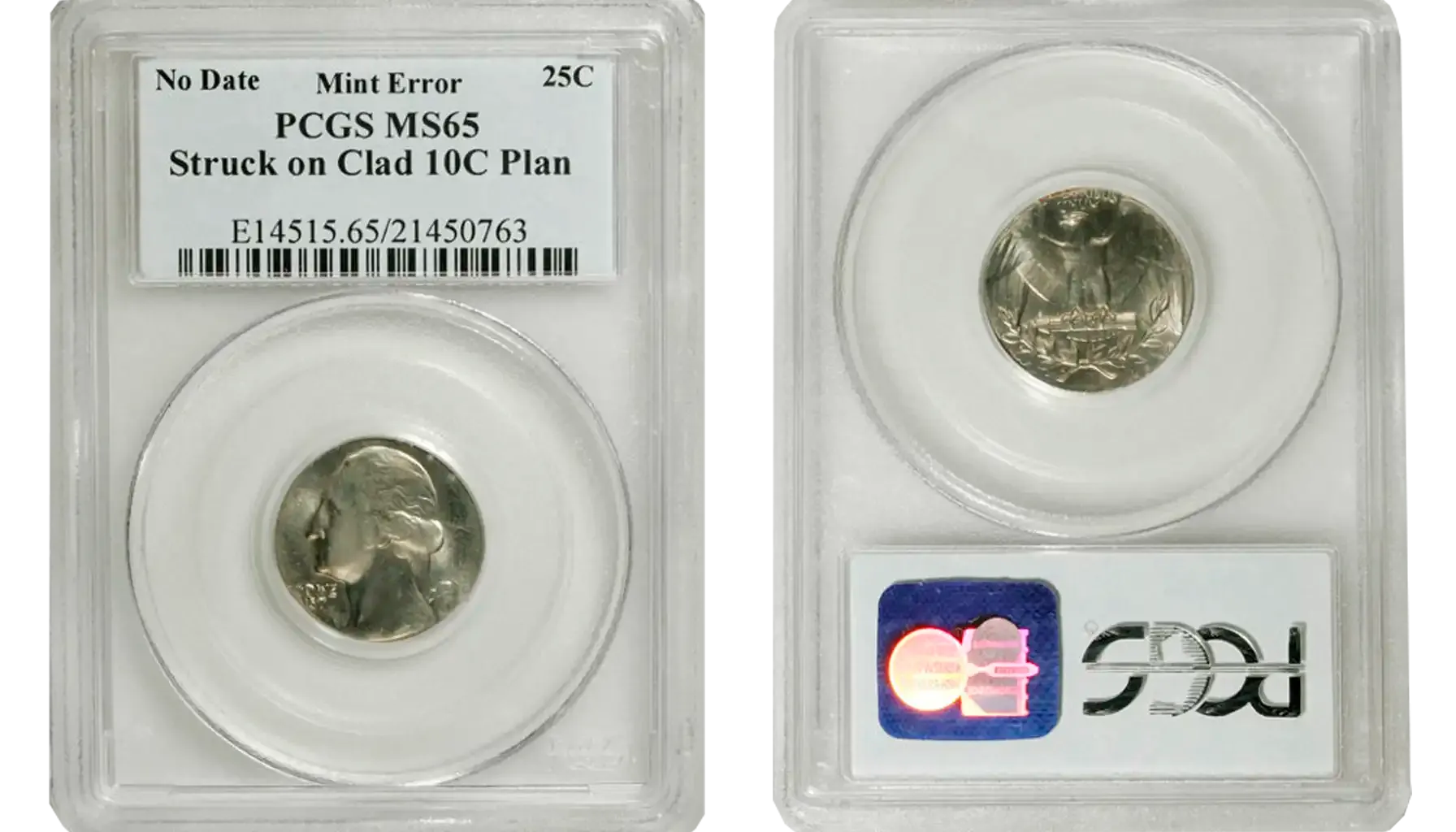
These happen when the Mint strikes a quarter design on a 10-cent dime blank. The coin ends up smaller than a standard quarter (not all design is placed on the planchet) and is a top-tier and one of the 1966 quarters worth money for collectors.
Weight is only 2.27 grams.
The smaller diameter often cuts off part of the outer lettering.
Market prices for this error vary from $600 to $1,500.
Other Errors: Broadstrikes, Off-Center Strikes
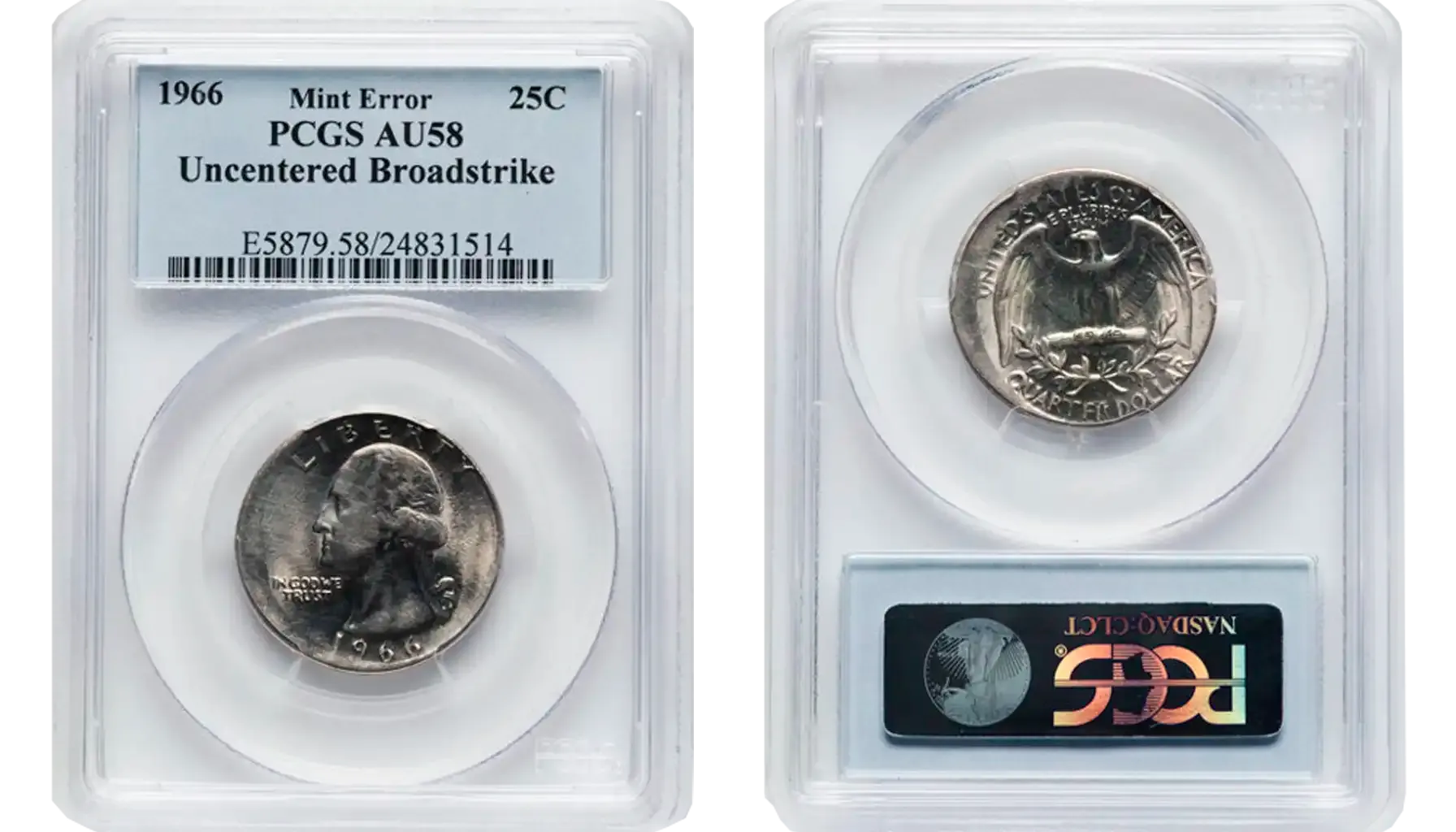
These are popular planchet errors. When a blank shifts in the press, it creates geometric distortions. Major shape defects are always worth more than minor surface scratches.
Off-center strikes with a shift of 25% or more start at $150.
Broadstrikes (coins without edge reeding) usually sell for $50 to $100.
Clear shape deformations significantly increase the final auction bid.
Grade and Examine Your 1966 Quarter
Self-inspection requires accuracy. Do not mistake heavy circulation wear for a genuine mint error. Weigh your coin properly on a digital scale to at least two decimal places.
Apps for Convenience
The Coin ID Scanner app helps identify your find, be it the 1966, 1996 P quarter, or other coin, and displays its official specifications. You can use the built-in assistant for quick questions or save photos to manage your collection digitally. For high-value errors, get professional certification through PCGS to confirm the variety and market price.

 Facebook
  X (Twitter)
  Pinterest
  LinkedIn