Contents:
The 1882 Morgan Silver Dollar represents one of the most admired symbols of American minting. It shows the United States’ enduring fascination with silver coinage.
The 1882 Morgan dollar came during an era when the U.S. economy relied heavily on silver bullion from western mines, shaping monetary policy and public sentiment. For new insights about rare silver and other items – check coin value.
The Historical Background of the 1882 Dollar Coin
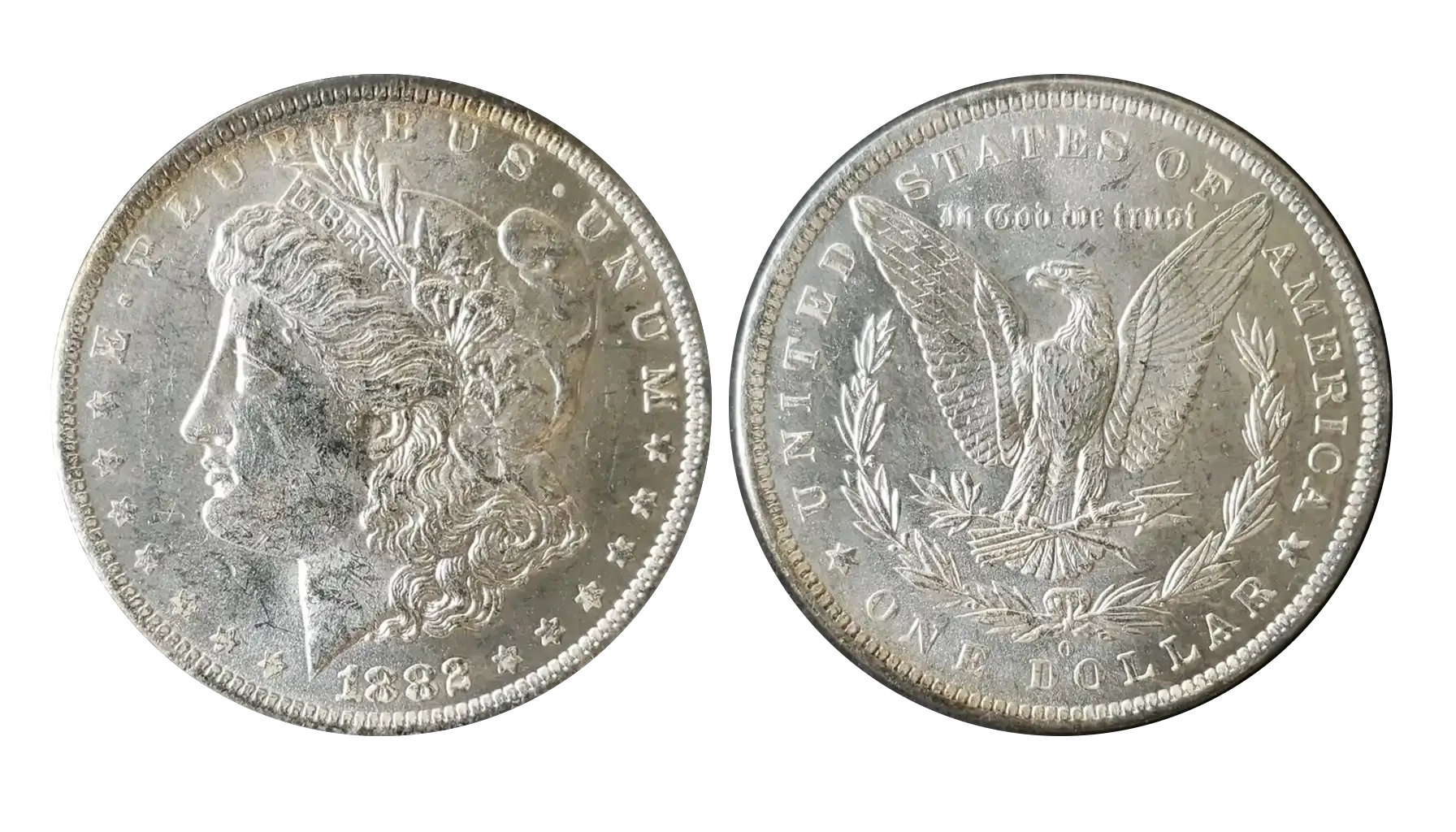
The Morgan series launched in 1878 and ran through 1904, with the end in 1921. George T. Morgan was an English designer for the U.S. Mint. He created it to replace the older Seated Liberty design. To give Liberty a more modern look. Morgan’s vision emphasized strength and independence.
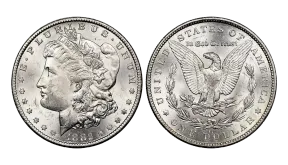
The obverse portrays Liberty. The reverse highlights an eagle with wings spread, holds arrows and an olive branch. It is a classic dual symbol of strength and peace.

«No other coin conjures up so much of the romance and history of the United States».
– Q. David Bowers, numismatist
A Guide Book of Morgan Silver Dollars
1882 Coin Production and The U.S. Mint Locations
The 1882 one dollar coin came from four production sites: the Philadelphia Mint, the Carson City Mint, the New Orleans Mint, and the San Francisco Mint. Each facility produced coins with distinct characteristics in strike and luster.
No Mint Mark – 11,100,000 mintage
CC – 1,133,000
O – 6,090,000
S – 9,250,000
The 1882 Carson City silver dollar became the standout issue, known for low mintage and outstanding preservation through the U.S. Treasury’s GSA sales of the 1970s.
Mint Marks and Their Impact on Value
Mint marks significantly influence the 1882 silver dollar value. Coins without a mark came from Philadelphia, which handled the highest output but produced consistent strikes. The Carson City Mint, however, minted fewer coins and preserved most of them in storage. It makes uncirculated examples highly sought after.
1882-CC Morgan Dollar: Collector’s Favorite
The 1882‑CC ranks among the most sought‑after Carson City issues. Its superior strike quality and characteristic luster contribute to its notable visual distinction. Many coins stayed untouched in government vaults, released decades later in pristine condition.
G | VG | F | VF | EF | aUnc | Unc |
$143 | $156 | $175 | $187 | $229 | $256 | $360 |
Remember: MS-63–MS-67 ranges from $390 to $6,389. Mint location determines survival rate and condition rarity.
1882 Dollar Coin Composition and Specifications
Category | Morgan 1878–1921 |
Mint | Philadelphia |
Designer | George T. Morgan |
Composition | Silver 90%, Copper 10% |
Weight | 26.73 g |
Diameter | 38.1 mm |
Edge | Reeded |
The American silver dollar value links directly to its silver purity. Investors monitor melt value alongside collector interest. As of current bullion prices, the melt value for an 1882 dollar coin stands near $37.59 USD, though collectible examples sell for far more.
1882 Dollar Coin Value Chart by Condition
Condition grading defines pricing and desirability. Professional services such as PCGS and NGC evaluate wear, luster, and strike quality to determine accurate market value. What's the value of a Morgan silver dollar?
Good $49.50
Very Good $50
Fine $51
Very Fine $52
Extremely Fine $54+
Mint State $70+
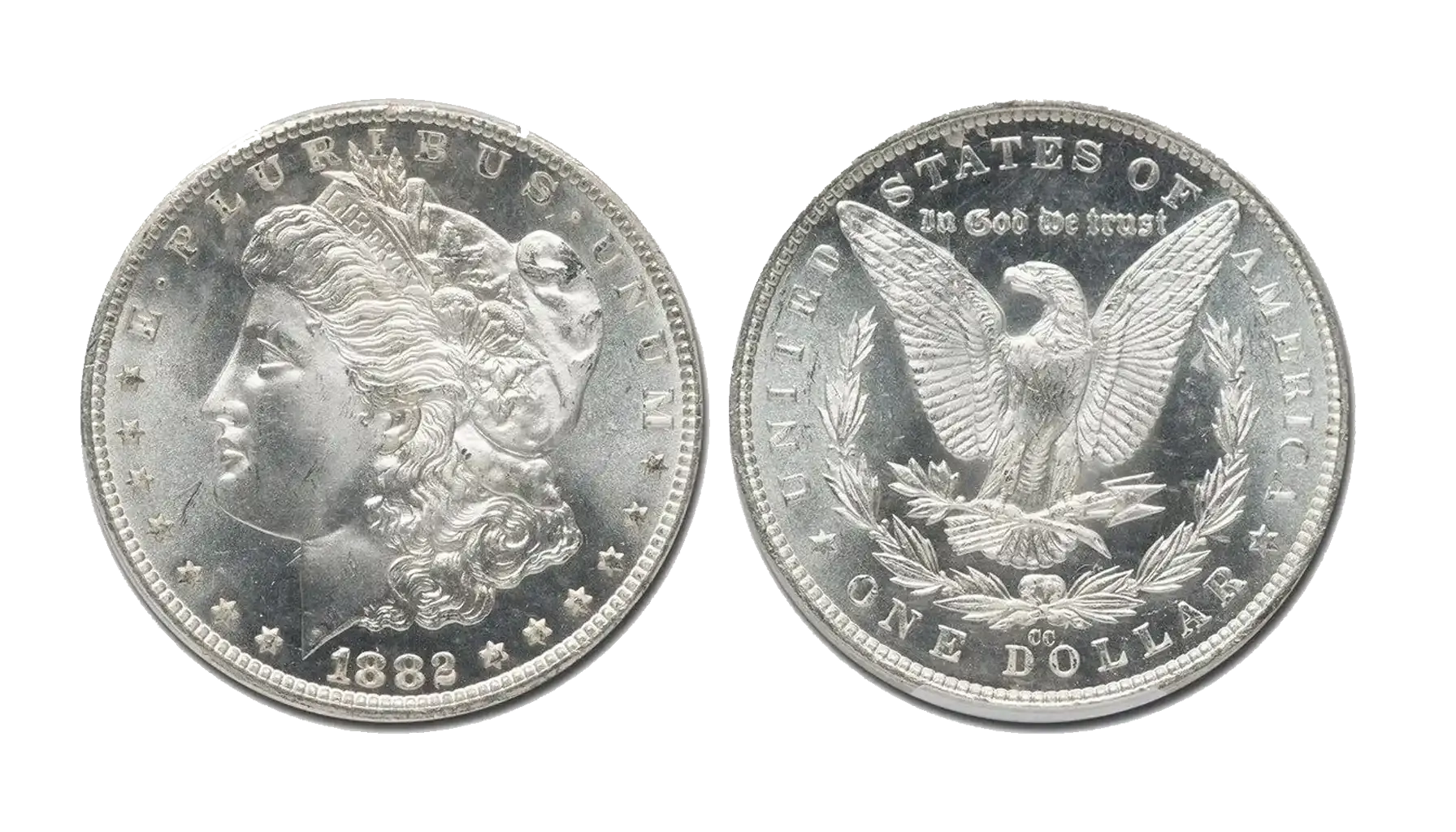
How to Identify Prooflike and Deep Mirror Prooflike Coins
The Reflectivity Test: Prooflike (PL) if you can read the text reflected in the coin from 2 to 4 inches away.
Deep Mirror Prooflike (DMPL) if the text remains clearly readable from 4 to 6 or more inches away.
Cameo contrast: Prooflike (PL): May have some cameo contrast, but it is not as strong as on a DMPL.
Prooflike and Deep Mirror Prooflike (DMPL) examples of the value of 1882 silver dollar grades MS-67 or above can exceed $3,000 USD at auction.
The Rarest and Most Valuable 1882 Dollar Coins
What makes a 1882 silver dollar rare?
1882-O/S Overstrike with double mint mark – $400–$1,500
1882-CC DMPL with deep mirror prooflike surfaces – $390–$6,389
1882-S MS-67 with superb gem quality – $2,000–$5,500
According to the October 2025 update of the NGC, an 1882‑CC graded MS‑68 can reach $45,000 in value.
Factors that drive collector premiums
Collectors evaluate:
Condition
Luster
Strike Strength
Rarity
Die Varieties (misplaced digits or overdates)
Investment Insights: Is the 1882 Silver Dollar Worth Buying?
Investors regard the 1882 silver coin value as stable, with consistent appreciation for certified high-grade examples.
PCGS data reveals steady price growth since the early 2000s. Over two decades, demand for uncirculated Carson City coins has risen as investors add tangible assets to their portfolios.
When compared to Seated Liberty or Trade dollars, Morgan coins maintain broader availability yet stronger brand recognition.
How Condition and Provenance Affect ROI
A certified provenance, such as pedigree from the GSA Hoard, raises long-term performance potential. Clean surfaces, natural toning, and full strikes all influence the 1882 morgan silver dollar value within global markets.
Now you can confidently evaluate Morgan coins because you understand the subtle differences between an ordinary copy and a valuable collector’s item.
Install the Coin ID Scanner app to keep your knowledge up-to-date and manage your collection conveniently. It will become your digital assistant in the world of numismatics.
FAQ
What makes the 1882 Morgan Dollar valuable?
Collectors prize this item for its silver, its place in history, and its status within the Morgan series. Value hinges on how well it’s struck, its mint mark, and its grade. Take a common Philadelphia issue: in Good condition, it trades around $50, 1882 CC around $1,000.
Which mint mark is rarest for 1882?
Look for the CC: it marks the rarest Carson City issue. In 1882, the tiny Carson City Mint in Nevada open only intermittently, struck about 1.1 million dollars. Compare that to New Orleans and San Francisco, where mints churned out several million each, yielding far more common coins.
How much silver is in the 1882 dollar coin?
This piece holds 0.77344 troy ounces of fine silver, equivalent to approximately 24 grams of pure metal. The rest of its 26.73 gram weight comes from copper for durability. Even a heavily worn example retains melt value – around $38 USD at current silver prices – but collectible coins command much higher premiums depending on condition and mint mark.
How can I tell if my 1882 dollar coin is real?
The original diameter is 38.1 mm, weight 26.73 grams. Fake coins are often too light and have blurry letters. Using a magnet can help; real coins contain no magnetic metals. PCGS and NGC professional authentication provides the safest way to verify an item.
What’s the difference between 1882-O and 1882-O/S?
The 1882-O/S overstrike is one of the most famous minting varieties in the series. It displays traces of an S mint mark under the O, revealing that dies originally made for San Francisco were reused in New Orleans. Values range from $400 for lightly worn examples to more than $1,500 in mint state. Standard 1882-O coins, without the overmark, usually sell for $45–$150.
How do I grade my 1882 Morgan Dollar?
To grade assesses wear, luster, and surface condition. Start by examining Liberty’s cheek on the obverse – it should retain smooth texture and minimal contact marks in higher grades.
What is the current melt value of an 1882 dollar?
At present, the melt value reaches $36.95.
Is the 1882-CC dollar a good investment?
Yes. Serious collectors know: the Carson City Morgan holds its value. Over time, prices for certified uncirculated examples have climbed steadily is a sign of confidence in physical collectibles. Since the Carson City Mint made only limited runs before shutting down in 1893, each CC‑marked coin combines rarity with strong provenance appeal.

 Facebook
  X (Twitter)
  Pinterest
  LinkedIn