Contents:
People have been handling coins for centuries now, but only a few old timers end up surviving. A coin from 1807 is a true rarity and should be treated like the treasure it is. The thing is… it is not actually from 1807.
What is the actual date of these 2 pounds? How much is the 1807 £2 coin worth? About this coin's value, design, and errors, you can learn here.
Do you have real pieces from over a century ago? We recommend trying out an old coin value checker.
1807 2 Pound Coin Overview
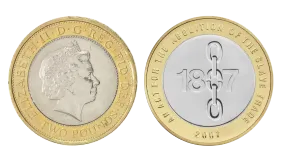
First and foremost, this 2 pound coin is not actually from 1807! The actual mintage happened in 2007, to celebrate the bicentenary of the Abolition of the Slave Trade. The name “1807” refers to the celebrated Abolition date, 1807.
It's not the first time a coin has a confusing date. In the US, there is a 1776-1976 Kennedy Half Dollar, which was made in 1976 to celebrate the bicentennial of American Independence.
But let's return to the UK and look a bit deeper at the coin in question.
2-pound coin 1807 (2007) | |
Country | United Kingdom |
Years of Minting | 2007 |
Type: | Standard circulation |
Shape: | Round |
Composition and metal content | Outer ring: Nickel-brass 76% copper, 4% nickel, 20% zinc Inner ring: Cupro-nickel 75% copper, 25% nickel |
Diameter | 28.40 mm |
Weight | 12 grams |
Fun fact: 2007 is the year when another piece connected to the past resurged. In the US, the John Adams $1 Coin commemorated the 2nd US president, John Adams (served from 1797 to 1801).
Obverse and Reverse Design
UK pounds are unified when it comes to design. Most share the obverse with the monarch at the time of minting (Queen Elizabeth), and a unique reverse.

Obverse (front): Portrait of Queen Elizabeth II by Ian Rank-Broadley. The Queen is facing right, wearing the “Girls of Great Britain and Ireland” Tiara. Around the portrait runs the inscription: “ELIZABETH · II · DEI · GRA · REG · FID · DEF”, meaning: Elizabeth II, by the Grace of God, Queen, Defender of the Faith.
Reverse (back): The date “1807”, with the “0” shown as a broken link in a chain, symbolising the end of slavery. Around the edge is the inscription “AN ACT FOR THE ABOLITION OF THE SLAVE TRADE”. David Gentleman borrowed the reverse design, which was fairly unique. Few coins make a date the centerpiece.
Different Versions
The UK has two kinds of commemorative pieces. The single edition, with one design and one year of making, and the series. Famous Beatrix Potter 50p Coins is a series, lasting 3 years, with over 7 different designs.
£2 1807 coin, on the other hand, had only one design. Nevertheless, it has a few versions depending on the metal compositions:
Bimetal: The most common variety, and the only one used for actual circulation. It had a big mintage of about 8.45 million. As this piece circulated, the quality differed.
Silver proof: Has .925 sterling silver with a band of fine gold plating around the edge. Because it’s composed of the precious metal, it is naturally more valuable than the common copper-nickel pieces. It is said that 7,095 silver pieces exist.
Gold proof: An exceptionally valuable limited edition. Only 1,000 gold proofs were made. Each piece contains 22-carat gold. Never circulated, for collecting only.

1807 2 Pound Coin Value
Now that you’ve seen a gold piece among the varieties, you might wonder: 2 pound coin 1807, how much is it worth? After all, UK Gold coins have always cost a large sum.
We present to you the chart with the values for all the varieties:
Version | Approximate Value |
Standard | Circulated pieces go for £2, the face value. Some Brilliant Uncirculated pieces, though, may sell for £10+. |
Silver Proof | Due to a precious metal, the values start from £30. Depending on various accessories (boxes, cards), it may cost more. There is also a heavier Piedfort silver, which costs even more, £45+. |
Gold Proof | Limited and with 22-carat gold, the values start from £1,350. The value might rise due to accessories. |
All in all, the values for circulated pieces are not much to brag about. They are relatively modern and had a big mintage, therefore a low price. But limited varieties, containing precious metals, can fetch a high value.
1807 £2 Coin Errors
How to get a valuable piece into your collection? Look for coins with errors. For those who have just started collecting, it might seem surprising, but errors on pence, pounds, dimes, etc., are highly valued by numismatists.
The question is, does 1807 2 pounds actually have an error? Often, sellers point to things like slight misalignments, colour differences in the metal, or faint inscriptions, and call them errors. In fact, these differences are just normal minting variations from high-volume production.
So, what is the printing error on the 1807 £2 coin? At this moment, no legitimate errors were found. Don’t lose hope, though. With such a big mintage, a few pieces must have some kind of error; they were just not discovered.
What can you do? If you own a piece, we advise you to check it for one of these possible errors:
Off-centre strike: The design is not aligned with the centre, leaving blank space.
Double strike: The bit was struck twice, causing overlapping images, usually on letterings and dates. Exceptionally valuable.
Broadstrike: The bit was struck without the collar (the ring that shapes the edge), making it spread wider and thinner.
Blank planchet: The bit was never struck with a design, and one side looks completely blank.
Clipped planchet: A small curved piece is missing, usually from the edge, caused when the metal strip is punched incorrectly.
Wrong planchet: The piece is struck on the wrong type of metal blank (for example, a £1 design on a 10p blank).
Die clash: A part of one die’s design was pressed into the other. This causes ghost-like features.
Rotated die: One side of the bit is rotated compared to the other.
Buying a £2 Coin 1807
If you are a collector or interested in the topic the piece covers (Slave Abolition), we recommend you get this 2-pound piece. But where can you get one?
Coin dealers: Reputable UK dealers like Britannia Coin Company, Chards, or The London Coin Company often stock both circulation coins and proof versions (silver, piedfort, or gold).
The Royal Mint: Although the bit is no longer in general issue, the Royal Mint sometimes resells older commemorative pieces through its collector’s shop.
Online marketplaces: Websites like eBay and Etsy usually have lots of listings. These range from basic circulated coins (usually sold for a few pounds) to brilliant uncirculated or proof versions (more expensive).
Specialist bullion and retailers: Some shops that sell bullion and collector pieces, such as BullionByPost or other numismatic retailers, carry them as part of their “collector coins” section.
Coins ID Scanner
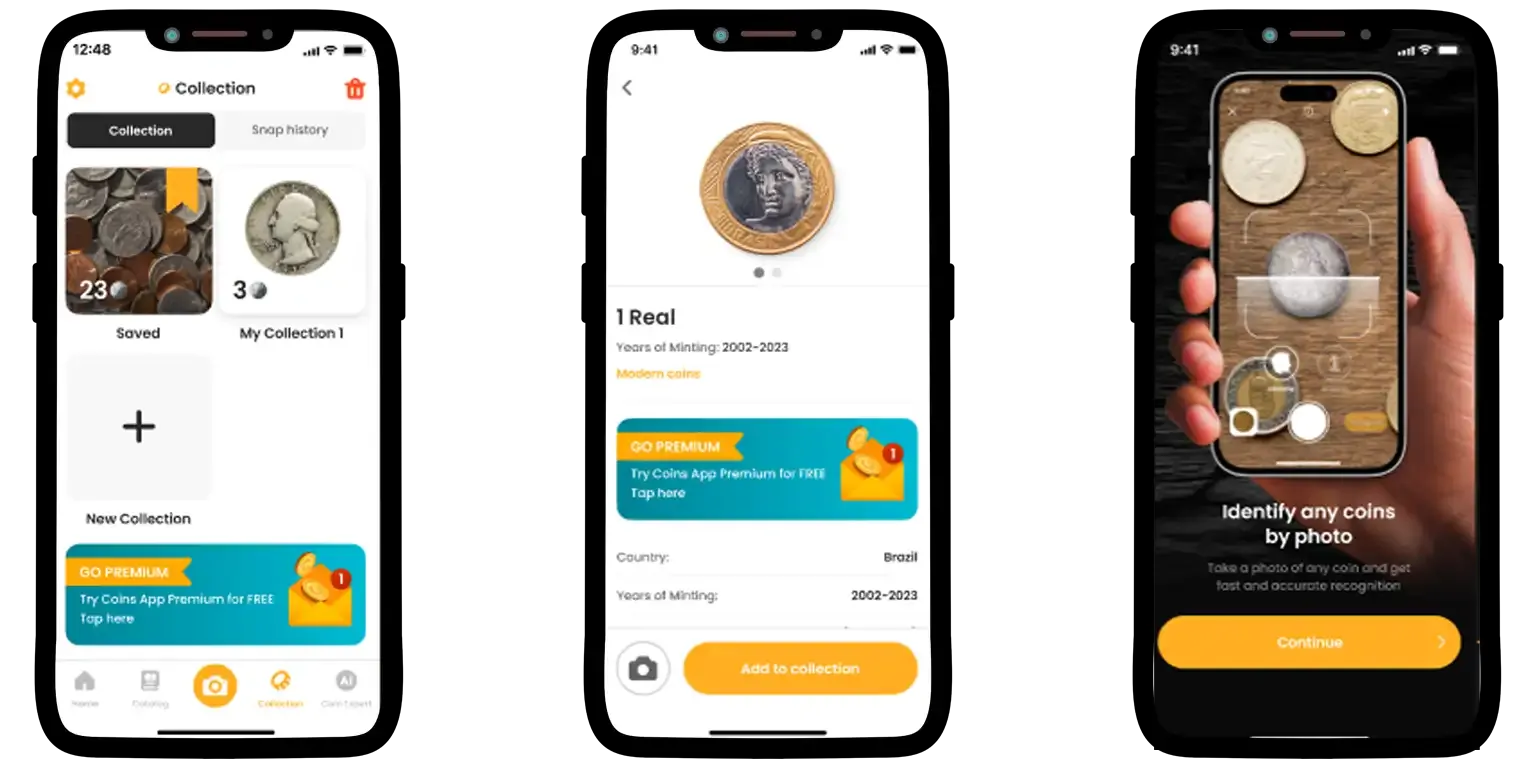
Coin ID Scanner is an app for any collector and coin enthusiast. The app lets you take or upload a photo of a piece (front and back) and attempts to identify it using image recognition and AI.
The recognition has an accuracy of 98% and relies on the database of over 150,000 coins, including modern, commemorative, and international coins.
What do you get after a scan? You get all the necessary information on your collectible, like country, denomination, minting details, metal composition, rarity, and estimated value.
After you’re done scanning, the app allows users to manage a personal collection: save photos, organize pieces, and track search results.
Coin ID Scanner is available for both iOS (iPhone) and Android.
FAQ
What Is a 1807 2 Pound Coin Worth?
Circulated versions usually cost £2 due to a big mintage. Brilliant Uncirculated versions start from £10, depending on condition and packaging. Silver Proof versions start from £30, and often come with a box and a certificate. The Gold Proof version starts from £1,350, and it is very limited.
Why Is The 1807 2 Pound Coin Rare?
In reality, this piece is not rare, at least it's a common variety. Silver and gold proof are rare, on the other hand, because of limited mintage, higher-quality finishes, and precious metal content.
Did the UK Make Other Commemorative 2-pound coins?
Yes. The UK has issued many commemorative coins across different denominations. Some notable examples: 1995 D-Day, 2002 Queen’s Golden Jubilee, 2012 London Olympics series, 2015 Battle of Waterloo Bicentenary, and others.

 Facebook
  X (Twitter)
  Pinterest
  LinkedIn