Contents:
The first large copper struck by the United States Mint has a much bigger price than its face value ever suggested. How much is a 1793 penny worth? Thousands. Even the most worn survivors will cost you a lot, well, because of the historical value, the coin is 200 years old, how much is it going to cost?
Collectors like three distinct issues of that year: the short-lived Chain design, the follow-up with a Wreath reverse, and the late-year Liberty Cap portrait.
There is probably a low chance to find a legit coin, especially on marketplaces, but if you have one already, you may want to read about design, history, varieties, 1793 penny value today, and the record-setting examples. If not, don’t worry, there are lots of pieces like rare Wheat pennies still left to collect.
A rule for the beginners: some collectors like to identify coins with coin identifiers like ID Coin Scanner, and it’s OK, but, you should know that you will still have to look for a professional to grade the piece if you ever want to sell it.
Historical Background of the 1793 U.S. Issue
Until the year 1793, the young republic had relied on foreign coins, private tokens, and a few experimental strikes like the 1792 half disme. You may have heard about the 1791 Trade Dollar, but read carefully, it’s actually a dollar from the 19th century. President Washington and Mint Director David Rittenhouse wanted something more official: federal pieces struck on federal machinery, with a design that represented the new nation.
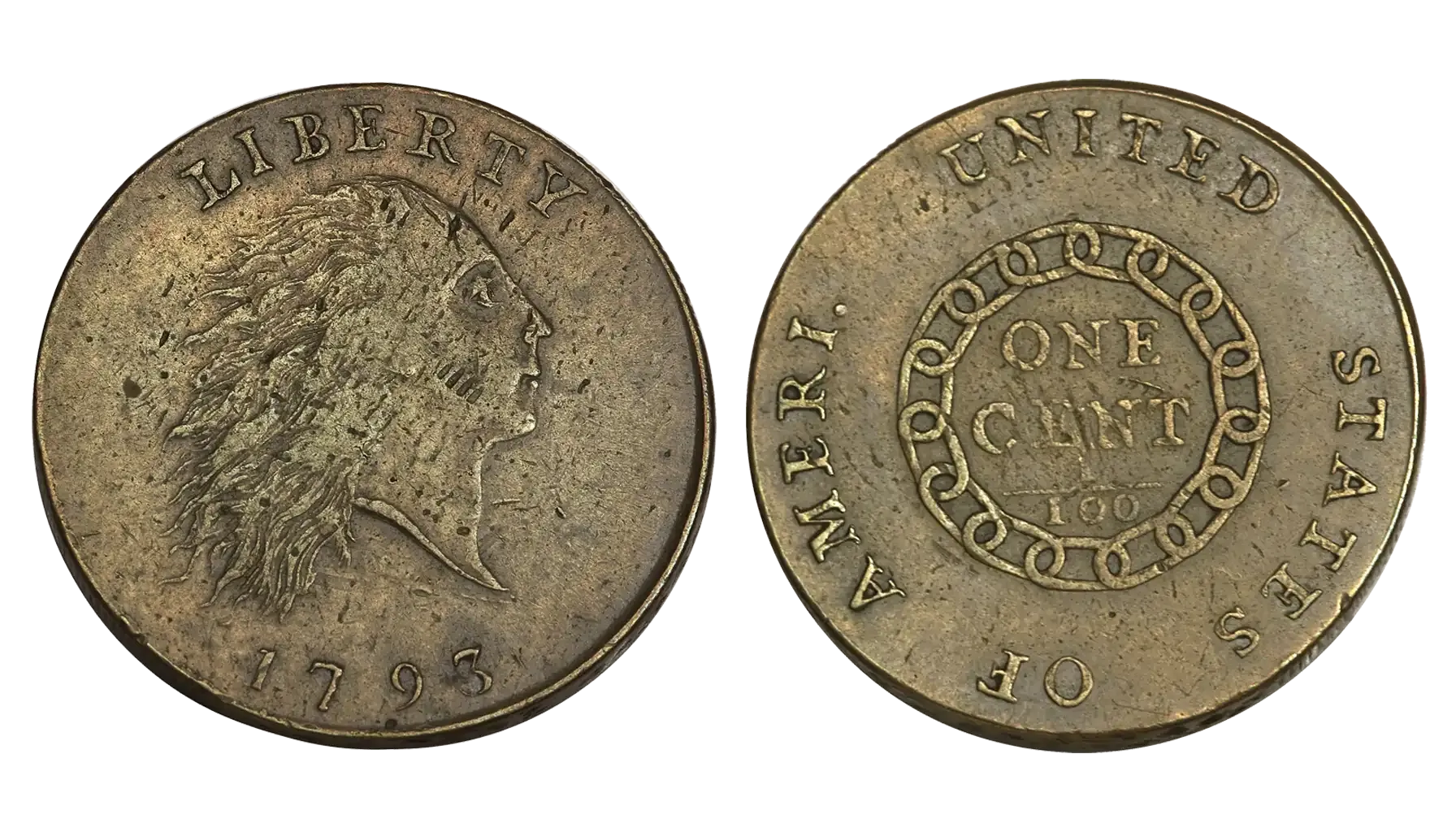
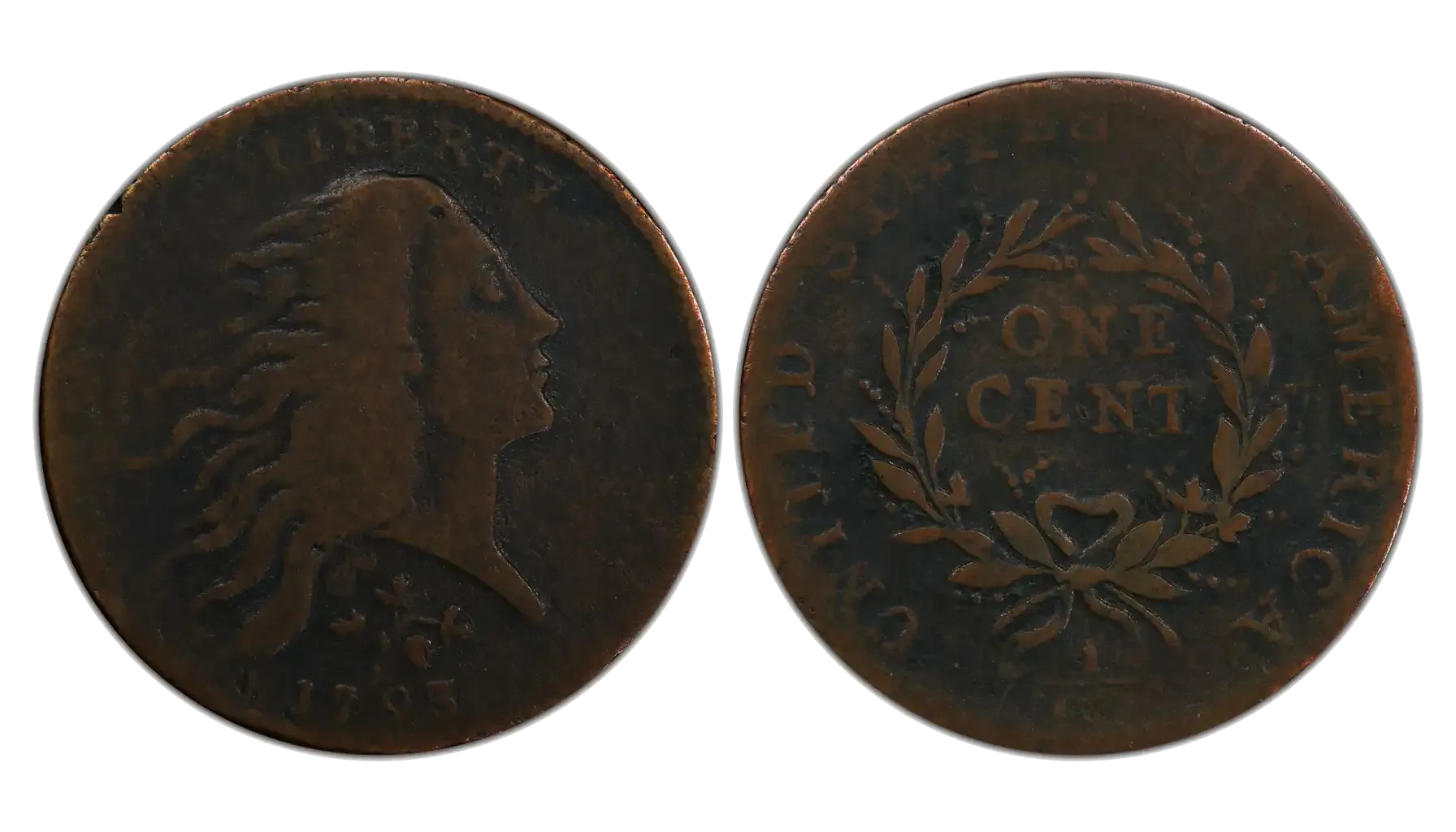
Henry Voight was a watchmaker turned engraver almost by accident. With crude equipment, questionable copper stock, and limited artistic training, he produced the first design: Liberty with unkempt, flowing hair on the front and a chain of fifteen links on the back.
To Mint officials, the symbolism was obvious, this means the states bound together in union. To the public, not so much. Some saw chains of slavery instead, newspapers mocked Liberty’s wild look as “in a fright.”
Production started in March with about 36,000 struck. By the fall, a third design appeared, this time it was a Liberty with a pole and cap: Joseph Wright’s calmer, more refined portrait. All told, three different styles emerged in one year.
How much is a penny from 1793 worth? What survived from 1793 is scarce. Many were melted, many circulated into the ground, and many others suffered from porous copper and hand-powered presses that left uneven strikes. Grading them today is tricky; the shallow relief on Liberty’s portrait means the front often looks worn even when the reverse details remain bold.
Design Features of the First 1793 Issue
The inaugural large copper of 1793 doesn’t look like later United States coinage, it feels raw, improvised, almost experimental.
So, who is on the 1793 penny? The figure is an allegory: Liberty personified, meant to embody the ideals of freedom. There are plenty of figures that have occurred on the penny since then, read more about in Top 100 Pennies Worth Money: Do You Have One?
Feature | Description |
Obverse | Liberty facing right, hair flowing loosely. No cap or bonnet. LIBERTY above, date below. Critics of the day called the look untidy or even mad. Symbolic figure: Liberty personified, not a real person. |
Reverse (Chain Type) | Fifteen interlocking links forming a circle, denomination ONE CENT and fraction 1/100 inside, UNITED STATES OF AMERICA around the rim. Famous AMERI. variety created when engraver misjudged spacing. |
Reverse (Wreath Type) | Replaced chain design; wreath symbolizing victory and peace. |
Reverse (Liberty Cap Type) | Later 1793 design with Liberty pole and cap-ancient symbol of republicanism. |
Edge Treatments | Either ONE HUNDRED FOR A DOLLAR inscription or vine-and-bars ornamentation. Both decorative and anti-counterfeiting. |
Technical Details | Weight ~13.5 g; diameter 26-27 mm; composition pure copper. All struck at Philadelphia, no mint marks. |
All collectors would like to have the earliest design of the 1793 Flowing Hair penny. Despite the criticism, it was important for US history.
The Varieties of the 1793 Issue
Design Type | Description | Notable Varieties / Features | Mintage & Survival |
Chain Design | First official coinage struck in March 1793. Liberty with flowing hair on the obverse; reverse shows a ring of fifteen interlocking links. | “AMERI.” reverse variety (abbreviated UNITED STATES OF AMERICA). Presentation strike nicknamed The Coin, prooflike and pedigreed. | ~36,000 minted; far fewer survive. Many are worn smooth or porous but still highly collectible. |
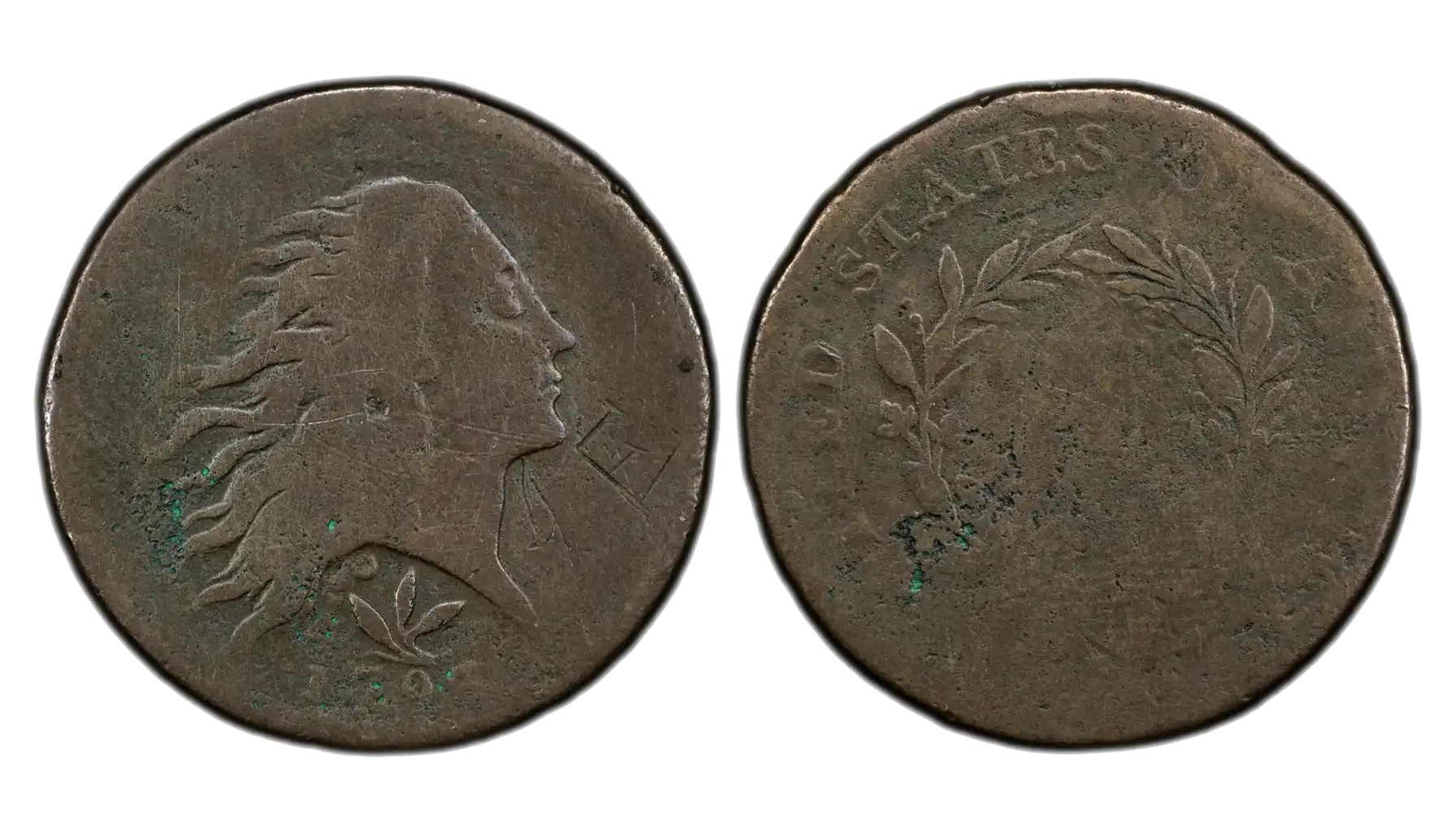
Wreath Design | Introduced mid-1793. Liberty still with wild hair, but reverse changed to a wreath tied with a bow. | Vine-and-bars edge or ONE HUNDRED FOR A DOLLAR edge inscriptions. The famous Strawberry Leaf variety with clover/strawberry-like leaves above the date, only a handful known. | ~63,000 minted; survival slim. Strawberry Leaf among the rarest U.S. copper coins. |
Liberty Cap Design | Issued in fall 1793. Liberty’s portrait refined by Joseph Wright, with a liberty pole and cap added. Classical imagery symbolizing freedom. | No major sub-varieties, but regarded for improved artistry compared to earlier designs. | Survival rate lower than Wreath type, though admired by specialists for design quality. |
The “Half Penny” Question
Collectors sometimes search for a 1793 half penny, but that’s a muddle of terms. The United States struck a half cent that year, yes, but no federal half penny. At the same time, British halfpennies dated 1793 were still common in circulation. If someone claims to own a “1793 half penny,” it’s almost certainly a half cent, or a worn British copper.
Value of the 1793 Issue Today
What is a 1793 penny worth? Thousands or over a million, depending on which design, how well it survived, and whether it has one of the legendary varieties.
Type | Low-Grade Value | Mid-Grade Value | High-Grade Value |
Chain Type | $5,000-$10,000 for heavily circulated examples | $25,000+ for mid-range pieces | Six figures for Extremely Fine or better; Mint State exceeds $1 million |
Wreath Type | $3,000-$5,000 in Good-Very Good | $15,000-$40,000 for better preserved coins | Strawberry Leaf variety: even in low grade, high six figures |
Liberty Cap Type | $2,000-$3,000 in low grade | Moves into five figures in finer states | Choice examples tightly held, seldom appear on market |
Grading Complications
These early strikes were inconsistent. Liberty’s portrait on the Chain type was shallowly engraved, the obverse wears faster than the reverse. That’s why coins with nearly blank faces can still show crisp chains. Wreaths and Caps also suffer from planchet flaws, so surface quality can matter as much as wear.
Highlights
A Chain piece with the AMERI. reverse, certified MS-64 Brown, topped $1 million at auction
A Strawberry Leaf Wreath in Fine-12 sold for nearly $900,000
Even a corroded, barely identifiable survivor will still sell in the thousands
So, how much is a penny from 1793 worth? At minimum, a few thousand. At maximum, millions.
Rare Varieties and Record Prices
The “AMERI.” Reverse
On the earliest reverse die of the Chain design, the engraver misjudged spacing and left the legend abbreviated as “UNITED STATES OF AMERICA." It wasn’t an intentional error, they just ran out of room, but today it ranks among the great early American rarities. Low-grade examples are still six figures. A certified Mint State piece sold for more than $1 million.
The Strawberry Leaf
The Wreath type normally shows a small sprig of leaves above the date. A handful, fewer than five known, have a broad-leafed variant, nicknamed the Strawberry Leaf. Why the engraver changed the punch is unknown. Maybe an experiment, maybe a mistake. Whatever the reason, this variety is almost unobtainable.
“The Coin”
Among early copper collectors, one specimen of the Chain design is simply called The Coin. Struck on an unusually broad planchet and possibly given multiple blows from the dies, it shows detail and surfaces that border on prooflike. 1793 predates official proof strikings, this piece is treated as such. Its ownership list reads like a who’s who of numismatics: Joseph Mickley, Sylvester Crosby, Dr. Sheldon, R.E. Naftzger. Value is beyond cataloging.
FAQs
Who appears on the coin?
It’s Liberty, an allegorical figure, not a president. The flowing-hair portrait was meant to symbolize freedom, though early critics mocked the wild look.
What is a 1793 penny worth?
Value depends on the design and condition. A heavily worn example still has several thousand dollars. Mid-range survivors run into tens of thousands. Choice or rare varieties like the AMERI. reverse or Strawberry Leaf can be into the high six figures or beyond.
How many were produced?
Chain: about 36,000. Wreath: roughly 63,000. Liberty Cap: smaller numbers, exact totals debated. That’s tiny compared to the billions of coins struck today.
Do any still circulate?
No. Every surviving piece is in collector hands. If someone thinks they’ve spotted one in pocket change, it’s either a counterfeit or a different coin entirely.
What about the so-called half penny?
The U.S. Mint did strike a half cent in 1793, but never a half penny. British halfpennies dated 1793 also circulated widely in America, which explains the confusion.
Where can I buy one?
Mostly at major auctions or through established dealers. Online venues list them too, but certification and authentication are absolutely important before spending serious money.

 Facebook
  X (Twitter)
  Pinterest
  LinkedIn