Contents:
Some coins seem so standard that they should be issued every year, yet their minting ended long ago. This is the case of a rare Australian coin with the denomination of only 1 cent, i.e., a small piece that had circulated for nearly three decades in a row. As of today, it is more of a collectible that should be preserved and cherished rather than a circulating coin with no heritage to boast about.
Its modest appearance is one thing. Another is the surprising value they can hold. Anyway, let us explore the basic features of these coins. What do these numismatic creations look like then? What is the 1 cent coin Australia worth, and why is it so collectible?
The History of the 1 Cent Coin Australia
The story of the 1-cent coin begins in 1996, when other denominations, including the Australian 50 cent coin and the rest, were meant to introduce the country’s new decimal currency system. As of then, this numismatic creation was designed by Stuart Devlin, and it gradually became a beloved unit of currency among the general public.
However, its age was not too long. In fact, it remained in circulation until 1992, when the Royal Australian Mint officially withdrew the coin from circulation. Only memories were left behind. These days, 1-cent coins, as well as those with the denomination of 2 cents and the rest (e.g., Australian Kangaroo coin), are considered legal tender, but with limitations imposed: they can only be used for payments up to a small total value of 20 cents, and most businesses no longer accept them in everyday transactions.
"..1c and 2c coins will continue to be legal tender: they can still be used to purchase goods and can be deposited with financial institutions in the normal manner."
Paul Keating, the Treasurer of the Commonwealth of Australia
Royal Australian Mint, the 1990 Budget Press Release
Design Features and Characteristics
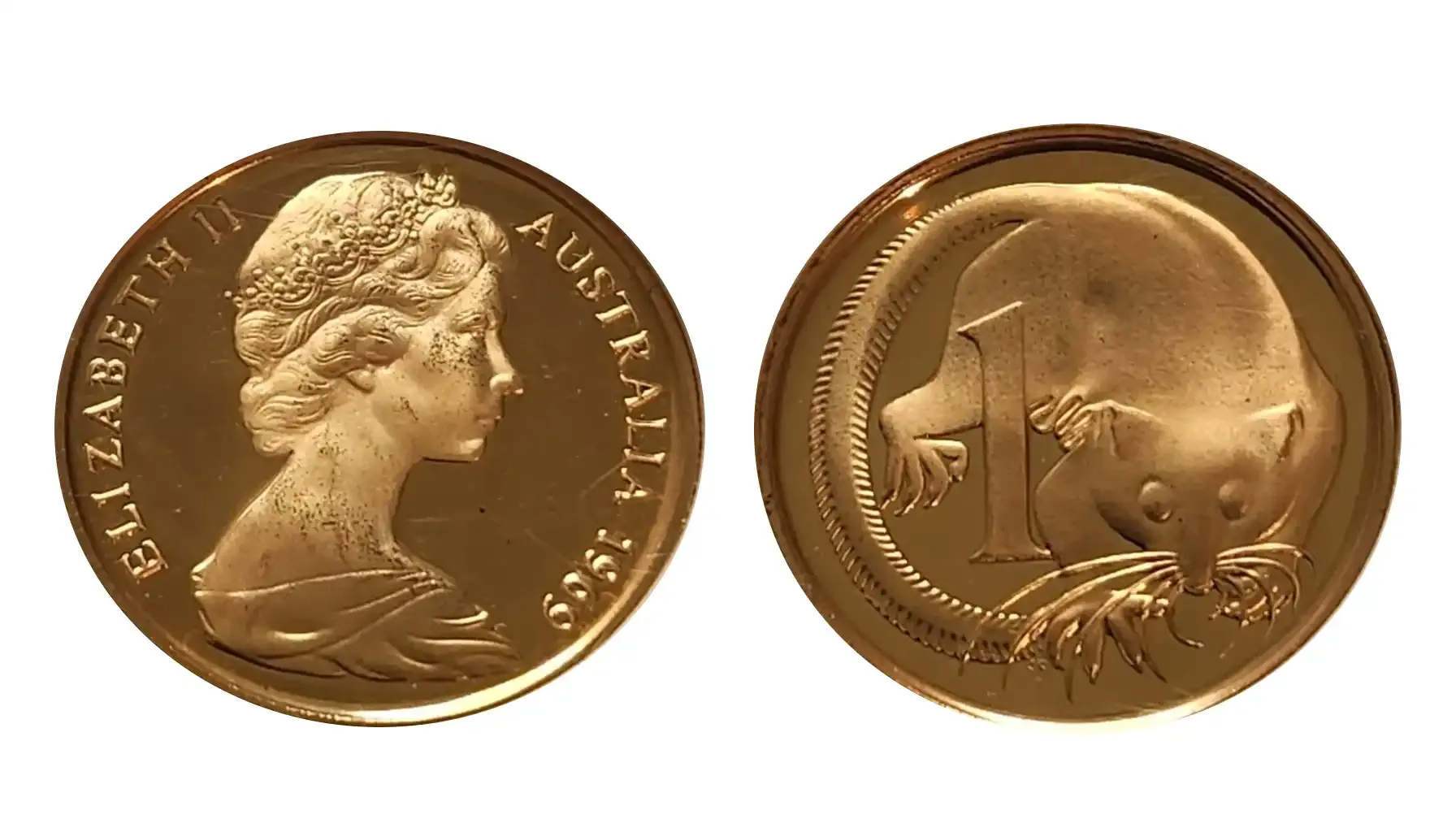
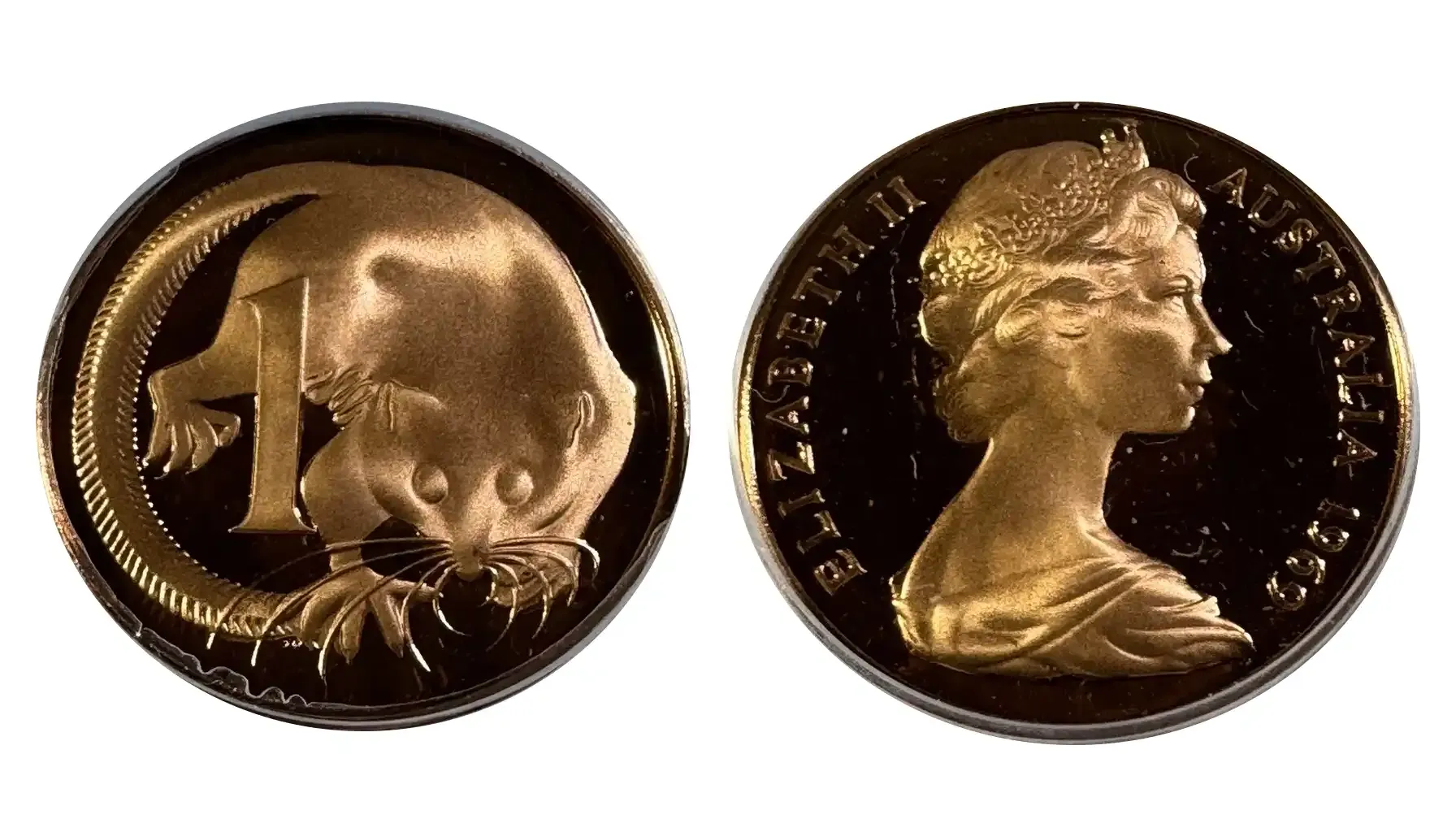
Obverse: Features a right-facing profile of Queen Elizabeth II, wearing the Girls of Great Britain and Ireland Tiara, as well as the inscriptions “ELIZABETH II AUSTRALIA” around the portrait and the year of minting to the right.
Reverse: Introduces the feathertail glider (i.e., the world’s smallest gliding mammal native to Australia), surrounding the denomination of the coin “1” (cent).
Nominal Specifications | |
Denomination | 1 cent |
Composition | 97% copper, 2.5% zinc, 0.5% tin |
Shape | Circular |
Edge | Plain |
Weight | 2.60 grams |
Diameter | 17.65 millimeters |
Thickness | approximately 1.30 millimetres |
Years of Circulation | 1966–1992 |
Mint Facility | Royal Australian Mint |
What Is a 1 Cent Coin Australia Worth Today?
Although this numismatic creation might have long vanished from circulation, its legacy persists, and coin enthusiasts strive to obtain a piece of history to expand their collections for good. The 1 cent coin value charts clearly show that certain examples, e.g., those of key-date issues, can be quite expensive when compared to the face value or the intrinsic worth.
Nonetheless, the condition is still the definitive factor that affects the price at which the unit of currency can be bought or sold. So, here are general value ranges for regular pieces in typical grades.
Grade | Estimated Rate (USD) |
Good (G to VG) | ~$0.03 – $0.07 |
Fine (F to VF) | ~$0.07 – $0.13 |
Extremely Fine (EF) | ~$0.13 – ~$0.21 |
About Uncirculated (AU) | ~$0.21 – ~$0.52 |
Uncirculated (UNC) | ~$0.52 – ~$1.30 |
Brilliant Uncirculated/Proof | ~$1.30 – $3.25+ |
Sometimes, coins might be gone, but this is what makes them so valuable. Check their status and enrich your collections with peculiar numismatic creations in turn.

 Facebook
  X (Twitter)
  Pinterest
  LinkedIn